Boy, Do We Need The Third Niggardly Principle Now.

To review….

The Third Niggardly Principle , the last of three Ethics Alarms rules applying to situations where someone mistakenly takes offense at a valid and useful word, comes into play when capitulating to such sensitivity create a precedent that will do tangible harm to society, culture, individual rights and personal freedoms. It declares:

“When  suppressing speech and conduct based on an individual’s or a group’s claim, sincere or otherwise, that such speech or conduct is offensive, however understandable and reasonable this claim may be, creates or threatens to create a powerful precedent that will undermine freedom of speech, expression or political opinion elsewhere, calls to suppress the speech or conduct must be opposed and rejected.

Spineless, fearful, submissive and appeasing corporate lackeys, showing us that they can be counted on to surrender core American principles and values to keep their market share and pander to the mob, have decided in recent days to ban certain well understood, useful, common and benign words because “some” believe they imply racism: Continue reading →

The Ethicist Apparently Endorses Discrimination As Ethical

, the New York Times Magazine’s ethics columnist, just opened a can of metaphorical worms, and I’m going to spread them around a little. It may get messy.

A woman—actually, now that I re-read the post, we don’t know it’s a woman— wrote to be reassured that he or she wasn’t a bad person for wanting to dump a man she had engaged in a nascent romantic relationship after discovering that he had Crohn’s Disease. “I know I’m being selfish, but is it unethical to not date him because of it?” she wrote. ” I don’t know what to do to support him, and I am worried about the future. He said it’s very likely his intestinal issues could get worse, and his life expectancy may be shorter. I want to shield myself from the pain, but I also feel like a terrible person for even thinking about it.”

Hey, don’t feel bad,  sayeth “The Ethicist”:

“Once someone is truly a friend or a lover, you have all kinds of responsibilities to them that you didn’t have before. So for example, it would be deplorable to abandon a spouse because he or she has become seriously ill. That’s part of what’s meant by saying a marriage is to endure “in sickness and in health.” Of course, this can turn out to be a promise someone can’t keep. But precisely because a partnership is for the long term, you can appropriately consider what your lives together would be like before you enter into one. When a potential partner is already seriously ill, committing to this person may be committing to a life as a caregiver. (The specific condition you mention has a wide range of severity; it can be mild and well controlled or genuinely debilitating.) You don’t owe it to anyone to accept that burden; indeed, if you think you don’t want such a life, you have a good reason not to enter into the relationship. It doesn’t make you a terrible person to think about the issue. The terrible thing would be to make the commitment and then to be unable to keep it.”

Oddly for “The Ethicist,” he ducked the main question that was asked, and instead answered what he thought was an easier one.   The questions he answered were ” Is it wrong to reject a commitment to someone because that commitment may be too burdensome?,” and “Is it wrong to think about the issue?” (It isn’t wrong to think about anything, regardless of what Black Lives Matter says. They should see what I think about them.)

What the inquirer was asking, however, is whether she should end a casual relationship—she had only known the guy through Zoom, after all—because he had Crone’s Disease, before she could form an attachment to him and might decide that he was worth the trouble…make that  potential trouble.

I see no distinction between what she wants to do and invidious discrimination in any other relationship, like employment. Discrimination is when you treat someone worse than someone else because of who they are and  features they have no control over, rather than what they do, have done, or “the content of their character.” It is also discrimination to make judgments about someone based on assumptions about people “like” them—profiling, essentially. “I don’t want to date him, even though I really like him, because he has a handicap” is,  as I see it, indistinguishable from saying, “I don’t want to hire her because she has a handicap/ is likely to become pregnant/ is old/ is black.”

That’s discrimination, and that’s wrong. Continue reading →

Quick Note: You’re Incompetent, Parler. Count Me Out. [Corrected]

Your big chance, and you fall flat on your face…

I believe it is essential that social media platforms emerge to challenge the left-wing censorship of Twitter, Facebook, Instagram and the rest. Since I am preparing to quit Twitter as a matter of principle, I attempted to register for the new service, Parler. It purports to allow free speech without censorship.

I failed. Why? The sign-up process is not only ridiculously complicated, it’s flawed. The process asked for my phone number…not my cell phone, just my phone. Then it sent the last stage of the process, my verification code, via SMS. But my office phone doesn’t receive SMS’s. The kids starting this service just assumed that everyone lives on cellphones. That’s arrogant and stupid. Do some market research.

One good thing about Twitter: a marmoset could sign up in less than five minutes.  If Parler can’t even develop a user-friendly sign-up process, and worse, makes a tyro mistake like the phone botch, it can’t be trusted. Heaven knows what else they will screw up.

Parler won’t get a second chance with me.

There are few things worse than accepting an important challenge ahead of others, and blowing it by ineptitude and carelessness.

_________________________

 One more point: it is already nearly impossible to contact the platform to address issues like this. This is a problem with too many tech firms, Facebook being among the worst. It’s possible to do better: WordPress will give you a live chat with an agent in minutes.

How Bad Is The Madness? This Bad… [Corrected!]

Trust me, that’s appropriate for this post. So is this:

What’s the connection? Well, as part of the effort to declare virtually all Western  culture racist to justify tearing it down, Black Lives Matter activist Fiona Onasanya, a former member of the UK parliament, argues that Rice Krispies are racist because the three elves who are the spokeselves for the Kelloggues cereal are all white. Moreover, she argues, “Coco Pops and Rice Krispies have the same compòsition (except for the fact CP’s are brown and chocolate flavoured)… so I was wondering why Rice Krispies have three white boys representing the brand and Coco Pops have a monkey?”

And you thought banning “Eskimo Pie” was loony.

Her first contention is mind-meltingly stupid, but also ominous. I have no doubt that the extreme and essentially racist logic of the George Floyd Freakout will eventually reach this point if it hasn’t already. Any group, even as small as three (or two?) that doesn’t include a black member, or at least, in this case, an “elf of color,” is prescriptively based on discrimination and thus racist.  We are seeing evidence of this trend taking root in such weird developments as “Jake from State Farm” suddenly changing color. Soon the Three Stooges will have to be colorized to show a black Stooge, and it will have to be Moe, since he’s in charge. It can’t be Larry, who’s submissive, or Curly, who’s an idiot. No, it has to be Moe, and the sight of him abusing the white Stooges will suddenly make the old comedy shorts popular again.

I’m kidding, but just barely. Continue reading →

Comment Of The Day: “Statue-Toppling, The Ethics Incompleteness Principle, And Calvin Griffith, Part Two”

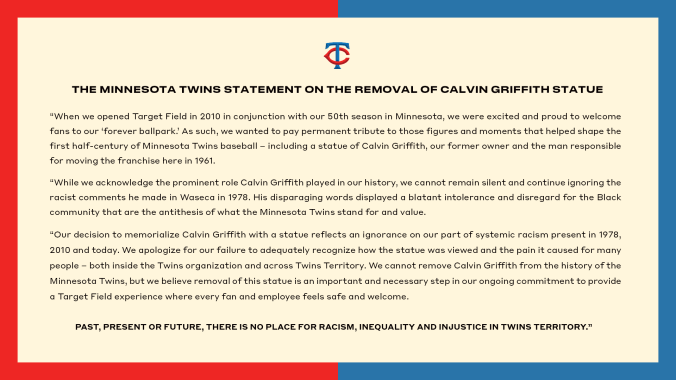
Having just banned a commenter for a useless and obnoxious comment on this same post, it it is a wonderful tonic to be able to post  JutGory’s masterful Comment of the Day critiquing the Minnesota Twin’s statement explaining their removal of Cal Griffith’s statue. It is a fine fisking of the kind of disingenuous babble we  have been getting from organizations of late.

The poll on Cal’s statue so far:

Here is JutGory’s Comment of the Day on the post, “Statue-Toppling, The Ethics Incompleteness Principle, And Calvin Griffith, Part Two”:

Jack: “Taking all of that together, I believe that the Twins are justified in taking down Griffith’s statue, and that it would have been unethical for the team not to.”

Apart from the whole statue-removing thing, here is my problem with this:

Their statement said:

“When we opened Target Field in 2010 in conjunction wit h our 50th season in Minnesota, we were excited and proud to welcome fans to our ‘forever ballpark.’”

Fair enough. Good start. Then:

As such, we wanted to pay permanent tribute to those figures and moments that helped shape the first half-century of Minnesota Twins baseball.

PERMANENT. That is a strong word. But, that is what they intended. Permanent Tribute.

– including a statue of Calvin Griffith, our former owner and the man responsible for moving the franchise here in 1961.

Including the man who moved them to Minnesota. Seems fitting. But for him, they wouldn’t have moved to Minnesota. And, why did he move the franchise? Because of the same racist attitudes that they condemn.

“We cannot remain silent and continue ignoring the racist comments he made in Waseca in 1978.”

I see. So, the permanent tribute was made while ignoring the racist comments you knew about. Continue reading →

Sunday Ethics Warm-Up, Father’s Day Edition Though There’s Absolutely Nothing Here About Father’s Day

Happy Father’s Day.

On YouTube, the first comment on this video is from someone who writes, “It’s a grate song.” Yeah, THAT guy had one hell of a father…

1. Bored with statue-toppling and honor stripping yet? Obviously the Hun and Vandals aren’t. Here in the D.C. universe, George Preston Marshall the original owner of the Washington Redskins who was the NFL’s version of Cal Griffith, lost his statue two days ago when the D.C. government pulled it down after protesters had vandalized it. Mayor Bowzer is one of the Democratic mayors who are actively enabling the protests. Of course, with statues being indiscriminately being toppled now, the gesture is increasingly less meaningful. Woodrow Wilson, the white-supremacist, racist President who spread the Spanish flu around the world by sending infected troops into Europe when he  sent the U.S. into The Great War for no discernible reason, and who then planted the seed for World War II by sitting by and allowing the victorious English, French and Italians inflict devastating punitive  term on Germany as long as he got his pet project, the League of Nations, into the Versailles Treaty, will have his name removed from buildings by Monmouth University and  Camden, New Jersey. A private college in West Virginia announced last week that it is removing the name of the late U.S. Sen. Robert C. Byrd from its health center. The Democratic Byrd may have been a reformed KKK member, but he also brought many millions of dollars into rural West Virginia, thus explaining the proliferation of his family’s name there. Surely you heard that protesters in Liverpool, England, want to rename Penny Lane of Beatles song fame, because a Liverpool man with the last name of Penny was a slave-trader. Was the street actually named after him? No, there’s no indication that it was, but hey, any association with the name Penny now has a “connection” to racism, so let’s see how far this goes. Penny candy! Penny arcades! Penny loafers!  Penny, Sky King’s niece on the old TV show!

Meanwhile, Dreyer’s Grand Ice Cream, the owned of Eskimo Pie, now says the name is “derogatory,” and that it will be changing the product’s name and marketing. The head of marketing  told CBS News. “We are committed to being a part of the solution on racial equality, and recognize the term is derogatory.”

This is yet another example of the Niggardly Principle. The term Eskimo, according to the Alaska Native Language Center at the University of Alaska Fairbanks, actually came from the French word esquimaux, meaning one who nets snowshoes, like what  Arctic peoples do. Never mind: the rumor started that the term was racist because racist Europeans used it. I highly doubt any native Inuit people are offended by the name of the ice cream bar. In fact, many Native Alaskans still refer to themselves as Eskimos, in part because the word Inuit isn’t part of the Yupik languages of Alaska and Siberia. Is it racist when they use it?

Losing its famous brand will almost certainly eliminate the product, costing business and jobs, but apparently it’s worth it for the company to signal it’s virtue with a move that can’t possibly have any salutary effect on racial equality whatsoever.

“Madness. Madness!” Continue reading →

Statue-Toppling, The Ethics Incompleteness Principle, And Calvin Griffith, Part Two

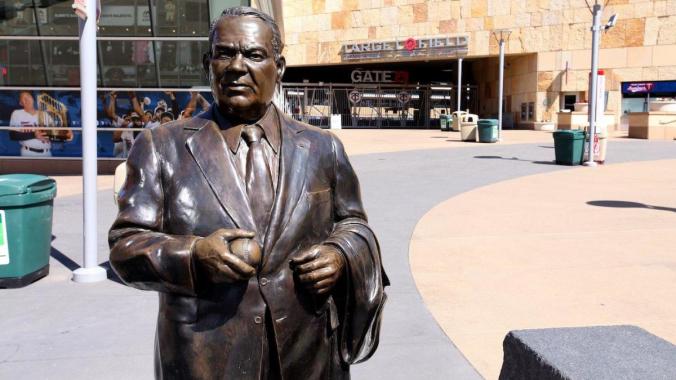
Where Cal Griffith’s statue once stood…

Here is what Calvin Griffith said in the 1978 remarks that led the Minnesota Twins to remove his statue in from of the team’s stadium, Target Field.

Griffith was invited to speak to the Lions Club in Waseca, a small city in southern Minnesota. Taking questions from the audience after his planned speech, someone asked Griffith  why he brought the Twins to Minnesota from Washington, D.C., in 1961. Griffith lowered his voice, asked if there were any blacks around, and  looked around the room. Apparently confirming that his audience was all white,  Griffith said,

“I’ll tell you why we came to Minnesota. It was when I found out you only had 15,000 blacks here. Black people don’t go to ball games, but they’ll fill up a ‘rassling ring and put up such a chant it’ll scare you to death. It’s unbelievable. We came here because you’ve got good, hardworking, white people here.”

It’s hard to get more racist than that, at least short of a Klan rally. I’ll poll this at the end of the post, but I believe that this is a case where the Ethics Incompleteness Principle applies, and the usually valid ethical objections to pulling down the statues of problematic, controversial or subsequently disgraced historical figures have to yield to other considerations, which are these: Continue reading →

Statue-Toppling, The Ethics Incompleteness Principle, And Calvin Griffith, Part One.

The Ethics Incompleteness Principle, a core concept on Ethics Alarms, holds that even the most convincing ethics rules, moral codes, laws and principles have exceptions. The inspiration for this observation was the work of Czech-born mathematician Kurt Gödel, whose two Incompleteness Theorems, which relate to mathematical proofs, are his most famous contribution to civilization and science. A linguist as well as a scientist,  Gödel unintentionally delivered an essential blow against the ethics absolutism of Kant and rigid morality when he proved that human language is not sufficiently precise to define rules that will work as designed in every instance. The logical extension of Gödel’s theorems, which he applied only to mathematics and, by extension, physics, tells us that there will always be anomalies on the periphery of every normative system, no matter how sound or well articulated it is. If one responds to an anomaly by trying to amend the rule or system to accommodate it, the integrity of the rule or system is disturbed, and perhaps ruined. Yet if one stubbornly applies the rule or system without amendment to the anomaly anyway, one may reach an absurd conclusion or an unjust result. [ Here is an online discussion of the application of Gödel to ethics, which appeared years after the Ethics Incompleteness Theorem was posited on Ethics Alarms.]

The Ethics Incompleteness Principle suggests that when a system or rule doesn’t seem to work well when applied to an unexpected or unusual situation, the wise response is to abandon the system or rule—in that one anomalous case only— and use  basic ethics principles and analysis to find the best solution. Then return to the system and rules as they were, without altering them to make the treatment of the anomalous situation “consistent.”

Much as we would like it to be otherwise, for life would be so much simpler if it were so, no system or rule is going to work equally well with every possible scenario. This is why is why committing to a single ethical system is folly, and why it is important to keep basic ethical values in mind in case a pre-determined formula for determining what is right breaks down.

When a reader and frequent commenter sent me this announcement from the Minnesota Twins a few days ago, my reflex reaction was as you would expect: Continue reading →

Comment Of The Day: “Scary Tales Of The George Floyd Freakout: The Mission On The Bay Fiasco”

Arthur in Maine accepted the challenge of answering my query that began the Mission on the Bay story: “What is it about restaurants that generate so many ethics messes?” I had never considered the reasons he cites, but they are sound. I was thinking about all the various restaurant ethics blow-ups I have posted on in the past, as well as the many I have left undiscussed. I was especially thinking about this one from seven years ago, about an Applebees waitress who posted online a receipt from an obnoxious customer, a pastor to shame her. That controversy prompted two additional posts, here and here. Yet as unethical as the waitress in that episode was, the eavesdropping bartender in Swampscott was worse.

Arthur argues persuasively that the culture of the restaurant business makes it a breeding ground for unethical conduct. Here is his Comment of the Day on the post, “Scary Tales Of The George Floyd Freakout: The Mission On The Bay Fiasco”:

Jack, your header asks why so many ethics problems arise in restaurants. Having spent some time in the field, I offer the following in answer.

  • High end restaurants tend not to have this type of issue. They usually hire highly competent kitchen and front-of-house staff, and management is usually diligent in training and supervision.

The ethical problems are more common in mid-level houses and chains.

  •  In such houses, staffing is a never-ending challenge, for the simple reason that restaurant work is essentially one of the few fields that actually rewards vagrancy. Servers and kitchen personnel might work a given house for a year or two and move on to something else – either a gig where they think they can make more money, or a different place altogether. Serving and cooking skills are easily transferable; if you leave one location for whatever reason (family, problems with the law, just a desire to see another part of the country, you name it) – it’s pretty easy to find another gig doing exactly the same thing.

In mid-level houses, actual loyalty to the organization tends to be the exception, rather than the rule.

  • The nature of restaurant staff. Senior-level positions – chef or sous chef (or kitchen manager) and the front-of-house manager generally require a fair amount of training and experience. These tend to be genuinely skilled positions. But servers and line cooks… candidly, these are mostly semi-skilled positions. The work is fairly physically demanding but really isn’t particularly mentally taxing most of the time. And with regard to service personnel: very few people in the United States actually work as restaurant servers because that’s their chosen field. Yes, you find true professionals in the high-end places. But for pretty much everyone else, it’s a way to pay the bills while waiting for your screenplay to be picked up, or finishing school, or whatever.

And in fairness, there are servers who really don’t have other options available to them based upon their skills and where they live. But for many, the number of hours required to make a decent amount of money are comparatively short. Continue reading →

Scary Tales Of The George Floyd Freakout: The Mission On The Bay Fiasco

The “mission” appears to be to enforce conformity of thought.

In my native state of Massachusetts, in the coastal town of Swampscott, home of Boston Red Sox tragic hero, the late Tony Conigliaro, comes a story where every element represents an ethics breach. The victim is being made the villain, the villain the hero. As I tell the tale, the faint refrain of “The World Turned Upside-Down,” the song the band played when General Cornwallis surrendered to General Washington, should  echo in the background.

What is it about restaurants that generate so many ethics messes? This one occurred at Mission on the Bay, an upscale waterside eatery that serves food with a Brazilian and Asian influence. Selectman Donald Hause was dining with a friend in the outdoor dining area, and bartender Erik Heilman was eavesdropping, what people are doing when they say later, “I couldn’t help but overhear.” Heilman heard Hause criticize Black Lives Matter, allegedly saying that the group was “liberal bullshit,” and making the case that white privilege was a myth.

What the Selectman said, short of planning a crime, was none of Heilman’s business; nonetheless, the bartender says he was “distraught” at the comments, and so he posted what he heard or thought he heard to a local website,  because he wanted to “inform” the community about the thoughts of an elected official.  Hause disputes his account, but it doesn’t matter, and I don’t care what he said.  Heilman’s conduct was unethical no matter what was said, or whether his post was accurate or not. Customers at a restaurant should, indeed must, be able to depend on the discretion and confidentiality of the staff. The bartender’s actions were a betrayal of his duties to the restaurant and its patrons.

We know Heilman’s rationalization for doing what he did springs from the totalitarian strain in what Commentary Magazine has called “the great unraveling.” Dissent from the Black Lives Matter and its supporters’ anti-American narrative will not be tolerated, and those resisting the mob, the movement’s mission dictates, must be exposed and destroyed. Continue reading →