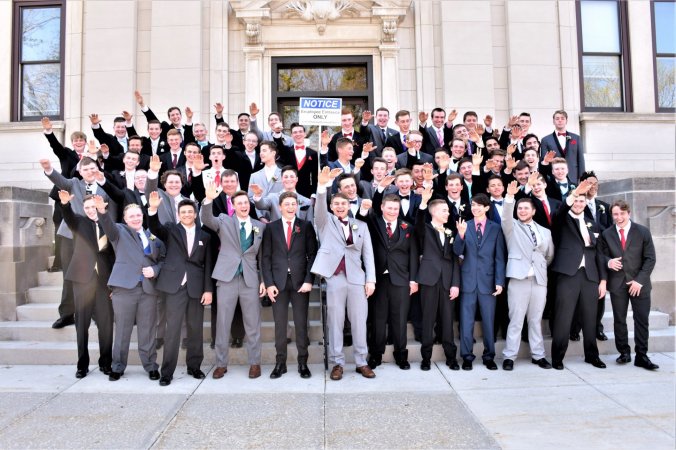
1. Baraboo hangover. Apparently the Wisconsin male high school students who gave a Nazi salute in an off-campus photo will not be punished. The superintendent overseeing Baraboo High, Lori Mueller of the Baraboo School District, said in the letter that the district was “not in a position to punish the students for their actions” because of their First Amendment rights. That’s right from a Constitutional viewpoint, and something good will come of the incident if it means that schools will stop punishing students for what they post on social on their own time. Here is the photo, in case you have forgotten…
The Times article sure is full of dissembling and nonsense, however. Peter Gust, the jerk who took and posted the photo, claims that it had been modified by “malevolent behavior on the part of some in society.” Sure. Jordan Blue, the boy in the upper right hand corner in the red tie, has embraced the role of ethics hero in the media, and is grandstanding and virtue signaling like mad, saying that he didn’t have time to leave the photo but that he didn’t raise his arm because “I knew what my morals were and it was not to salute something I didn’t firmly believe in.” Uh, that should be “firmly didn’t believe in,” Jordan. Then there is Brock Turkington, also in the photograph, whose story is that “As we were about to take that photo, the photographer instructed the boys to give a ‘high-sign.” The photographer instructed us to extend our arms out, no one knew what a ‘high-sign’ was. I asked another student next to me ‘What are we doing?’ He responded, ‘Stick your arm out.’” But that’s not a “high-sign.” That’s a Heil-sign.
2. I won a bet with myself! Cracked, the list and pop culture commentary website that evolved out of a cheap Mad Magazine rip-off from the Sixties, has a feature called “5 Laws From Other Countries (The USA Should Totally Steal).” Cracked is dominated by smug, if clever, social justice warriors, so I made a bet with myself that the list would contain several concepts that were unconstitutional or that would advance the Left’s dream of perpetual power. (By the way, you can’t “steal” a law.) Sure enough, the tally was three out of five. I win!!! Continue reading →
Once again I am posting the Ethics Alarms Ethics Guide to Frank Capra’s 1946 masterpiece “It’s A Wonderful Life,” perhaps the greatest ethics movies of all time, as this blog’s official welcome to the holiday season. The film is commonly thought of as a Christmas movie, but it really is a Thanksgiving story. Unfortunately, the movie is so well known, so much imitated, so familiar in its tropes and cliches that we really don’t think about it very hard. We should.
The movie is exactly the kind of important shared cultural touch-point that I am advocating when I emphasize the importance of cultural literacy to our nation’s connective tissue. The film teaches about values, family, sacrifice and human failings unlike any other: its power and uniqueness disproves the assertion, made in one online debate here this year, that new cultural creations inevitably and effectively supersede older ones. No, they really don’t, and like copies of copies, eventually the cultural values conveyed get fainter and less influential. “It’s A Wonderful Life” would be an excellent basis for a middle school ethics course. I haven’t seen a better, richer film for that purpose come along since, and I’ve been looking.
I am also constantly amazed at how many people haven’t seen the movie. My son’s girlfriend admitted that she hadn’t at dinner today. A few months ago I gave a DVD to a pharmacist at our local CVS after I made a reference to the film and he had no idea what I was talking about. He said he would wait until the holidays to watch it with his family. I hope he does: he left the job soon after. There are some classic movies that parents have an obligation to make sure their children see. This is one. Despite the many ethics complexities and nuances that the film glosses over or distorts, its basic, core message is crucial to all human beings, and needs to be hammered into our skulls at regular intervals, far more often than once a year.
What I wrote about this message in an earlier posting of this opus still seems right to me:
Everyone’s life does touch many others, and everyone has played a part in the chaotic ordering of random occurrences for good. Think about the children who have been born because you somehow were involved in the chain of events that linked their parents. And if you can’t think of something in your life that has a positive impact on someone–although there has to have been one, and probably many—then do something now. It doesn’t take much; sometimes a smile and a kind word is enough. Remembering the lessons of “It’s a Wonderful Life” really can make life more wonderful, and not just for you.
I wondered about posting the guide again this year, as this feels like a year in which Ethics Alarms lost old readers rather than gained new ones. Then I read it again, and it reminded me of some important things I had forgotten, and I wrote it. I also, as is my yearly habit, edited and added to the commentary a bit. I’m smarter this year than I was last year, and I bet you are too…especially if you’ve been reading Ethics Alarms, just from figuring out how I’m wrong.
I hope you all had a terrific Thanksgiving, and that the holiday season is joyous for all.
And here we go:
1. “If It’s About Ethics, God Must Be Involved”
The movie begins in heaven, represented by twinkling stars. There is no way around this, as divine intervention is at the core of the fantasy. Heaven and angels were big in Hollywood in the Forties. The framing of the tale seems to advance the anti-ethical idea, central to many religions, that good behavior on earth will be rewarded in the hereafter, bolstering the theory that without God and eternal rewards, doing good is pointless.
Yet in the end, it is an ethics movie, not a religious one. George lives a (mostly) ethical life, not out of any religious conviction, but because step by step, crisis after crisis, he chooses to place the welfare of others, especially his community and family, above his own needs and desires. No reward is promised to him, and he momentarily forgets why we act ethically, until he is reminded. Living ethically is its own reward.
We are introduced to George Bailey, who, we are told, is in trouble and has prayed for help. One has to wonder about people like George, who resort to prayer as a last resort, but they don’t seem to hold it against him in Heaven. The heavenly authorities assign an Angel 2nd Class, Clarence Oddbody, to handle the case..He is, we learn later, something of a second rate angel as well as a 2nd Class one, so it is interesting that whether or not George is in fact saved will be entrusted to less than Heaven’s best. Some lack of commitment, there— perhaps because George has not been “a praying man.” This will teach him—sub-par service! Good luck, George!
2. Extra Credit for Moral Luck
George’s first ethical act is saving his brother, Harry, from drowning, an early exhibition of courage, caring and sacrifice. The sacrifice part is that the childhood episode costs George the hearing in one ear. He doesn’t really deserve extra credit for this, as it was not a conscious trade of his hearing for Harry’s young life, but he gets it anyway, just as soldiers who are wounded in battle receive more admiration and accolades than those who are not. Yet this is only moral luck. A wounded hero is no more heroic than a unwounded one, and may be less competent as well as less lucky. (This is not an observation that one should make in public, as President Trump learned when he made a lifetime enemy of John McCain.)
3. The Confusing Drug Store Incident.
George Bailey’s next ethical act is when he saves the life of another child by not delivering a bottle of pills that had been inadvertently poisoned by his boss, the druggist, Mr. Gower, who is addled by grief and drink after learning about the death of his own son. George’s act is nothing to get too excited over, really—if George had knowingly delivered poisoned pills, he would have been more guilty than the druggist, who was only careless. What do we call someone who intentionally delivers poison that he knows will be mistaken for medication? A murderer, that’s what. We’re supposed to admire George for not committing murder.
Mr. Gower, at worst, would be guilty of negligent homicide. George saves him from that fate when he saves the child, but if he really wanted to show exemplary ethics, heshould have reported the incident to authorities. Mr. Gower is not a trustworthy pharmacist—he was also the beneficiary of moral luck. He poisoned a child’s pills through inattentiveness. If his customers knew that, would they keep getting their drugs from him? Should they? A professional whose errors are potentially deadly must not dare the fates by working when his or her faculties are impaired by illness, sleeplessness or, in Gower’s case, grief and alcohol.
One could take the position that Mr. Gower “just made one mistake.” But trustworthy professionals don’t get to make such mistakes, not and still be trusted the next time. Trust is easily destroyed, and should be.
Mr. Gower also slaps George on the head several times. Today hitting a child like that is regarded as child abuse by a parent; when another adult hits a child, it’s grounds for arrest. This is one of many examples of evolving societal ethics in “It’s A Wonderful Life.” When the film was made, Mr. Gower’s conduct in beating a child employee was considered forgivable. If the local pharmacist slapped my son, I’d swear out a criminal complaint, and he still might end up shambling bum like Mr. Gower in the film’s alternate reality section.
4. The Uncle Billy Problem.
As George grows up, we see that he is loyal and respectful to his father. That’s admirable. What is not admirable is that George’s father, who has fiduciary duties as the head of a Building and Loan, has placed his brother Billy in a position of responsibility. As we soon learn, Billy is a souse, a fool and an incompetent. This is a breach of fiscal and business ethics by the elder Bailey as well a classic conflict of interest, both of which George engages in as well, to his eventual sorrow.
Now don’t let any “turkeys,” related or not, spoil it for you. This is a uniquely American holiday, celebrating our history, journey, values and culture, remembering the value of family, and extolling qualities that Americans should all try to embrace in their daily lives: generosity, empathy, charity, loyalty, perspective, respect and gratitude. Once it was regarded as a religious holiday, but as the culture has gradually rejected religion, for better or worse, and not without the full complicity of organized religions whose conduct would repel anyone, the holiday has struggled to find new moorings. Its value as a yearly ethical touchpoint makes that struggle worth continuing.
1. Speaking of Thanksgiving “turkeys”...A helpful Twitter-user compiled these shots from various progressive websites and blogs:
Nice.
One of the things I have long been thankful for was the excellent training I received at our family dinner table from my proudly iconoclastic father, who could argue any side of any issues, and did, just to teach his kids that they better have a firm grasp of facts, logic, language, and critical thinking before making any assertion, lest they be made to look like fools. He also taught the value of an open mind, and resisting lazy conventional wisdom without foundation, like, say “Trump is a racist.”
2. This one is Obama’s fault. Though heated political arguments were always a potential part of family gatherings, it was Obama’s administration and his allies that made the disgusting decision to weaponize the holidays, commanding their human drones to arrive at gatherings ready to argue the benefits of the Affordable Care Act, and providing brochures and videos to help them accomplish the mission. (Bulletin from Justice Roberts: “There are no Obama Thanksgivings or Trump Thanksgivings!”) Continue reading →
Me? I’m thankful that I’ve had the Warm-Up to fall back on when I’m too busy trying to sleep off this ^$$@!#^& endless chest cold, so I can at least keep a little bit current on Ethics Alarms. Today, the hell with it! Mind over matter, exhaustion be damned, I’m going to work, shop, make delayed client calls and research until I drop, literally. Time to stop being a weenie. Then tomorrow I can be thankful that I’m still alive.
1. Do not let the Clinton defenders off the hook. For me, this is head exploding: the New York Times is crediting an A&E series about “The Clinton Affair” with suddenly, remarkably, making it possible to see that Paula Jones, as well as Katherine Willey and Juanita Broaddrick, were not just “right wing conspiracy”- primed bimbos weaponized to bring down Bill Clinton. Ah! Now, through the sudden clarity provided by the #MeToo movement, the Times and the rest of the mainstream media feels that the truth, so impenetrable all those years ago, has been revealed! Jones was credible! Willey and Broaddrick were (and are) credible! What a shock! Who knew?
Excuse me if I barf. I knew, and, I submit, so did the New York Times et al,, including my hypocritical feminist lawyer friends at the Association of Trial Lawyers of America, where I worked during the Clinton years. “I believe Anita Hill!” boasted the button worn by the association’s first female President. “Really?” I asked her? Then why didn’t you believe Paula Jones? Clinton has had a history of sexual harassment and predator allegations; Clarence Thomas hasn’t.” Her answer was, to paraphrase, “Humina humina humina…’ She had no answer. She knew she had sided with a powerful man against a powerless woman for purely political reasons, and credibility and justice had nothing to do with the calculation. So did the New York Times. All of the defenses of Clinton were rationalizations—all of them, every one. I argued, and I taught at the time, that the Lewinsky affair was classic workplace harassment where the disparity of power made true consent impossible, even as such feminists as Gloria Steinem denied it, because, you see, Bill supported abortion rights. Of course he did. I’ll bet those rights served him well at one or more junctures in his rise.
Now, though, the realization of what Clinton was really doing has come into focus, as if it wasn’t deliberately blurred by the same forces now proclaiming it. In her essay for Vanity Fair earlier this year, Monica wrote that #MeToo had given her a “new lens” for seeing her own story, writing “Now, at 44, I’m beginning (just beginning) to consider the implications of the power differentials that were so vast between a president and a White House intern.”
Well, you’re slow, Monica, but at least you have an excuse. The New York Times is simply covering up a lie. It has no new lens: it was just pretending, along with the Democratic Party and most of the news media, that it didn’t know what was obvious to anyone with a neutral perspective. Bill Clinton was a serial harasser and sexual predator. He used his power in office to abuse women, and then to cover up his misconduct. Hillary Clinton was his accomplice, for her own gain. The President lied under oath in the Jones suit, a genuine, proven, “high crime.” It was not personal conduct, but professional, official, workplace misconduct, by well-accepted standards in the employment law field. That other Presidents, notably Kennedy, hasalso been sexual predators was not an valid excuse or a defense. The Democratic Party’s alleged feminism and dedication to women’s rights has been pure hypocrisy and cynical misrepresentation as long as the Clintons were embraced as allies and icons, a situation which existed right up through the 2016 election.
How dare the Times pretend all of this was unfathomable before 2018? Are Times readers really this corrupt and gullible? I know I especially resent it, because everything the paper says is suddenly, amazingly “in focus” was clear to me 20 years ago, and I got the same sneering condescension from my left-corrupted friends then that I get from them now, though on different topics. I’m thankful for the Clinton Ethics Train Wreck, because it started me writing about ethics on-line. But I am not letting these liars and hypocrites off the hook. Neither should you. Continue reading →
Anthony Derlunas, 58, a drunken idiot attending a performance of “Fiddler on the Roof” in Baltimore, suddenly started shouting “Heil Hitler, Heil Trump!” He told police that his display was motivated by his hatred of the President.
Is it fair to call this “Trump Derangement”? I think so. I think that’s fair.
He told an officer he “had been drinking heavily throughout the night” before his performance at the Hippodrome Theatre, which understandably unsettled the audience, many of whom apparently thought that another anti-Jewish massacre was underway like the one in the Pittsburgh synagogue last month that killed 11 people. Some people started running, other wept. According to the police report, Derlunas explained that the final scene of the musical before intermission, depicting a Jewish wedding celebration disrupted by a Russian pogrom, reminded him of his hatred for the President—I know I’m always reminded of Donald Trump when I see “Fiddler on the Roof”—prompting his outburst. Derlunas was surprised, he said, when people around him became angry. You can certainly understand his confusion: all he was doing is shouting “Heil!” during a musical about Jewish history and culture. Somepeople get offended so easily.
Baltimore Police escorted Derlunas out a few minutes later, a police spokeswoman said, and the show continued.
He wasn’t charged with anything, though the theater has banned him for life. “As reprehensible as those words are, they are considered protected free speech because nobody was directly threatened,” police spokesman Matt Jablow said in an email. Continue reading →
(You can tell I’m starting to feel better, because the morning warm-up is actually appearing before noon… I had an unavoidable early morning conference call, and I’m hoping to get the post up before I crash.)
1. Regarding the hypothetical Hillary pardon briefly discussed in the previous post…An esteemed commenter corrected me in the comment thread when I stated incorrectly that the object of a Presidential pardon couldn’t refuse the gift: the 1915 SCOTUS case of Burdick v. US says otherwise. The case is one more example of how a bad decision can become settled law. From the New York Times:
The story behind the 1915 case is little known but very relevant today. It involved the city editor of The New York Tribune, George Burdick, who…flatly refused to testify before a federal grand jury about his sources for an article on fraud in the United States Custom House in New York. He said he might incriminate himself in his testimony. The federal prosecutor saw a quick pardon as the answer to this problem, and President Woodrow Wilson agreed.
Wilson gave Burdick “a full and unconditional pardon for all offenses against the United States” he might have committed in connection with the article and for any other matter the grand jury might ask him about. That would seem to have let Burdick off the hook, but he still didn’t want to testify. He refused to accept the pardon, and was locked up for contempt.
The case went to the Supreme Court, which held that Burdick was within his rights and ordered him discharged. In doing so, the court embraced Chief Justice John Marshall’s 1833 definition of a pardon as “a private, though official” act of grace whose validity depended on its acceptance: “It may then be rejected by the person to whom it is tendered; and if it be rejected, we have discovered no power in a court to force it on him.”
Marshall’s pronouncements, in United States v. Wilson, were pure dicta — nonbinding observations — but the courts treated them as gospel. In the Burdick case, the court likewise held that “a pardon, to be effective, must be accepted” because it “carries an imputation of guilt; acceptance a confession of it.” This made Marshall’s view the law of the land.
The problem is that both Marshall’s definition and the court’s 1915 reinforcement of it were bad history and tortured logic. Acceptance of a pardon should not be a confession of guilt, especially if there is documentation of innocence. The “imputation of guilt” would disappear if acceptance of a pardon were not required. If one has no choice but to take a pardon, it would become like a grant of immunity, and thus would be noncommittal.
There is nothing in the Constitution that gives a person the prerogative to turn down a pardon, and strong support in the Constitutional debates for the president’s having an unfettered power to grant one. “The benign prerogative of pardoning should be as little as possible fettered or embarrassed,” Alexander Hamilton wrote in The Federalist No. 74. Even more to the point, the framers turned down an effort to limit the power to pardons “after conviction” because they wanted to make it useful for law enforcement. That is, of course, exactly what President Wilson tried, and was told he couldn’t do, in the Burdick case.
So Hillary could turn down a Presidential pardon for her crimes related to flouting the law regarding classified material.
2. Run, Kamala, run! One of the awful alternatives the Democrats have as they paint themselves into the requirement of nominating a woman as their candidate in 2020, California Senator Kamala Harris, highlighted her awfulness while questioning Ronald D. Vitiello, the acting director at U.S. Immigration and Customs Enforcement, as he appeared before the Senate Homeland Security Committee as it weighed his nomination to become permanent ICE director. She deliberately compared ICE to the KKK in this exchange:
Vitiello: “The Klan was what we could call today a domestic terrorist group.”
Harris: “Why? Why would we call them a domestic terrorist group?”
Vitiello: “Because they tried to use fear and force to change the political environment.”
Harris: “And what was the motivation for the use of fear and force?”
Vitiello: “It was based on race and ethnicity.”
Harris: “Right. And are you aware of the perception of many about how the power and discretion at ICE is being used to enforce the law and do you see any parallels?”
There are no parallels between the KKK and ICE, and Harris’s assertion that “many” see such parallels is one more example on the growing list of Big Lies being wielded by the Left to spread fear and misinformation. I heard Geraldo Rivera say this morning that Harris was “too smart” to make such a comparison, which he characterized as slander. Obviously she is not too smart to make the comparison, since she made it. She’s too smart to believe that the comparison is fair, but unethical and irresponsible enough to suggest it anyway.
3. Here’s one reason why I don’t have more Ethics Heroes. I’ve already written twice about the deteriorating saga of the kind homeless veteran and the woman he helped who raised money to let him turn his life around.. It began as a heartwarming Ethics Hero saga, then rotted into a tale of greed, ingratitude, betrayal and exploitation. By August of last year, this was the suddenly depressing story…
Johnny is back living under a bridge, panhandling for change. GoFundMe is investigating whether McClure and her live-in boyfriend absconded with most of the donations, which eventually amounted to about $400,000. Johnny claims that his once grateful benefactor and friend have been spending the money that was supposed to ensure, in Kate’s memorable words, that “his life can get back to being normal….”
The New Jersey couple who became famous for raising hundreds of thousands of dollars for a homeless man after he helped with their disabled car — as did the homeless man himself — will all face charges for allegedly providing a false story in order to raise money for themselves, a source familiar with the case told NBC10. Mark D’Amico, Kate McClure and Johnny Bobbitt Jr. will face charges including conspiracy and theft by deception, according to the source. A complaint obtained by NBC10 alleges that the three conspired with one another to make up a false story in order to raise more than $400,000.
Sigh.
4. Now that’s acceptable gender bias discrimination. Somehow. I guess. Rep. Tim Ryan (D-Ohio) said Wednesday that a congresswoman besides Rep. Nancy Pelosi (D-Calif.) should be the House Speaker. “There’s plenty of really competent females that we can replace her with,” Ryan told reporters, before listing people such as Rep. Marcia Fudge (D-Ohio) as potential candidates, The New York Times reported. I dare anyone to try to explain what one’s sex organs and chromosomes has to do with being a capable Speaker of the House. Bias not only makes you stupid, it makes you ridiculous and hypocritical. As for Marcia Fudge: oh, GOOOOOD choice there, Tim!
“Attorney Michael Avenatti has been placed under arrest on suspicion of felony domestic violence and was booked early Wednesday evening.
Los Angeles Police Department officer Jeff Lee said the domestic violence report was taken on Tuesday in West Los Angeles and the arrest was made Wednesday.
“We can confirm that today LAPD Detectives arrested Michael Avenatti on suspicion of domestic violence. This is an ongoing investigation and we will provide more details as they become available,” the LAPD Twitter account posted Wednesday. In a statement, Avenatti called the allegations “completely bogus.”
…Avenatti posted $50,000 bail and left police custody Wednesday evening. He told reporters waiting outside the station, “I have never struck a woman. I never will strike a woman.”
“I am confident I will be fully exonerated,” he added.
…Avenatti emerged this year as a regular antagonist of President Donald Trump, beginning with his legal representation of Stormy Daniels and his frequent media appearances..he has publicly flirted with a potential bid for the Democratic presidential nomination to challenge Trump in 2020. The alleged domestic violence incident could dash Avenatti’s prospects as a potential insurgent Democratic candidate and clash with the image he has presented of himself as an advocate for women, including Daniels in her clash with Trump and an accuser against recently confirmed Justice Brett Kavanaugh.
The Vermont Democratic Party canceled Avenatti’s appearances for Friday and Saturday following his arrest, and it will refund all ticket sales, said Christopher Di Mezzo, the party’s communications director.
This story is like a great, big, ethics piñata that got hit squarely by a stick and spilled ethics candy all over the floor!
Observations:
1. Is it unethical to take pleasure in the misfortune of another, even a grandstanding, publicity-obsessed gasbag who makes me want to burn my bar card?Nah, not when the inspiration for mirth is condign justice. Like Michael Cohen, the shenanigans of Avenatti were signature significance for a phony and a charlatan, and his fall was just a matter of time.
We should always take pleasure in the exposure of such public figures, however it occurs. Continue reading →
The weekend was a near total wipe-out for me, as the incipient flu-cold or whatever it is that has been stalking me for at least a couple of weeks finally ended all ambiguity by leveling me just as the long weekend was getting started. I was in bed virtually all day yesterday, most of the day before, and if I’m getting better, damned if I can see it. I’ve always got to be wary when I cough like this, as I am susceptible to bronchitis, but ProEthics, and ethics itself, wait for no Weenie.
1. What do you do with these idiots? The guys in Baraboo High School’s class of 2019 posed with Nazi salutes at their junior prom this year.
It isn’t Mel Brooks High School: “the Heil sign” is only amusing or satirical in the most carefully constructed context. In any other time of place, it trivializes a historical nightmare, genocide and the engineered murder of millions of people by a madman, his henchmen, and a poisoned culture. The Wisconsin school district that included Baraboo claims to acting on the photo, but since it went viral on social media, current and former students have said that the school itself has a culture of racism and bigotry openly that is allowed to thrive by indifferent teachers and administrators. There’s a lot I don’t understand about the photo. Where are the girls? Are these only the Nazis in the class, or is it all of the boys? The kids that aren’t saluting: are they protesting against the display? Did they just miss the shot? Why are they in the photo at all? Who in their right mind would participate in such a stunt?
2. Fact: acting U.S. Attorney General Matthew Whitaker has no conflicts of interest with the Mueller investigation. So why are Democrats insisting that he recuse himself, now that his is overseeing the investigation as Jeff Sessions could not? As far as I can see, the only reason is that they want Rod Rosenstein, who had been the acting AG for only the Mueller matter to continue to supervise it because he is perceived as being hostile to the President. Rosenstein does have a conflict, and properly should have recused himself long ago. He was very much involved in the Comey firing, which is part of the Mueller investigation’s inquiry into alleged obstruction of justice by the President. He conceivably possesses information about the President’s motives in firing Comey, and quite possibly has a personal interest in how the episode is interpreted. Rosenstein thus would very likely be a necessary fact witness in any obstruction inquiry in connection with the Comey firing. That’s a conflict.
Whitaker, however, has no conflict. His statements about how Mueller has run the investigation don’t create a conflict of interest under the applicable ethics rules, not does it raise the appearance of impropriety. Democrats are signaling here, as they have repeatedly for two years, that their objective is to “get Trump” by any means necessary, and they will torture and distort, law, ethics and common sense to achieve that goal. Continue reading →
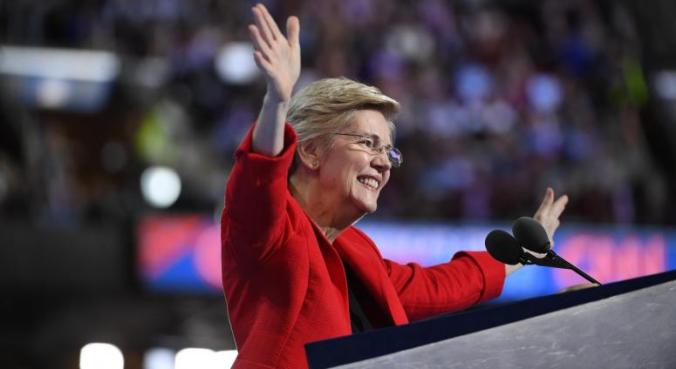
Elizabeth Warren has been allowed to have her embarrassing experience with DNA testing slide back into the memory hole, and Massachusetts voters happily returned the Leftist demagogue to the Senate. Ignoring the character deficiencies of its Senators is a long tradition in my home state. For once, my sloth in not posting Comment of the Day in a timely fashion has paid dividends, for it allows me to raise the Warren fiasco of last month…yes, it was less than a month ago, incredibly—in all of its yummy ethics nastiness.
If all goes well, Elizabeth Warren’s triumphant discovery that she is 99.9% white and therefore was justified in representing herself as a “person of color” for institutional diversity purposes will sink her career aspirations as deep as they deserve to be sunk. The fact that so much of the mainstream media is willing to have their credibility brought down with her is indicative of how stupid bias will make people. The Daily Beast, for example, writes in a headline, “Warren revealed results show Native American heritage Monday.”
Keep it up, guys. Pretty soon the jig will be up for identify politics, since if 1/1,024th Native American means “Native American heritage,” then everyone is “of color” somehow. In that case, perhaps we’ll owe Warren a debt of gratitude….
Now here’s jb….
Warren had an easy out of this mangled story: She should/could have said that she believed her family’s telling of the events and, being originally from Oklahoma, it would be reasonable to believe that she had Native American heritage.* But, she elaborated on the story, to make it more compelling. She also told interviewers her father’s parents did not approve of his choice for a wife because her mother was Cherokee.**
Warren is a lawyer and, supposedly, is very bright. If you’ve watched or listened to CNN and MSNBC for the last four years or so, she is the very embodiment of moral authority over all things . . . erm . . . moral, guided by a passionate desire to help the poor and the middle class.
She knew, and reasonably should have know, that DNA is not determinative of Native American heritage. What matters is being included in the tribes’ relevant hereditary scrolls. In fact, she said that in an interview, so she was aware of the standard and she is aware that she is not so listed. Continue reading →
I apologize for combining these two deserving comments into a single post, but the baseball season is over, and as much as I try to make the case that readers who are tragically immune to baseball’s charms should still read and ponder the ethics posts this most ethically complex of sports inspires, most don’t, and I also have a backlog of Comments of the Day that feels like a 400 lb monkey on my back.
First is Slickwilly’s Comment of the Day on the Halloween post, Unfinished World Series Ethics Business. He is discussing this iconic moment, when a crippled Kirk Gibson limped to the plate as a pinch-hitter against the best closer in the game at teh time, Dennis Eckersley:
Used a clip from one of your posts to teach my kids last night: Game 1 of 1988 World Series last at bat.
The mental aspect of Baseball was NEVER more apparent than in that at bat. The names and teams are irrelevant. Dangerous runner at first as the tying run, two outs, bottom of the ninth inning. Crippled power hitter is substituted to bat for the bottom of the lineout, in hopes of a base hit.
Pitcher, a professional at the top of his game, has not allowed a home run since late August: a powerful matchup indeed!
First two pitches are fouled away. Pitcher starts messing with the batter by throwing to first (where there was no chance of an out.) Two more foul balls and the count is still 0-2. Pitcher continues to throw to first, where the runner is taking progressively larger leads.
Batter hits almost a bunt down the first base line: foul. However, we see how badly the batter is hurt: he is almost limping and could never reach first base on an infield hit. Indeed, he is so banged up he did not take the field during the warm ups: a sign that the manager never expected to play him. (One suspects that a pinch runner would be used, should a base hit occur.)
The mental game continues with the pitcher, way ahead in the count, throwing hard-to-hit pitches in an attempt to make the batter strike out. The batter gets a hold of a pitch: foul ball. Pitcher throws outside again. Now the count is 2-2. More throws to first, and the runner is a legitimate threat to steal second as the count evens up.
The pitcher throws way outside, and the runner steals second, getting into scoring position. Now the count is 3-2, and the advantage goes to the batter: a base hit can tie the game!
The batter hands some of the crap back to the pitcher: calls time out just as the pitcher has his mental focus for the deciding pitch. The batter takes his stance, and HIS focus is unshaken: you can see it in his stance, how he holds his head, how he holds his bat, everything. This man suddenly exudes confidence, and the pitcher can see it. Everyone in the ballpark can see it!
Sometimes, in Baseball, a thing is meant to be. I cannot explain it, but there are moments where you know you are about to see greatness, where all of the little factors are lining up to produce a great play. There is a feeling in the air at such times, and it is palatable even on video and across decades of time. For those who worship at the altar of Baseball, these are the moments that make the game great.
Pitcher throws a low slider (betting on a junk pitch!) and as a result, hangs out what Baseball fans affectionately call ‘red meat’ for the batter, who gets EVERY BIT OF THAT PITCH AND SENDS IT ON A TOUR OF THE RIGHT FIELD BLEACHERS!