Ethics Dunce: Anyone Who Ran This Story

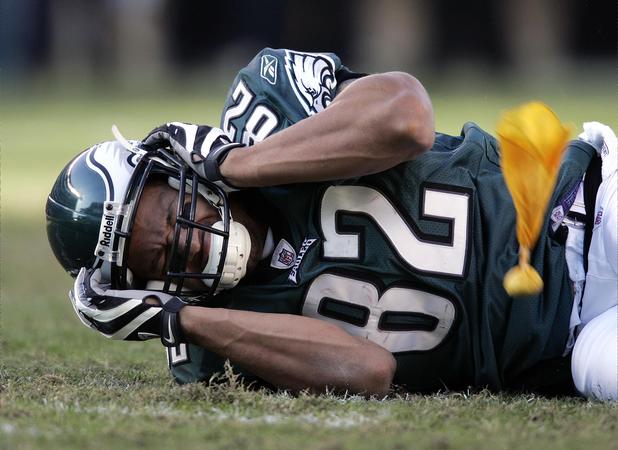
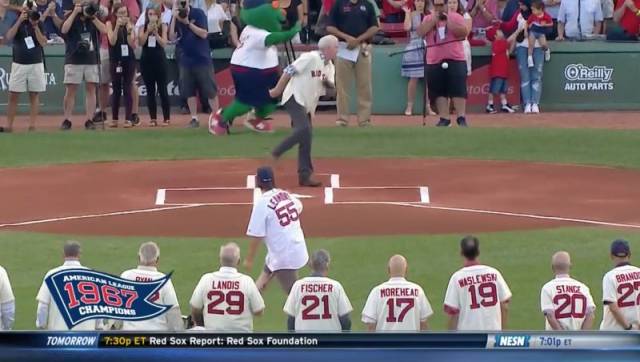
On my way home from my seminar today, I saw that my cab’s in-ride video featured, along with three Jeopardy! questions from Alex Trebek, a Jimmy Kimmel feature (his “Pedestrian Belly-Flop” competition) and the weather, and a video from the ceremonies I had just returned from witnessing in person at Boston’s Fenway Park. The headline was-HAHAHAHA!—“First Pitch Goes Horribly Wrong!” and showed Mike Andrews, the ex-Red Sox second baseman from the 1967 “Impossible Dream Team,” receiving a pitch from the ceremonial first pitch tosser, who then heaved the ball far beyond Mike’s reach into a group of photographers, hitting one of them—it’s important to note that he is male–right in the crotch. The clip was attached to an ad for the local ABC affiliate here.

I thought that the mocking video was an ABC product, and it might be, since other ABC affiliates have distributed it. But the same video with similar mockery of the pitch in the commentary is elsewhere, and on its way to going viral. Here is the attached story used by ABC Channel 15 in Arizona:

A photographer and University of Arizona alum was the unfortunate victim of one of the worst first pitches in MLB history on Wednesday night.

Before the Boston Red Sox hosted the St. Louis Cardinals at Fenway Park, the gentleman who tossed out the first pitch threw it juuuuuust a bit outside — and right into a sensitive spot for Tony Capobianco, a photographer and page designer for The Eagle-Tribune who graduated from UA in 2013.

Fortunately, Tony reported he’s OK. Way to Bear Down, sir.

That “sir” is a triumphant cancer survival and success story by The Jimmy Fund, the Dana-Farber Cancer Institute’s ‘s research drive to cure cancer in children that the Red Sox  made the organization’s affiliated charity since Ted Williams became passionate involved with the project in the late 1940s. His pitch was the climax of the ceremonies honoring the 50th anniversary of  the storied pennant winning team, in part because that team became the first to ever award a full World Series share to cancer research, and in part because Andrews had followed his playing days with 25 years as the Jimmy Fund’s executive director. Continue reading →
Yes, Virginia, There Is A White Supremicist Teacher Principle

“Oops! Sorry.”


A commenter yesterday inquired about the Ethics Alarms position regarding efforts to punish participants at white nationalist rallies by publishing their photos on Facebook and other social media, presumably to help get them fired.

I’ll begin the analysis with the Naked Teacher Principle, explored in its many variations on Ethics Alarms, which states,

“A secondary school teacher or administrator (or other role model for children) who allows pictures of himself or herself to be widely publicized, as on the web, showing the teacher naked or engaging in sexually provocative poses, cannot complain when he or she is dismissed by the school as a result.”

The same general reasoning would apply to a secondary school teacher or administrator (or other role model for children) who placed videos or photos of himself or herself demonstrating in favor of racist causes, or giving the “Sieg Heil!” salute, on social media. Even a superb teacher, and one who never exhibited any racial bias at all, would be rendered untrustworthy by such photographs. A neo-Nazi has a right to his or her political views, but those views cannot interfere with the individual’s ability to do a job.

No, I wouldn’t trust a Klan member, a neo-Nazi or a white nationalist to teach my child.

The same would apply to social media posts, and the exact analogy are the college professors who have recently found themselves enmeshed in controversies by declaring on Twitter or Facebook that white people should be killed, that males are a social contagion, or similar bigoted sentiments. These teachers should be separated from their students, and many, though not all, have been. They are, however, publicizing themselves, as well as their bigoted views. Like the naked teachers who posed on-line, they are accountable for the images they project and publish, and how those images affect present and future employees.

However, this is different:

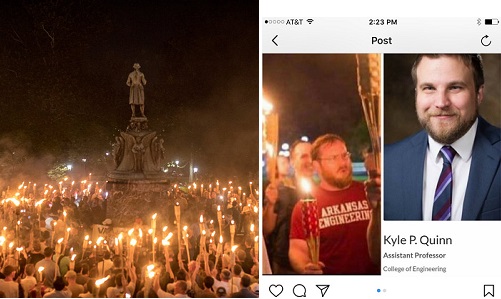
Thousands of strangers across the country had been working together to share photographs of the men bearing Tiki torches on the University of Virginia campus. They wanted to name and shame them to their employers, friends and neighbors. In a few cases, they succeeded.

The activity described is a direct effort to punish people for  their opinions expressed through legal means. It is in the same unethical category as sending private e-mails that reflect badly on former lovers through social media, or using a questionable tweet to destroy the life and career of the tweeter. This kind of  “amateur sleuthing”  as the Times whitewashes the practice, is vicious, destructive, reckless, unfair, and a Golden Rule breach.

I have already pointed out that I might be tempted  join a demonstration against the unethical airbrushing of history that taking down Robert E. Lee’s statue in his home state represents. If I were an idiot (but not a bigot), and didn’t recognize that the white nationalists were just exploiting the General’s memory for their own agenda, I might have been in that group of Tiki torch marchers. A photograph of me marching with a bunch of Klansman and neo-Nazis would hardly be good for my ethics business, though I would be completely innocent of racist views.

The “amateur sleuths” also are not always correct (being amateurs, after all) , as well as being self-righteous, vicious, and opponents of free speech. The Times describes that fate of a professor, Kyle Quinn, who runs a laboratory dedicated to wound-healing research, and who resembled another man caught in a photo marching with the racists. Quinn was attacked on Twitter and Instagram, and social media demanded that he be fired, accused him of racism, and posted his home address online.

Nice.

Be proud, you vicious social justice warriors! Continue reading →

Ethics Hero: World War II Veteran Marvin Strombo

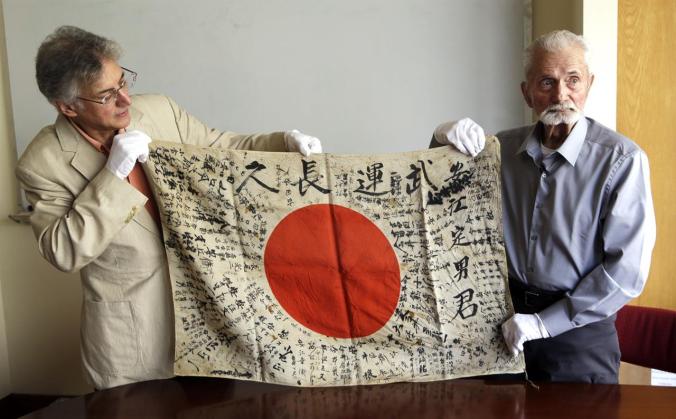
Many Japanese soldiers during World War II went into battle carrying small “Rising sun” flags, the red sphere on the field of white, with the white field decorated by hundreds of classmates, family members and friends. The flags were for good luck, and to link soldiers to their loved ones while they fought for the Emperor.  I had never heard of this practice until today; my father served in the European theater, so he would not have known that many American soldiers took these personal talismans from the bodies of fallen Japanese soldiers as war trophies.

U.S. Marine Marvin Strombo was such a soldier. A member of  an elite sniper platoon during the bloody battle for the Pacific island of Saipan in 1944, he had taken a flag from a dead Japanese soldier lying on his left side—he remembered that the young man looked like he was  asleep—after he noticed something white sticking out from his jacket.

The flag with all the inscriptions on it hung behind glass in Strombo’s gun cabinet in his home in Montana for decades until 2012, when the son of his former commanding officer contacted him for assistance with a book he was writing about the exploits of his father’s platoon. (ARGHHH! I just remembered that I haven’t gotten back to a member of my Dad’s unit who wrote me a couple of months ago!) Working with the author,  Strombo learned about  the Obon Society, a nonprofit organization in Oregon that works to locate and return the personal Japanese flags to the families of the fallen soldiers who carried them. Researchers determined that the dead soldier Marvin’s flag had belonged to was named Yasue Sadao. What Strumbo thought was calligraphy were really the signatures of 180 friends and neighbors, including 42 relatives, who saw Yasue off to war from Higashi Shirakawa, a small village of about 2,400 people in the mountains roughly 200 miles west of Tokyo. Continue reading →

Morning Ethics Warm-Up: 8/13/2017

1. Is the concept that people and groups who have ugly or even essentially un-American beliefs and positions still ave the right to express them, advocate them, and do so without being attacked, and once attacked, have the right to defend themselves like any other citizen really so hard to grasp? Is it also controversial after all these years? Based on the echo-chamber garbage I’m reading on Facebook and on blogs like The Huffington Post, it would appear so.

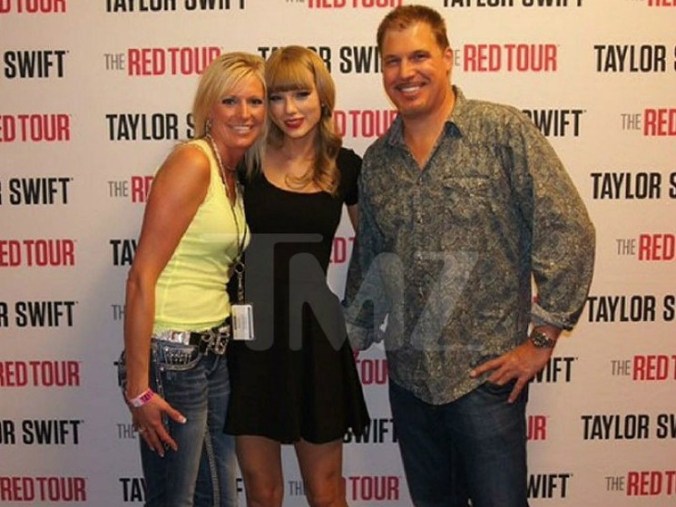
2. I haven’t been following the Taylor Swift groping lawsuit, have you? I’m not sure it justifies following, though it does follow the path of campus sexual assault accusations. To summarize for those of you with higher priorities, pop superstar Taylor Swift was in the midst of a 2013 tour when  she hosted a meet-and-greet for fans in Denver. David Mueller, then a DJ for the radio station KYGO, came to the event and posed for a photo with Swift and his girlfriend. Here is the resulting photo, courtesy of gossip site TMZ:

Swift said that Mueller reached under her skirt and molested her from behind. Her security team ejected the DJ and complained toMueller’s employer, KYGO, which fired him.. In 2015,  Mueller filed a defamation suit against Swift,  denying that he touched her intimately and demanding millions in damages for his lost job and sullied reputation. She has counter sued for a single dollar.

As with many sexual assault cases tried in a civil setting or by a university kangaroo court, this lawsuit will come down to who the jury believes, and the photo, which is the only evidence. (Mueller says that he recorded a two-hour phone call with KYGO the day after he learned of  Swift’s complaint, and had a copy of the audio file on his laptop and on an external hard drive, and his cell phone too, but he spilled coffee on and then lost the laptop, while the external hard drive inexplicably stopped working. Then he threw out the cell phone.  ( Sure. ) In its article about the case, Vox says,

“America has long had an unspoken understanding that famous women have no real right to bodily autonomy. Women in general aren’t understood to have much right to bodily autonomy in America: hence rape culture, hence comments about rape like, “if a man walked around with a suit made of $100 bills, he’d expect to be robbed, wouldn’t he?” that make women’s bodies analogous to money. But because fame already comes with diminished expectations of privacy, celebrity women are considered to be especially fair game.”

Fake history. I was certainly not taught this, nor did I “understand it” to be true. There are, and have always been, pig assholes who think like Vox describes, but they have been regarded as assholes for decades. This is feminist bigotry at work, stated as fact. As a civilized male who was raised to respect women and their bodily autonomy, I find the trope that all men, especially those on college campuses, are nascent rapists political propaganda of the most despicable kind, and not worthy of the seriousness accorded it by female Democratic Senators, publications like Vox, Obama’s Education Department and feminists.

My reading of the case is that Swift made the unfortunate but understandable choice of continuing to pose for the picture while this creep was fondling her butt, but that Mueller will have a difficult time proving defamation—the burden is on him, not her—and is likely to lose, not in small part because Swift, a trained PR whiz, was a spectacularly effective witness. ( Question from the plaintiff’s counsel: Why did your skirt look undisturbed in the photo if my client had his hand under it as you claim?  Swift: “Because my ass is located in the back of my body.” Continue reading →

Morning Ethics Warm-Up: 8/11/17

GOOD MORNING!!!

1. From sources within Google management, we learn that the firing of the diversity memo writer, James Demore, was hotly debated, but in the end...

“…Damore’s focus on biology really made it clear that he had crossed the line.” What turned the tide, said sources, was when it was noted that if Damore’s dubious contentions about women’s skills were replaced by those about race or religion, there would be no debate.’

Ethics diagnosis: Bias made them stupid…that is, Google’s political correctness bias. If someone says that blacks, for example, are biologically handicapped for certain jobs, that’s bigotry and ignorance, the equivalent of poor Al Campanis’s  infamous statement to Ted Koppel that blacks “lacked the necessities ” to manage a baseball team. If someone says that holding religious beliefs suggests one may have biological disadvantages, then that individual is, of course, an idiot.

Women, however, are biologically different from men. If this was the reasoning behind Demore’s dismissal, then it is an example of regarding fealty to cant and politically correct mythology as more important than dealing with complex realities.

2. Professional Trump apologist Jeffrey Lord reacted with a tweeted Sieg Heil! to  Left Wing attack group Media Matters organizing a boycott of the Fox News star’s sponsors to force Sean Hannity off the air.  CNN responded by firing Lord, saying, “Nazi salutes are indefensible.”

Except that Lord was not performing a Nazi salute, but alluding to it to make the very accurate point that the Media Matters wing of progressive America is anti-free speech, and, Nazi-like, determined to shut down inconvenient dissent. Sieg Heil!, in the context of Lord’s tweet, did not mean “Yay Hitler, and let’s kill some Jews!” but rather “Media Matters embodies fascism of the left.”

Which it does.

This story is just full of detestable people and organizations. Jeffrey Lord is a dishonest hack whom CNN keeps parading before its viewers to pretend that the network is “balanced” in its relentless critical commentary on the President. Typically Lord is the sole defender of the Administration on a panel of multiple virulent critics, presided over by one of CNN’s myriad anti-Trump hosts. Sean Hannity is a knee-jerk conservative without scruples, perception or shame. Media Matters is a left-wing propaganda machine that makes a mockery of the term “media watchdog” by its very existence, and it is not unfair to rate its creator and leader, David Brock, as unstable. And I don’t like Nazi salutes either, though to call them “indefensible” is just plain wrong. They are defensible on the History Channel, to show how Nazis behaved. They are defensible in films like “Valkyrie,” since Tom Cruise’s doomed hero’s reluctant salute was a central theme.

It is defensible in Mel Brooks movies, which feature the salute frequently, to mock the Nazis. It is defensible in “Dr. Strangelove,” to make the running joke that mysterious ex-Nazi genius has a Nazi arm with mind of its own.

And it is defensible to use the Nazi salute derisively to say,”David Brock and Media Matters are fascist in the their methods and attitudes towards free speech.”

CNN’s firing of Lord falsely implied that he was referencing the salute positively. By doing this, the increasingly unprofessional and untrustworthy network was also able to impugn President Trump; after all, if his most visible defender in a Nazi, that makes the President Hitler, right?

In this particular basket of deplorables, CNN may be the most unethical of all. Continue reading →

Unethical Quote Of The Month: An NFL Wife, On The Private Facebook Fearful Spouses Of Future CTE Victims Support Group Page

“It’s scary to think about the future and the ‘what ifs’ … if it’s what he loves, I have to support it.”

What? No, you don’t!

The above anonymous quote from a feature about how 2,000 wives of past and current NFL players share their fears and console each other as the evidence mounts that their husbands are likely to spend their final years as tortured, brain-damaged victims of their sport and burdens on their families illustrates how delusional supporters of the NFL money machine have become.

It also shows, to depressing degree, how people will rationalize and justify conduct that cannot be rationally defended.

If an unmarried NFL player without family responsibilities chooses to shorten his life and cripple himself in exchange for a brief career in the limelight and a lot of money, that’s his stupid choice to make. Then the only other responsible parties are the cynical and corrupt sport that knowingly pays him to make that choice, the amoral and greedy corporations that make such cruelty worth the NFL’s while, and the ethics alarms deficient football fans who get their Sunday thrills watching young men slowly disable themselves. Continue reading →

Comment Of The Day: “The Viral Google Diversity Memo”

The perspective Ethics Alarms readers often add to topics based on their personal experiences is a often great enhancement to the discussions here. This Comment of the Day by Alex is a perfect example, as he clarifies the context of the Google diversity memo through his own observations as an employee of another large tech company.

Here is his Comment of the Day on the post, “The Viral Google Diversity Memo”:

Rather than rehash the memo or analyze it or say what is right or wrong with its reasoning, I’ll instead add my experience dealing with internal policies and “requests for comment” at a large tech (software) company – this is a direct competitor of Google, based in the Pacific NW and employing ~100,000 people (you can figure out who they are with that). My background is in Electrical Engineering with a strong focus on Computer Science, and I was hired by my previous employer just out of college after spending a summer internship with them. I worked there for 12 years, until the summer of 2016 (actually today is my one year anniversary at my new job). In my time there I can only describe diversity and HR policies around race and gender are schizophrenic, even if well-intentioned. These are my stories [insert Law and Order opening notes].

The official harassment/discrimination policy as stated in the employee handbook (which was updated every year) is incredibly vague, and this is intentional (although no one will come out and accept it publicly). We are in an at-will state, so you can be easily dismissed based on that one vague rule; and it has been used as a negotiation tactic on borderline performance dismissals to settle for a lower severance package. (“Do you really want us to state that you’re leaving for violations of the harassment policy? No? Ok, how about you settle for 2 weeks instead of 4?”) But I also have to state that the cases where I saw this section being arguably misused can be counted with the fingers of one hand. Also, I am certain that there are good intentions behind this policy, but as is the case with many well-intentioned rules, it is when the rubber meets the road that things get messy.

Every year we had to take Standards of Conduct training. Every year we had a new edition, and every year there was at least one case study dealing with gender or racial discrimination. Some years were better than others, but in general the training was terrible. If you had the cognitive abilities of a 7-year-old you could figure out what were the right responses without watching the videos or reading the policies. (The Saturday morning cartoons I watched in the 80s – G.I. Joe, He-Man, Transformers – had more complex moral dilemmas). I remember one year around the middle of my tenure when the videos and cases were actually interesting and engaging. A case that I still remember from that time is about an ambiguous situation between a male manager and a female engineer not in the same chain of command. There was a big internal debate about that one, and the next year we had the blandest possible training to avoid controversies.

The above two points are to set the stage: corporate policies are clear, you should toe the line, do not do anything that might be misconstrued, you can be dismissed for very small transgressions.

And then… well… tech companies are rebels, they thrive in chaos, and you’re expected to rock the boat. In many (may be even all) groups you can only grow so much by being a technical expert, you are expected to influence larger and larger teams as you get promoted to keep getting good performance reviews. You can be the only expert on a certain software component, but unless other people know about you and have been “influenced” by you, you are not considered good enough. This has the effect of incentivizing “visibility”. Other people and other teams should know you exist and be willing to state that you’ve had a positive impact for the company. Continue reading →

Morning Ethics Warm-Up: 8/9/2017

Good Morning!

1. On the matter of whether James Demore’s Google memo was unethical in its distribution, which some commenters here dispute, apparently he took the precaution of hiring an employment lawyer before he sent the memo. This strongly suggests that he was not merely opening up an internal discussion, but intentionally provoking a confrontation. If he just wanted to alert management to a problem, the ethical approach was to speak directly to management, not put out an e-mail that he had to know someone would leak to the internet.

Meanwhile, Google’s firing Demore for politely raising legitimate culture issues belies its “Don’t Be Evil” motto. It also may be illegal: Federal labor law bars union AND non-union employers alike from punishing an employee for communicating with fellow employees about improving working conditions. California also has a very strong anti-political discrimination law which “prohibits employers from threatening to fire employees to get them to adopt or refrain from adopting a particular political course of action.”

2. I noted this in yesterday’s post, but it’s worse than I thought: the left-wing news media, which is to say the news-media, has displayed neither discipline, common sense (you can’t keep signalling how biased you are, guys—eventually people will notice) nor ethical journalism by outrageously misrepresenting the message and the tone of the memo. CNN’s Brooke Baldwin, for example, described the memo as saying  “I don’t really like women anywhere near a computer.” That’s false reporting. Do these people understand that anyone can read the memo and see that either they are lying, or haven’t read the memo?

3. The memo’s allegedly “controversial” statement that men and women have some innate physiological, emotional and psychological differences that make their genders (in general, not in specific cases) better or less-well-suited for certain jobs, tasks or fields takes me back to my multiple battles with feminists who insisted that I cast female actors in “Twelve Angry Men.” They simply put their fingers in their ears and hummed when I pointed out that the play was about the group dynamics when twelve disparate male strangers are locked in a room. Do women in such a situation keep threatening each other physically? I think not. Actually, the play is an advertisement for diversity: having women in that largely dysfunctional fictional jury would have probably solved many of its problems, but because women are different from men, not because they are exactly the same, as the Georgetown feminists insisted. Women really need to decide what their stand is: are they different in ways that can be advantageous, or not different at all? They can’t have it both ways. On Instapundit, Glenn Reynolds recalled “The Althouse Rule of Gender Research”, which is, : “Scientists: remember to portray whatever you find to be true of women as superior.”

This goes for commentators, pundits, journalists, educators and, of course, Presidential candidates. ‘We need a woman in the White House (because men screw things up)’ is wise and true, and not sexist at all. Continue reading →

Ten Further Thoughts On The “The Taunting Girls Softball Team”

Well! I returned from my seminar to find an excellent discussion underway regarding this Morning’s Ethics Warm-up, wholly devoted to the Virginia girls softball team that was hammered mercilessly for the raised middle fingers of six teammates to send off their vanquished foes in the semi-finals. Here are some further thoughts after reading the comments:

1. There is no question that the conduct of the girls concerned the game, the sport, and the League. They were in uniform. The message directed the “up yours” gesture to the other team. This is not a case where personal expression via social media was punished by an outside authority. Ethics Alarms has been profuse in its rejections of efforts by schools to punish students for their language, ideas or other expression on platforms like Facebook and Snapchat. Those are clearly, in my view, abuses of power, parental authority and free expression. This is not like such cases in any way. If a cheerleader squad, wearing the uniforms, colors and emblems of a school, behaved like these girls, punishment by the school would be appropriate, right up to the “death sentence” of dissolving the squad.

2. Would the reaction to the photo be different if it were a boy’s team? I just don’t think so.

3. The comparison has been made to the earlier post about Matt Joyce, a major league player, being suspended by the league for a comment made to one fan during a game in a heated exchange. For the life of me, I cannot figure out what anyone would think is similar about the two episodes, the primary difference being the fact that in one case, an adult was disciplined for professional misconduct on the field of play, and in the other, children were disciplined for breaching conduct their sport and organization exists in part to teach, reinforce and convey. The punishment of the player was $60,000 in lost income for a single word, not broadcast via social media. The team was not punished except to have to play without his services for two games, but then it was not colorably a team offense by any stretch of the imagination. I don’t even want to think about what an MLB team would do to six players who, in uniform, made the same gesture the girls did to “our fans.” They might all get released. Continue reading →

Morning Ethics Warm-Up: 8/8/2017: The Taunting Girl’s Softball Team

Good Morning!

I’m squeezed today like fresh orange juice!

I have an early morning ethics seminar in about 90 minutes, so one topic is all I have time for. But it is a good warm-up, reaching an ethics issue—the proper level of punishment for civility breaches in sports— recently discussed here, but with very different factors and ethical considerations involved.

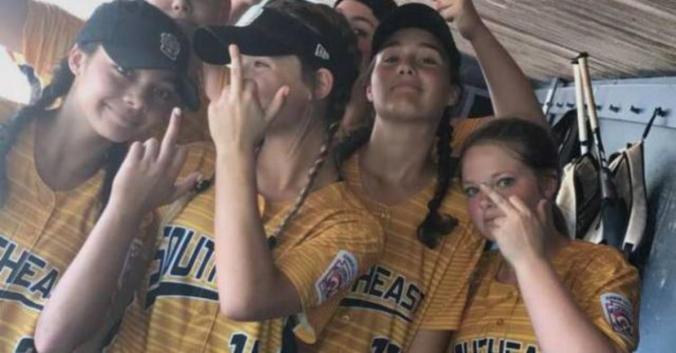
Here and Virginia, many are steaming over the harsh punishment handed down to the victorious Atlee Little League girls’ softball team, which was kicked out of  the Junior League World Series,  featuring the best 12-to-15-year-old girls teams in the world, only hours before its players were about to take the field on national television. The team’s offense: an unsportsmanlike social media post, taunting its last opponent.

Atlee prevailed in a week long tournament in Kirkland, Washington, culminating in tense 1-0 victory in the semifinal game against the host team. Apparently resentment between the teams ran high, and the game featured a controversy over the Kirkland team stealing signs. (Stealing signs in a girls’ softball game? Wow. I didn’t even think there were signs in girls’ softball!)

After the victory, the carptain of the Atlee team used Snapchat to post a photo of showing six members of the team flipping the Fuck You Finger at the Kirkland team.

The Atlee manager Scott Currie heard about the post and had it deleted. Then he arranged for his team to deliver a formal apology in person  to the Kirkland players the same evening. Nonetheless, it was too little, too late. The next morning the head office of the Little League World Series disqualified Atlee from the tournament, and awarded Kirkland the berth in the title game.

The Junior League  issued the following statement:

“After discovering a recent inappropriate social media post involving members of Atlee Little League’s Junior League Softball tournament team, the Little League® International Tournament Committee has removed the Southeast Region from the 2017 Junior League Softball World Series for violation of Little League’s policies regarding unsportsmanlike conduct, inappropriate use of social media, and the high standard that Little League International holds for all its participants.”

Not surprisingly, supporters of the Atlee team, and the team itself, feel that the punishment is excessive.

Observations: Continue reading →