Morning Ethics Warm-Up: 6/28/17 (Yes, It’s The CNN Sting Video)

1. What weight should we place on the latest James O’Keefe Project Veritas sting video? I detest O’Keefe, whose methods are unethical and whose bias is manifest. Nonetheless, what he catches he catches: like the Wikileaks leaks showing Donna Brazile cheating for Hillary, we can’t pretend that damning evidence doesn’t exist because it has been obtained and released unethically.

To track O’Keefe’s latest, I had to search through multiple websites that I don’t trust, like (yuck! pooie!) Breitbart, because the liberal-biased sources either aren’t covering the story or aren’t covering it thoroughly, because, I assume, “There but for the grace of God go we!”, and everything the stung CNN producer said might have been said by someone in their shops as well.

And, of course, since they are not happy about the #1 Get Trump plot by the Democrats and the news media flopping like a dying mackerel on the deck, they want to hide the story from the public as much as they can.

2. Here is the most publicized part of the surreptitiously shot video’s text, which occurs after CNN producer John Bonifield is asked about the Trump-Russia story and the investigation.

“Could be bullshit. I mean, it’s mostly bullshit right now. Like, we don’t have any giant proof. Then they say, well there’s still an investigation going on. And you’re like, yeah, I don’t know. If they were finding something we would know about it. The way these leaks happen, they would leak it. They’d leak. If it was something really good, it would leak…. The leaks keep leaking and there’s so many great leaks, and it’s amazing. I just refuse to believe that if they had something really good like that that wouldn’t leak because we’ve been getting all these other leaks. So, I just feel like they don’t really have it but they want to keep digging. And so I think the president is probably right to say, like, look you are witch hunting me. You have no smoking gun. You have no real proof.”

If any of this surprises you, then you really have to get your ethics alarms checked and your IQ-lowering biases treated, because all this has been obvious except to logic and fairness-deprived members of “the resistance,” Hillary bitter-enders, and people who think CNN and MSNBC are trustworthy. Like most Project Veritas videos, this one only confirms what progressives have denied for political reasons, thus rendering themselves untrustworthy.

3. I was more interested in another quote caught on the video, one which was harder to find because most reporters and bloggers don’t think ethics is newsworthy. After describing a CNN meeting in which reporters were told by CNN brass to stop covering the climate accords with the directive, “Let’s get back to Russia!”, Bonifield says,
Continue reading

The New York Times’ Lies About “Trump’s Lies”

In a grandstanding stunt that was even beneath the fallen role model of U.S. journalism, The New York Times printed what it claimed to be “the definitive list of Donald Trump’s lies” since his inauguration. To say the the list was itself full of lies, and that the over-all assertion that these were “Trump’s lies” was a misrepresentation, is not in any way to excuse the President’s lazy, careless, incompetent use of language, impulsive habits of communication, shockingly inept reasoning and  reckless tweeting. Almost all of the statements quoted by the Times contain misinformation, irresponsible opinions  or unwarranted conclusions, and it is dangerous and disruptive for any leader, indeed anyone, to express themselves this way. Nevertheless, the statements are not all lies. Most of them, in fact, are not lies.

Does it matter? It does. When the New York Times call a list “definitive,’ that list should at a minimum meet the definition of what the New York Times claims to be exposing. It does not. The definition of a lie is a “a deliberately false statement designed to deceive.”

If we assume that the New York Times knows what a lie is, and if the Times does not then it should have no credibility at all, since a journalist’s mission is to report the truth, then the list proves that the New York Times deliberately set out to deceive its readers.

At one point, the Times says,

“We are using the word “lie” deliberately. Not every falsehood is deliberate on Trump’s part. But it would be the height of naïveté to imagine he is merely making honest mistakes. He is lying.”

This is a self-contradictory statement. If a falsehood isn’t deliberate, then it isn’t a lie.

In presenting this unethical project, the Times took unethical advantage of its readers’ confirmation bias. When the “Lie” list was printed, the Times made certain that it would require super-human dedication and extraordinary eyesight to read it, through the devices of listing every item and the Times commentary in horizontal sequence and in half the usual size type-face. (See above) This ensured that almost no readers would make the Herculean effort to read the whole thing , especially since the well-trained Times readers already “knows” that Donald Trump is a liar. In addition, the explosion of tiny words created the visceral response of “Wow! Look at all those lies!” which is exactly the effect the Times editors wanted.

But that isn’t reporting, and it isn’t journalism. The “list” was a page-size, visual, ad hominem attack. The Times wasn’t seeking close scrutiny of its list, nor was it interested in making any rebuttal easy or likely.

We have learned that the Times list was largely assembled from various fact-checker columns. That is a red flag, and explains many of the most embarrassing inclusions on the list. None of the fact-checkers are trustworthy. All of them are biased, Snopes and PolitiFact worst of all, and they consistently register opinions that the writer disagrees with as “false.” Many, many of the items on the Times list are in this category.

I’m not going to go over the entire list here and distinguish between the lies and non-lies, though I have done the analysis. My template for an undisputed Presidential lie would be Bill Clinton’s “I did not have sexual relations with that woman”—he did, and he said this deliberately to deceive; and Barack Obama’s “If you like your plan, you can keep your plan” declaration that he made repeatedly to sell Obamacare to the American people in 2009. The “women make 77 cents for every dollar a man makes for the same job” is a fake statistic that both Clinton  and Obama (and Hillary and Bernie) used, but that would not qualify as a lie on my scale.  I think they believe it, or believe that it’s close enough to true that they aren’t lying when they refer to it. Many of the “lies” on the list fall into this gray area. Of course, the Times never set out to list all of Obama’s lies, or Clinton’s, because they never wanted to suggest either of them were untrustworthy, though a good argument could be made that Clinton was, and Obama regularly engaged in deceit and misrepresentation. To its credit, the Post’s Factchecker did create a list of outgoing President Obama’s “Top Ten Whoppers.”

Many statements that Obama made that were much like dozens of the items on the Trump list were never called “lies” in the mainstream media, as when he attacked the Supreme Court and the Citizens United ruling in a State of the Union address by saying that the decision “will open the floodgates for special interests”…“ including foreign corporations”…” to spend without limit in our elections.” (Justice Alito was seen mouthing “not true” and shaking his head.”)

Unfortunately for the Times, listing “Trump’s lies” chronologically exposed the dishonest and biased nature of the exercise from the start. The first three “lies” are not lies.: Continue reading

Morning Ethics Warm-Up: 6/27/17 [Updated]

1. Since I don’t want to have too many posts at once showing how untrustworthy CNN has become, let’s put this one in the short form: on Sunday, CNN’s alleged show about journalism ethics, “Reliable Sources,” hosted by “watchdog” (stifling a guffaw here) Brian Stelter, conveniently skipped the single biggest broadcast journalism scandal in years.

Thomas Frank, a reporter for “CNN Investigates, announced that “the Senate Intelligence Committee  was investigating a Russian investment fund”, the Direct Investment Fund — “whose chief executive met with a member of President Donald Trump’s transition team four days before Trump’s inauguration.” The CNN “exclusive ” was based on a single  unnamed source, and quickly attacked as fake news—which it appears to have been. CNN, of course, has pushed the Trump-Russia collusion hypothesis as if it were a missing Malaysian airplane. The network pulled the story, retracted it, and three reporters involved in the fiasco “resigned.”

If one were depending on Stelter to get a weekly briefing on how reliable and ethical news media sources were in the week past, one would have been thoroughly deceived. “Reliable Sources,” under the oversight of Stelter, itself isn’t reliable or ethical. It is a house mouthpiece, masquerading as an ethics show. This is res ipsa loquitur, an episode that speaks so loudly by itself that no further evidence is required. If the host of a broadcast ethics watchdog cannot and will not report on serious ethics breaches by his own employer, which is also one of the most visible and significant broadcast news outlets in the journalism, then the show isn’t really dedicated to journalism ethics. It is a biased tool of competition and propaganda, with conflicts of interest that it neither admits nor tries to avoid.

Stelter devoted most of his show to attacking President Trump for not according proper respect to the news media. The President has labelled CNN as “fake news.” This episode vividly demonstrated why.

2. Watching HLN’s Robin Meade this morning to avoid “Fox and Friends” (the CNN outgrowth also has thus far  neglected to mention the network’s fake news episode,) the Cheerful Earful began, “The minimum wage might actually hurt workers????” while making a shocked face that would be appropriate if she was saying that the moon was made of cheese. Thus do those constantly marinated in progressive/ Bernie-style fantasies set themselves up for amazement by the obvious.

Yes, Robin, it has been well-known for about a century that raising the minimum wages causes unemployment for workers whose negligible skills just are not worth the new mandated wage, eliminates whole job categories (summer jobs for teens being the most harmful to society), and puts many small businesses out of business. But never mind! “Living wage” sounds so kind and  good, and the rising minimum wage is always a tool to help unions  argue for increases in their much more than minimum wages, which is why the Democratic Party keeps promoting the lie that raising the minimum wage ever higher makes sense.

Robin was shocked at a new study of the results of Seattle’s huge minimum wage increase, enacted in the heat of mindless progressive faith. Conducted by a group of economists at the University of Washington who were commissioned by the city, the study indicates that far from benefiting low-wage employees, the costs to low-wage workers in Seattle outweighed the benefits by a ratio of three to one. This is the study found that  some employers have not been able to afford the mandated minimums, so they are cutting payrolls, delaying new hiring, reducing hours or firing workers. Gee, who could have predicted that?  The news media is reporting this as if it is a surprise. It’s not. I oversaw a study at the U.S. Chamber of Commerce decades ago that indicted this would happen, because it has happened before. Frankly, it’s obvious; so obvious that I have long believed that Democratic Party advocates for the minimum wage are lying to their gullible supporters.  Both Bernie Sanders and Hillary Clinton made raising the minimum wage a rallying cry, which is one of many reasons why I found it impossible to trust Bernie Sanders or Hillary Clinton.

In the meantime, having seen the writing on the wall, restaurants are increasingly moving to replace waiters, waitresses, and cashiers with automated systems, because they are cheaper…thanks to the minimum wage. If humans were cheaper, humans would keep those jobs, and restaurants would be more pleasant, unless you prefer dealing with computers than human beings. I don’t.

Lies have consequences. Or as Robin would say, “Lies have consequences???” Continue reading

Comment Of The Day: “Sought: An Ethical Reason Why This Professor Should Not Be Fired Immediately, And Never Hired For A Teaching Position Again, Anywhere”

There is an update on story behind the post that sparked the latest Comment of the Day.  The racist professor at Trinity College in Connecticut who made inflammatory social media statements advocating killing whites and urging potential rescuers to allow white men and Republicans to die as part of the effort to destroy a “racist system” has reportedly fled the state after receiving death threats. The “I’ve received death threats” is now the reflex tactic for anyone who is under fire for hateful and vicious social media content: the idea is to generate sympathy and victim status. However, excessive negative response to irresponsible speech does not mitigate the offense. No, Williams should not be threatened. He still should be fired.

My favorite Comments of the Day occur when an intelligent reader  candidly explores his or her own thoughts and feelings on a difficult ethics topic without filtering them. Even the contradictions are enlightening. Spartan has proven herself expert on such commentary before, and this is another example.

Here is her Comment of the Day on the post, Sought: An Ethical Reason Why This Professor Should Not Be Fired Immediately, And Never Hired For A Teaching Position Again, Anywhere:

My husband and I have this discussion quite often. He feels there is no duty to rescue any of the assholes of the world, and his definition of what constitutes an asshole is far broader than mine. (For e.g., he has Bill Gates on his list because of his proliferation of a shitty operating system.)

The reason we have this discussion is that I do feel that there is a duty to rescue, but I do not feel that this duty is absolute. (And also he is a nutter, as his position on Bill Gates demonstrates.) I have no duty to be a live organ donor, but if a friend or family member needed one, I would do it. If Trump asked me, I would not. It’s absolutely my call and I while I don’t wish him to die, I would rather reserve that kidney for someone more worthy. Continue reading

Morning Ethics Warm-Up: 6/18/2017

1. After I criticized Prof. Glenn Reynolds for  his “tit for tat” reaction to the conservatives who disrupted the Central Park production of “Julius Caesar,” I noticed that he had posted a more moderate, ethical and responsible reaction to the same event, writing,

“I’d rather live in a world where this sort of thing wasn’t done at all. But it’s not clear that we’re better off living in a world where it’s done all the time, but only by lefties.”

Muuuch better, professor. Thank-you.

2.

This photo of a “teacher of the Year” being ostentatiously gay in a White House photo with the President was originally posted at the Huffington Post with the headline, “Gay Teacher Photobombs Trump With Fan.” Fake news, but never mind: the photo went viral with the teacher, Nikos Giannopoulos, being hailed for making a disrespectful gesture of defiance, since the LGBT community is committed to the narrative that the President is anti-gay. (He isn’t, but facts and the narratives of “the resistance” are not correlated.)

This account was unfair to both Giannopoulos and the President. I was ready to make him an Ethics Dunce—when you are a guest, you don’t set out to embarrass your host, President or not—until I checked the story. In an NPR interview, the teacher was asked about the President’s reaction to the fan, and replied,

In other words, both the teacher and Trump behaved impeccably, and the President displayed no hostility to a gay pride salute at all. Under no circumstances, however, can anything this President does or says be presented in a positive light. He’ll never be impeached that way. Continue reading

The Michelle Carter Verdict

Michelle Carter’s 18-year-old boyfriend, Conrad Roy III, had told her that he has been considering suicide. First, she told him to seek counseling, then  she changed course, texting him to go through with it. “The time is right and you’re ready, you just need to do it!” she wrote.  “You can’t keep living this way. You just need to do it like you did last time and not think about it and just do it babe.”

Later, she texted to Roy that his family accept his death, and that he would enjoy the afterlife. “Everyone will be sad for a while but they will get over it and move on. They won’t be in depression. I won’t let that happen. They know how sad you are, and they know that you are doing this to be happy and I think they will understand and accept it. They will always carry you in their hearts,” she texted.

“You are my beautiful guardian angel forever and ever. I’ll always smile up at you knowing that you aren’t far away.”

A week before the suicide, encouraging her boyfriend to be more diligent as he searched for the supplies he needed and then going through with his plan in these exchanges:

“Do you have the generator?”

“Not yet LOL,”

“WELL WHEN ARE YOU GETTING IT?”

“Now.”

“You can’t think about it. You just have to do it. You said you were gonna do it. Like I don’t get why you aren’t”

“I don’t get it either. I don’t know”

“So I guess you aren’t gonna do it then All that for nothing. I’m just confused. Like you were so ready and determined.”

“I am gonna eventually. I really don’t know what I’m waiting for but I have everything lined up”

“No, you’re not, Conrad. Last night was it. You keep pushing it off and you say you’ll do it, but you never do. It’s always gonna be that way if you don’t take action”

 “You better not be bullshitting me and saying you gonna do this and then purposely get caught.”

“No, none of that.”

On July 12, 2014, Conrad drove to a Kmart parking lot and connected his truck to a pump that released carbon monoxide. When he lost his nerve and got out of the truck, his girl friend texted him  to “get back in.”  She never alerted any authorities to stop the suicide attempt. The young man was found dead in his truck.

Yesterday, Judge Lawrence Moniz, of Bristol County Juvenile Court in southeastern Massachusetts, ruled that Ms. Carter, just seventeen at the time of her crime, committed involuntary manslaughter by urging Roy to kill himself. Continue reading

Yet Another Comment Of The Day On “Comment of the Day: ‘Morning Ethics Warm-Up: 6/14/17’”

Steve-O-in NJ continues the very topical discussion of hate and partyism in our society. This story from yesterday is on point: increasingly Americans regard those supporting different parties as unfit for friendship, marriage, and other forms of association. I have been writing about this trend for almost two decades; it has accelerated greatly due to social media, the increasing bias and incompetence of the news media, divisive political leaders and bad luck. Democracy cannot thrive or even survive in an atmosphere of such distrust. This should be obvious, and as I have observed elsewhere on Ethics Alarms, those who are feeding the hate and distrust appear to bee doing so deliberately for some imagined political gain. This is madness.

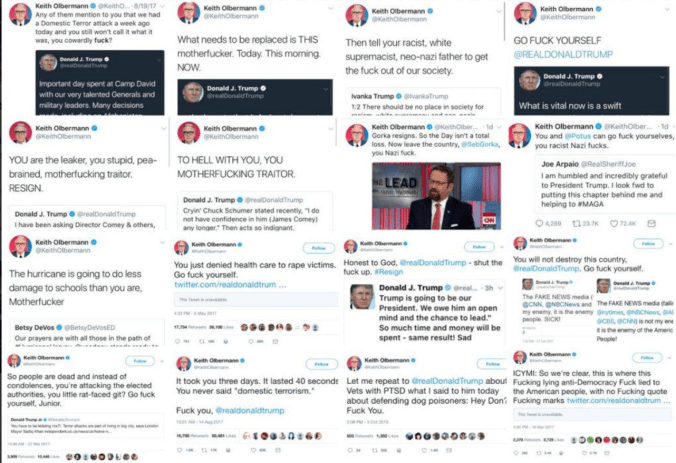
More stories surface every day showing members of the political class embracing the madness. Like this one, about a Democratic strategist who has started promoting the hastags #HuntRepublicans and #HuntRepublicanCongressmen. on Twitter. “We are in a war with selfish, foolish & narcissistic rich people,” wrote James Devine on Twitter. “Why is it a shock when things turn violent? #HuntRepublicanCongressmen.” A Democrat who has has run for office, consulted for numerous New Jersey candidates, and worked for New Jersey lawmakers, Devine said in an interview, “If you want to invite a class war, then you have to expect people to fight back at some point.”

Wait….Bernie Sanders is a Republican? All those people cluttering up Wall Street vilifying the “1%” were conservatives? Republican Congressmen called citizens who wouldn’t fall into line “deplorables’? 

This is the latest rationalization I have been seeing on Facebook: Donald Trump has made Democrats act like spoiled street gang members. How? Why, by having the audacity and bad manners to win the election, of course. Here was Peggy Noonan correctly diagnosing the phenomenon:

Here I want to note the words spoken by Kathy Griffin, the holder of the severed head. In a tearful news conference she said of the president, “He broke me.” She was roundly mocked for this. Oh, the big bad president’s supporters were mean to you after you held up his bloody effigy. But she was exactly right. He did break her. He robbed her of her sense of restraint and limits, of her judgment. He broke her, but not in the way she thinks, and he is breaking more than her.

We have been seeing a generation of media figures cratering under the historical pressure of Donald Trump. He really is powerful.

They’re losing their heads. Now would be a good time to regain them.

They have been making the whole political scene lower, grubbier. They are showing the young what otherwise estimable adults do under pressure, which is lose their equilibrium, their knowledge of themselves as public figures, as therefore examples—tone setters. They’re paid a lot of money and have famous faces and get the best seat, and the big thing they’re supposed to do in return is not be a slob. Not make it worse.

By indulging their and their audience’s rage, they spread the rage. They celebrate themselves as brave for this. They stood up to the man, they spoke truth to power. But what courage, really, does that take? Their audiences love it. Their base loves it, their demo loves it, their bosses love it. Their numbers go up. They get a better contract. This isn’t brave.

Today, on Facebook, my wife intervened in a liberal echo chamber exchange among women saying they were going to boycott a local department store because it sold Ivanka Trump’s merchandise.  She pointed out that this was unfair and made now sense, and kept batting away various rationalizations offered by the women, who were lawyers. Finally one wrote, “Ok, I admit it. I just hate Donald Trump.” That was the best and only argument she had.

This is both admitting bigotry and being so comfortable with it that you accept it.

Here is Steve-O-in NJ’s Comment of the Day on the post, “Comment of the Day: “Morning Ethics Warm-Up: 6/14/17”: Continue reading

From The Law vs. Ethics File: The Discriminatory Charlotte Pride Parade

Brian Talbert, a member of “Gays for Trump,” submitted  an application to Charlotte Pride, Charlotte’s Gay Pride parade, so they could have a float in this year’s event. His application was rejected, with this explanation:


Charlotte Pride reserves the right to decline participation at our events to groups or organizations which do not reflect the mission, vision and values of our organization, as is acknowledged in our parade rules and regulations by all groups at the time of their parade application. In the past, we have made similar decisions to decline participation from other organizations espousing anti-LGBTQ religious or public policy stances.

Charlotte Pride envisions a world in which LGBTQ people are affirmed, respected and included in the full social and civic life of their local communities, free from fear of any discrimination, rejection, and prejudice.

Charlotte Pride invites all individuals, groups, organizations and causes which share our values to join our community’s celebration of the LGBTQ community, history, arts and culture during the Charlotte Pride Festival and Parade, Aug. 26-27, 2017.

In other words, because Charlotte Pride does not support Talbert’s political views, he is being denied the opportunity to present a minority point of view. Constitutional Law prof Eugene Volokh explains why this is entirely legal:

“First, Charlotte and North Carolina do not ban discrimination by parade organizers based on political affiliation. Only a few jurisdictions include political affiliation on their lists of prohibited bases for discrimination.

Second, even if a public accommodation law did ban such discrimination, it couldn’t apply to parades organized by nongovernmental organizations. Such parade organizers have a First Amendment right to exclude groups from their parades based on the messages the groups convey about their members’ sexual orientation, political affiliation, religion, race and whatever else to make sure that a parade conveys just the speech that parade organizers want to convey.”

The precedent Volokh cites for this principle? Why, it’s Supreme Court’s holding in Hurley v. Irish-American Gay, Lesbian, and Bisexual Group of Boston, Inc. (1995), declaring that the organizers of Boston’s St. Patrick’s Day Parade had a First Amendment right to exclude the gay/lesbian/bisexual group.

It seems that many groups advocate diversity, tolerance and fairness until they achieve the power to do their own discrimination. That is, good bigotry. Discriminating against gays is bad.  Gays discriminating against gays who support the President of the United States is good.

Sure it is. Golden Rule? What’s that? This is intolerance, bigotry, a failure of integrity, hypocrisy….and also bullying, as it aims to coerce group members to accept mandated political views that are not their own.

But it’s not illegal, so it’s all right! Continue reading

Reconsidering “Lincoln,” Lincoln…And Trump

I’ve been reading a lot about Abraham Lincoln of late. A book by William Hanchett called “The Lincoln Murder Conspiracies” reminded me that while President Jackson is the closest historical match for the populist, outsider aspect of Donald Trump’s rise, the startlingly close match for the antipathy and hatred Trump has faced from the moment of his election eerily traces the experience of Abraham Lincoln.

Like Trump a minority President, Abe won only 39.8% of the popular vote but was still comfortably elected by the Electoral College. As with Trump, his opposition refused to give him a chance to govern or unify the nation, although in his case, the Democrats divided the country literally, seceding from the union before Lincoln took the oath of office. Today’s Democrats are without that option (thanks to Lincoln!), but are doing everything else in their power to undermine the elected leader. (And California, the most Democratic state, is saber-rattling about seceding.) Also like Trump, Lincoln did not concede that his lack of a popular vote majority in any way robbed him of a mandate to govern.

From the moment the election results were known, many Democrats proclaimed the election of Lincoln itself to be an act of aggression, a “declaration of war.” Many in Lincoln’s own party—even his own Attorney General—accused him, with some justification, of engaging unconstitutional measures. The Governor of New York evoked the Revolutionary War generation, saying that they would not stand for such incursions on their rights. Constitutional expert George Ticknor Curtis of Massachusetts predicted that the Lincoln Presidency would “be an end to this experiment in self-government.”

Meanwhile, pundits and critics heaped personal abuse on Lincoln, calling him grotesque, a barbarian, ” gorilla.” Diarist George Templeton Strong, whose words are so often quoted by Ken Burns in his documentary about the Civil War, called him a “yahoo.” It was said that fashionable New Yorkers would be ashamed to be seen in the presence of someone as boorish and uncultured as Lincoln;  it was rumored that he rejected handkerchiefs and “blew his nose through his thumb and forefingers, frontier-style.” As late as 1864, a New York editor wrote,

“[The President] is an uneducated boor. He  is brutal in all his habits and in all his ways. He is filthy. He is obscene. He is vicious.”

Somehow, despite this cruel barrage of ad hominem rhetoric, arguably more successful then that it would be now since the public has more knowledge of the President and can make their own observations, Lincoln persevered to meet the greatest challenges any President ever faced.

While still pondering some of the parallels with today’s relentless attacks on our current President, I watched again the 2012 Stephen Spielberg-directed film “Lincoln,” which was almost unanimously praised when it was released, and which I enjoyed a great deal when I first saw it. This time, however, “Lincoln” revealed itself as an ethics corrupter. Continue reading

The Comey Testimony, Part II

[Part I is here]

Now let’s look at some direct quotes from James Comey’s testimony: 

1. “Even though I was appointed to a ten-year term, which congress created in order to underscore the importance of the FBI being outside of politics and independent, I understood that I could be fired by a president for any reason or for no reason at all. And on May 9th, when I learned I had been fired for that reason, I immediately came home as a private citizen. But then the explanations, the shifting explanations, confused me and increasingly concerned me. They confused me because the president that I had had multiple conversations about my job, both before and after he took office, and he had repeatedly told me I was doing a great job and he hoped I would stay. And I had repeatedly assured him that I did intend to stay and serve out the remaining six years of my term. He told me repeatedly that he had talked to lots of people about me. Including our current attorney general. And had learned I was doing a great job. And that I was extremely well-liked by the FBI work force. So it confused me when I saw on television the president saying that he actually fired me because of the Russia investigation. And learned, again, from the media that he was telling privately other parties that my firing had relieved great pressure on the Russian investigation. I was also confused by the initial explanation that was offered publicly, that I was fired because of the decisions I had made during the election year. That didn’t make sense to me for a whole bunch of reasons, including the time and all the water that had gone under the bridge since those hard decisions had to be made. That didn’t make any sense to me. And although the law required no reason at all to fire an FBI director, the administration then chose to defame me and more importantly the FBI by saying that the organization was in disarray. That it was poorly led. That the workforce had lost confidence In its leader. Those were lies, plain and simple. And I am so sorry that the FBI workforce had to hear them and I’m so sorry the American people were told them. I worked every day at the FBI to help make that great organization better. As a help, because I did nothing alone at the FBI. There are no indispensable people at the FBI. The organization’s great strength is that its value and abilities run deep and wide. The FBI will be fine without me. The FBI’s mission will be relentlessly pursued by its people and that mission is to protect the American people and uphold the constitution of the United States. I will deeply miss being part of that mission, but this organization and its mission will go on long beyond me and long beyond any particular administration. I have a message before I close for the — for my former colleagues of the FBI. First I want the American people to know this truth. The FBI is honest. The FBI is strong. And the FBI is and always will be independent. And now to my former colleagues, If I may, I am so sorry I didn’t get the chance to say good bye to you properly. It was the honor of my life to serve beside you, to be part of the FBI family and I will miss it for the rest of my life. Thank you for standing watch, thank you for doing so much good for this country. Do that good as long as ever you can. And senators, I look forward to your questions.”

Observations: This entire statement is unworthy of the emphasis that has been placed on it by the wildly spinning news media, The key piece of information to frame the entire episode is  “I understood that I could be fired by a president for any reason or for no reason at all.” Comey also presumably understood that a sub-fact within that understanding is that he could be told some of the reasons he was fired, no reasons, or the reasons the President felt like talking about. He was told he was doing a great job and then fired? Welcome to the work force. Telling an employee that he is doing a great job when he isn’t may be good management, usually isn’t, but is still well within the range of management discretion, and certainly not illegal.

Comey said that he also concerned that the President was saying that firing “had relieved great pressure on the Russian investigation.” As we learn later, the President was not being targeted in that investigation, and we know that he regards it as a politically motivated effort to distract and derail his administration and its agenda. There was nothing sinister about the President’s desire that the investigation go away as quickly as possible. I would argue that he has an obligation to do whatever he can to speed it along. If he didn’t trust Comey’s judgment—and who would?—seeing his exit as a plus is reasonable. Naturally, Comey wouldn’t see it that way.

It is amazing to me that a fired employee saying that his superior’s assessment that his organization was in disarray, that he was a poor leader and that his staff had “lost confidence In its leader” is given any weight at all. What fired employee doesn’t think his firing is unjust and the criticism of him is unfair? Comey calls it a lie: how does he know what Trump had been told or heard? How does Comey know what his agents say behind his back?

Your opinion that someone’s negative opinion about you is wrong and based on erroneous information does not make that opinion a lie. As a lawyer, Comey should know that, and should not have thrown the word “lie” around to be misunderstood by people who don’t know what a lie is—that is, most of the public. Continue reading