Observations On The Democratic Presidential Candidates “Debate”

Jets Cowboys

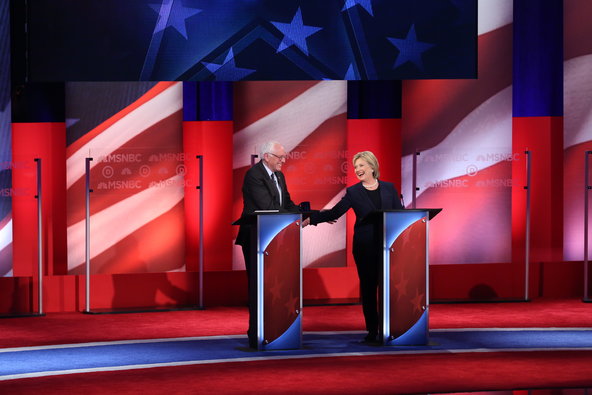
1. The major significance of the way the Democratic nomination competition has been handled so far is what it appears to say about the complacency and/or corruption of ordinary Democrats. Why is there no outrage—hell, disgust— over this sham of a race? Are Democrats so devoid of character and standards that they are satisfied with a Communist regime-like process where the Party’s hand-picked candidate has a giant box next to her name in the ballot while it is made clear to all that the other candidates are window dressing?

2. Well, they did it: this debate was scheduled so cynically to avoid viewers that even I was foiled: I had other things to do. [ I’ve read the transcript, here.] Scheduled on a  weekend, against NFL football, on the biggest shopping Saturday of the year, right before Christmas…Wow.

I actually laughed out loud to hear CNN analysts expressing puzzlement at the scheduling. “It’s really mind-boggling; I can’t conceive of why the DNC would do this!” one said. “I know, it really is incomprehensible,” said the other, looking befuddled.

Pop Quiz: Lying, or stupid?

This reminded me of the TV reporter—I can’t recall which network—who said, after the second airplane slammed into the second tower, “Now, the tendency will be to assume this is a terrorist attack, but we caution viewers not to leap to conclusions.” That’s right, it might all be a horrible coincidence! The head-scratching over the DNC’s third straight weekend debate is just about that ridiculous. They don’t want Hillary, who is a shaky campaigner and debater, to be seen or heard by any more undecided voters than necessary.

With that, back to #1. What kind of respectable political organization tries to minimize the opportunities for citizens to know its leader? No kind, that’s the answer. Deceptive, manipulative, dishonest, suspicious, untrustworthy organizations behave this way, and only them. Do Democrats care? Does this trouble them? By the evidence, I guess not. Continue reading

Marco Rubio’s Unethical Concept Of “Doing Your Job”

Senator Marco Rubio at work in the Senate this week.

Senator Marco Rubio at work in the Senate this week.

It would be nice if the most viable alternatives to Donald Trump didn’t go out of their way to show that they aren’t qualified to be President of the United States either.

Marco Rubio, who was already under well-earned fire for saying that he hated being a Senator and  not bothering to vote on Senate bills, a rather substantial part of the job he was elected to do, thought about it, shrugged, and then became the only Senator who couldn’t be bothered to cast a vote on massive $1.8 trillion spending and tax package engineered by new House Speaker Paul Ryan. There’s just no excuse for this, and Rand Paul was not being unreasonable to suggest that if all Rubio wanted to do was run for President–and many have commented that unlike Trump, Cruz, Bush and the rest, he isn’t even doing that very hard—he should resign and let someone else represent the people of Florida.

“It’s a trillion dollars in spending and I think earlier this week he talked about having some activity and then wasn’t here,” Sen. Paul told POLITICO. “So yeah I think it’s important to show up to your job. I think that really he ought to resign or quit accepting his pay if he’s not going to come to work.”

How can anyone argue with that?

For his part, Rubio offered a weak, weak, weak excuse for his no-show, saying, “In essence, not voting for it, is a vote against it.” No, not voting is also not voting against it. As Thomas More pointed out before he lost his head, the law’s assumption is that “silence gives consent.” If Rubio is correct, then a bill could be voted down by more Senators abstaining than voting for a measure. Is he correct? No.

But then he doesn’t show up to work that often, so it’s understandable that he’s confused.

Rubio’s conduct demonstrates arrogance, lack of diligence, integrity and trustworthiness, laziness, and it doesn’t encourage me about his judgment, either.

Somewhere, Donald Trump is smiling.

Ethics Observations On My 2013 Ethics Observations On The “Affluenza” Sentence, Now That The Teen Sociopath Is On The Lam

Ethan Couch

Ethan Couch

You may recall the so-called “Affluenza” case of 2013, which I wrote about here.

Ethan Couch a Texas teenager from a rich family, killed four people in a drunken-driving crash (he also had no license) and crippled a friend riding with him. Instead of jail time, the 16-year-old was given probation mandating expensive counseling and treatment by a judge who found herself vilified far and wide. Now this, from his lawyers, Reagan Wynn and Scott Brown:

“We have recently learned that, for the last several days, the juvenile probation officer has been unable to make contact with Ethan or his mother with whom he has been residing.”

A video surfaced showing Couch playing beer pong, which is a violation of probation that could send him to prison. The assumption is that he had fled to avoid that result, and may have even left the country. The Washington Post reports that The FBI and U.S. Marshals Service have joined the search for Couch, who is now considered a fugitive.

So, I am asked, how do the Ethics Alarms observations on the original sentence stand now, since it is clear that the judge’s attempt to reform Ethan without locking him up has failed?

The answer is, having read what I wrote initially again, that I wouldn’t retract a word.

Here’s what I wrote, and my comments now: Continue reading

An “Awww!” Ethics Dunce: Vidal Valladares

vidal

People who stage elaborate public ambush proposals of marriage in sports stadiums, using airplanes and other instrumentalities are inherently unethical, as well as narcissistic  jerks who warrant embarrassing rejections but never get them. This figures, since the women have been dating these tools and are usually jerks themselves. Few such stunts are quite as audacious in their jerkishness as that planned and executed by Vidal Valladares, 24, who shut down the Gulf Freeway, one of the busiest thoroughfares in Houston, to propose to Michelle Wycoff, 23, in the middle of the highway.  The Houston Chronicle, local TV station KTRK and other media outlets treated the stunt with a sympathetic “Awww!”—Ain’t love grand? Who could criticize these love birds, who, but for the vagueries of moral luck, could have caused one or more accidents and  death and destruction, hopefully just to them and not innocent commuters, but you never know.

Reportedly traffic was stopped for less than a minute as Valladares  got down on bended knee to propose (to his ex-wife whom he divorced in June) while the automobiles waited. “I never really thought about causing an accident,” Valladares told a local  paper. “I thought about my girlfriend.”

Awww!

How romantic!

You’re an idiot.

The Harris County District Attorney’s Office is charging the couple with “obstruction of highway, a Class B misdemeanor.

Good.

_______________________

Pointer, Source, and Graphic: Houston Press

Observations On The CNN Republican Candidates Debate

Is it the debate, or the Burger king Commercial?

Is it the debate, or the Burger king Commercial?

1. Whoever decided that presidential candidates debates require  patriotic songs to start them off should be shunned and mocked. This simultaneously over-sanctifies the event and trivializes it. This is a serious enterprise, but not that far removed from a an interview on “Meet the Press,” and it’s also not a variety show.

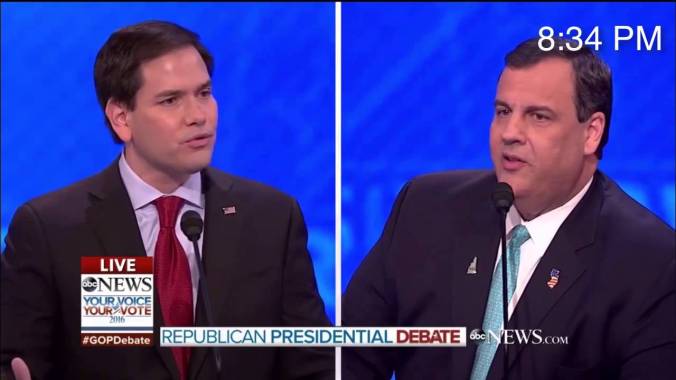
2. With Wolf Blitzer’s competent, respectful, fair and benign debate moderation last night,  media and liberal pundit defenders of the disgraceful CNBC inquisition should admit they were defending the indefensible.

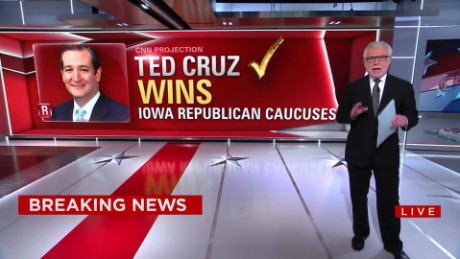
3. Ted Cruz had a terrible night, meaning his arrogance,  cynicism and dishonesty were exposed and nobody trapped him into it. His talking over the moderators after they repeatedly told him to pipe down was outrageous. His long, evasive non-answer to the question about why he refused to level the same criticism of Trump in public forums that he has made in private appearances was like a parody of a double-talking pol. Cruz’s plan, it’s obvious to see, is to avoid alienating Trump’s base so he can snap it up when The Donald finally starts imitating Michael Richards in his career-ending stand-up meltdown or does something similarly self-destructive. At this point, that plan appears irresponsible and cowardly. Cruz is the best qualified candidate to take Trump apart, because he has the rhetorical tools and requisite ruthlessness to do the job right. That means that he has an ethical obligation, not just as a Republican but also as a citizen, to remove this ugly blight from  the political scene before he does more damage. Yet he refuses to do it.

There has been a lot of talk about what disqualifies a candidate to be President. Cruz’s refusal to take on Trump when he knows how wrong and dangerous he is disqualifies him. Continue reading

Now THAT’S An Unethical Lawyer!

Don't keep them waiting, Doug...

Don’t keep them waiting, Doug…

You know, I don’t comprehend  professional ethics alarm malfunctions like this one. I mean, if a lawyer thinks, “Hey, I think I’ll threaten opposing counsel with pepper spray and a stun gun to keep him in line,” and no faint ringing in his head suggests, “Wait—that might be unethical—maybe I sould check the rules,” what would make his ethics alarms sound? How can a lawyer ever think such conduct is justifiable or permissible, never mind that he could get away with it?

Nevertheless, California Douglas Crawford  held a can of pepper spray a yard from the face of the opposing lawyer, Walter Traver, during an April 2014 deposition  (with a stenographer there!). Crawford then told Traver, “I will pepper-spray you if you get out of hand.” Then the lawyer pointed a stun gun at Traver’s head and said, “If that doesn’t quell you, this is a flashlight that turns into a stun gun.” To show he wasn’t kidding, Crawford discharged the stun gun near Traver’s face. Continue reading

The Lesson Of The Pete Rose Saga: It’s Hard Being Ethical When You’re Stupid

Rose rejected

Pete Rose’s final appeal to have his ban from Major League Baseball lifted was rejected, as Commissioner Rob Manfred delivered a stinging rebuke. (You can read his letter here.) The very first ethics post I ever wrote was about Pete, and I have posted about his character and plight several times since. Rose, the all-time leader in hits and undeniably a great player, was banned from the game in 1989. An investigation concluded that he had bet on baseball games while a manager of the Cincinnati Reds, a violation of MLB’s famous “third rail” no-gambling rule, which makes it an automatic expulsion from the profession to place bets on baseball games as a manager, coach or player. This is regarded as an existential rule for baseball, which was nearly ruined when gamblers fixed the 1919 World Series.

Rose maintained his innocence of the allegations for decades, then admitted(to sell a book) that he had been lying, and did gamble. Just a few months ago, evidence surfaced that he had also bet on baseball while a player, which Rose has always denied.

In his letter rejecting Rose’s appeal, Commissioner Manfred noted that one of the conditions that had long been set for Rose to have any chance of reinstatement—though Rule 21 has no exceptions, MLB was willing to do almost anything not to have the holder of the record for lifetime hits on its blacklist—Rose would have to earn a pardon by showing he had turned his life around, meaning that Pete was no longer a sleazeball.

Manfred wrote that Rose, who had, among other black marks, served time in prison for tax evasion, asserted in his latest appeal that he indeed was a new and better man. Nevertheless, Rose…

1. Refused to admit that he had bet on baseball as a player, when the evidence was incontrovertible, and

2. Revealed that he still gambles on horse racing and professional sports, including baseball.

Manfred came to the obvious conclusion that “Charlie Hustle,” who pretty clearly has a gambling addiction, has taken no positive steps toward addressing it, is still a risk to gamble on baseball games or get himself in debt to gamblers if he returned to the sport, and  can’t be trusted.

All of the above could be more concisely summarized by six words: Pete Rose is a stupid man. As comedian Ron White says, “You can’t fix stupid.” Manfred, in his letter telling Pete that he can forget about any future employment in baseball, noted more than once that Rose does not appear to understand the import and purpose of the rule he violated, which exists  to protect the integrity of the game. Indeed,  Pete Rose wouldn’t know what integrity was if it sat on his face. Continue reading

Remembering The President Whose Dedication To Ethics Made The U.S. Possible

george_washington_death

We no longer honor George Washington on his birthday to the extent his importance to our nation warrants. George Washington died on this date, in his Mount Vernon Home, at the age of 67. Let’s think about him now, specifically his character.

Washington is still something of a mysterious man, but there is no question that he was one who was possessed of natural and remarkable leadership abilities, unusual instincts of common sense and justice, astounding courage, striking charisma and most of all, the rare ability, especially in one so celebrated and successful, to change his attitudes and beliefs over time. He was chosen, among the most outstanding collection of leaders this nation ever had at a single point in history, to lead them  all, and the primary reason was that while few of our Founding Fathers trusted each other, they all trusted him. George Will calls him “the indispensable man,” and the assessment is apt.

One formative experience that created that indispensable man was his lifetime dedication to civility, respect, conscience, kindness and ethics as they were taught to him by his father. The elder Washington made young George copy a list 110 rules of civility and deportment into his school notebook when the President-to-be was about sixteen-years old. Scholars have determined that the list originated in the late sixteenth century in France, and had been in use there and in England before the elder Washington ever imbued his son with them. Biographers of George have been struck by the extent to which these maxims accurately describe his behavior, habits and ethical conduct throughout his life. He was quick to quote them;  it has been said that if you awoke George from his slumber prior to breathing his last on that December 14, and asked him, “What’s Rule #7?,” he would have recited it on the spot. (“Put not off your clothes in the presence of others, nor go out of your chamber half dressed.”) The Library of Congress owns the original manuscript for the Rules of Civility.

Washington’s 110 Rules have been on the Ethics Alarms home page in the left margin under “Rule Book” almost from the beginning of the blog, and I posted them back in 2009. It’s time to look at them again, as we remember, and are properly grateful for, this special man. Many are funny, in retrospect, in their dated reflection on earlier times, but the ethics principles sounded still resonate, especially the last:

110. Labor to keep alive in your breast that little spark of celestial fire called conscience.

That one alone is worth a lifetime.

George Washington’s 110 Rules

The Rules of Civility & Decent Behavior in Company and Conversation
(As memorized by George Washington as a youth. Authorship unknown)

Continue reading

Ethics Heroes: The Community of Middlesborough, England.

COX_funeral_3524163b

Thomas Cox, a British World War Two vet who served in the Royal Pioneer Corps, died at the age of 90 with no known surviving relatives.

Hoping to give Cox the final salute he deserved, the Royal Pioneer Corps Association  posted an appeal on its Facebook page asking for people to attend his funeral. The plea was shared among veteran groups, military groups and others, and when the day came, hundreds of strangers to Cox were on hand to say farewell and thanks to the old soldier. Many of the mourners at the service in Middelborough, Teaside sent flowers and wreaths as well.

They didn’t do this for the family, for there was none, and Cox was beyond caring. They came out of respect for a generation, a pivotal moment in human history, and to assert that we are all part of a larger family, though we usually don’t behave that way.

There’s not a lot more to say, is there?

Mission accomplished.

The US’s Existential Ethics Dilemma

take-it-or-leave-it1No, I don’t mean how to hold on to our core values while taking responsible measures to prevent a fatal cultural infestation by radical Islam, though that’s a tough one too.

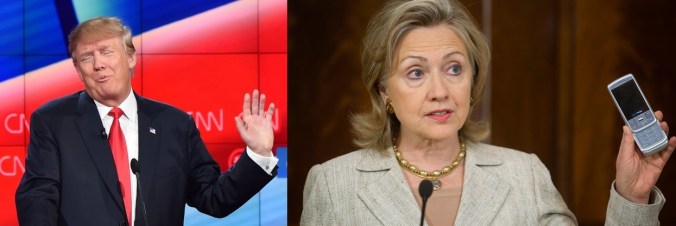
The U’S.’s existential dilemma is how to prevent a 2016 Presidential election between Hillary Clinton and Donald Trump. Such a race would represent a holistic failure of the assumptions of American democracy, including the belief that ordinary Americans can be trusted with responsible self-governance.

I just forced myself to watch an entire Donald Trump campaign appearance in Iowa. Unbelievable. Just unbelievable.

He is a pathological narcissism case study. He’s having a ball, just being in front of a beaming crowd. Not a word of genuine substance came out of his mouth. Mostly, he talked about himself—how popular he is (He’s ahead in the polls! He’s ahead in the polls!), how nice he is, how he gets along with everybody, how he’s always right. Good God. Get the hook. If a high school candidate gave that kind of preening, hubris-gagging, “I’m the greatest thing since string cheese” speech running for student body president, he’d be jumped by the football team after the assembly. People who act like Trump are not well: this is about him being desperate for affection, not leading the country. Why do so many people fail to see that?

Well… Continue reading