Ethics Quote of the Day: Ken White at Popehat

File photo of U.S. Director of Exempt Organizations for the IRS Lerner being sworn in to testify before a House Oversight and Government Reform Committee hearing in Washington

“Pardon me: if you accept the proposition that the government targets organizations for IRS scrutiny because of their political views, and you still say things like ‘why take the Fifth if you have nothing to hide’, then you’re either an idiot or a dishonest partisan hack.”

—-Attorney-blogger Ken White, discussing former IRS official Lois Lerner’s refusal to testify in front of Rep. Daryl Issa’s House Government Oversight Committee

Good point.

Elaborating on the point before this statement, Ken points out why this is so:

“You take the Fifth because the government can’t be trusted. You take the Fifth because what the truth is, and what the government thinks the truth is, are two very different things. You take the Fifth because even if you didn’t do anything wrong your statements can be used as building blocks in dishonest, or malicious, or politically motivated prosecutions against you. You take the Fifth because if you answer questions truthfully the government may still decide you are lying and prosecute you for lying.”

Got it. Or, you take the Fifth because you really did engage in illegal activity in a coordinated effort to obstruct legal political action for partisan motives, on orders from someone with close ties to the White House, which still may be the case.

In the same post, Ken explains that Lerner may have waived her Fifth Amendment right against self-incrimination, or may not. If she has, then she is in contempt of Congress. If she hasn’t, she isn’t.

My observations on this slow-motion ethics train wreck: Continue reading →

Lawyer Daniel Muessig’s Clever, Effective, Legally Ethical And Thoroughly Despicable Ad

Just as I’ve been desperately trying to explain that lawyers do not represent bad people because they like them or want to loose them upon the world,  here comes innovative Pittsburgh lawyer Daniel Muessig, whose clever TV ad proclaims that this is exactly what he wants to do. Here it is:

Is this an ethical ad? According to the Pennsylvania Rules of Professional Conduct, it is within the conduct permitted by the state’s legal ethics rules. The ad isn’t misleading. It doesn’t make promises the lawyer cannot keep. It doesn’t represent dramatic recreations as fact, or use broad metaphors and exaggerations. (Lawyer ads are held to a standard of literalness that presumes the public has never see any other kinds of advertising in their entire lives.) Once upon a time the various state bar advertising regulations included prohibitions on “undignified” communications, or those that undermined public trust in the profession, but those days are long past: the standards were necessarily vague, and breached free speech principles.

So we have this: a lawyer who appeals to his future criminal clients by saying that he thinks like a criminal, believes laws are arbitrary, that other lawyers will “blow them off” and that he visits jails frequently because that’s where his friends are. He attacks his own colleagues and profession, denigrates the rule of law he is sworn to uphold, and seeks the trust of criminals not because of his duty as a professional, but because he’s just like them. Muessig is willing to undermine the law-abiding public’s belief in the justice system and the reputation of his profession and his colleagues in order to acquire clients. I’m sure his strategy will work, too. Continue reading →

Jumbo* of The Month: Hillary Clinton

Charging Elephant

“The claims by President Putin and other Russians that they had to go into Crimea and maybe further into Eastern Ukraine because they had protect the Russia minorities—that is reminiscent of claims that were made back in the 1930s when Germany under the Nazis kept talking about how they had to protect German minorities in Poland, in Czechoslovakia, and elsewhere throughout Europe. So I just want everybody to have a little historic perspective. I’m not making a comparison certainly, but I am recommending that we perhaps can learn from this tactic that has been used before.”

—-Hillary Clinton on the Crimea crisis, showing that she has learned deceit and dishonesty at Bill’s knee, or, perhaps, was really the teacher all along.

‘I’m not making a comparison: I’m just comparing them. I’m not saying Putin is like Hitler, I’m just saying he’s acting like Hitler. I’m not making a comparison; I just want to evoke the specter of Hitler’s expansion over Europe while everyone looked the other way without being accused of doing so.’

And adding “certainly” makes it all undeniable.

Some observations, in the throes of disgust: Continue reading →

Gift Horse Ethics: The Babe, The Splendid Splinter, and The Ethics Of Self-Promoting Virtue

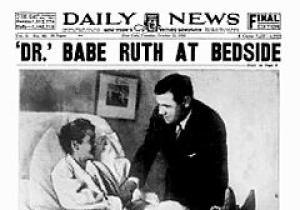
sick child and-babe-jpgBaseball slugger Babe Ruth was famous for visiting hospitals and orphanages to give kids a thrill. Babe always had reporters in too to record his noblesse oblige , of course. He was an orphan himself, and nobody should doubt the Bambino’s genuine dedication and generosity when it came to kids. He just wasn’t going to let his good deeds go unnoticed.

Other baseball greats, notably Ted Williams, made most of his visits without fanfare or publicity, and he didn’t tip off the press. “The Splendid Splinter” wasn’t visiting kids in cancer wards because he wanted his fans to know what a good guy he was. He did it because he wanted to make sick children feel better.

Was the Babe less ethical than Williams? Did his self=promotion take the ethical sheen off of his good deeds? This is the issue raised by the activities  of the  “Magician Prankster” who calls himself “Magic of Rahat” on YouTube and Twitter. He recently posted a video called “Homeless Lottery Winner” showing him playing  a prank on a homeless man, who ends up with $1,000. He is understandably grateful:

Slade Sohmer however, on HyperVocal, is hearing ethics alarms: Continue reading →

Darling Ellen’s Deceptive Tweet For Samsung

Taken completely spontaneously using a

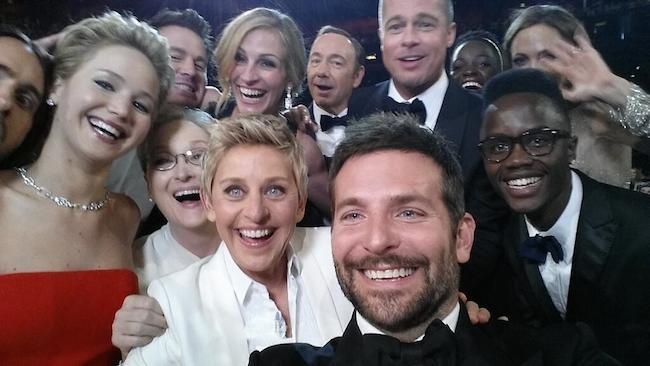
Taken completely spontaneously using a Galaxy S5 by Samsung. Get yours today!

Ellen DeGeneris is adorable, and as ideal a public face to place on the image of gay acceptance and same-sex marriage as you could concoct in a marketing strategy meeting. She’s funny, she’s friendly, she’s nice: to be threatened in any way by Ellen is to be the epitome of an irrational homophobe.. Her accumulated good  largely insulated her from the negative criticism she earned with a shockingly inept performance as this year’s host of the Academy Awards ceremony. She didn’t exactly make one long for Seth (“We saw your boobs!”) McFarland, last year’s oppressive MC,but watching her—any experienced performer could see the signs of a comic who knew she was bombing and had no idea what to do about it—was uncomfortable when it wasn’t deadly boring.

The one routine that seemed successful was DeGeneris’s successful effort to create the “most re-tweeted tweet of all time,” which she accomplished by dragooning Bradley Cooper, Julia Roberts, Meryl Streep, Angelina Jolie, Brad Pitt, Jennifer Lawrence  Lupita Nyong’o, Kevin Spacey and Jared Leto in to take a selfie with her. It garnered over 3 million retweets at last count. But it was a set-up. This was not just a fun party stunt with friends, which is how it was represented to the audience and indeed to the stars themselves. No, the selfie was part of a very pricey deal between the Academy and Samsung, which sells the recently enhanced Galaxy S5 Ellen used to take the picture.

From the Wall Street Journal: Continue reading →

The Academy’s “In Memoriam” Snubs: Much Better This Year—Thanks, Oscar

The great Jonathan Winters in the not-so-great "It's a Mad, Mad, Mad, Mad World"

The great Jonathan Winters in the not-so-great “It’s a Mad, Mad, Mad, Mad World”

In past years I have taken the Academy of Motion Picture Arts and Sciences to task for the ethical breach of ingratitude and disrespect, as the honor roll of the year’s deceased film notables have omitted important figures who deserved their final bows. Omissions are inevitable, I suppose, but some of the past examples were unforgivable—last year alone, for example, the Academy snubbed Ann Rutherford, Andy Griffith, R.G. Armstrong, Russell Means, Harry Carey, Jr., and Susan Tyrell. 2012 was worse.

2013, however, shows that the Academy is being more careful, and Oscar deserves credit for cleaning up its act. I have ethical and historical objections to bestowing the prestigious final slot on actor Phillip Seymour Hoffman, dead prematurely of self-inflicted drug abuse, when a genuine, bona fide Hollywood legend, Shirley Temple, was on the list. I understand the thinking: Hoffman had friends and colleagues in the room, and Temple is of another generation; his premature death was a tragedy, and she lived a long and productive life. Still, the priorities and relative values such a choice exemplifies is disturbing. Great actor that he was, Hoffman was a criminal, an addict, and left his children fatherless. Shirley was the greatest child star who ever will be, a ray of sunshine in the dark days of the Depression, a one-of-a kind talent and icon, and later a lifetime public servant who raised a family. She represented the best of Hollywood and the profession; Hoffman represents its dark side. Naturally, he’s the one who received the greatest recognition. I will suppress my dark suspicions that Shirley was docked because she was a Republican. A  Facebook friend actually wrote that Shirley deserved to be penalized because some of her movies were racist. My response to this slur was not friendly. Continue reading →

Ethics Quote Of The Week: Matthew McConaughey

Matthew-McConaughey

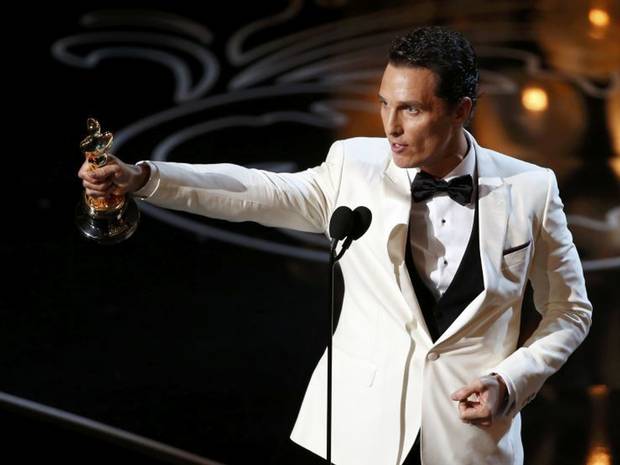
It happens but rarely: an Oscar acceptance speech with something of substance to communicate, other than a list of thank-yous. Yet last night was one of those rare occasions, as actor Matthew McConaughey used his well-deserved award for Best Actor to express his views on how to lead an ethical life:

Here is the text of his speech—much thanks to reader Phil Kraemer, who located it:

Thank you. Thank you, thank you, thank you, thank you to the Academy for this—all 6,000 members. Thank you to the other nominees. All these performances were impeccable in my opinion. I didn’t see a false note anywhere. I want to thank Jean-Marc Vallée, our director. Want to thank Jared Leto, Jennifer Garner, who I worked with daily.

There’s a few things, about three things to my account that I need each day. One of them is something to look up to, another is something to look forward to, and another is someone to chase. Now, first off, I want to thank God. ‘Cause that’s who I look up to. He has graced my life with opportunities that I know are not of my hand or any other human hand. He has shown me that it’s a scientific fact that gratitude reciprocates. In the words of the late Charlie Laughton, who said, “When you’ve got God, you got a friend. And that friend is you.”

To my family, that who and what I look forward to. To my father who, I know he’s up there right now with a big pot of gumbo. He’s got a lemon meringue pie over there. He’s probably in his underwear. And he’s got a cold can of Miller Lite and he’s dancing right now. To you, Dad, you taught me what it means to be a man. To my mother who’s here tonight, who taught me and my two older brothers… demanded that we respect ourselves. And what we in turn learned was that we were then better able to respect others. Thank you for that, Mama. To my wife, Camila, and my kids Levi, Vida and Mr. Stone, the courage and significance you give me every day I go out the door is unparalleled. You are the four people in my life that I want to make the most proud of me. Thank you.

And to my hero. That’s who I chase. Now when I was 15 years old, I had a very important person in my life come to me and say “who’s your hero?” And I said, “I don’t know, I gotta think about that. Give me a couple of weeks.” I come back two weeks later, this person comes up and says “who’s your hero?” I said, “I thought about it. You know who it is? It’s me in 10 years.” So I turned 25. Ten years later, that same person comes to me and says, “So, are you a hero?” And I was like, “not even close. No, no, no.” She said, “Why?” I said, “Because my hero’s me at 35.” So you see every day, every week, every month and every year of my life, my hero’s always 10 years away. I’m never gonna be my hero. I’m not gonna attain that. I know I’m not, and that’s just fine with me because that keeps me with somebody to keep on chasing.

So, to any of us, whatever those things are, whatever it is we look up to, whatever it is we look forward to, and whoever it is we’re chasing, to that I say, “Amen.” To that I say, “Alright, alright, alright.” To that I say “just keep living.” Thank you.

You have to wonder about the various tweeters and pundits who objected to McConaughey’s candor about his inner compass as “bizarre” (Time) or egomaniacal (several). Yes, by nature and necessity actors are unusually self-absorbed; the latter complaint is akin to faulting a dog show winner as inarticulate. What was admirable and inspiring about  McConaughey’s speech was his exuberant explanation of how his personal hero is always who he will be in the next ten years.

I doubt that this is an original formula, but I have never heard it before, and it is the essence of ethics: we strive to keep learning, getting better, and aspiring to be the best people we can be, or life is pointless. Ironically, this was also the lesson of “Groundhog Day,” the comedy masterpiece of the late writer-director Harold Ramis, whose name and career were evoked more than one during the Academy Awards broadcast. Having other people as heroes doesn’t accomplish much, unless we aspire to and learn from their values and conduct, and eventually  capable of similar heroism ourselves.

As for all those who are criticizing the actor for his religious sentiments: back off. Religion has played a major role in minting some good and remarkable human beings, and McConaughey seems to be one of them. If he chooses to thank God in his moment of exhilaration and triumph, that should be beyond reproach.

Ethics Blindness: The Pro-Abortion Ethical Disconnect

To anyone who is capable of compassion and objectivity, the abortion controversy represents a classic ethics conflict: two ethically defensible positions based upon undeniable ethical principles that are in opposition. Both factions have their absolutist wings which would deny the other side’s interests, holding that either the life of the unborn ( abortion opponents) or a woman’s autonomy (abortion advocates)  is such a societal priority  that nothing should be permitted to compromise its primacy in any way. Yet the best solution to most ethics conflicts, if possible, is balancing, resulting in acceptance of a  reasonable middle position that acknowledges the validity of both interests.

Recent comments from prominent pro-abortion advocates are ethically troubling, because they suggest a complete denial that any valid interests on the other side exist at all. This signals a retreat from reason and fairness into zealotry and fanaticism, and it makes balancing not merely more difficult, but unimaginable.
In an interview on the cable station Fusion, Planned Parenthood president Cecile Richards had this revealing exchange (video above): Continue reading →

How Can Lawyers Be Shockingly Unethical Without Breaching Any Legal Ethics Rules? Meet Styles & Pumpian

"Let's have a moment of silence for Ira, our troubled friend, partner and colleague, a fine lawyer who left this world too soon....Ok, now that's over, how can we keep his fee from his family?"

“Let’s have a moment of silence for Ira, our troubled friend, partner and colleague, a fine lawyer who left this world too soon….OK, now that’s over, how can we keep his fee from his family?”

Ira Bordow, a partner in the Wisconsin law firm of Styles & Pumpian, had been handling a family’s dispute with an insurance company. Successfully too: he negotiated a $250,000 settlement, and the company sent him the check for that amount, to be divided among the plaintiffs and Bordow’s firm. Bordow, as a partner, was going to get a $41,666 share.

The 54-year-old lawyer, however, had problems of his own that money could not solve, and committed suicide. His brother found the quarter of a million dollar check on the seat of Bordow’s Lexus coupe, and properly and correctly sent it on to  Styles & Pumpian.  Bordow had already earned his cut of the settlement at before he took his own life, for he, and the firm, were working on a contingent fee basis. The representation was at an end. Apparently, however, once the firm had the check in hand, the brilliant legal minds at Styles & Pumpian applied their craft to thinking of ways they could avoid paying the grieving family of their tragically demised partner any of the loot. They thought of one too, at least one they felt was worth a shot.  The firm is refusing to pay the Bordow estate the late lawyer’s $41,666 cut, arguing that Bordow’s suicide in his River Hills home negated his partnership agreement with the firm. It was a breach of contract, they say, and thus, even though he would have received the money if he had lived, the firm can keep it now.

Continue reading →

Ted Nugent Ethics, Part I: The Ted Nugent Rule

Ted-Nugent

This is really simple. From this point on, any one who intentionally gives Ted Nugent a public forum  is to be considered irresponsible regardless of what Nugent says, and accountable for whatever offensive garbage he does say.

Nugent’s uncivilized and hateful description of the President of the United States as a “sub-human mongrel” set this rule in stone. Anyone who wants to argue   that the Ted Nugent Rule should apply retroactively to Republican Texas Attorney General Greg Abbott, who foolishly allowed Nugent, with  his already wretched record of making uncivil, vicious, and obnoxious statements unfit for civilized public discourse, to represent his campaign for Governor  will get no argument from me.

The rule also applies to talk show hosts or interviewers seeking to goad Nugent into making inflammatory statements that they can use to generate controversy and discredit those who agree with any of Nugent’s political positions, based on the flawed theory that all  opinions held by an idiot must be idiotic.  Sorry: if you let Ted Nugent speak under circumstance where his words will be broadcast, reported or put into print, you are as responsible for the resulting carnage as he is, an accessory to outrageous and destructive incivility.

A good argument could be made for Nugent-like rules for some other prominent flame-throwers, like Bill Maher, Donald Trump and Ann Coulter, but that is for another day. As for Nugent, he is like the party guest who repeatedly arrives drunk, molests your teenage daughter and throws up on the couch. He’s persona non grata, and has forfeited the privilege of being invited to any more parties, because he can’t be trusted not to ruin them for everybody else.