Unethical Quote of the Month: Attorney General Eric Holder

“This is a way to get at the president because of the way I can be identified with him, both due to the nature of our relationship and, you know, the fact that we’re both African-American.”

—-Attorney General Eric Holder, explaining what he believes to be the motives of “extreme factions” in their efforts to hold him accountable for the Justice Department’s “Fast and Furious” debacle in an interview with the New York Times.
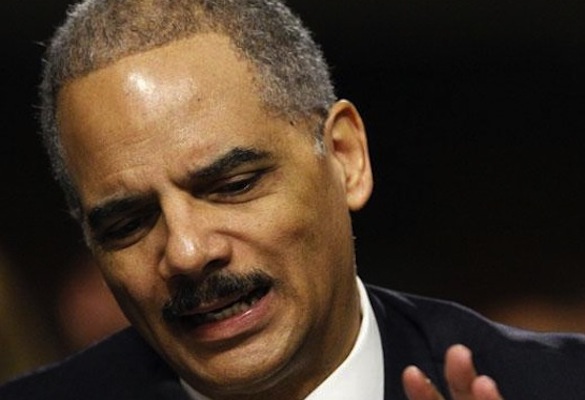
That's right, Eric. It's not because you've been a pathetic Attorney General---heck, aren't they all?

Ah, the race card! What a versatile, powerful weapon in the arsenal of public figures under scrutiny, criticism and attack who happen to be African-American! How comforting it must be to know that when it gets really difficult, even impossible, to talk your way out of a mess of your own making, there us always this last ditch, accountability-ducking tactic that will cause reporters to recoil, accusers to quail, public sympathy to shift, and Al Sharpton and Tavis Smiley to leap to attention. Play the race card! Jesse and Al have made a career doing it. Clarence Thomas, Barry Bonds, Marion Barry, Armstrong Williams, Herman Cain, and so many others resorted to it. Sometimes it works, sometimes it doesn’t, but it’s always worth a try…unless, of course, you have sufficient dignity, honesty and integrity to resist the impulse. Say what you will about Charlie Rangel, and I’ve said plenty, but he never claimed that his ethics problems were due to his race. It’s strange to praise someone for not resorting to dishonest and unconscionable tactics, but so automatic is the race card ploy among prominent African Americans in peril that I think Rangel deserves more credit than I gave him. Continue reading →

Distracted Driving, Pot, and “The Great Debate”

As balm for Christiane Amanpour’s bruises from being kicked off her ABC Sunday show back to CNN, the network honchos let her try a different format this weekend (since nobody was watching anyway.) Styled “the Great Debate,” it pitted conservatives Paul Ryan, the GOP House intellectual, and columnist George Will against soon-to-be-retired Democratic Congressman Barney Frank and Clinton’s former Labor Secretary and perpetual Munchkin Robert Reich for the full hour, exchanging familiar talking points on the usual suspect national issues. The debate wasn’t so great, for several reasons, prime among them being the natural motor-mouth tendencies of Reich and Frank, who, I would guess, took up approximately twice the air time as the conservative pair. The teams were similarly unbalanced in cheer, with Reich as perky as his Lollipop Guild training would suggest, and Frank full of his trademark wisecracks, while Will was dour as ever (when faced with liberal cant, the columnist always looks like my high school Latin teacher did when I was botching the day’s translation) and Ryan radiated the charisma of a certified public accountant.

The most interesting exchange was when George Will derided proposed federal regulations against “distracted driving” as the latest installment of the nanny state encroachment on personal rights, saying that individual freedom should trump the government’s concern for public safety except in the most extreme circumstances. One of the good uses of absolutist reasoning is that it raises a very high bar before breaching a valid principle can even be considered, since it has to be considered as an exception if it is to be contemplated at all. Barring unsafe conduct that increases the likelihood of automobile accidents, however, is not the place for absolutism, but for utilitarianism—rational balancing. Continue reading →

Three Terrible Tales From the Busted Ethics Alarms Files…

An unfortunate side-effect of writing Ethics Alarms is becoming aware of such stunningly unethical conduct in all reaches of American society that it risks sending me into despair. I have no illusions about my level of influence over the problem—virtually nil—and the mounting evidence, often bolstered by the tenor of the comments to some posts, that our society does a poor job installing functioning ethical reflexes is both frightening and intriguing. What percentage of the American public go through their lives without functioning ethics alarms, and how do we tell who they are in time to protect ourselves?

As to the first question, I have no idea, but I suspect it is disturbingly high. The second question is even more difficult. Fear of consequences keeps most unethical people from revealing themselves until they face a crisis or an opportunity too tempting to resist. Then they do things like this: Continue reading →

Ethics Hero Emeritus: Christopher Hitchens (1949-2011)

Too many excellent writers are writing about Christopher Hitchens in the wake of his premature death from cancer for me to add much of value. I disagreed with Hitchens frequently, but then, so did everyone. What I appreciated was his integrity, which was unshakable. What I admired, and will always try to emulate, was his refusal to be seduced by convention, ideology, political agendas and partisan bias. Hitchens looked at the world with clear and piercing eyes, and dissected what he observed with a mind that was curious, rigorous, and forever open. Thus he was never a comfortable ally for liberal or conservative, Republican or Democrat, because he would never hesitate to arrive at conclusions that shocked his friends and cheered his friend’s enemies. He was fearless and principled.

Most of all, however, Christopher Hitchens wrote like an angel, a simile the committed atheist would have hated. It is a measure of the depths to which popular taste and intellect have fallen that the Mark Train Prize was awarded in recent years to the pedestrian likes of Will Farrell and Tina Fey when Hitchens routinely churned out prose wittier than their best efforts on the most inspired days of their creative lives. He was truly the spiritual and literary descendant of Mark Twain, as well as Swift, Ambrose Bierce, H.L. Mencken, George Bernard Shaw, W.S. Gilbert, Dorothy Parker, Gore Vidal and the rest of the select crew of social critics blessed with the ability to infuriate, illuminate and amuse simultaneously. When he focused all of his passion, intellect and rhetorical skills on a topic he cared about, Hitchens was as close to an irresistible force as a writer can be. Yet his mission was always noble. His constant goals were truth, justice, fairness, and wisdom. Of him it could be fairly stated, as of few others, that while Christopher Hitchens was around, bullshit was never safe.

I’ll close with four links about Hitchens: the New York Times obituary, the Washington Post obituary, a collection of comments and other links about Hitchens, a collection of his essays, an appreciation from a friend, and a collection of some of his best quotes.

If you can only read one, choose the last. The list is heavily tilted toward Hitchens’ attacks on religion, and he wrote about so many other things, but it is representative of his skill and style. One quote on the list  in particular I remember well, and it makes me laugh every time I read it:

“If you gave [Jerry] Falwell an enema he could be buried in a matchbox.”

Ah, we’ll miss you, Hitch!

Ethics Alarms Awards: The Sioux City GOP Candidates Debate

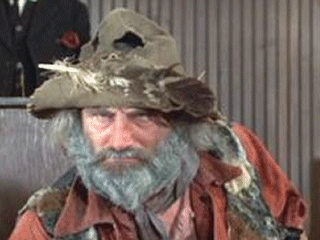
What do Mitt Romney, Ron Paul and Newt Gingrich have in common with "Blazing Saddles'" Gabby Johnson?

There were ethics revelations, lessons and cautionary tales in last night’s final debate before the Iowa Caucuses. The envelopes, please!

The Boy Who Cried Wolf Award

Winner: Rep. Michelle Bachmann

Bachmann  twice protested that she was constantly being accused of not having her facts right, when she really did. This is a hard lesson for people like Bachmann, but she might as well learn it now: when you habitually make factual errors and then deny that you made them, people aren’t going to trust you to be responsible with your claims or to be telling the truth. Nobody has spun as many whoppers and jaw-droppers as Bachmann in the last year, and nobody has more consistently tried to deny the truth when her misrepresentations were brought to her attention. Or to put it another way: once a candidate has claimed that 6th President John Quincy Adams, who was all of 8-years-old when the Declaration of Independence was signed, qualifies as “Founding Father,” nobody is going to credit your representation of “facts” whether they are accurate or not.

The Gabby Johnson Award

Winners (tie): Newt Gingrich, Mitt Romney, Rep. Ron Paul Continue reading →

Tim Tebow Hatred and the Rabbi’s Fears

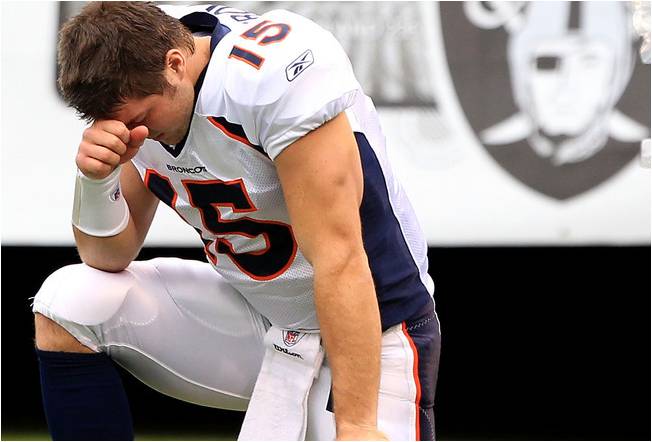
How dare he?

I have avoided weighing into the controversy over Tim Tebow, the Denver Bronco quarterback whose very public Christianity, combined with his penchant for leading miracle comeback victories for his team, has made him the most polarizing figure in sports today, and one of the most polarizing people in the culture as a whole. I have avoided commenting because I think the ethics of the controversy are obvious. Tebow is a decent, law-abiding, well-bred young man in a sector of our culture that produces profane, semi-literate, violent, or arrogant  jerks, fools, cheats and felons, not to mention arrested adolescents, by the hundreds, who are cheered, worshipped and enriched based solely on their talent to excel in stadiums and arenas. Anyone who chooses Tim Tebow, out of all these travesties of sports celebrity, to deride solely because he is vocal about his religious beliefs isn’t worth arguing about, because the verdict’s in: that critic’s priorities are backwards, inside out and warped. Tebow, unlike the NFL’s assorted felons, the NBA’s many dead-beat dads, and baseball’s steroid cheats, is a worthy role model for kids. He is humble, respectful, does his job and plays by the rules. What’s not to like?

Well, we know the answer to that question. He prays on the field, thanks God after every touchdown pass, and is prone to saying things like, “First and foremost I gotta thank my lord and savior Jesus Christ”  to reporters. Is it annoying? Oh, sure it is. This stuff is annoying from any athlete. To begin with, it is silly—the very idea that a Supreme Being gives a hoot which wins a football game is infantile—and it comes off as a commercial, like an athlete who makes sure that he says, “Well, first and foremost I have to thank the General Mills  people, because Wheaties, “The Breakfast of Champions,” has made me who I am today!”  in every interview. But Tebow’s statements aren’t  commercials, though, and anyone inclined to be fair knows it. This is a man with a deep religious faith who really believes that God guides his every move, and that it is right and responsible to thank Him when  the quarterback  is being celebrated for athletic exploits that in Tebow’s belief system are the product of his relationship with his deity. The sentiment is sincere and the motivation is virtuous. For Tebow’s displays of faith to incur hatred is an indictment of the haters. If he annoys you, don’t listen to him. If you do, the annoyance is your fault, not Tebow’s. Continue reading →

Gallup’s Trust Survey: Congress in Freefall

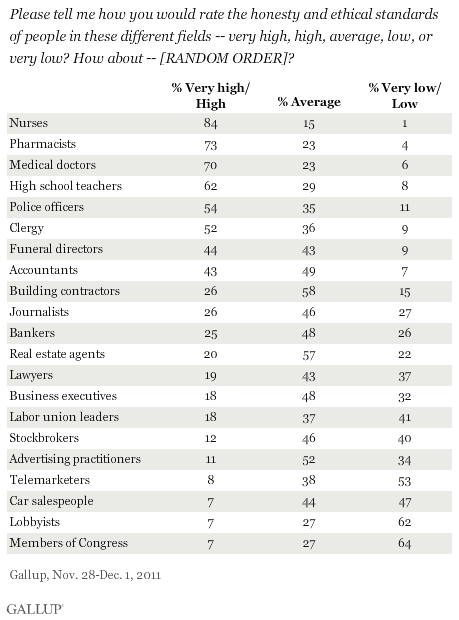
Gallup’s just released annual survey of public attitudes toward various professions held few surprises this year. As has been the case for over a decade,nurses and pharmacists topped the list as the  professions regarded as the most honest and ethical. I find the presence of high school teachers fourth (ahead of police officers)  a triumph of public relations, nostalgia and wishful thinking, but the other top rated professions were predictable. In general, the professions we are forced to depend upon the most are the ones we trust the most—because we have little choice. The ones we trust the least tend to be those with whom we can be in conflict with or see as having differing interests from our own. Doctors are always going to rank higher than lawyers, for example, because there are no doctors trying to make us sick.

Of the 21 professions in the survey, only seven—including funeral directors!—had positive numbers, meaning that more people regarded them as ethical than unethical. The seriously distrusted professions, with a percentage of very low ratings significantly higher than the proportion of very high ratings, begins with lawyers, business executives, union leaders, stock brokers, and advertising execs in order of trustworthiness; bankers, interestingly, avoided this group and had about as many supporters as detractors. But the bottom four is where the really dishonest professionals dwell, according to the poll. With single digit positive ratings compared to negative ratings of  more than 50% are telemarketers, car salesmen, lobbyists, and at the very bottom, Congress, with 64% of the public regarding the institution as dishonest and unethical. That, Gallup says, is not only the lowest rating for Congress since the survey has been taken; it is the worst rating for any profession.

That Congress has sunk so far is not a surprise. It is just depressing.

Here are the results:

Candidate for Dishonest Quote of the Year: Rep. Michele Bachmann

"Huury! There's another four alarm fire in Rep. Bachmann's pants!!"

“I’m happy to say I don’t think that I’ve said anything inaccurate in any of the debates. And I’m extremely grateful for that. It’s a high-profile stage and so I’m grateful that I don’t think I’ve made a blunder.”

—Rep. Michele Bachmann on NPR’s Morning Edition. Bachmann saying she has never said anything inaccurate is like Steve Martin saying that he has never said anything funny.

This quote occurred on November 25, and I missed it. It came to mind because the Washington Post did a long feature on Bachmann today as it profiled the Republican presidential contenders who haven’t been fingered by past paramours. As part of the coverage, Post “Fact checker” Glenn Kessler noted that of all the candidates, Bachmann has made the most statements that rated four “Pinocchios”, his rating system for dishonesty. Four puts a politician in the “liar, liar, pants on fire” category, and Bachmann’s metaphorical pants are always smoldering.

I think I missed this statement because I assumed the jig was up with Bachmann, and I could look elsewhere for topics. There are some public figures—Al Sharpton, Howard Stern, Sen. Harry Reid, Michael Savage, Joy Behar, Bill Maher (gasp for breath), Bill O’Reilly, Donald Trump, Mark Levin, and others—who violate principles of honesty, civility and fairness in their statements so regularly that I can just check their most recent comments on a slow news day and have something juicy to write about. But with these regular ethics violators there is little point in doing so. Their fans are so biased or corrupted that they are beyond reaching with reasoned analysis, and any objective, ethically grounded observer knows all about these culprits already. Bachmann is on the list; she is a charter member, in fact. Continue reading →

Alec Baldwin, Something of the Year

I should have known I was going to regret naming Donald Trump the Ethics Alarms “Jerk of the Year” in May. True, The Donald has only burnished his credentials since then, but other worthy candidates have charged into what would be contention for the crown, had I not rashly bestowed it on Trump, confident that nobody could be a bigger jerk than a man who sided with the birthers while using the crucial presidential nominating process as a crude promotion for his cheesy reality show.

But 2011 has been a banner year for jerks, uber-jerks, and beyond-jerks. There was Rev. Terry Jones, for example, who got people killed by threatening to burn a Koran. He blew right past jerk to asshole, so Trump was spared having to compete with him. There was Leroy Fick, the despicable lottery millionaire who kept getting food stamps after his bonanza, because of a loophole in the Michigan food stamp regulations. He inspired a whole new category for himself,  fick, which describes an especially shameless jerk.

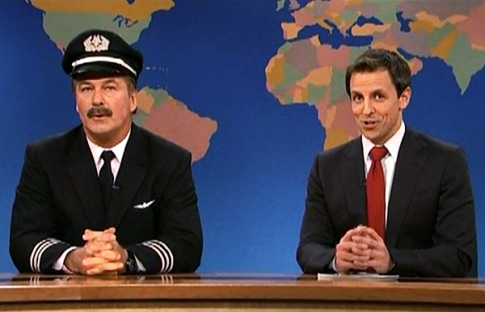
Now, however, I am faced with a serious dilemma. What is an appropriately severe designation for actor (and alleged New York mayoral hopeful, which is disturbing on so many levels) Alec Baldwin, who in addition to revealing himself as a 9-11 conspiracy theorist earlier this year, just behaved like a spoiled child on an American Airlines flight, got himself kicked off to the inconvenience of his fellow passengers, and insulted the airline and the plane’s crew afterwards on Twitter?  Continue reading →

So Who Do We Trust To Fight Crony Capitalism?

Shut out of the last Iowa debate because of low poll numbers, earnest, honest, ethical, reasonable, intelligent and boring candidate Jon Huntsman gave his assessment of the event to ABC’s Christiane Amanpour, saying that the main issue facing the country was a trust deficit:

“The most important issue of all was not even touched upon and that is the deficit of trust we have in the United States, in fact it may have played right into the trust deficit. That is, nobody trusts Congress anymore. We need term limits in Congress, we need to close the revolving door that allows members of Congress to move right on into the lobbying profession. No one has trust anymore towards the executive branch, no one trusts Wall Street with the banks that are too big to fail. So I would argue that the issues that are most salient in our political dialogue today were not even touched upon last night…”

Huntsman is right. It was especially astounding that this issue wasn’t addressed in the debate (and that those crack moderators Diane Sawyer and George Stephanopoulos  didn’t mention it) after more than a month of Occupy Everywhere protests that sorta-kinda dealt with the trust issue (oh,  what a little focus could have wrought!)  and the recent “60 Minutes”  expose on insider trading by members of Congress. Also preceding the debate was this trust-buster: in July of 2008, Bush Treasury Secretary Hank Paulson held a meeting with select Wall Street fund managers and gave them advance notice of government action that they could use to make significant profits: Continue reading →