Here’s A First: Kansas Suspends A Lawyer For Facebook Bullying

It's unethical for a lawyer to play a sad violin over Facebook??? Why yes, it is!

It’s unethical for a lawyer to play a sad violin over Facebook???  Why yes, it is!

Eric Michael Gamble was representing a biological father opposed to the adoption of his daughter, which had been approved by the 18-year-old mother.

After Gamble deposed the young woman, he messaged her on Facebook in a shamelessly manipulative fashion, saying…

‘I wish to offer you some reasons why you should stand up and fight for your daughter. As you know, I am the attorney for [the biological father]. We held your deposition in my office. I wanted to give you the chance to make things right. This may be your last opportunity to be a mom for [the baby]. As I told you after your deposition in my office, it is not too late. You still have a wonderful opportunity to have a real relationship with your daughter if you so choose. I have attached a document for you to consider signing and bringing to court or to my office. It is a revocation of your consent to adopt. If you sign this document there is a very good chance that you will be able to call [the baby] your own and [the baby] will call you her mom. I can’t begin to explain how beautiful and wonderful parenthood is. I have a little girl myself and she is my world just like you are your dad’s world. [The baby] deserves to know her parents. She deserves to know that you love her and care for her as well. Do not let this opportunity pass you by because you will live with this decision the rest of your life and [the baby] will know someday what happened. [The adoptive parents] do not legally have to ever let you see her again after court (although they are probably trying to convince you otherwise with the idea of an ‘open adoption’). The reason why you don’t know about the trial was because they don’t want you there because that doesn’t help [the adoptive parents] case. This is your time to get rid of the guilt and standup and do what is right and what [the baby] deserves. She deserves to have her parents love and care for her. She deserves to know her grandparents and extended family. If she’s adopted, she won’t have that chance. [The biological father] wants to be her dad and to love her. She deserves that. I urge you to print, sign, and notarize this document and bring it to my office before court. Trial is June 27, 2013, at 9:00 a.m. at the Johnson County Courthouse, Division 15. I hope to see you and your father there.’

What’s wrong with this? The legal ethics rules protect unrepresented parties in a matter from exactly this sort of pressure. Rule 4.3, in Kansas and elsewhere, prohibits a lawyer from giving advice to adversaries of his or her client, which statements like “This is your time to get rid of the guilt and standup and do what is right and what [the baby] deserves” clearly are. The rules also require lawyers to treat all participants in the justice system with fairness and respect. That message constitutes neither. Rule 4.4 says that “In representing a client, a lawyer shall not use means that have no substantial purpose other than to embarrass, delay, or burden a third person.” Gamble has a defense, of course: his substantial purpose was to have the adoption dropped like his client wanted, but since he wasn’t supposed to be talking to her anyway (other than to advise her to get a lawyer), that wasn’t going to fly. Rule 8.4, meanwhile, says that a lawyer must not “engage in conduct that is prejudicial to the administration of justice.”

After he lost the case, Gamble reported himself for the Rule 4.3 violation. This is usually a good tactic to encourage lenient treatment, but in this case, it didn’t work. In suspending Gamble for six months, the Kansas Supreme Court seemed to invoke all three of the violated rules, as it wrote,

“…As the hearing panel noted, respondent “attempted to manipulate the biological mother and, as a result, interfered with justice.” Respondent’s conduct “amounted to emotional blackmail” of an unrepresented 18-year-old who was dealing with a process that was already “’emotionally exhausting.'” His “electronic message was designed to embarrass, burden, and create guilt in the mind of the biological mother.” These “bullying tactics directly reflect on [respondent’s] fitness to practice law as an attorney.” Consequently, we hold that the respondent should be suspended for a period of 6 months. A minority of the court would impose a longer period of suspension. We unanimously order a reinstatement hearing under Rule 219.”

And the social media claims another victim.

Addendum: I was remiss, in posting this, not noting that the underlying issue in the lawsuit is a far more serious and complex ethical and legal one than the topic of this post: the matter of unwed mothers putting their new borns up for adoption without the father’s consent or participation. That has been a battle royale on Ethics Alarms twice, and you can review it here.

_________________________

Pointer: ABA Journal

Facts: Legal Profession Blog

Comment of the Day: Daily Comics Ethics: When Did Erection Gags Become Appropriate For The Funny Pages?

unicorn

Traversing such seemingly unrelated topics as aphrodisiacs, “Mr. Ed,” post-war culture, literacy, and the evolution of childhood,  Penn’s Comment of the Day is one of my all-time favorites. Here it is, a response to the post, “Daily Comics Ethics: When Did Erection Gags Become Appropriate For The Funny Pages?” I have a lot of reactions, but here are three:

  • If kids really don’t read the funny papers any more, what good are they? Who does read them? The Washington Post and other papers used to take “Doonesbury” out of the section and place it in the main body of the paper on the theory that it’s humor was “adult.” (Of course, “Doonesbury’s” humor has also been non-existent since around 1978—but I’ve never seen an erection joke there, either.)
  • Just because little kids are familiar with the term “horny” doesn’t mean they have any idea of what it refers to.
  • I like the “Mr. Ed” song!

In reply to your rhetorical (and tertiary) query, Jack, you missed (that small part of the) evolution just as we all did and do, because it was an evolution, a slow-moving American tsunami of post-war change beginning in the late 40s.

As a child, I recall controversy, strictly among adults, over things that wouldn’t be even thought of today such as the idea of having a girl (Lois Lane?) take up a weapon against a villain instead of waiting, albeit bravely, for Superman, to come rescue her. It was argued to be unladylike – and therefore, unsuitable for children’s comics — for females to fight for themselves if there was a man around, even as the WACS, nurses and ambulance drivers returned home, joining widowed moms & rosie-riveters in job-hunts. Or unless it was Wonder Woman. And oh the struggles to allow Wonder Woman — she of the skin-molding, crotch-height tights and the noticeable chest bumps, however well armored — into the son’s bedroom. Or the daughter’s wardrobe (next, she’ll want a bra!) Continue reading →

Daily Comics Ethics: When Did Erection Gags Become Appropriate For The Funny Pages?

Grimm cartoon

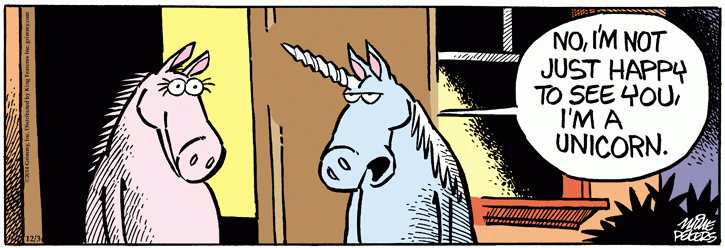
When did I miss the evolution of the newspaper comics, always regarded as the young tyke’s entry into the newspaper perusal habit, into one more entertainment medium requiring ratings and advance parental review? The comic above appeared in today’s Washington Post and elsewhere. I think it’s funny—for a Playboy cartoon. Maybe it’s not too racy for the New Yorker. But the funny pages? Seriously? This is an erection joke! In a strip with Mother Goose in the title! (The strip is “Mother Goose and Grimm” by Mike  Peters, who is also an award-winning political cartoonist.) It refers to the classic naughty line that had censors screaming when Mae West said it (after writing it.) My Dad read the daily comics to me before I could read, then explained the jokes that I couldn’t understand. Is this the kind of joke toddlers will be having explained to them now? Continue reading →

Ethics Dunce and Unethical Facebook Post of the Month: Elizabeth Lauten, Spokeswoman for Rep. Stephen Fincher (R-Tennessee)

Elizabeth Lauten, communications director for Republican Congressman Stephen Fincher, decided that she is authorized to give parental advice to First Offspring Sasha (13) and Malia (16) Obama. She was deeply troubled by the young ladies looking bored in photographs she saw online, so she posted this jaw-dropper on Facebook:

Facebook lecture

Wow. What a Thanksgiving feast of unethical features! Let’s see: Continue reading →

Baby-Switching Ethics

The song from H.M.S. Pinafore tells the story amazingly well.

In Johannesburg, South Africa, a horrendous situation resembling the plot-resolving song from “H.M.S. Pinafore” may be reaching an unusual resolution for such cases—a sensible and ethical one. The families never suspected until one of the mothers underwent tests when her ex-husband refused to pay child support. One of the mothers wanted her biological child back, while the other wants to keep the child she had raised. A judge now has to decide.

The court asked the University of Pretoria’s Centre for Child Law to investigate and make a report n what would be in the children’s best interests. The experts’ answer: “The recommendation is that the children should stay with the parents who have raised them and should also be permitted to have contact with their biological parents.”

Exactly. Let’s hope that the court follows the recommendation, the only ethical one. Four years old is too old for this wrong to be set right without making it worse. What about three years old, though? Where do we draw that line? Furthermore, I am assuming that the two families are more or less equally fit, able and qualified to raise children. What if the investigation showed that one family was clearly more advantageous for a child: better educated parents with more resources and experience with children, living in a safer community? Then what would be the calculation of “the right thing”? The benefit of one child would be the detriment of the other, a zero sum game. In such a case, would fairness govern, rather than the best interests of the children? Why should one child be cheated out of the better life awaiting him, because of a nurse’s mistake? Fortunately, we don’t have those details, so we can make a confident abstract ethics judgement without confounding factors and issues. Continue reading →

Note To Advertisers: Babies Are Not Props. Do You Really Need To Have That Explained To You?

Let’s take a little break from the Ferguson Ethics Train Wreck, picking up passengers so fast that I can’t keep up with the manifest, and let Bill Cosby hide for a while, as suddenly all sorts of associates and colleagues are finally admitting that he wasn’t such a nice guy even when he wasn’t raping actresses, and focus on some child abuse—but funny child abuse!

Here’s a recent Halos recent commercial:

Wrong. This is an extreme example, but I frequently see infants being used—that’s the clue, “being used”—in TV shows, ads and movies featuring environments and  conditions that have to be stressful. Making babies cry to sell products or tell a story is unethical: they haven’t consented, they are helpless, and doing this to them is an abuse of power. It is also cruel.

How could a set full of techs and actors not feature any faint ringing of a single ethics alarm while a baby was duct taped to the back of a door? One disturbing sidebar to this “funny video”: some idiots have actually done this:

Go ahead, Halos, give those happy child abusers out there some new ideas.

This one was flagged by child actor advocate, and my friend, Paul Petersen, who has taken action to make sure Halo doesn’t engage in this kind of abuse again.

Babies aren’t props. They are human beings, This shouldn’t have to be taught to any adult, but it obviously does.

Terry Turnage, Serial Father and Utter Fick

"So? Not my problem."

“So? Not my problem.”

Terry Turnage  has fathered 26 children by 15-20 different women, the precise number being difficult to establish. And that’s not all:  he apparently has failed to pay child support to any of the women who bore his offspring, all while driving expensive cars,  throwing elaborate parties, and spending money on everything but his bastard progeny.

He is a co-owner, with one of his many sons, Terry Jr. (and maybe one of many Terry, Jr’s), of Club Envy, an Arkansas nightclub. Recently Terry Sr. threw a two-day party for his birthday. He threw another party for 700 guests.

Of course, that could just be his relatives.

What does society do with someone like this, so irresponsible and shameless? It you lock them up, they can’t support any of the kids. We can’t castrate him (cruel and unusual, that) and courts can’t order citizens not to procreate, or ensure that they they don’t. That’s Nazi stuff, though the U.S. did a bit of it until relatively recently. Continue reading →

Now THIS Is Abuse Of Police Power

Andy and Opie

No riots are anticipated, fortunately.

Police Lt. Brian Keller, an assistant sheriff,  used his unmarked black Dodge Charger, with emergency lights flashing, to stop a school bus so he could hand his son his lunch, which the boy left home without. The bus was not within Keller’s jurisdiction….not that his actions would be much better it it has been.

There was a complaint,  which Lake County (Illinois) officials are investigating.

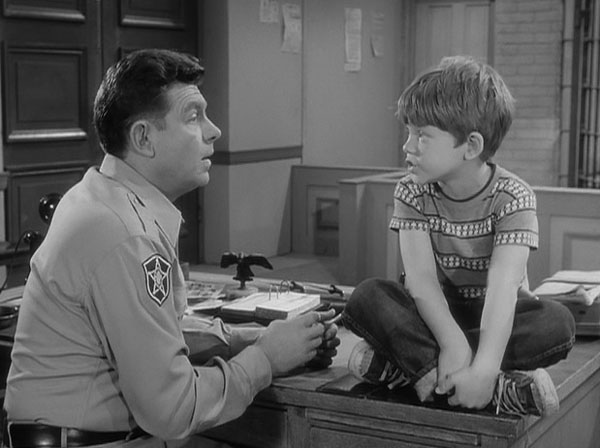
This is the kind of thing Sheriff Andy Taylor might have done for Opie in little Mayberry, but such abuse of power is neither cute nor funny outside of TV Land. I don’t care if he’s a single dad (like Andy); it doesn’t even matter if the kid had crucial, life saving prescription drugs in the lunch bag—insulin, maybe. Using official authority for a personal matter like this is the sign of an untrustworthy cop who doesn’t comprehend his job. It is small wonder that police labor under the public presumption that they don’t respect the law or the limitations of their authority.

___________________

Pointer: Mediaite

Comment of the Day: “Rationalization List Update: 29 (a). The Gruber Variation and 47. Contrived Consent, or ‘The Rapist’s Defense'”

Magician, hoax-exposer, historian, truth-seeker James Randi

Magician, hoax-exposer, historian, truth-seeker James Randi

Alexander Cheezem weighed in with a wonderful expansion on The Gruber Variation (and its parent, Rationalization #29,  The Altruistic Switcheroo). It speaks for itself: the gist involves the situations when deception really does have  beneficial results for the deceived,  intended by the deceiver—in which case, the claim that an otherwise unethical act was “for his own good” mean that the act not have been unethical, and thus the claim is not rationalization, but truth.

One immediate result of Alexander’s comment is that I’m editing the text in #29. I wrote:

It is true that misfortune carries many life lessons, that what doesn’t kill us often makes us stronger, and that what hurts today may be the source of valuable wisdom and perspective later, but it really takes a lot of gall to cheat, lie to, steal from or otherwise harm someone and claim it will be a good thing in the long term. Yet an amazingly large number of people possess this much gall, because the Altruistic Switcheroo is very common, especially among parents who want to convince themselves that bad parenting is really the opposite. A marker for this rationalization is the statement, “You’ll thank me some day”—the specious theory of the sadistic parent who named his son “Sue” in the famous Shel Silverstein song made famous by Johnny Cash. No, he won’t.

“A Boy Named Sue” is a lousy example. It is true that the singer ends the song by saying he isn’t thankful, and I don’t blame him, but the father’s theory was borne out: the name did make his son tougher. There’s nothing in the lyrics to suggest that he name choice was sadistic, and if the only rationale for the song was what the father claimed it was, it’s no rationalization. Oh, it was cruel, irresponsible and unfair—and stupid— but the father did name the boy “Sue” for his own good. (The fact that his cruel tactic worked still doesn’t make it right: that would be 3. Consequentialism, or  “It Worked Out for the Best.”

I’ll end the passage before the dash.

Here is Alexander’s Comment of the Day on the post, “Rationalization List Update: 29 (a). The Gruber Variation and 47. Contrived Consent, or ‘The Rapist’s Defense'”:

Interesting additions, but I think that the Gruber Variation needs a bit of a caveat in nuance regarding its description: it needs to be distinguished from both legitimate teaching techniques which involve parallels and certain grey areas.

To handle the last first, I’ll just give a few examples, starting with Project Alpha ( http://en.wikipedia.org/wiki/Project_Alpha ) and the Sokal Hoax (http://en.wikipedia.org/wiki/Sokal_affair ). Both involved presenting people who were supposed to safeguard against deception with a hoax in order to expose the holes in said safeguards. Both involved rationales which closely paralleled the Gruber Variation in several respects, and were criticized for actually following that sort of logic (I disagree, although I do think that both were ethically “grey”). Continue reading →

Unethical Quote Of The Month (Lawyer Representing A Hypocritical And Unethical Client Division): Keith Wyatt

“She lied to her mother so she could have sex with her teacher. She went to a motel in which she engaged in voluntary consensual sex with her teacher. Why shouldn’t she be responsible for that?”

—-Lawyer Keith Wyatt, L.A. Unified School District’s trial attorney who successfully defended it in a law suit by the family of a middle school girl who had been engaged in a six month sexual relationship with her math teacher. The girl’s family claimed the district negligently permitted the teacher’s criminal conduct to occur and that the teacher’s exploitation of the girl had caused emotional damage to their daughter. Wyatt also told a radio interviewer that it was a more dangerous for a 14-year-old to cross a street in traffic than to have sex with her middle-school teacher.

Yes, he’s an idiot.

Yeah, those middle school tarts all want it, right, Keith?

Yeah, those middle school tarts all want it, right, Keith?

The school district fired him, disavowing and apologizing for his comments. Yet they were willing to let Wyatt argue in court—on the school’s behalf, remember— that a 14-year-old middle school student was mature enough to consent to having sex with her 28-year-old teacher, and that she shared responsibility for what happened. Wyatt introduced the girl’s sexual history into evidence as proof of his client’s lack of culpability.

There is nothing wrong or unethical about Wyatt’s tactics in the trial itself. State law is weird in this area—this is California, after all, home of Hollywood, Roman Polanski fans, Woody Allen enablers, Miley Cyrus and the Kardashians—for while the age of consent is 18 in criminal cases, two appellate court rulings have held that the argument that a minor can consent to sex with an adult is permissible in civil law suits. He did what the law permitted him to do in defense of his client. That’s not just ethical lawyering, it is at the core of legal ethics. The argument won. Wyatt did what he was trained to do, paid to do, and obligated to do if he agreed to take the case

However, it is a revolting and irresponsible argument for any school or school district to make. Wyatt should have made this clear, and maybe he did (though that quote doesn’t support such a supposition.) Who in their right mind–well, OK, this is L.A.–would send their child to a school system that takes the position that a 14-year-old student is responsible when she is raped by her 28-year-old teacher, and that she’s really not being harmed if he does? The teacher, Elkis Hermida, was convicted of lewd acts against a child and sentenced in July 2011 to three years in state prison.  Continue reading →