Vote For The Curmies: The Worst In Unethical Education, 2014

Rick Jones2

Every year, blogger Rick Jones (above) announces his “Curmies” (he is the Curmudeon, after all) nominations for “the person or persons who most embarrass the profession of educator.”

I encourage Ethics Alarms readers to vote over at Rick’s blog. Here are his worthy nominees, with Rick’s commentary:

1. James Miller, President B. Kaye Miller, and their co-conspirators at Bergen Community College, who suspended and demanded a psychiatric evaluation of art professor Francis Schmidt for tweeting a photo of his seven-year-old daughter wearing a t-short reading “I will take what is mine with fire and blood” even after it was proven that the line is a well-known pop culture reference to the Game of Thrones. They did finally back off several months later, but it was too little, too late. In mitigation: if you’re both an idiot and completely unengaged in popular culture, that line might actually make you think about recent school shootings. In aggravation: the shirt is obviously inoffensive, the process was obviously flawed, and the school’s defense of their actions is the perfect balance of irrationality and pomposity.

2. A cadre of incompetents at Harley Avenue Primary School in Elwood, NY, who cancelled the school’s traditional kindergarten show because of concern with making their charges college-ready. In mitigation: I can think of none. In aggravation: these people have no comprehension of child development, of what goes into making a show, of real college-readiness, or indeed of anything other than their own hubris, from what I can tell.

3. Secretary of Education Arne Duncan is likely the worst cabinet member of the 21st century, but he outdid even his own high standards of incompetence and arrogance with the proclamation that even students with disabilities will be expected to attain basic standards of reading and math: “We know that when students with disabilities are held to high expectations and have access to a robust curriculum, they excel.” Actually, no, Arne, we know no such thing, and if you think we do, maybe you should get off the hard stuff. In mitigation: I got nothing. In aggravation: Duncan’s plan has no upside, will cost pots of money, and ignores differences between students’ innate ability and preparation while pretending to privilege individuality.

4. Wasatch (UT) High School officials, for puritanically altering female students’ yearbook photos without as much as giving the girls the opportunity to fix their alleged transgressions. In mitigation: there was indeed a sign warning students of the need to obey the school’s dress code. In aggravation: the policy was enforced inconsistently and apparently whimsically. More significantly, the level of sexism involved is positively stunning: boys had their pictures taken with shirts gaping open, tattoos, copious amounts of visible boxer shorts… and a cutline “Studs doin’ what studs do best.” I couldn’t make this up.

5. There were plenty of cases of schools’ and universities’ over-reacting to the Ebola pseudo-crisis. We’re going to give the specific nomination to Cline Elementary in Friendswood, TX, not because their craven stupidity was any worse than that exhibited by several other schools, but because of the distance the teacher in question was from an actual outbreak while traveling in Africa relative to the distance to the nearest confirmed case to the district itself: roughly 11 to 1. In mitigation: there was lots of false information circulating, and parents (especially) were nervous. In aggravation: you’re supposed to be a school. Educate. When people are being paranoid idiots, it is your responsibility to keep your collective heads and do the right thing.

6. The administration of Rhame Avenue School in East Rockaway, NY, for taking teacher Vuola Coyle out of her classroom because her students’ test scores were too good. Yes, too good. It costs the school because students supposedly learn too much in 4th grade and therefore don’t show enough improvement as 5th graders. In mitigation: we haven’t really heard the school’s side of this story. In aggravation: even if everything else is false, the school’s addiction to testing, and to practice testing, is demonstrable.

7.The University of North Carolina for allowing a corrupt system of allowing athletes (especially) to enroll in “paper courses” for the sole purpose of keeping them eligible or off suspension to continue for nearly two decades. In mitigation: the real offenses are in the past, as are the worst of the offenders. But if the release of an investigator’s report marks a new event in the minds of SACS accreditors, it can for Curmie, too. In aggravation: it is impossible to believe that a lot of people currently in powerful positions at UNC didn’t know exactly what was going on and did nothing. And if “everyone does it,” it is the portent of very bad things to come, indeed.

8.Assistant Principal Paula Johnson and the rest of the administration of Bayside Middle School in Virginia for suspending 6th grader Adrionna Harris, who took a razor away from a classmate who was cutting himself, immediately throwing it away. But she dealt with the problem instead of calling a teacher. In mitigation: Adrionna was technically in violation of a rule that actually makes sense if not applied irrationally. In aggravation: the administrators wouldn’t have known about the incident if Adrionna hadn’t told them, so she was punished for being honest as well as being heroic.

In part because Rick was very busy this year, his nominations do not include as many subjects of Ethics Alarms posts as usual: only #2, #7 and #8 of Rick’s nominees were discussed here. On the other hand, Rick left un-nominated some truly awful examples of unethical teachers, administrators and institutions that flipped my bippy, such as, these, currently being assessed as I prepare my Best and Worst of Ethics 2014 list. They are a miserable list too, and include… Continue reading →

Sarah Palin, The Animal Gene, and Some New Year’s Inspiration

Trig on dog

Gandhi famously said that the greatness of a nation can be judged by the way its animals are treated. I’m not sure that’s true, but it certainly is true that respect for the lives and welfare of animals is a useful symptom to diagnose sound ethical values, and the tendency toward animal cruelty is signature significance for a human being that I would not turn my back to in the dark.

The issue is complicated by the divergence of humans into “animal people” and “non-animal people,” with the latter claiming, with some justification, that they are not cruel or callous toward animals, just willing to recognize that they are, well, animals. These are the people who cannot understand someone wanting to take a sick day to mourn the passing of a cat. On the other hand, they are also clear-eyed about those animal lovers who dress their parrots in elaborate costumes and who hold birthday parties for their dogs. Those who live in the country or on farms are an interesting case: they are not prone to sentimentalize of anthropomorphize animals like city folk. Dogs and cats sleep outdoors unless there’s a freeze on, and they have jobs to do. My wife’s sister sold the family horse to a dog food company, and the two didn’t speak for months.

Sarah Palin blundered into this divide this week when she posted pictures (above) of her son Trig standing on the family dog in an inspirational post about overcoming obstacles. Now she’s being attacked for promoting cruelty to animals. Some points on this:

1. Many are always looking for justification to vilify Palin. This time, she gave them legitimate ammunition.

2. The sequence looks staged to me: otherwise, why was anyone taking photos of this?

3. If so, then this just wasn’t an innocent but mistaken choice by a special needs child, but the directive of someone who should know better.

4. Of course one doesn’t ever sit or stand on a dog, or allow or encourage a child to do so, unless we’re talking about a very small child.

5. We don’t know that Palin didn’t admonish Trig after the fact, while saluting his ingenuity.

6. It was still an irresponsible choice for the point she was making.

7. Assuming the dog isn’t ill, drugged of dead, however, he doesn’t seem in distress. One thing about dogs: if you are hurting or ignoring them, they aren’t shy about letting you know.

8. Trig is developmentally disabled. Animals, particularly dogs, have incredible tolerance and intuitive kindness in such situations. That was the real lesson of the photos.

Now, to wipe those images out of your mind, here are a group of photos showing normal, non-celebrity, non-Palin, human beings here and elsewhere demonstrating the kind of kindness and compassion for animals that we all should aspire to. Continue reading →

Hard Lesson Of The Walmart Tragedy: Bad Ethics Kills

5-year-old-with-a-gun

A two-year old sitting in a shopping cart shot his mother dead at point blank range in a Walmart, after finding a loaded pistol in the mother’s open purse. It is such a horrible story that journalists are reluctant to call attention to its obvious lessons. Veronica Jean Rutledge engaged in grossly irresponsible conduct as a mother, a citizen and a gun owner. If her actions, which constituted child endangerment of all four of the children in her charge, as well as a public menace to unsuspecting shoppers in a public store, were to result in anyone’s death or injury, she was the best possible victim. This was all her fault.

The analogy might be a parent who leaves an infant locked in over-heated car, but this is far, far worse. Carrying a loaded gun in public without observing gun safety principles—safety off, for example— posed a threat to everyone around Rutledge. (UPDATE: It is apparently illegal in Idaho to carry a concealed, loaded gun.) Leaving any gun accessible to children is criminal negligence. She was lucky—yes, lucky—that her toddler didn’t shoot one or more of the three girls, all under 11, participating in the shopping trip, or himself. Now the boy will live with the trauma of knowing that he killed his own mother. He will be lucky not to be psychologically scarred for life.

Who knows how many times Rutledge had left her firearm, safety off, within reach of children? I find it hard to believe this was the first time. I find it difficult to believe that she didn’t regularly leave her child in peril, if she would do this even once. Allowing a child access to a loaded gun ready to fire is the equivalent of leaving an open bottle of rat poison within reach of an infant, allowing a child to share a home with a pet wolf, leaving a child alone without supervision while the mother partied and got stoned, or perhaps letting a toddler run free in a home meth lab. If any of these resulted in the death of the child,  public outrage against the parent would be merciless and deafening. It should not be any less intense in this case, simply because moral luck took a relatively merciful turn.

Veronica Jean Rutledge was an unforgivably unethical gun owner, citizen, caretaker and mother, and it killed her.

If there had to be a victim, she was the right one.

UPDATE: From the Washington Post 12/31:

Rutledge isn’t just sad — he’s angry. Not at his grandson. Nor at his dead daughter-in-law, “who didn’t have a malicious fiber in her body,” he said. He’s angry at the observers already using the accident as an excuse to grandstand on gun rights.

“They are painting Veronica as irresponsible, and that is not the case,” he said.

  • That link from Post reporter Terrence McCoy comes right back to this post. I’d like to know where “gun rights” are mentioned or even implied above, much less used to “grandstand.” I can’t even figure out what gun rights point McCoy thinks I’m trying to make (I’m for them, by the way.)
  • VERONICA WAS NOT IRRESPONSIBLE????? This is res ipsa loquitur: if you get shot by a toddler because you left your loaded pistol, safety off,  where he could get it while you are in a public place with 4 kids under your care, you ARE irresponsible: negligent, incompetent, reckless, ignorant of gun and safety obligations, careless. The facts speak for themselves; no further proof is necessary.

KABOOM!* The Most Unethical Anti-Gun PSA Yet

[ If you are new to Ethics Alarms and don’t understand the significance of a Kaboom, go here.]

Should you need any further proof that anti-gun mania turns some people into clinical phobics, melting their ethics alarms and leaving all rationality behind, I give you this, a recent public service video out of San Francisco’s Sleeper 13 Productions:

Could such an ad be more irresponsible? It urges children to

  • Go looking for their parents guns (and why did is the gun in the video where a kid can have access to it?);
  • Pick them  up and handle them (Is the gun loaded?);
  • Steal the guns ( Any gun? Shotguns? Rifles? Semi-automatic weapons?)
  • Take the guns to school, breaking the law in the process;
  • Turn them over to their teachers, who also may have no business handling one.

In the process of this well-intentioned, hysterical brain rot, the PSA also encourages children to be terrified if their parents own a gun, though there is no context at all in the video. Is a parent a cop? An FBA agent? A gun collector? A hunter? A trained marksman? Clint Eastwood? James Bond? Never mind: steal the gun. This attitude is the tell-tale symptom of an anti-gun zealot: it’s the gun itself that is dangerous, and who owns or wields it is irrelevant. Continue reading →

Remembering Christmas Music

nativity

It is slowly dawning on me that Christmas music, one of the annual joys of my childhood and perhaps yours, is in a perilous state, both culturally and aesthetically. The best of the songs musically are religious in nature, which means that schools won’t pass them along to their charges as happened routinely when I was a child, and even playing them on the radio is likely to be regarded as a religious statement. I just loved the music, as I think most kids would if they ever got the chance before they were brainwashed into believing the ancient songs were subversive.

A full court cultural press is underway to make those songs as rarely heard outside of church as hymns, and I don’t see the trend as reversible. One obvious bar to a comeback: current pop stars don’t have the pipes to sing most of them without causing a sound pollution emergency. Or, if one of the few singers who could actually hit the notes dared to cover a carol like “O Holy Night,” he or she would feel required to apply flourishes of the sort that make every rendition of “The Star Spangled Banner” at a major sports event an invitation to PTSD.

Even for the more secular Christmas repertoire, the clock is running out. The most listenable versions, and the definitive ones in most cases, are by performers of the past who are not just dead, but also long forgotten by the current culture. An hour of classic Christmas recordings on the radio is now a reminder of how old I am and close to joining great singers like Bing Crosby, Judy Garland, Andy Williams, Nat King Cole, Jo Stafford, Burl Ives, Gene Autry, Frank Sinatra, Dean Martin, Elvis—dead, dead, dead. I guess Brenda Lee is still alive, so “Rockin’ Around The Christmas Tree” is a little less depressing, but it’s a minor classic at best. It’s gotten so bad that when I hear “The Little Drummer Boy,” I find myself wondering if the whole Harry Simeone Chorale is dead too—Harry died in 2005, and the recording is 56 years old, after all.

Meanwhile, our post-modern culture is sneering at the whole idea of Christmas songs, and Christmas itself. Most modern Christmas songs either are making fun of Christmas, about sex, or just lousy. The tradition is being undermined in more creative ways, too: this week I watched a 2012 straight-to-video movie called “12 Disasters of Christmas,” based on the loopy premise that “The Twelve Days of Christmas” was really a coded recipe for stopping the 2012 apocalypse predicted by the Mayan calendar. “The Mayans knew that the knowledge would have to be preserved for centuries, so they devised a song that would carry the secret and would be passed on and learned by children for generations,” explains the old codger who’s figured it all out. (But why would they choose such a monotonous and stupid song?) Come on, guess: How does the “Chosen One” stop the end of the world? [Answer below.]*

The movie is on to something, though. The Christmas songs that have the best chance of persevering though this age of  cynicism and cultural illiteracy may be those that either tell a story  or that have an interesting one related to their creation. The simple and beautiful tune of “Silent Night,” for example, as one of those films they used to show in school assemblies every year before some anti-religious hysteric sued, was composed for guitar in response to a Christmas Eve crisis for a small church in the Austrian alps in 1818: the church organ wasn’t working.  I have found that Irving Berlin’s “White Christmas”  affects me far more deeply since I learned that the Berlins’ infant son died on Christmas day, and that while his children celebrated Christmas as a cultural holiday, Berlin and his wife did not. They spent each Christmas after their son’s death in mourning. The song is a wistful remembrance of a happier time that the composer will never experience again.

Maybe another Christmas song will persevere if its origins are remembered; I was reminded of its history this week as a result of the thaw in U.S. relations with Cuba. Though my wife hates it, the song is one of my favorites, perhaps because it brings back warm memories: I watched the song’s first national broadcast with my sister and parents, and the Marshalls bought the recording the next day.

It was 1962. Noel Regney and Gloria Shayne were a husband and wife songwriting team of modest success. They were saddened by the lack of any spiritual content in popular Christmas songs then; imagine what they would think today.

Like all Americans, they were petrified during the thirteen days of the Cuban Missile Crisis, when the world stood on the brink of nuclear annihilation. As the crisis intensified, Regney found himself inspired to write down a simple poem with a Christmas theme. (Later, the couple would say that neither of them could ever sing the song through, because of the strong emotions it recalled.) When the nation could finally take a deep breath of relief as the threat ended,  Gloria devised a melody for her husband’s words, though he had always been the composer when he and wife wrote songs together.

The result of this unique variation on their collaboration was recorded before the end of 1962, but it wasn’t until the following year, when Bing Crosby sang the team’s creation live on ABC’s  “Hollywood Palace,”  that it became widely known. The song written during the Cuban Missile Crisis became a best-seller, Crosby’s last hit Christmas record, and also the last popular Christmas song to have a religious theme.

It was, and remains, a prayer for peace.

____________________________

* By finding and wearing FIVE GOLDEN RINGS, of course!

We Really Do Entrust Our Precious Children To People Like This…

water-noodles

The headline says it all:

North Kansas City School District apologizes for taking away blind child’s cane

Well, maybe not all…

Eight-year-old Dakota Nafzinger, born blind, attends Gracemor Elementary School in Kansas City, Missouri.*  Like many blind Americans, he uses a white cane to maneuver himself through life.

The school staff decided that the boy’s misbehavior on a school bus warranted punishment, so they took away his cane and

GAVE HIM A SWIMMING POOL NOODLE TO USE AS A SUBSTITUTE !!!!!!!!!!!!!

North Kansas City School District Spokeswoman Michelle Cronk explained that the staff was withing its rights to take away his cane, since it was given to him when he enrolled and thus  it was school property. She might as well have said that the kid should feel lucky they gave him one of those neon colored floating pool noodles to use instead, rather than, say, a garden hose or a live anaconda. The cane was taken away  because the child reportedly  hit someone with it. I suppose if his seeing eye dog had bitten someone, they would have taken the dog away, shot it, and replaced it with a guinea pig or a stuffed animal. Continue reading →

“It’s Unethical To Be A Weenie,” Part I: The Lipreading NFL Fans

Preface: The Rise of the Weenies

Tom Brady, mid-

Tom Brady, mid-“Fuck!”

Everywhere we look, it seems, we see the United States culture being threatened by weenies and the rise of Weenyism. In a nation founded on the principles of self-reliance and individual liberty, built and shaped by stunningly brave men and women who hacked civilization out of an uncertain and perilous wilderness, there is a growing mass of citizens—the cancer imagery is intentional—who are committed to giving the government near total control over every conceivable danger, threat, peril, offense, inconvenience or annoyance, real or imagined, as the role of individual Americans devolves into pointing and saying, “There! Fix that! I don’t like that! Arrest them. Fine him.” Increasingly, the primary motivation for public policy is fear, planted by activists and politicians to panic, terrify and mobilize the weenie base, who are ever eager to trade individual freedom for protection against, well, almost everything.

I know I am hyper-sensitive to the weenification problem right now, having spent three weeks reviewing the history of the American West and its portrayal by Hollywood in preparation for my Smithsonian Associates program last week on how the Hollywood Western shaped American culture. Around the same time that the Sixties exploded, the culture’s unified acceptance of traditional American values began to collapse, just as the primacy of the Western as an entertainment genre declined. Now weenyism is in its ascendency. There are those who claim that the name of a distant football team causes psychological trauma to Native Americans who don’t follow football. Blogger Andrew Sullivan (a candidate for Head Weenie) asserts that the United States should have the “courage” to do nothing about ISIS and allow it to run amuck (the ultimate goal of the Weenies: an Orwellian “Weenies Are Heroes” motto). Feminists insist that women are so vulnerable to male sexual predations on campus that due process, fairness, common sense and much of the respect as equals their predecessors fought for must be surrendered, in a new system that begins with the presumption that all men are potential rapists and all women simpering, helpless victims, even when they say “yes.” College students and other are demanding that books, stories, essays and blog posts contain “trigger warnings” to alert weenies that words and topics in the text might give them the vapours. Needless to say—I hope—this not a healthy development for the United States, or  our culture.

The resistance to Weenyism ought not to be a partisan issue. The obligation to help the weak, disadvantaged and powerless become stronger, overcome their handicaps and acquire power is part of the American tradition too. Somewhere, however, this obligation was distorted by the realization that in a system where the government is looking for victims to justify its existence, Weakness Is Power (Orwell again). Weenies—fearful, risk-averse, passive-aggressive citizens who shrink from conflict, confrontation and the messy process of democracy— have realized that they can mobilize power to satisfy their narrow biases and interests, often at the expense of their fellow citizens’ right to liberty and the pursuit of happiness. Now the culture is tilting away from the uniquely American model that encouraged individuals to fight their own battles and succeed or fail on the merits of their causes and their own determination and skill, to one that rewards the perpetually offended, victimized, and passively unsuccessful.

It is unethical to be a weenie, and equally unethical to allow Weenieism to overcome what has been an American cultural strength.

Part I: The Lipreading NFL Fans

Several TV viewers who watched the NFL’s  New England Patriots-Green Bay Packers made official complaints to the Federal Communications Commission because they could see Patriots quarterback Tom Brady saying “fuck” repeatedly on the sidelines in frustration over his own play.  They couldn’t hear it, mind you: they were just able to read his lips. This was so horrible that they felt that the Federal government needed to investigate and take remedial action.

One complaint was from an Indianapolis parent who wrote that their “6 year old children know how to read lips.” Another was from a Pennsylvania grandparent who complained to the FCC,  “My 8 year old grandson was watching the game with me and even commented that he should not have said that.”

The Horror. Law professor Jonathan Turley opined on his blog,  “I do not believe that this was a good thing for a NFL QB to be doing.” Well, sure: he should be picking his nose of grabbing his crotch, either, but this isn’t scripted, and its a football game.  The whistle has to be blown for Federal retribution for mouthed obscenities to nobody in particular, as these sensitive parents and grandparents happily allow their delicate charges to cheer men in the process of maiming themselves and risking that their children will be changing their fathers’ diapers in the disturbingly near future?

The really frightening thing is that our regulatory morass encourages such attempts at censorship. Continue reading →

Criminal Charges For Web-Shaming? Sure.

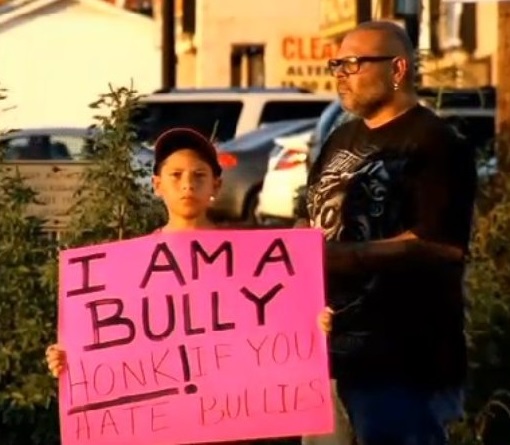
Gee, I wonder why that kid is a bully?

Gee, I wonder why that kid is a bully?

Police in Winter Garden, Florida have arrested and charged Christle Prado and her, ah, “roommate” for forcing her 10-year-old son to wear a dress, and then posting photos on Facebook to humiliate him. Discipline, you see; he had wet his bed.

The model mom and Keith Driscoll were charged with cruelty toward children and infliction of mental injury on a child.

Good.

I’ve written about web-shaming children before, and characterized it as child abuse, which it is. A maxim here is that when ethics fail, the law must take over. It is a poor second option, but for this couple and those like them, including the parents of the boy in the photo to the left, it is a necessary and an ethical one.

Police learned about the abuse after one of the boy’s relative saw posted photos of the boy dressed as a girl and wearing makeup. He was crying. I wonder how many of Prado’s friends “liked” those photos on Facebook? Prado told police that Driscoll came up with the idea to dress her son like a girl as a way to discipline him, went along with it because she “did not want to cause problems with her living situation.”  Oh, well, that’s all right then, ma’am—you can go now. Driscoll, you see, is her sleep-in landlord.

Yechhh. I wonder what else she’ll do to her son to keep that cozy relationship peaceful? Cigarette burns? Whipping? Water-boarding?

The child cruelty charge is a second-degree felony. I’m all in favor of expanding such charges to apply to the parents who post photos of children holding signs that read “I pooped on the floor” and other self-incriminating screeds compsed by mom and dad, even those who aren’t doing it to interfere with their sex-for-rent arrangements. In fact, I’d expand it to include those Jimmy Kimmel fans who make YouTube videos of their children crying because their Christmas gift appeared to be old sweat socks or broccoli, in the hopes that Jimmy will make their exploitation of their own kids go viral. (An excellent discussion of everything that is wrong with child-shaming on the web can be found here.)

Using the web to humiliate your powerless children—forever, remember—is wrong, but if parents are so stupid, cruel and ethically inert that they can’t fathom this basic Golden Rule principle, it should be illegal too.

___________________________

Pointer: Fark

Facts: WFTV

Continue reading →

Vice President Biden May Be A Boob, A Hypocrite And An Ethics Dunce, But He Understands The American Culture Better Than Most Of His Party

I’m late to the blog today, because I spent it giving a special program for the Smithsonian Associates called  “From Stagecoach to Django Unchained: The Hollywood Western and Its Influence on American Values, Aspirations and Culture.” It consisted of me talking, a terrific Powerpoint presentation by the gifted Grace Marshall, and almost three hours of clips from classic Westerns—the whole session was five hours. My primary message is that anyone who is not literate  regarding the Hollywood Western really doesn’t understand the myths and archetypes that powerfully influence U.S. culture to this day. Within that “anyone” are the majority of pundits and journalists, a large percentage of citizens under 50, and the vast majority of women and minorities. This is a problem.

For example, no one can consider the vast influence of the Western genre on American culture and be the least bit surprised that gun control has an uphill battle with the American public. No other culture has as its primary source of heroes, legends and lore figures and events so dependent on firearms as a means to right wrongs, protect the innocent, and punish evil. Frankly, if a pundit doesn’t understand why John Wayne (who died in 1979) just set a Harris poll record by being included in its annual list of top ten most popular movie actors for twenty consecutive years, from 1994 to 2014, I don’t think they can comprehend the nation sufficiently to opine on it.

Joe Biden, however, understands. I have been critical of Joe, as he is frequently an embarrassment, and there was a lot wrong with his comments today as he was honored with the “Voice of Solidarity” award by Vital Voices, a women’s rights charity, at their event celebrating “men who combat violence against women.” Still, Biden proved that whether he knows it or not, he is more atuned to U.S. culture than most of his colleagues. He deserves credit for that, if nothing else.

You see, Biden told a fascinating personal anecdote from his childhood. He related:

“I remember coming back from Mass on Sunday Always the big treat was, we’d stop at the donut shop…We’d get donuts, and my dad would wait in the car. As I was coming out, my sister tugged on me and said, ‘That’s the boy who kicked me off my bicycle.’ So I went home—we only lived about a quarter mile away—and I got on my bicycle and rode back, and he was in the donut shop.”

Biden said the the boy was in a physically vulnerable position,“leaning down on one of those slanted counters,” so he took immediate advantage:

“I walked up behind him and smashed his head next to the counter.His father grabbed me, and I looked at his son and said, ‘If you ever touch my sister again, I’ll come back here again and I’ll kill your son.’ Now, that was a euphemism. I thought I was really, really in trouble… My father never once raised his hand to any one of his children—never once—and I thought I was in trouble. He pulled me aside and said, ‘Joey, you shouldn’t do that, but I’m proud of you, son.’”

The lesson, Biden said, was that one should to “speak up and speak out” to correct wrongdoings. Like much of what come out of Biden’s mouth, this was nonsense in the context of his own story, and was not what the lesson was at all. The lesson was that force, punishment, violence and intimidation is sometimes necessary to stop bullying, discourage misconduct, protect the innocent and vulnerable,  set standards, and give more than lip service to core values. Little Joey Biden didn’t “speak up”: he bashed a bully’s head and threatened to kill him. Apparently it worked, too. America, Americans, the culture and our history—as well as the Duke–have long believed that sometimes violence is necessary to stop violence, and send important messages, and can therefore be virtuous and ethical.  Biden understood that when he was ten, and somewhere deep in that mess of mush he calls a mind, he understands that now. Continue reading →

On Peter Pan, Pippi Longstocking, And Ethics Of Applying Political Correctness To Art And Literature

Cultural events earlier this month brought to light, on two continents, the problem of maintaining the integrity of art and literature under the onslaught of political correctness.

In Sweden, a controversy has erupted over the re-broadcast of a 1969 television adaptation of the Pippi Longstocking books, the children’s classics authored by Astrid Lindgren. The Swedish national TV station, SVT, announced that it is revising a scene from the 1969 television series about Pippi  which she says her father is “king of the Negroes,”a direct quote from one of the stories. Believe it or not, this has set off a contentious national debate.

The family has approved the station’s  desire to change the TV version, but is keeping the term in future editions of the books. In 2006, the family added a preface explaining that today, the word is considered “offensive,” but that when the books first appeared, “Negro was a common expression for people with black skin who lived in other parts of the world than ours.” That’s a sensible solution. Period and context is important in art and literature: the urge by some to constantly purge the world of any reference, word or attitude in past creations that seem out of place now leads to a form of cultural self-lobotomy. Erik Helmerson, a columnist at Dagens Nyheter, an influential Stockholm newspaper, called the changes a form of censorship. “I’m very sensitive to the fact that people are offended by the N word,” he said in an interview. “I’d never use it myself.” He even called revising the TV series  “a huge interference into freedom of speech.”  “Where do we draw the line? What do we cut and what do we keep? Who should decide? Who needs to be offended before we cut a word?” Continue reading →