1. Totalitarianism watch. Idling one’s car for longer than three minutes, or more than one minute while adjacent to a school, is illegal in New York City. There have been anti-idling laws since 1972, but they were previously examples of the law being used to encourage conduct rather than enforce it. Now, with socialist Bill de Blasio at the city’s helm, the laws are being enforced with a vengeance.
The city is offering bounties to citizens who report their neighbors, for example. “If you witness a vehicle idling illegally, you can potentially receive a reward for your enforcement efforts through our Citizens Air Complaint Program” says a city website.
Nice.
The theory is that forcing people into not idling their car will mitigate climate change, just like forcing people to ride bicycles and to stop having children when the Left gains sufficient power and the Green New Deal is within reach. Cars idling for no reason is a pet peeve of mine, particularly when they idle in a parking space with cars waiting while the driver checks his or her messages on a cell phone. There are, however, good reasons for idling. I have idled while recharging a dead battery for example. I have idled in sub-freezing weather to keep the car warm while my wife, who had a cold, ran into a 7-11 to buy some cough medicine. The blunt boot of the law does not belong in this matter, like many matters that today’s progressives and socialists want to turn into government edicts.
This is “extreme free-birthing“…doing it all alone. Not recommended.
I love it when a new commenter makes an entrance with a Comment of the Day, and that’s what Megan did in response to last week’s post about the credulous mother-to-be who placed inordinate trust in the opinions of amateurs and well-meaning activists with tragic results.
Here’s the way the poll on that story has turned out; polling closes in a week, so if you haven’t voted, time is running out:
Frequently first time visitors with especially impressive debut comments are only interested in a single issue, and go recede into the mists of anonymity from which they came, never to be heard from again. I hope that isn’t the case with Megan.
I’d like to offer my 2 cents as a pregnant woman who is currently planning a “freebirth” (but is open, of course, to taking whatever unpredictable path unfolds in labor).
Judith is responsible for her body and her baby. This is one of the core beliefs, in my opinion, of anyone who is willingly choosing to go this route in pregnancy and childbirth. The freebirth movement was born out of women who wanted to take more responsibility for their pregnancies/births, rather than feeling like another number on an OB conveyor belt. Typically, it is women who want to lead the decision making process when it comes to what is done or not done to their bodies (which includes their babies, obviously).
There are so many problems in our current obstetric system, it is one of the least evidence-based areas of medicine, period. There are been plenty of research to show that new technological advances have NOT improved average outcomes in the past 30-40 years, such as constant fetal monitoring, multiple ultrasounds, C-sections, inductions, etc. That being said, if you’re going to make radical choices that go against common sense consensus and what history has shown to be true about pregnancy (ie: a pregnancy lasting 44 weeks + has a very high risk of stillbirth), you must also be willing to suffer the consequences of those choices. Judith will live with the consequences of her choices for the rest of her life, it is heartbreaking. No one will suffer more than her, and my heart goes out to her. There is no worse pain than losing a child.
I still believe that women should always be the final decision makers over their bodies, even if those decisions are shortsighted or ill-informed.
If anyone is interested, the reason I am planning a birth without medical professionals present (except that I will have a friend present who received midwifery training but never ended up becoming licensed) largely has to do with my first birthing experience in the hospital, and the protocols in place that are presented without care for a woman’s bodily autonomy. I was given ZERO choices about how my care proceeded at 40 weeks, was told that I HAD to be induced, after having 2 HBP readings over the course of 24 hours. I had zero symptoms of preeclampsia, was incredibly healthy, and felt great. I’ve since consulted with several OBs who agree that mine was an unnecessary induction. Nevertheless, the OB that was on staff that morning was a cautious one, proving that sometimes all it comes down to is a provider’s personality, and I was shuffled into the standardized induction protocol. This turned what I believed would be a powerful, momentous, incredible experience in my life (initiation into motherhood) into one of extreme pain (pitocin contractions don’t give you breaks!) and then numbness (epidural to numb the pain), leaving me feeling helpless and completely dismissed by staff. I’m one of the “lucky” ones who goes through this process and doesn’t end up with a C-section (you’ve got about a 50/50 chance after being induced with pit). Continue reading →
Just yesterday I bought my yearly two boxes of Thin Mints from some incredibly adorable little girls selling the Girl Scout cookies from a card table outside my local CVS. I had planned on buying them from a Girl Scout I have never met, though the agency of her mother, who sold them to me last year. But she never got in touch with me—I think she’s another one who is steamed at me for some post here (over at Windypundit, it’s slam Jack Marshall day by another former commenter) —so the adorable little girls got my 20 bucks this year.
Today I encounter an interesting opinion piece that holds that mothers like my friend are “cheaters.” JM Finster writes:
As with any fund-drive, the idea is to support the cause, but with the cookies, uniquely, customers buy them to give “the awesome girls who sell them,” in the words of the Girl Scouts, “the opportunity to learn essential life skills, soar in confidence, and quickly discover the leader within.” Research has shown that none of that happens when parents sell the cookies at work..So it is that the cookies land on a desk in a skyscraper without a Girl Scout in sight.
The cookie drive should be better than that. Selling is crucial to every endeavor, in that it requires the ability to make a convincing presentation, to answer questions, and to project self-assurance. Everyone needs to do that, in one form or another, but that last attribute, in particular, is sometimes lacking in the best of us, especially shy young ladies.
Since Girl Scout troops keep track of sales by individuals, even offering prizes for the best results, parent-cheaters can hardly resist the chance to prove their own sales skills and boost their girl to the top of the ranking. …If a Scout comes over to the house for a sales call, a parent will undoubtedly come along as an escort. That’s all right, except that the parent will do all the talking, no matter how hard one tries to give the awesome girl standing off to the side the opportunity to learn essential life skills, soar in confidence, and quickly discover the leader within. With the adult recording the sale and later delivering the cookies, their daughter the Girl Scout—all in one stroke!—wins a prize for outstanding sales and loses the chance to learn something about sales…For the sake of the runny-nosed little girl, who keeps poor sales records, lets her boxes get crushed in the back of the car, and exhibits more enthusiasm than smooth-talk, kindly sidestep the parent-cheaters and let her learn. In fact, make her learn and insist she does the talking.
Your Ethics Alarms Ethics Quiz to kick off March:
Are parents who help Girl Scouts sell more cookies cheating?
For some reason there has been a breakdown of civility in the comments lately. This has happened from time to time; something in the air or too many social media rants or something; I don’t really care. You all know where the lines are; you cross them intentionally when you cross them. I appreciate the use of a vulgar word or harsh phrase as much as anyone; “asshole” is particularly tempting, because there is no non-vulgar term that quite captures the essence of its meaning. I also prefer to keep moderation light here, and for the most part, the select commenters who have passed my standards and answered the three questions at the bridge correctly usually make me proud, especially when I see what crawls onto other sites’ comment sections. The would-be Ethics Alarms participants who send in entries like “Your a Trump-loving fuckface LOL!” are all stacked up in the spam vault, and you would not believe how many of those I have to read to maintain the high level of participants here. I do not care to read that kind of gutter residue on the blog itself.
I just trashed a full comment by a regular commenter here, something I have not done in over ten years, and I’m not happy about it. Let’s keep that lapse the anomaly that it is.
1. From the “When ethics alarms don’t ring” file. Pop Quiz! If you were on the staff of a fashion show about to begin at what the New York Times calls “New York’s famed Fashion Institute of Technology”—which I have never heard of—and several of the models appeared backstage preparing to go out looking like this…
…what would you do?
The answer is that no matter how high or low you were on the metaphorical totem pole, you would be obligated to throw a fit, phone the brass, tell everyone in sight that they are out of their minds, and do everything short of calling in a bomb threat to halt what you know without a shadow of a doubt will result in a public relations disaster.
Incredibly, not a single person raised the obvious objection except an African-American model-who refused to don the giant lips and monkey ears. After the predictable uproar, two F.I.T. administrators were suspended, and the school’s president, Dr. Joyce Brown (who is African-American) issued a public statement admitting that the Feb. 7 show, intended to demonstrate the work of recent graduates of the school’s M.F.A. program, “failed to recognize or anticipate the racist references and cultural insensitivities that were obvious to almost everybody else.”
Wait—if they were obvious to almost everybody else, why were they not obvious to anyone involved in the show?Continue reading →
As I thought it would, today’s ethics quiz about the 6th grade dance with the “must accept” policy has sparked some excellent reflections and flashbacks. Taking off from Bryan’s comment—
When my son was in sixth grade cotillion class, the instructor prefaced dances with “in this class, and only in this class, if someone asks ‘may I have this dance?’ the answer is ‘yes, thank you.’ “ They also switched off having boys ask girls and girls ask boys. The whole point of the class was to learn polite interaction at an age when they’re so confused and might otherwise act weird. I thought it was a lovely compromise. This was in about 2005, so it was not so long ago, yet not inflicted with today’s outrageous thinking.
My experience was the same as Bryan’s – about a half-century prior. The class was once a week, part of the gym program as well as a “social” activity, I believe, and emphasizing a similar “buddy” system – you partnered with everyone at one time or another.
Ours was a smallish class so we got around to everyone else at least twice. We learned ethnic circle dances in lower classes, then box step, fox trot, waltz, and some others, ending the 8th grade (preparing for our first “formal”) with a singularly unsensual rumba. One of my classmates had hyperhydrosis, aka, a surfeit of sweat, and holding her hand was a chore for her partner and an agony for her. It got so we would safety-pin a pair of socks – not necessarily clean ones – under the shirt’s left shoulder to take care of half the problem and then, with her eager cooperation, each would try to touch each other’s palms with as little pressure as possible. Continue reading →
If you don’t know what I’m talking about, you should. Frederick is the overly duty-conscious and somewhat dim-witted hero of Gilbert and Sullivan’s “The Pirates of Penzance,” one of the Savoy duo’s so called “Big Three,” the Victorian operettas that have been performed the most over the years. (The other two are “H.M.S Pinafore,” and the currently unfairly besieged—but arguably the best of them all—“The Mikado.”) They aren’t my three favorites, mind you, but like seven of the other G&S masterpieces, they are damned good, and have aged better than most American musicals, especially the Rogers and Hammerstein classics. Poor Frederick was apprenticed to a pirate until his 21st birthday, but due to a cruel twist of fate and legalistic nit-picking, his 21st birthday didn’t arrive until 1940, because he was born on leap year. Today is his 41st birthday, though he is 164 years old.
I apologize for the stupid subtitles in the clip from the movie. Unlike most G&S performers, the diction of Kevin Klein, Rex Smith and Angela Lansbury is excellent.
(I’m hurrying because I’ve learned from cruel experience that traffic on Saturday after 12:30 slows to crawl..)
1. Thus ends Black History Month. I do not favor tribal distinctions in our days and months. It is inherently divisive, and Black History Month smacks of honors affirmative action. The history of black Americans is American history, inextricably intertwined with the history of the rest of us. Our entire history ought to be taught and learned without bias and spin, and no race or ethnic groups should hesitate to take pride in the accomplishments of other Americans regardless of their color or ancestry.
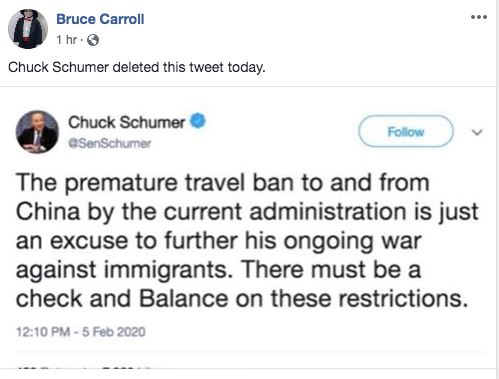
NOTICE of CORRECTION! Item #2 below has now been shown to have been based on a hoax. More after…
2. Res ipsa loquitur:
Obviously the note in Chuck’s tickler file came up: “Today transition from saying Trump was doing too much in response to the Corona virus to saying that he isn’t doing enough.”
What awful, awful hacks these people are.
They are still awful hacks, but I hate being caught by these hoaxes. This one was especially sinister, because the fake tweet is completely consistent with what the Democrats and the news media had been saying about the President’s move to stop travel from China. However, insisting that a faked message is still “true enough” is what Dan Rather did in the scandal that ended his career as a respectable journalist.
We now know that the tweet is a hoax because ProPoblica, a nonprofit journalism organization, maintains a database of tweets deleted by politicians called Politwoops that uses Twitter’s Streaming API to find tweets from politicians that have been deleted. Schumer’s tweet is NOT in the database, thus we know it wasn’t posted.
[T]here are the Tilli Buchanans among us, who want to tear down social norms, not really knowing what the consequences will be over the long term, just for the hell of it. In addition to being irresponsible and disrespectful, they are also lousy citizens.
They are not, however, criminals. She should be able to walk around naked in front of her children, just as we allow parents to engage in all sorts of other dubious practices. That she can doesn’t mean she should, but this is part of a long, long list where we must rely on ethics rather than law.
Facing being placed on a sex offender registry for 10 years, Tilli agreed to a plea deal with her pleading guilty one class B misdemeanor lewdness charge and paying a $600 fine while serving probation. The charge will be dismissed if Buchanan can keep her shirt on for a year.
4. More “The rest of the story,” uber-jerk division. In 2018, Saturday Night Live performer Pete Davidson mocked GOP Congressional candidate Dan Crenshaw for his eyepatch, the result of a combat wound. Davidson said that he looked like “a hitman in a porno film” and dismissed the origin of his disfiguring injury as something he got in “war or whatever.” Veterans, their families and others who don’t usually pay attention to SNL anymore since it has become partisan, shrill, and lazy protested loudly, and Davidson apologized while Crenshaw appeared on a later show, where he was funny, gracious, and forgiving
It was obvious to me (and, I’m sure, Crenshaw) that Davidson was forced to apologize, but it takes a special breed of jerk to come back after he has left the scene of his insults and say so.
In Davidson’s new stand-up special, “Alive from New York,” Davidson, says,
“So I made fun of this guy with an eyepatch and then, like, I kind of got forced to apologize. My roommate thought I should apologize so that I didn’t get shot in the face. People were like, ‘You hate America!’ And I’m like, ‘No, I just didn’t want to be incorrect about how he lost his fucking eye. Is that a crime?! The only thing I did do, which I am guilty of — and I apologize for — is I did make that guy famous and a household name for no reason, right? I did what, like, Ariana Grande did for me, right? I sucked his dick at ‘SNL.'”
This is what you lost your eye for, Dan.
5. You could show this to your Bernie Bros friends, but I doubt they could understand it. At the Foundation for Economic Education, J. Kyle de Vries does an excellent job of explaining the Social Security cheat, and why it has to be reformed. The system no longer makes sense, but the socialist enablers refuse to consider the problem. de Vries writes in part,
Millennials and Generation Z: Do you want to fund my Social Security benefits with higher payroll taxes than I paid in the past? Especially when the likelihood is high that your benefits are not going to be as lucrative as mine?
I am lucky. My Social Security benefits will be funded by you and other workers, and I plan on living to 140. If you are younger, that should concern you. Right now, you and your employer are forced to contribute 12.4 percent of your income into a fund that goes into a black hole, financing some other guy’s retirement. Wouldn’t you rather put that 12.4 percent into a fund you manage?
…Assume a self-employed 25-year-old makes $75,000 this year. Further assume she is required to set aside 12.4 percent of her income into a protected, tax-deferred trust, just as she must do for Social Security. But this is her account, managed by her, just like a 401k plan. If she realizes a 3 percent increase in income each year and can earn 6 percent on a conservative mix of stocks and bonds during her lifetime, her trust will accumulate to over $3,500,000 at age 70. At 8 percent growth, that number will be an astounding $6,142,000.
Would you rather have accumulated these much larger sums to augment your retirement income than get the average $1,500 per month Social Security check issued today? Lesser potential income is just one of the problems with the present system.
…Contrary to popular belief, payroll taxes are not invested in a fund to secure benefits like most other pension plans. Since the beginning, payroll taxes went first to make payments to current retirees with the balance “borrowed” by the feds for spending on things other than Social Security benefits. For most of the program’s history, the amount of payroll taxes the feds received was much higher than the Social Security payments, meaning the feds had a lot of money to spend on other things. Because of demographics, that situation has changed perilously, threatening the future of the Social Security system.
…What all this means is millennials and Gen Zers will see higher taxes for Social Security across the board, perhaps many times. They will also most likely see reductions in promised benefits, especially if they accumulate a lot of money over their working lifetimes.
…Wouldn’t you rather have your own retirement fund you manage yourself instead of the flimsy promise of government IOUs? Increasing payroll taxes today only delays the day of reckoning. The current unfunded liabilities for Social Security are over $34 trillion. Let’s not double down on a failed experiment that will bankrupt our country in the future and leave millions destitute in retirement.
Wouldn’t it be nice if Donald Trump was articulate enough and organized enough to explain this in a debate, or in a national address to the public? Wouldn’t it be nice if young voters would pay attention, and if the news media could report on the issue fairly?
Wouldn’t it be nice if I could fly to Disney World by flapping my arms really hard?
A furious mother is making an issue out of a Utah middle school’s policy requiring sixth-graders to agree acquiesce when a classmate asks them to dance.
Alicia Hobson’s 11-year-old daughter, Azlyn was asked to dance by a boy she thought was icky. She “politely” refused, but the principle at Rich Middle School in Laketown, Utah, intervened, telling the couple to get out onto the dance floor. Was the boy short, fat, covered with acne, bad-smelling, a bully, afflicted with Down Syndrome? Was he poor, have a lisp, or Muslim? Was there a cool boy Azlyn was waiting to play Prince Charming? Never mind: As the principal, Kip Motta, later explained in a letter to Alicia Hobson, the school has a policy requiring students to accept dance invitations, and sticks by it. Motta wrote,
“We do ask all students to dance. It is the nice thing to do and this will continue to be our policy. There have been similar situations in the past where some students have felt uncomfortable with others, and, as stated prior, the issues were discreetly handled. This allowed all students to feel welcome, comfortable, safe, and included.”
Hobson equates the policy with “rape culture,” and is prepared to take the issue to the Utah Board of Education. “Girls HAVE to learn that they have the right to say no and that those around them have to respect that,” Hobson wrote on Facebook. “I’m not going to quietly stand by while my daughter and all of her classmates are being wrapped up in rape culture. No way.”
Ethics Alarms dealt with a similar issue in a different context in this post, about children accepting kisses and hugs from repulsive family members.
Before I pop the quiz question, I have three observations. The first is that that the principal’s fad use of the word “safe” has just got to stop. That’s not what “safe” means, and if we keep using “safe” to mean “insulated from any event, feeling or experience that someone might prefer to avoid,” the word will cease to have any communication value. The second is that equating the social obligation to accept an invitation at a supervised dance with “rape culture” is a hyperbolic crock, and should be identified as such immediately.
The third observation is that the “Today” headline is intentionally misleading and unfairly supports the mother’s inflammatory framing. “School policy forbids kids from saying ‘no’ when asked to dance” presumes the conclusion Hobson wants. “School policy requires students to be kind and considerate when asked to dance” promotes the school’s rationale. An ethical and responsible headline would be, ““School policy requires students to accept an invitation to dance.”
Kwame Anthony Appiah is the first and only competent ethicist to handle the long-time New York Times Magazine column, so I feel badly that most of the time when I reference his opinions, it is to criticize one of them. He over-all record is excellent, despite the impression one might get from Ethics Alarms. For example, read his superb, if a bit overblown, response to a white woman who was “deeply offended” that a contractor hired by her husband flew a small confederate flag on his truck. She wanted to report him as a racist to his boss, and asked Appiah if this was the right thing to do.
That nuanced advice is more typical of “The Ethicist’s” work than this recent chapter, in which a man wrote that he had split from his wife after she had refused any physical intimacy, saying that it was no longer “part of her life.” She suggested a trial separation, which led to a formal divorce, and the couple signed a non-disparagement agreement as part of the process. Recently she admitted to him that she had repeatedly cheated on him during their marriage, and that she suggested the trial separation so she could resolve her affair at the time with a married man.
The inquirer says that he has never blamed his wife in discussions with his sons for the end of the marriage, but that he has learned from them that she “places the sole blame on me for every problem ever experienced by our family, including the drug addiction of our older son. When I recently contacted her about visiting him in jail, she said he didn’t want to see me. I contacted him and found that this was not true.”
He asks “The Ethicist” if he can ethically violate the non-disparagement agreement in his own defense, and tell the sons what a lying, cheating, betraying mother they have. To my amazement, Appiah said he could, and even suggested that he should, arguing in the process of a looooong discourse, Continue reading →
I’ve been working on accounting ethics, which always slows down my metabolism to Galapagos tortoise levels…
1.Worst lie of the year (so far)…In Winter Park, Florida, Jorge Torres was found dead , zipped into a suitcase. Suspect Sarah Boone insisted that it was all a tragic mistake. They were playing hide and seek, she said, and he just hid too well. A cellphone video, however, caught his cries for help from inside the suitcase, as she said, “That’s what I feel like when you cheat on me!” Boone, however, told police that the wacky couple thought it would be funny if he got inside the suitcase. They were drinking at the time and who hasn’t zipped up a loved one in a suitcase when spirits run high? Unfortunately, Sarah passed out on her bed, and when she woke up hours later, poor Jorge was dead.
That’s her story, and she’s sticking with it.
2. Remember “Baby Peggy”? Probably not, but she was probably the last living link to the silent movie era, and she died this week at 101. She was also one of the earliest examples of the child abuse that became routine in Hollywood. Baby Peggy, real name Peggy-Jean Montgomery, had made about 150 movies by the time she was five-years-old, and was a multi-millionaire at four. As has been the norm with child stars from Peggy through Jackie Coogan to Gary Coleman, Peggy’s parents stole her money and spent it all. They also let her risk life and limb in pursuit of her “art” that she was too young to understand. During her silent-film career, “Baby Peggy” was thrown from a speeding pickup truck, narrowly escaped a horse trampling and survived near-drownings and incineration. Continue reading →
Enigmatic commenter Extradimensional Cephalopod (that’s not him in the picture, just a relative) returned to Ethics Alarms after an unexplained absence (though who knows how time passes in his dimension) to provide one of several excellent observations on the post and poll about “Judith,” the expectant mother whose faith in a “freebirthing” cult cost her unborn child his life. The comments of Tim LeVier, Humble Talent, JutGory, and Mrs. Q, among others, were all Comment of the Day worthy, but for now, I’m going to award EC the prize.
First off, I’m grateful for all the nuanced and well-considered opinions here. I can always count on getting reasonably well-balanced information about human society from people’s experiences here, and the encouragement that reasonable people are not alone–just not yet organized.
The poll didn’t let me vote multiple times, but I’m tempted to select “all of the above,” in the sense that “responsible” can mean “contributing to the problem and needing to change.” For “primarily responsible,” I’m obligated to go with “Judith,” since she is presumed to have ultimate decision-making authority in this case.
That survey question by the National Partnership for Women & Families spins so hypnotically, I’d like to take it off its axle.
“Giving birth is a natural process that should not be interfered with unless absolutely medically necessary.” Who wouldn’t agree to that?
1. Yes, giving birth is objectively and literally a natural process, in that humans didn’t deliberately design it. (Although I wouldn’t put it past them to have done so under a tight budget of time and money. I’ve supported software rollouts that were just as awkward and painful.)
However, stating something to be “a natural process” in so many words implies on an emotional level that it is by default perfectly healthy and should remain purely natural, which is an appeal to nature fallacy. “Cancer is a natural process.” “Epidemics are a natural process.” “Hurricanes are a natural process.” There are plenty of natural things that I am very grateful civilization has altered or wants to alter using technology. Continue reading →