Flat Learning Curve Update: Yet Another Jaw-Dropping Leadership Fail From President Obama

curve-flat

In the midst of yet another flashing neon display proving beyond all reasonable doubt that Barack Obama has the worst grasp of the Presidential leadership of any POTUS in over a century, a cheerful CNN/ORC poll found that 50% of those polled assert that Obama tenure has been a success, and 53% believe that things are peachy in the United States. It is beyond comprehension.

WARNING!

IMPULSIVE RANT FOLLOWS! SKIP TO MAIN BODY OF POST FOR RETURN TO RESTRAINED ETHICAL ANALYSIS! Continue reading

Yes, Aaron Schock Is Untrustworthy. Why Wasn’t that Obvious From The Start?

SchlockRep. Aaron Schock (R-Ill) resigned from Congress this week, effective March 31, after it was revealed that he charged more driving miles of travel to taxpayers than he had mileage on his car. This was just the latest indication that Schock was infected with a fatal sense of entitlement, which you can read about here and  here. I’m not going to waste time declaring the Congressman unethical: obviously he is unethical. What concerns me is that he was elected to Congress three times despite being such a textbook example of a Narcissistic Personality Disorder victim that everyone should have been running away. This was a stunning instance of voters, journalists and pundits being naive, ignorant and incompetent. Continue reading

The Unethical Cosby Victim: Jewel Allison

accuser

The thirty or so declared victims of sexual assault by Bill Cosby (sorry: when we get into double figures, “alleged” is misleading) have given various reasons for not reporting the crimes against them: fear of Cosby’s power, fear of retribution from the entertainment industry, fear of publicity, fear of not being believed, fear of humiliation. A recent addition to the list, however, has given an unequivocally unethical explanation for her 20 year silence in a Washington Post op-ed that has been called “courageous.” Jewell Allison’s confession is not courageous. It is disturbing and ominous. It shows what the trauma of the black experience in the United States has done to some African Americans, causing them to place group identification above reason, decency, good citizenship, compassion and common sense.

She writes:

“When I first heard Andrea Constand and Tamara Green publicly tell their stories about being drugged and assaulted by Cosby, I wasn’t relieved; I was terrified. I knew these women weren’t fabricating stories and conspiring to destroy America’s favorite dad, but I did not want to see yet another African American man vilified in the media. As I debated whether to come forward, I struggled with where my allegiances should lie – with the women who were sexually victimized or with black America, which had been systemically victimized.”

This makes no ethical sense or rational sense. Continue reading

Iran Letter Ethics Q and A: Senate Heroes, Blame, Trust And Captain Queeg

Question:  Are the seven GOP Senators who did not sign the Iran letter Ethics Heroes?

Answer: I almost designated them as such, but that would have been a mistake. There are too many non-heroic and even unethical reasons Sen. Lamar Alexander (R-Tenn.), Sen. Lisa Murkowski (R-Alaska), Sen. Dan Coats (R-Ind.) and Sen. Thad Cochran (R-Miss.), Sen. Susan Collins (R-Maine), Sen. Jeff Flake (R-Ariz.), and Sen. Bob Corker (R-Tenn.), Senate Foreign Relations Chairman might have chosen to refuse to go along with their colleagues. Based on the explanations I’ve read, that seems to be the case. Collins, for example, says that she didn’t think the letter would work. Wrong answer: the reason to reject the letter is because it’s a flat-out violation of legislative limits imposed on the Constitution. Similarly, Flake says that he didn’t think the letter was necessary, whatever that means. It is also likely that some of the seven felt they could have their cake and eat it too: they want the letter to undermine U.S. diplomacy, but don’t want to take the criticism that goes with signing it.

Question: Do I blame President Obama for the letter?

Answer: A friend who is such a knee-jerking Obama enabler and excuser that it’s a miracle he can walk posted yesterday’s  Thirteen Ethics Observations On The GOP’s Letter To Iran on his Facebook page, and one of his knee-jerking friends wrote, “Typical: blame Obama.” I did not and do not blame Obama for the fact that the Republican Senators engaged in a foolish, dangerous and bright-line violation of the separation of powers, and anyone who could read the post otherwise is so deranged by bias that their faculties are impaired…or they just aren’t very bright.

I did write, and it is true, that the President shares significant responsibility for the poisonous and dysfunctional relations with the Congress that led to this fiasco. He is at the top of the government; it’s ultimately his job to make the government and the system work. Obama and his enablers reject accountability at every turn, but the unavoidable facts are that he is in charge, he took the job voluntarily, and whatever doesn’t work, including the government itself, is on his record. He never made a good faith, sincere, dedicated effort to work with the Republicans in Congress; he never worked to develop the negotiation, compromise, horse-trading, cajoling, quid pro quo skills that successful, competent Presidents have used to deal with the same levels of political opposition that he has found impossible to cope with. He took no steps to build trust in Congress, and engaged in serial conduct that was guaranteed to destroy trust, and has.

Finally, his illegal immigration executive order (the illegal accurately modifies both “immigration” and “order”) and his unilateral alterations to his own, incompetent and sloppy, health care law showed exactly the same contempt for constitutional limits as the Senate letter.

Obama is not to blame for the letter. He is absolutely and ultimately accountable for the conditions that prompted the letter and the decision to send it.

Question: Is there an ethical justification for sending the letter? Continue reading

Sooner Ethics Quiz: Abuse Free Speech Rights, Or Ignore Them?

David Boren, the president of the University of Oklahoma, announced that two students would be expelled from the school for leading a racist chant that was preserved on a video and went viral on YouTube. The video shows tuxedo-clad men from the Sigma Alpha Epsilon fraternity  on a bus chanting :

There will never be a nigger at SAE
You can hang him from a tree
But he’ll never sign with me
There will never be a nigger at SAE

Who would want to be in a house with these assholes?

 The national fraternity apologized and closed the OU chapter. That was a proper response. (Tell me again what’s good about fraternities.) First Amendment specialist Eugene Volokh, however, pointed out on his blog that the expulsion was unconstitutional:

First, racist speech is constitutionally protected, just as is expression of other contemptible ideas; and universities may not discipline students based on their speech. That has been the unanimous view of courts that have considered campus speech codes and other campus speech restrictions …The same, of course, is true for fraternity speech, racist or otherwise…Likewise, speech doesn’t lose its constitutional protection just because it refers to violence — “You can hang him from a tree,” “the capitalists will be the first ones up against the wall when the revolution comes,” “by any means necessary” with pictures of guns, “apostates from Islam should be killed.”

To be sure, in specific situations, such speech might fall within a First Amendment exception. One example is if it is likely to be perceived as a “true threat” of violence (e.g., saying “apostates from Islam will be killed” or “we’ll hang you from a tree” to a particular person who will likely perceive it as expressing the speaker’s intention to kill him); but that’s not the situation here, where the speech wouldn’t have been taken by any listener as a threat against him or her. Another is if it intended to solicit a criminal act, or to create a conspiracy to commit a criminal act, but, vile as the “hang him from a tree” is, neither of these exceptions are applicable here, either.

Hey, Oklahoma…Rodgers and Hammerstein just called. They’re officially changing the name of the musical and the song to “North Dakota!”

Your Ethics Alarms Ethics Quiz:

Which is the greater ethics breach: the students abusing their First Amendment rights, or the University of Oklahoma violating them?

Continue reading

Ethics Observations On The Selma Celebration “Gotcha’s!”

Selma redux

1. The big controversy as of this morning involved the New York Times front page photo, which managed to be cropped exactly at the point where former President Bush could have been seen. Given the Times’ proclivities, conservative blogs and Fox News presumed the snub was intentional. If it had been intentional, that would have indeed been disrespectful and unethical photojournalism. The Times explanation, however, seems reasonable. It tells us something, though, that nobody at the Times saw this coming. I think it’s incompetence born of bias. “Where’s Bush?” “He was too far down the line, so the photo looks lousy if he’s included.” “Damn. Well, put a note in explaining that.” Bias makes us stupid, and the fact that no Times editor had this conversation is, in fact, stupid.

2. If the NAACP was setting the place cards, and I assume they were, then Bush should have been second row center, and not an MSNBC demagogue and race-hustler who owes the U.S. back taxes. Talk about biased and stupid. The NAACP claims it wants to be a unifying force in the country, but it doesn’t. It promotes divisiveness,and intentionally. It’s good for business.

3. A graceful, fair, respectful and competent President of the United States would have insisted that his immediate predecessor be in a position of prominence, as part of the message that this event was an important part of the history of America and all Americans. It would have been the right thing to do. Bush would have done the same for him. But we do not have a graceful, fair, respectful and competent President. We have an arrogant, petty, self-absorbed and divisive one.

4. …who can, on occasion, rise to give an excellent speech, which he did. Continue reading

Unethical Quote Of The Month: Democratic Operative Paul Begala

“Voters do not give a shit. They do not even give a fart… Find me one persuadable voter who agrees with HRC on the issues but will vote against her because she has a non-archival-compliant email system and I’ll kiss your ass in Macy’s window and say it smells like roses.”

—Clinton enabler/mouthpiece/consultant Paul Begala, quoted in Politico’s essay by Gabriel Debendetti 

roses

Begala, just in case you’ve forgotten, was the most loathsome of Bill Clinton’s paid defenders—deceitful, smug, arrogant, Machiavellian. I’ll confess my bias: along with Karl Rove, David Axelrod, Dick Morris, James Carville and his wife, Mary Matalin, and others whose names I am mercifully unaware of so far, Begala and his species are the scourge of the political culture as well as democracy itself. Their stock in trade is misrepresentation, and their objective is to make Americans ignorant, uncritical, lazy, compliant, and gullible. The contempt they have for Americans is palpable, as in Begala’s quote. Continue reading

Ethics Tales: How Julia Sand Saved A President And Changed The Nation

open book on concrete background

In my recent overview of the U.S. presidency (the four parts are now combined on a single page under “Rule Book” above), I noted that our 21st President, Chester A. Arthur, was one of my personal favorites and an Ethics Hero. He confounded all predictions and his previous undistinguished background, not to mention a career marked  by political hackery and toadying to corrupt Republican power broker Roscoe Conkling, to rise to the challenge of the office and to effectively fight the corrupt practices that had elevated him to power. Most significantly, he established the Civil Service system, which crippled the spoils and patronage practices that made the Federal government both incompetent and a breeding ground for scandal.

I did not mention, because I did not then know, the unlikely catalyst for his conversion. Recently a good friend, knowing of my interest in Arthur, his tragic predecessor, James Garfield, and presidential assassinations sent me a copy of Destiny of the Republic, the acclaimed history of the Garfield assassination and its aftermath by Candace Millard. It’s a wonderful book, and while I knew much of the history already, I definitely did not know about Julia Sand. Her tale is amazing, and it gives me hope. If you do not know about Julia and Chester, and it is not a well-known episode, you should.

Allow me to tell it to you?

James Garfield, an Ohio Congressman, had been the dark horse nominee of the Republican Party in 1880, foiling the ambitions of many powerful politicians, the most powerful among them being Sen. Roscoe Conkling of New York. In order to cement New York’s electoral votes, the convention gave the Vice Presidential nomination to Conkling’s lackey, the dignified-looking but otherwise unimpressive Chester A. Arthur, who may have been the least qualified individual ever to run for that office. The highest position he had ever held was Collector of Customs of the Port of New York, which had been handed to him by Conkling, and he was later removed from that post for incompetence and corruption.  He’d never been elected to significant office or been any kind of executive. Arthur’s career before becoming Vice President makes Sarah Palin look like Winston Churchill.

After the election, Arthur got to work being a disloyal Vice-President, acting as Conklin’s agent in the White House. (Arthur, a widower, even lived as a guest in Conkling’s Washington mansion.) He actively undermined Garfield’s efforts at government reform, at one point going so far as signing a petition supporting Conkling when Garfield refused to appoint only Cabinet members with the Conkling stamp of approval. Then,  on July 2, 1881, less than six months after taking office, the impressive Garfield was shot in Washington D.C.’s Union Station by Charles Guiteau, easily the craziest of the various crazies who have taken a shot at our leaders. (He was also the only lawyer in that group.)

Everybody was horrified, initially at the crime, but also at the prospect of Arthur becoming President. Some even suspected him of being complicit in the act; Guiteau didn’t help by writing Arthur a letter prior to his attack telling him what he needed to do as President.  Most, however, were just aghast at the prospect of the brilliant, courageous, skilled and honorable Garfield being replaced by this utter non-entity under Conkling’s thumb.

None were more aghast than Chester A. Arthur. He may have been a hack, but he was no fool, and he knew he wasn’t up to the job. It was reported that when he learned of Garfield’s shooting, Arthur began weeping like a child. During the nearly three months it took the hardy Garfield to die—he was killed by sepsis induced by the unsanitary prodding of his doctors as they searched for Guiteau’s bullet: the wound itself was probably survivable—Arthur descended into panic, shock, and depression.  For nearly two months, he stayed at home with the blinds drawn, fearing his own assassination. So invisible was he that there were  rumors that Arthur had poisoned himself.

Then Arthur received a letter, dated August 27, 1881, from a woman he did not know, Julia Sands. It immediately got his attention, for she addressed him in a manner he had never been spoken or written to before. The remarkable letter said in part… Continue reading

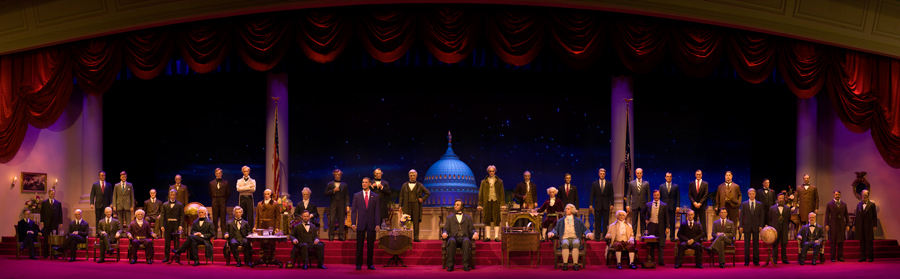
A Presidents Day Celebration (PART 1): I Love These Guys, I Really Do. Yes, Every One Of Them.

Hall of the Presidents

I have a lifetime love affair with the Presidents of the United States.

I love these guys, every one of them. The best of them are among the most skilled and courageous leaders in world history; the least of them took more risks and sacrificed more for their country than any of us ever can or will, including me. Every one of our Presidents, whatever their blunders, flaws and bad choices, was a remarkable and an accomplished human being, and exemplified the people he led in important ways. Every one of them accepted not only the burden of leadership, but the almost unbearable burden of leading the most dynamic, ambitious, confusing, cantankerous and often unappreciative nation that has ever existed. I respect that and honor it.

I have been a President junkie since I was eight years old. It’s Robert Ripley’s fault. My father bought an old, dog-eared paperback in the “Believe it or Not!” series and gave it to me. It was published in 1948. One of Ripley’s entries was about the “Presidents Curse”: every U.S. President elected in a year ending with a zero since 1840 (William Henry Harrison) had died in office, and only one President who had dies in office, Zachary Taylor, hadn’t been elected in such a year. The cartoon featured a creep chart—I still have it—listing the names of the dead Presidents, the years they were elected, and the year 1960 with ???? next to it. When Jack Kennedy, the youngest President ever elected, won the office in 1960, my Dad, who by that time was sick of me reminding him of the uncanny pattern, said, “Well, son, so much for Ripley’s curse!”

You know what happened. (John Hinckley almost kept the curse going, but Ronald Reagan, elected in 1980, finally broke it.) That year I became obsessed with Presidential history, devising a lecture that gave an overview of the men and their significance in order. My teacher allowed me to inflict it on my classmates.  Much later, Presidential leadership and character was the topic of my honors thesis in college. When I finally got a chance to go to Disneyland, the first place I went was the Hall of Presidents. When the recorded announcer said, “Ladies and Gentlemen, the Presidents of the United States!” and the red curtain parted to show the audio-animatrons of all of them together, it was one of the biggest thrills of my life.

Today I will honor our past Presidents with some of my favorite facts about each of them, trying hard not to get carried away. Is it ethics? It’s leadership, which has always been the dominant sub-topic here, but yes, it’s ethics.  I know I’m hard on our Presidents, as I think we all should be: supportive, loyal, but demanding and critical. I am also, however, cognizant of how much they give to the country and their shared determination to do what they think, rightly or wrongly, is in the country’s best long-term interests. File this post under respect, fairness, gratitude, and especially citizenship. And now…

“Ladies and Gentlemen, the Presidents of the United States!

Continue reading

I Can’t Wait To Find Out If Craig Hicks Was Just A Murderer Who Killed Three Innocent Neighbors Over A Parking Space, Or A Bigoted Murderer Who Killed Them Because They Were Muslims.

"EXTREMIST!"

“EXTREMIST!”

I am sitting here, drinking coffee and trying to wake up, and listening to CNN go on ad nauseum about the FBI investigation into whether Craig Hicks’ murder spree is a “hate crime.” No, I personally think he shot his neighbors because at that moment he was overcome with affection.

Sure, it’s important to know the motive for any murder. The “hate crime” scar on our laws, however, is creeping government thought control. After all, the law adds penalties to the punishment for a proven crime according to what the criminal was thinking, and nothing else. That’s thought-crime, by definition. The point is and was —-and this is another gift to the culture from the increasingly fascist-tending American Left, which wants to make it impossible (or painful) not to think as good people (you know, them) think—to use such prosecutions to send the message that it’s not just wrong to be prejudiced, it’s illegal and evil, and those who hold such views must be removed from society like tumors. Thus we are subjected to the interminable blathering that just finished on CNN about what the FBI’s examination of Hicks’ completely legal and Constitutionally protected writings and statements suggested about whether his thoughts should put him in jail for a few more years or decades. The message is unambiguous. Carol’s guest, a human rights expert, explained that Hicks’ act was a hate crime if any part of his motive was hateful.

Boy, Jesus was really ahead of his time: no wonder he warned us to love our enemies. It makes it safer to kill them. Continue reading