Ethics Hero: NBA Clippers Owner Donald Sterling (And Yes, I Mean It)

When you think about it, the champion in this fight would almost have to be repulsive for a victory to mean anything.

When you think about it, the champion in this fight would almost have to be repulsive for a victory to mean anything.

The other shoe dropped, and however it may be intended, it’s an ethical shoe. Donald Sterling now says that he’ll refuse to pay the 2.5 million dollar fine levied on him by NBA Commissioner Silver and his fellow owners for what he said in his own bedroom.

Good. I was waiting for this, and hoping that would be his course of action. Ironically, a good, compliant, progressive billionaire, and one who was not, unlike Sterling, a repulsive asshole, who was nationally embarrassed as Sterling has been, would crawl quietly into a hole, periodically send out big checks and mea culpas to Al Sharpton, Jesse Jackson, and the NAACP, and in the process, take  big, bloody chunks out of our freedom to think and speak freely, and our personal privacy. Sterling is doing the right thing, although it is going to cause him to be even more vilified by the media and even more assailed as the personification of racism than he has been already—and that has already been disproportionate to his “crime.”

Fighting is also going to be expensive. Never mind. It is revolting to write it, or even think it, but he is fighting for all of us. Continue reading

Cincinnati’s Swinger Parochial School Teacher Principle*

Sexy nun*The reference in the title is to the “Naked Teacher Principle,” discussed often here. In brief, it holds that a teachers whose nude (or in some cases, almost nude or sexually provocative) photographs become publicly available cannot object when they are terminated as unfit to teach.

Teachers employed in the Catholic schools in the Cincinnati archdiocese are being asked to sign a new restrictive contract that denies them the option of engaging in acts outside the classroom that are in opposition to Catholic teachings. It expressly forbids a “homosexual lifestyle” as well as any public support of homosexuality. It forbids abortions or advocacy of abortion rights, surrogacy, and in vitro fertilization.  A teacher who signs the agreement agrees not to live with a partner as a couple outside marriage,  engage in sexual activity out-of-wedlock,  and not to endorse either practice.

New York Times columnist Frank Bruni is offended by this, and feels it is unethical. “Does a Catholic-school teacher relinquish the basic privileges of citizenship?” he asks, pointing to political engagement and free speech. Continue reading

HGTV And Corporate Cowardice: Hold Companies Accountable For Stifling Speech, Opinion, And Thought

"Remodeling Homes, and Wrecking Democracy"

“HGTV: Remodeling Homes, and Wrecking Democracy”

Once again,  a company that is in effect punishing an American for his or her views on a complex social or political issue is being excused as simply “watching out for the bottom line.” This time, it is cable network HGTV, which cancelled a planned cable show about home repair because one of the prospective stars expressed an opinion adverse to gay activists. Last week, it was the NBA; before that, the agent of activist vengeance was Mozilla, and before that, A&E, until it decided that it was more profitable to do one “right thing” (not punish the duck call eccentrics for being open about who the network and its viewers always knew they were) rather than what it had decided earlier was the “right thing” (“STONE THE BIGOTS!!!”). None of these profit-making organizations are the least bit interested in what is right or wrong, of course, and probably don’t give the ethical implications of their acts a moment’s thought. All they are worried about is money, and what they will grandstand as their “principled decision” will always, amazingly, coincide with whose bullying tactics are more likely to succeed. Continue reading

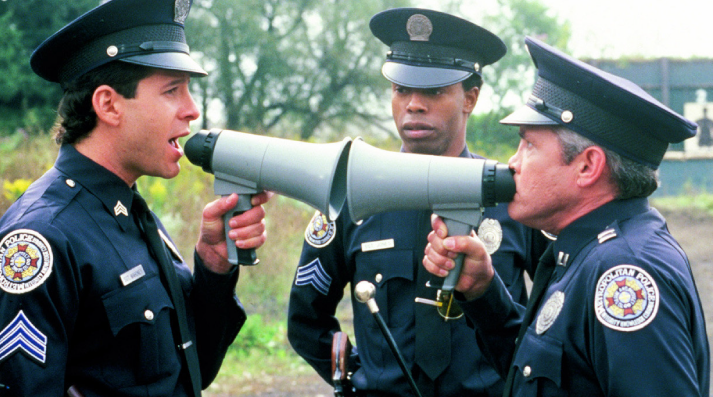
Ethics Dunces: The Quincy (California) Police

police-academy

Awww, isn’t this cute?

I’ve got bad new for you, Quincy, California:

You aren’t serious enough.

The England-based company Wall’s… set a crew up in Quincy on April 11 to film a commercial to be aired online later this month…On Friday, April 11, the crew set up multiple cameras around the courthouse…The premise of the commercial was simple. Hagwood, along with Deputy Sgt. Carson Wingfield and actor Scott Peat from Los Angeles, would pull cars over in front of the courthouse for “driving too serious.”The commercial filmed in Quincy will be part of a larger ad campaign by Wall’s. Filming also took place in such countries as the United Arab Emirates and Columbia. The global message is simple: don’t take life so seriously.

At around noon last Friday, filming began. Rather than receiving a ticket, drivers were given a complimentary ice cream cone and their expressions and reactions were filmed for the commercial. All the drivers pulled over reacted well, and generally enjoyed being a part of the commercial….To show appreciation to Quincy for allowing the stunt, Wall’s held an ice cream social at the Dame Shirley Plaza later that afternoon. Droves of people showed up for free ice cream and live music.

It may be cute, but it is also unprofessional, unethical, and outrageous. Law enforcement is a serious responsibility always, with no breaks for ice cream commercials. Using the police power to pull over motorists on false pretenses to assist a company’s advertising campaign is an abuse of power, and illegal. Gee, I wonder what other gags this police department will pull for the right price?

I hope someone sues. A town cannot ethically rent out its police and use them to dragoon citizens into an ice cream commercial. No one complicit in this corrupt sell-out should be trusted with a budget, a title, or a gun. Ever.

_______________________

Pointer: Fred

Facts: Plumas County

Incompetent Elected Official Of The Month, Or “You Know, Sometimes The Southern States Really Ask for All The Ridicule They Get”: Alabama Chief Justice Roy Moore

This is, I know, akin to shooting fish in a barrel, as Moore has long established himself as a renegade wacko, notably when he defiantly displayed the Ten Commandments in his court house even after a higher court declared that it was unconstitutional. It’s unethical to violate a court order if you are a judge (duh!), and as a consequence of his silly and expensive grandstanding in defiance of the Establishment Clause (Moore believes that the Government of the United States was established to support Christianity,that’s all there is to it, and nobody is going to convince him otherwise, so there), he was quite properly removed from office by a court order he couldn’t defy.

Oh, never mind ethics, law, the Constitution, the U.S. Supreme Court and the general advantages of not having a Chief Justice heading your state’s Supreme Court who makes up the law as he goes along: the citizens of Alabama, in their wisdom, elected Moore to be Supreme Court Justice again, and so he is.

WOW. Continue reading

The Sterling Backlash: Signature Significance, Racism, Hypocrisy, and Double Standards

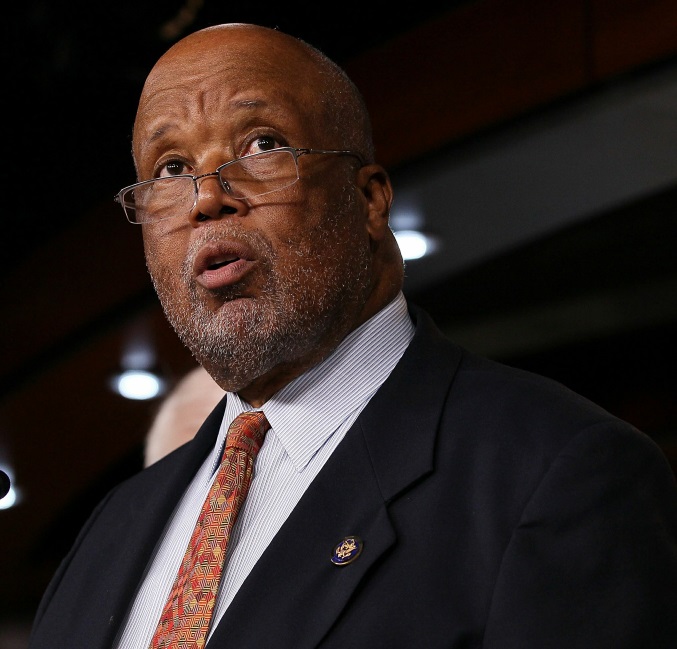
Bennie Thompson

“No big deal, he’s  just a Congressman…”

I often use the term “signature significance” in posts, and since it is a term that is not often applied to ethics, I thought today would be a perfect time to illustrate it in its original context, while clarifying the ethical murk around the Donald Sterling Ethics Train Wreck.

The original context of the phenomenon of signature significance is baseball, and I just watched an example of it. Today Red Sox left-hander John Lester beat the Oakland A’s, a very good team, by hurling eight innings in which he gave up no runs, only one hit, two bases on balls, while striking out 15 batters. If you don’t know anything about the game, let me tell you: this is extraordinarily good. Pitching performances can be measured and compared by using the “game score” method, developed by sabermetrics (that is, baseball statistics) pioneer Bill James. The best game score ever achieved was 105; the highest score in major league history for a pitcher who did not pitch all nine innings (as with Lester today) is 95, and has only been done once. (Theoretically, a game score could be as high as 145)

James also devised the term “signature significance” in the context of such games. His research showed that pitchers who were not outstanding talents never pitched a game with such a high game score even once—it simply didn’t happen. Thus, he reasoned, pitching a single game like Lester’s (the actual game he used was a similar performance by a young Roger Clemens before anyone knew what Clemens would become) was sufficient proof, all by itself, to conclude fairly and scientifically that the game was meaningful, without any other data. In cases of signature significance, he explained, the usual statistical rule that small sample sizes are not reliable indicators do not apply. Sometimes one incident, performance or episode is sufficient to make a confident verdict.

Signature significance is very useful, I have found, to rebut unethical rationalizations for unethical conduct that are used to excuse the agent of the ethical breach. “It’s only one mistake” and “Anyone can make a mistake” are the main ones. In the case of some serious kinds of bad conduct, this reasoning is misleading and false. Donald Sterling’s comments recorded and publicized by his whatever-you-call-her V. Stiviano have signature significance: they prove he’s a racist. Can you imagine any non-racist individual saying, in public or private, that he didn’t want his girlfriend being seen at his team’s games in the company of blacks?  How could this possibly occur? It wouldn’t, of course. Only those who hold racist attitudes and beliefs think and say such things. Sterling is a racist.

Stiviano, for her part, despite being the one who brought the media, the sports world and the public down on Sterling’s 80-year-old head, now says she doesn’t believe he’s a racist. Of course, she also says she’s his “silly rabbit” and that she is going to be President some day. She is an idiot. But I digress.

Other figures have made statements in the media that also have signature significance of the same sort as Sterling’s, yet the very same groups and journalists who have been whipped into a self-righteous froth over Sterling are strangely silent: Continue reading

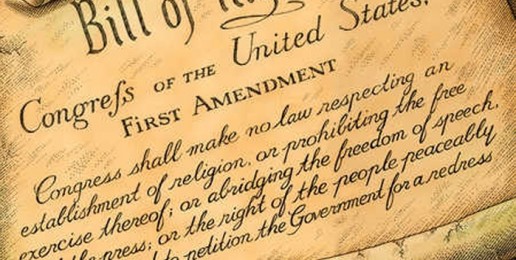
A Brief Ethics and Culture Lesson For First Amendment Pedants

First-Amendment-on-scroll1

Thousands or pundits and web commenters, perhaps hundreds of thousands, in their concerted effort to justify the speech and thought police, (at least as long as the Enforcers are not likely to disapprove of their thoughts and speech), are mocking those who cite the First Amendment as authority for the proposition that the treatment of Donald Sterling, and others, are harmful, sinister, and un-American. The pedants are technically correct, of course. When someone who is fired for posting something offensive on Facebook screams, “My First Amendment right of free speech has been violated!”, that typically speaks of a poor civic education. The Bill of Rights only constrains government action, not private transactions. No rights, which are enumerated and protected from government incursions by the Constitution, have been lost or affected when only private action is involved.

That does not mean, however, that when private action opposes an individual’s Constitutional rights, it is necessarily acceptable, fair, harmless, reasonable or right. Indeed, the government and law serves a crucial function by delineating and encouraging cultural and ethical values. The principles articulated in the Declaration of Independence, the Constitution and the Bill of Rights do not merely constrain government. They form the basis of the ethical values that make the United States a unique culture, and point the way to what Americans, as Americans, regard as right and wrong.

Thus, while searching though a friend’s private e-mail account isn’t a violation of one’s right to privacy under the 10th Amendment, violating a fellow citizen’s privacy is wrong, and the Bill of Rights stands as authority that it is something important to each individual that should be respected. The Constitution and the 13th, 14th, and 15th Amendments won’t and can’t stop Americans like Sterling from being bigots in their private dealings, but they send a clear message that bigotry is not approved by the United States and was not by those who have charted our ethical course. Privately interfering with someone’s right to worship as they please is wrong, and the fact that the government is prevented from doing it tells us so. The First Amendment’s existence also tells us that preserving free speech—open, fearless, speech—is essential to core American values, because it also supports free thought, that which tyrants and dictators fear. Yes, we all have the right to make free speech, thought and discourse costly, difficult and painful, but we should not. We have the right to punish severely the non-conformist, the iconoclast, the rebel, or the citizen who may be a little late, or slow, or reluctant, to accept the conventional wisdom of the moment. We have the right to do it, but it is wrong. It is un-American. The Constitution tells us so.

Addendum: After I wrote the post, I encountered this.


Comment of the Day: “Clayton Lockett Is Dead, Right? Then 1) Good! and 2) His Execution Wasn’t “Botched””

capital-punishmentThere are well-established group of ethics topics that will always cause spirited debates here, because they are issues that have always divided public opinion and always will: morality vs ethics, drug legalization, abortion, war, social justice, socialism, plus various controversies involving race, sexuality and gender. I try to wade into these only when a current even beckons, as to some extent the arguments are futile and familiar, and too many people refuse to think or listen anymore, retreating to slogans and reflex positions articulated by others.

I decided to wade into one of the most polarized, of these, capital punishment, when the Clayton Lockett execution in Oklahoma sparked a national debate that seemed strange to me, and indeed driven by the unwarranted assumption, uncritically accepted by the news media, that the painlessness of executions were a crucial feature of making them ethical as well as societally palatable. It also opened the question of whether one execution that doesn’t follow the script necessarily calls capital punishment itself into question. I confess: both in my post’s title and in the tone of my responses to anti-death penalty commentators, I intentionally sought to roil the waters of debate, and was determined not to allow the nice people who usually express compassion for the pain and suffering of humanity’s worst and deadliest escape with the usual pieties.

Sure enough, this annoyed the heck out of some readers. Responding to the emphatic objections of one, Isaac delivered a personal and powerful rebuttal. Here is his Comment of the Day on the post Clayton Lockett Is Dead, Right? Then 1) Good! and 2) His Execution Wasn’t “Botched:” Continue reading

A Sterling Ethics Train Wreck Update, Ethics Heroes Opposing The Mob, and The Comment of the Day

thoughtpoliceEthics Alarms commenter Chris Marschner again scores a Comment of the Day regarding the subtext of my recent post about Peoria Mayor Jim Ardis, whose stunning abuse of government power to punish a citizen’s free speech was ignored while destroying NBA team owner Donald Sterling, because he privately articulated offensive views to a vengeful girlfriend, became a media obsession and a national rallying point.

Before I get to Chris’s excellent comment, however, I should bring us up to date on the Donald Sterling Ethics Train Wreck, which has proceeded as I feared it would: Continue reading

Ethics Quiz: “Ick!” Or Unethical—The Arabic Pledge Of Allegiance

"I pledge allegiance to the flag...that the terrorists who speak this language want to tear down..."

“I pledge allegiance to the flag…that the terrorists who speak this language want to tear down…”

In the latest smoking gun example of how the administrators of public schools are widely recruited from the Homes For The Bewildered, we learn of Rocky Mountain High School in Fort Collins, Colorado, where the principal, Tom Lopez, and his staff agreed to let the school’s “Cultural Arms Club” lead the student body in an Arabic version of the Pledge of Allegiance, one that replaced  “under God,” the ill-advised addendum to the Pledge added by Congress when the U.S. felt under siege from “godless Communism” with  “under Allah.”

As further proof that they should be managing a street corner balloon establishment, the school’s administration professes amazement that parents and citizens are upset with this, and as more evidence yet, places the blame on the students. After all it was their idea, and if they voted to have their fellow students recite the pledge in duck voices, or Pig Latin, or punctuated with “Heil Hitler!” salutes and “der Fuhrer” in place of “God,” I’m sure that would be okey-dokey too. Continue reading