Comment of the Day: “The Humiliation of Jessica Urbina”

catholic church

I confess to priming Patrice, an old friend and the resident Catholic theologian here, for this. I have known here for many years, and she is what I would call a passionate and rebellious Catholic scholar, and hoping she would weigh in on my criticism of the Catholic Church in the wake of the treatment of high school senior Jessica Urbina, which I view as symptomatic of the Church as it is of the schools. As I expected, however, Patrice makes a strong case.

Here is her Comment of the Day on the post, The Humiliation of Jessica Urbina:

Well, you knew I was going to respond, right?

“The cruel treatment of Jessica is one more indication of the sorry state of the Catholic Church, which appears to be a fatal cesspool of hypocrisy, desperate public relations, and an integrity vacuum. There are two kinds of Catholics, it seems: those who profess the be devout followers of the Church but who discard and violate its doctrine and core principles whenever they seem too burdensome, unpopular or embarrassing, and those who blindly follow the dictates of the Church, no matter how clearly they have been proven wrong and wrongful by the accumulated experience and wisdom of civilization, because morality never changes.”

So, what am I? The feckless “Cafeteria Catholic” or the “Fundamentalist Catholic”? I really take exception to your gross generalizations about Catholics as being one or the other of your versions. Knowing me, Jack, how could you make such generalizations?

As a sometime student of Theology, I prefer to see myself as a Catholic who dissents in good conscience from certain teachings of the Church — not because they are “too burdensome, unpopular, or embarrassing,” but because I believe that there is more to be learned from the core teachings of Jesus than what we have thus far proclaimed. And for the record, I am saddened by what happened to Jessica. What the school did (notice I say school, not church) was not compassionate, kind, or tolerant.

The Catechism of the Catholic Church states the following:
“A human being must always obey the certain judgment of his conscience. If he were deliberately to act against it, he would condemn himself.”

The problematic part comes after that: “Yet it can happen that moral conscience remains in ignorance and makes erroneous judgments about acts to be performed or already committed.” It’s kind of a Catch 22. Does the Church see a well-formed conscience as one that has been properly educated (indoctrinated?) in the “truths” that the Church has put forth, and therefore agrees with the Church on all matters? Maybe. I suspect that this conscience thing was intended to give courage to Catholics who would have to disobey their “Catholic conscience” to do something they were being encouraged or forced to do in the secular world that is against Church teachings. Thus, martyrs. Regardless, I stand by my educated conscience.

I hold up the subjects of my senior thesis, which was about dissent in the Church: Hans Küng and Charles Curran. Both censured for their dissent, but still voices in the wilderness. Look at Pierre Telhard de Chardin. Got into a lot of trouble for his writings, but somewhat “rehabilitated” in today’s world of theological thought.

With regard to Jessica, I see this as an educational system problem, because it might have happened at any school. The fact that it happened at a Catholic school makes it look like a Catholic problem, but I sense that you would find the same problem in schools in various places around the country, as well as other denominations which teach (yes, there are others) that homosexuality is wrong/forbidden/whatever. I’m sure I’m breaking one of your principles here, but really I do see this as an authoritarian school problem first and foremost. It’s also a self-expression issue.

I personally wish Jessica great success as she, no doubt, continues to break the barriers that keep her and others from being and expressing who they are.


Comment of the Day #2: “Animal Ethics: Now THIS Is An Unethical Veterinarian”

Sid the dog

Rarely has a post generated as many defenders of the target of my critique as the recent Ethics Alarms commentary regarding the Fort Worth, Texas arrest of Dr. Lou Tierce, an aging veterinarian who, according to Jamie and Marian Harris, agreed to euthanize their dog Sid—that’s Sid above— based on Tierce’s diagnosis, but instead kept the dog caged in filthy and inhumane conditions for six months, until a whistleblower on his staff alerted the Harrises. 

Here is a portion of the arrest report, regarding another dog at the same clinic:

“The dog was lying on the floor twitching in pain with one leg missing, one leg dislocated and two dislocated shoulders. I then spoke to the suspect, Dr. Millard Lucien Tierce. He told me that the injured black and white collie was his dog. He said he had given water and food to the dog but had not given any medical treatment to the dog. He said he had not euthanized the dog even though in his professional opinion he knew it needed to be.

Dr. Morris, DVM, of the Fort Worth Animal Clinic, arrived on the scene and performed an evaluation of the dog. He informed me that in his professional opinion the animal was a victim of animal cruelty and the conditions of the clinic were deplorable.

Animal Cruelty Investigator R. Jacobs spoke to Dr. Millard Tierce. Tierce told him he knew the dog needed to be euthanized but he did not allow it. He signed over ownership of his dog to the Fort Worth Animal Control and the Fort Worth Animal Control took the dog to their facility.

On April 29, 2014, Dr. M.L. Morris, DVM examined the black and white border collie. Dr. Morris concluded that the dog was emaciated, had severe mouth disease, cataracts, abnormal overall health, non-ambulatory bottom of foot missing, had a degenerative neurological and untreatable disease and should have been euthanized when originally accepted for treatment. The dog was then euthanized by the city of Fort Animal Shelter.

Due to the aforementioned facts and information being related to me as a result of this investigation, I have reason to believe and do believe that Millard Lucien Tierce, did commit the offense of Cruelty to Non-Livestock Animals, against the laws of the State of Texas as set forth in the Penal Code; 42.092 (b)(l).”

Nonetheless, several loyal clients of Tierce’s clinic wrote to protest. They had entrusted their pets to him for many years, and he was clearly incapable of any kind of cruelty to Sid or any animal. The real villains were the Harrises. Or the tech who alerted them that their dog was still alive and being used for blood transfusions. Just wait, they assured me, when all the facts come out, this veterinarian from Hell will be exonerated. That the only way this could possibly occur would be for it to be proven that what the police thought was Sid was actually a hologram didn’t deter the doctor’s defenders at all.

Luckily, commenter Candy Roberts, a veterinary technician, put their arguments in perspective. Here is her much appreciated Comment of the Day on the post, Animal Ethics: Now THIS Is An Unethical Veterinarian: Continue reading →

Comment of the Day #1: The Eventual Firing of Daniel Picca: Why Our Children Are Not Safe In Public School

child-endangerment

One aspect of Ethics Alarms that provides me with both satisfaction and pride is that participants in the events that sparked particular ethics commentaries sometimes comment on the posts, providing fascinating and useful perspective. Such a comment arrived yesterday, a heart-felt and wrenching testimony by a former student who was one of the many abused by teacher Daniel Picca, in Montgomery County (Maryland) schools. My post had focused on the fact that his proclivities were well known by 1995, yet it took school administrators until 17 years later to fire him.

I also note, ruefully, that the original post concluded by pointing out that the tendency of those in positions of authority to postpone confronting reality, to avoid confrontation and to rationalize inaction even in the face of undeniable peril to others was mirrored in the U.S.’s irresponsible approach to the conduct of the leadership in Syria and Iran. It was written in 2012.

Here is Sergio Madrid’s Comment of the Day on the post, The Eventual Firing of Daniel Picca: Why Our Children Are Not Safe In Public School:

As a former student, this is all true. I was too young to know it back then, but this man is a calculating monster. Reading this story does not surprise me one bit.

Back in the day (early 90′s – Rachel Carson Elementary), he had kids from my neighborhood help him come clean his classroom and we did challenges for candy. He had a closet FULL of candy. I can reflect that his “Picca Magical Dollars” was an excellent motivator in the classroom – it was also my neighborhood’s downfall for young boys at the time. The magical bucks were used to buy candy on Fridays (if we chose to spend our money) and that candy was the bait for young boys. We were too young to even know. After school, we would clean his classroom and he would have me sit on his lap. He would have me flex and he squeezed my muscles. I do remember one incident where he squeezed and did not let go. I squirmed in agony and would back and head butt him – busted his lip and he got up and yelled at me to leave his room and go home.

Too bad I’m late. I really wish I would have stepped up on this man. He IS a monster and let me tell you …. he single-handedly destroyed all my African American and Latino friends in 5th grade with his malicious words and style. They were targets from day one and NEVER recovered to be successful students in school. I still remember all this some 20-25 years later.

Although I do not know where he currently is, keep this man away from ANY schools with young children. If one person reads this – please understand it’s very real and true. I didn’t hide my real name. He was my 5th grade teacher. Real shame and sad to read these articles.

Comment of the Day: “Clayton Lockett Is Dead, Right? Then 1) Good! and 2) His Execution Wasn’t “Botched””

capital-punishmentThere are well-established group of ethics topics that will always cause spirited debates here, because they are issues that have always divided public opinion and always will: morality vs ethics, drug legalization, abortion, war, social justice, socialism, plus various controversies involving race, sexuality and gender. I try to wade into these only when a current even beckons, as to some extent the arguments are futile and familiar, and too many people refuse to think or listen anymore, retreating to slogans and reflex positions articulated by others.

I decided to wade into one of the most polarized, of these, capital punishment, when the Clayton Lockett execution in Oklahoma sparked a national debate that seemed strange to me, and indeed driven by the unwarranted assumption, uncritically accepted by the news media, that the painlessness of executions were a crucial feature of making them ethical as well as societally palatable. It also opened the question of whether one execution that doesn’t follow the script necessarily calls capital punishment itself into question. I confess: both in my post’s title and in the tone of my responses to anti-death penalty commentators, I intentionally sought to roil the waters of debate, and was determined not to allow the nice people who usually express compassion for the pain and suffering of humanity’s worst and deadliest escape with the usual pieties.

Sure enough, this annoyed the heck out of some readers. Responding to the emphatic objections of one, Isaac delivered a personal and powerful rebuttal. Here is his Comment of the Day on the post Clayton Lockett Is Dead, Right? Then 1) Good! and 2) His Execution Wasn’t “Botched:” Continue reading →

A Sterling Ethics Train Wreck Update, Ethics Heroes Opposing The Mob, and The Comment of the Day

thoughtpoliceEthics Alarms commenter Chris Marschner again scores a Comment of the Day regarding the subtext of my recent post about Peoria Mayor Jim Ardis, whose stunning abuse of government power to punish a citizen’s free speech was ignored while destroying NBA team owner Donald Sterling, because he privately articulated offensive views to a vengeful girlfriend, became a media obsession and a national rallying point.

Before I get to Chris’s excellent comment, however, I should bring us up to date on the Donald Sterling Ethics Train Wreck, which has proceeded as I feared it would: Continue reading →

Comment of the Day: “Ethics Quiz: Peeps Ethics”

Peeps Last Supper by Leonardo DiPeepchi

Peeps Last Supper by Leonardo DiPeepchi

Extradimensional Cephalopod’s thoughtful answer to today’s ethics quiz was instantly recognizable as a Comment of the Day, so here it is, EC’s musings on the ethical limits on peeps art, as posed by the post, Ethics Quiz: Peeps Ethics:

Full disclosure: I identify as a freethinker, which in my case means my opinions are informed by this idea: “It is the mark of an educated mind to be able to entertain a thought without accepting it.” –Aristotle (or so the Internet tells me)

With that in mind, offhand I’d say anyone who can’t handle the juxtaposition of a serious scene with a cutesy or comical medium is not emotionally mature enough to be trusted to react appropriately in today’s complex and nuanced culture, and their reverence is likely to be taken to unhealthy levels. I think it is not only ethical, but a requirement for intellectual health to be able to entertain different perspectives and styles of presenting even the most serious subjects. Before someone asks, yes, that includes depictions of the prophet Muhammad, along with all other historical figures on pedestals. I think taboos are unhealthy for a society because they limit critical thinking and creative free thought, both of which are necessary (yet seldom employed) to resolve social issues and differences in perspective.

Bad taste is still a valid concept, but it is context-dependent. It is possible that a subject is not appropriate for most contexts because it leads people to feel bad, but it is imperative that there be some place where it can be discussed, even if it is only under the Jester’s Privilege. My subjective judgment rules that depicting the Civil Rights Movement with marshmallows in this case is not intended with disrespect: the contest stipulated that the medium be marshmallows, and the artist chose a powerful scene without regard for the medium, as is the artist’s prerogative. I personally think the marshmallow scene is quite dignified, but then I am a bit out of sync with humanity as to what I take at face value and what I don’t. I form opinions of peeps by their actions, not by their countenance. It’s unethical for an artist to deliberately spread misconceptions about history, and it may be unethical for an artist to deliberately show disrespect to powerful agents of good. Disrespect is usually unethical because it causes so many problems. However, I’m not sure a sincerely respectful artist can be unethical in their art, unless they simply fail to do the research on the facts they depict and the cultural context for showing respect.

If depicting scenes from the Civil Rights Movement with marshmallows (and putting a good deal of effort into it) is wrong, though, what else is wrong? Crayon drawings by kids? Macaroni? Charcoal? Embroidery? Spray paint? Etch-A-Sketch? Is anything that looks insufficiently grandiose for depicting humanity’s legendary heroes an affront upon their memories? Are scenes of historical importance off-limits to mediocre artists, for fear the general public will lose respect for heroes drawn with funny expressions and ridiculous poses? What if an artist is deliberately depicting a heroic person comically, but without telling lies? Why can’t we be mature, and tell the history with respect while artists do their best in sincerity or spite? Why not simply say, “Well, it’s nice, but it really doesn’t do it justice,” and walk away?

Continue reading →

Comment of the Day: “Comment of the Day: ‘An Unethical Website, Golden Rule Malpractice And The Worst Anti-Bullying Program Ever'”

Atom bomb cloud

Responding to according2grayson’s passionate defense of non-violence and the Golden Rule while encountering bullies (as well as while opposing despots on the march), Steve-O-in-NJ enriched Ethics Alarms with an epic response including historical perspective, ethics and personal experience.

Here is his terrific post—long but not to be missed—and the Comment of the Day, on Comment of the Day: “An Unethical Website, Golden Rule Malpractice And The Worst Anti-Bullying Program Ever”:

I question this litany of life experiences, since it sounds a bit too pat and a bit too neat to be real, or at least it sounds sanitized/incomplete. Those with truly outstanding records usually don’t feel the need to trumpet them. That said, I wasn’t there, so maybe it is all true.

I know I tried the non-violent approach a few times, and it just lead to more bullying. I also tried the fight-back approach, smashing one bully’s head against the sidewalk and nearly strangling another, and it frankly didn’t get much more done beyond getting the bullies off my back temporarily. That said, a temporary respite from abuse is better than absorbing abuse every day without a respite. What really broke one group of problem people was a combination of finally going to the authorities and the people overreaching.Despite the justified criticism of Catholic schools (a whole separate discussion), they did have one very big thing going for them: no one who was enrolled had to be, or had any right to be, and dismissal or necessary discipline was easily accomplished. Continue reading →

Comment of the Day: “An Unethical Website, Golden Rule Malpractice And The Worst Anti-Bullying Program Ever”

He chose his adversaries well.

He chose his adversaries well.

Debut commenter according2grayson submitted a heartfelt, extensive and thought-provoking reaction to the post about a Lincoln, Nebraska school’s  much-criticized anti-bullying advice and the website that spawned them. I’ll have some comments at the end; in the meantime, here is the Comment of the Day on the post, An Unethical Website, Golden Rule Malpractice And The Worst Anti-Bullying Program Ever:

The rule is “Do not attack” immediately “If I attack you.” You’re being asked to place yourself in the shoes of an attacker. NO ONE attacks without feeling angry, hurt, or victimized. Why do homophobes beat up gay kids? Fear that they might be gay too, or offense at people mocking their God. Fear of what’s different. No, fear isn’t always a rational response to something that might put us on a breathing tube. The word “phobia” by it’s definition means “irrational,” and this pertains to everything from Xenophobia to Homophobia to Genderphobia to Arachnophobia. I guarantee that a garden spider isn’t going to put anyone on a breathing tube, but how many people shriek when they see him anyway?

Now here’s the issue– if you lash out irrationally because you’re afraid of someone, and you punch them in the face– that person now has a very rational reason to punch you in the face. But, being an emotional creature and not understanding why your own initial attack was wrong, you’re not going to say “Well, I punched him…..” You’re going to say “Ow! My nose is bleeding, you little shit!”


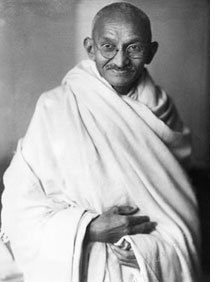
Until someone does decide to turn the other cheek, it’s only going to keep going back and forth, if not escalating. That’s the entire purpose behind such things as the Golden Rule and Christ’s “Turn the Other Cheek” argument. Read Gandhi. Try to follow the rules of Satyagraha. These rules lead a nation to Freedom without bloodshed. No, it wasn’t a “perfect revolution.” Yes, there were years of hardship that followed. But if you want a perfectly demonized bully (aside from maybe Hitler) British Empire’s your best bet. And these tactics DID take them down.

You can argue that “kids aren’t ready for this.” But I’m sorry, I can only laugh at you for underestimating children. I was 12 years old when my older brother was killed in 9/11. I grew up involved in activism against the wars. I was shoved into lockers, thrown down stairs, beaten up, called a “terrorist” and a “traitor to my nation.” And that was just the latest permutation of bullying I had faced.

I was taught, however, that our duties were to “think globally, act locally” and “become the change we wished to see in the world.” I was told that I wanted to be a voice for a non-violent response to a terrible act– I HAD to learn to respond non-violently to children being children.
And you know what? It didn’t turn me submissive. It didn’t take away a single ounce of pride.

I knew that the assholes picking on me lacked fundamental understandings of most of the reasons -why- they claimed they were picking on me. I knew that if any of these rich kids with their Hallmark Card homes (and, yes, when you go to a private parochial school of 8 kids, you do pretty much know that) had stood so close to national tragedy as any of the family members I was working with– they wouldn’t have handled it. They already couldn’t handle adversity. The gay kids? The black kids? The poor kids? They beat them all up. If other people’s hardships were so terrifying, how would they react to their own?

I laughed at these kids. I went on to graduate third in my class, was the first accepted to college. By which point I’d already worked for 3-4 years with a twice Nobel Prize nominated organization. Already helped organize lobbying campaigns (including one to shut down GITMO with PT & Amnesty International, which Obama recalled the involved groups to respond to in his first press conference) I’d already been a founding member of the World Conference for Peace and shaken hands with one of the last of the habakusha, with a minister who trained under Desmond Tutu, with mothers from Israel and Palestine working side by side (minority though they’ll always be) to end conflict.

In college, when I came out as pansexual, no one batted an eye. Afterwards, when I lost weight and started performing with the NYC Rocky Horror Cast (to an audience of at least 200, weekly. Not factoring special performances at other venues and in NYC cultural events) started performing Off-Broadway, started working with NPR (where a workshop I head-lined along with a few other youths effects by 9/11 won 4 awards including Bronze for “Best Radio Doc of 2011″ from the Society of Professional Journalism) People FLOCKED. Not only was I a hot commodity professionally. But socially as well. I’ll refrain from speaking of my exploits, as this is a mature site– but, when my buddies and I play the “Cassanova” drinking game, I’m usually one of the first to lose, and I always do so in a single scene.

The only argument you can make against any of this is “your life’s not that great” and no, you’re right, it isn’t. I’ve faced many hardships including the death of my brother. Lost my job and apartment in a hurricane last year. But none of that had to do with my response to bullying. And while some of those events may have had me, at times, not in places where I was able to deal to the best of my ability it’s not MY ability in question

ANY child can learn to find personal pride in their own accomplishments, can learn not to take bullies seriously (BECAUSE THEY AREN’T) Can learn not to perpetuate cycles.

And in the end, years down the road, they’ll be getting Facebook requests from their former bullies with notes saying “I’m sorry.” It’s not delusion. I’ve lived it.

Continue reading →

Comment of the Day: “Ethics Rant: Here Is The Smoking Gun Proof That The Government Doesn’t Care How Much Money…”

Whatever anyone might think of Ethics Alarms, it can’t be accused of not being eclectic. Today’s Comment of the Day illustrates the point, with an impressive  and informative debut by new commenter Dave on the cost savings to be had based on choice of  printing fonts, and more. The original post used a sixth-graders science project conclusion that our federal and state governments could save hundreds of millions of dollars by simply conserving ink as a departure point for a general critique of government diligence, responsibility, and competence.

Here is his exposition, inspired by the post, Ethics Rant: Here Is The Smoking Gun Proof That The Government Doesn’t Care How Much Money It Wastes, Or, In The Alternative, That It Isn’t Run By Sufficiently Competent People To Be Trusted To Spend What It Does:

The most important aspect of the 14 year old’s study is valid. You can save money with a better font. How you get there is not important. So I support the hypothesis of the study. Of course, as in almost all studies, it requires more study. Adding paper to the mix makes it more hopeful.

I like his study for three reasons:

1. It puts ink and paper into the public discussion
2. It illustrates that really large numbers times really small numbers equals a big number.
3. It moves us ahead in our quest to the use of something other than Times New Roman. It’s a newspaper font!

First off, names are useless in discussing typefaces as they were trashed by the patent/copyright office many years ago. Garamond is one of dozens of great type families. Each has it’s unique features but most do not perform optimally in all applications. The criticism of using Garamond in the testing misses the point entirely. Successfully curtailing the weight of an optimized font, versus a newspaper font, to image on bond paper is likely. Let’s move on from nitpicking Garamond. 

Ink is measured in dimes with inkjet, nickels with toner and pennies with printer’s ink. Breaking down the imaging techniques of all government documents is a massive effort, census like. But, for now, let’s address word processed documents. This is probably the largest population of original documents. (We’re not going to make much headway in savings attacking the professional typeset material that is printed in the millions.)

Given we tune a font for ink/toner use, one of the last considerations influencing legibility and readability of a word processed document is typeface. Because MS Word is used exhaustively for this application, I would order the priorities leading to better legibility and readability as follows:

1. Word Spacing. You can see in the example used to trash the study (3rd line of Garamond) It’s like talking to someone who says “uh” every other word.

2. Serifs v. Sans Serif. This choice is more of a readability thing than a legibility thing.  I choose sans-serif for heads (eliminating the need for bold italic serif fonts) and serif for text  when I create a typical Word doc. Generally, type really doesn’t have to be serif if the document is short but the longer it gets….

3. Line Measure. This goes together with word spacing, the longer the measure the worse word spacing becomes with MS Word. And personally I have attention issues so I need a break more often.

4. Body leading. Otherwise known as line spacing in the world of glorified type writers; it’s like word spacing only in the vertical direction.

5. Letter-spacing. This is font design dependent but not typeface dependent. They can screw this up no matter how the the letters look. It’s one of MS Times New Roman most nasty offenses. It’s not only looks awful, it wastes paper.

6. Hyphenation and Justification (H&J). Justified type is lined up on both sides of the page. Word Processors are not good at this, MS is particularly bad at both H&J.  It’s an old requirement with setting type, but it helps readability with long documents. It generally saves paper to boot but it’s not worth botching up word spacing to get these advantages. (It’s not as critical with 1-2 page documents so that’s why it’s 6th on the list.)

7. Type Style. If we excel at all of the above, like professional design software, then the particular type design is a factor. Because we are focused on text, the theory is if we significantly adjust the design for 12 point and with word processing in mind we can do well here in ink savings.

8. Paper color. Office paper is very good here.

9. Type color. Anything other than black type can’t be discussed here but it is realistic to discuss grey. I exclusively  use draft mode on my inkjet printer and nobody notices.

10 . Room light. Using serifs or not and setting an appropriate type size is about wearing out your eyes with too little or too much light. Serifs on text cut back on light, while size impacts detail helping legibility. Sans serif type in headlines are not an issue because they are short and it provides contrast with the text.

So, the student’s focus on the smaller, most used type is appropriate. The focus on weight relative to ink usage is also appropriate. A focus on more sophisticated typography than MS offers today would significantly impact paper usage, even without using two sided features we have today.

TrueType, GX stuff, et al were all awesome in 1996, a big accomplishment. They are still relevant for designers, but here we are stuck with MS Word; Opentype features are wasted. Moving to a maybe more primitive technology but optimized for both savings and readability would be a good start towards the $400 million goal.

We are in a transition period, so it may be awhile. Saving money along the way to fully electronic isn’t a bad thing. These no valid reason to make trade offs during the transition. It will be complicated but in step with the transition. All ideas are worthwhile, there is no reason not to implement all of them.

Continue reading →

Comment of the Day: “Ethics Quiz: Targeted Dress Coding”

Yoga-PantsThe ethics quiz on banning leggings and yoga pants for some female students and not others produced several excellent responses. I was surprised that the majority here supported selective enforcement, which is normally regarded as per se unfair. This response is especially remarkable considering that the selective enforcing will be done by the kinds of geniuses that punishe little girls for shaving their heads to make cancer victims feel better.

Here is the Comment of the Day by the intriguingly named “The Wednesday Woman” (whose comment arrived on a Sunday) on the post Ethics Quiz: Targeted Dress Coding, which answered the quiz query, “Is targeted dress coding ethical?”

Continue reading →