Comment of the Day: “Desperate Ethics Quote Of The Week: Louis C.K.”

This is a combination of two comments, by the same wise commenter. I thought both were excellent, and together they are better still.

This is La Sylphide’s Comment of the Day on the post, Desperate Ethics Quote Of The Week: Louis C.K.:

Twice a summer I work as a “runner” for two huge music festivals: one country, one rock. I am often in close quarters, or in a car, with very famous people. I’m always professional. I’m always discrete. Rarely am I star struck. (O.k., driving Johnny Depp was pretty cool.) Most stars and their tour managers are kind and thoughtful. But now and then you get a blowhard, or two. One, very well known country star wanted me to share his cigar with him as I drove him to his private plane. “C’mon, sweetheart” as he held out the cigar to me, “it’s not THAT wet…” The whole car went silent. There I was, the only woman in a car with 5 men, a wet cigar, and a wink wink. I played dumb. I blew off his remark with a smile… They all laughed. Here’s the thing: he held no power over me. He couldn’t advance my career or ruin it. I had nothing at stake. And so yes, I can understand these women, in the same industry as Louis C.K., trying to make it, in a hotel room with him and wondering “wtf, do we do now ?!? How much damage will be done if we stay? How much damage will be done if we tell him to GFH? ” So very often, when you are dealing with someone who wields enormous power, it’s like navigating a mine field. For women, there are often split second decisions to be made: do I cross the street now because it’s late at night, I’m alone and he’s coming toward me, or if I cross the street will I anger him and make things worse.”

… Continue reading →

Comment Of The Day: “Megyn Kelly, William Saroyan, Ethics, Me, And Us: A Rueful Essay” (#2)

The second of the Comments of the Day sparked by my musings on Megyn Kelly’s descision to move from a job where she excelled to a completely different assignment at which, at least so far, she is crashing and burning like the Hindenburg. The first, by  Extradimensional Cephalopod, was very different, an abstract analysis of the phenomenon that bedevils Kelly, and many of us. The second, a personal account of the dilemma in action, is no less enlightening, but very different.

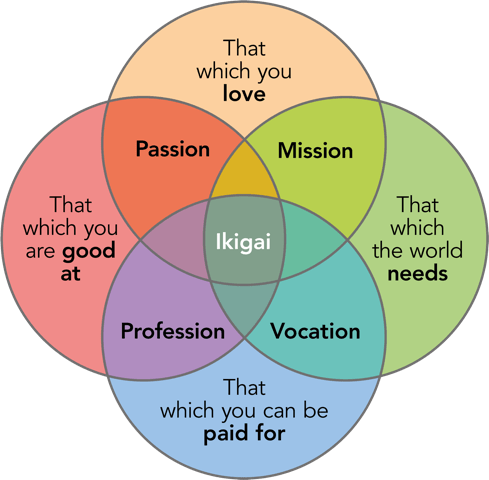
The comment also reminded me that I have never posted about the Japanese concept of Ikigai, and I should have. There is no English equivalent for the word: ikigai  combines the Japanese words ikiru, meaning “to live”, and kai, meaning “the realization of what one hopes for.” Together the words encompass the concept of “a reason to live” or the idea of having a purpose in life. Ikigai also invokes a mental and spiritual state where individuals feel that their lives have value—to them, to loved ones, to society.

Ikigai odes not spring from actions we are forced to take, but from natural, voluntary and spontaneous actions. In his article titled  “Ikigai — jibun no kanosei, kaikasaseru katei” (“Ikigai: the process of allowing the self’s possibilities to blossom”) Japanese wrter Kobayashi Tsukasa says that “people can feel real ikigai only when, on the basis of personal maturity, the satisfaction of various desires, love and happiness, encounters with others, and a sense of the value of life, they proceed toward self-realization.”

Sounds simple.

It isn’t.

Here is Alex’s Comment of the Day on the post, Megyn Kelly, William Saroyan, Ethics, Me, And Us: A Rueful Essay:

This topic is close to my heart, so time for some confessions and public reflections.

As I’ve previously mentioned I’m a software engineer, over a decade of experience, and modesty aside, a darned good one at what I do. The main areas of work I’ve been involved in are speech recognition, accessibility and development runtimes (think along the lines of the Java runtime). It was not necessarily world transforming work, but it had an impact and passionate following by our users. Pay was good if slightly low for the experience I had, and as of late I was getting tired of the work and wanted to try something new – also, a reasonable salary increase was not going to hurt.

So I start my job hunt, both internally and externally. At the end it comes down to two very good offers: One working for a social media giant with at a still-to-be-determined role with extremely good pay and no clear route for advancement. The other working closer to hardware (I’m an EE but never worked on it professionally) with lower pay (still an improvement over my previous job) at a clearly defined role with an advancement development plan and with the goal of putting people in space.

Putting it like this it sounds like a home run, but with a family in the line – I’m a single earner with three kids – the financial sides are a big consideration. There were so many things to balance: money, prospects for advancement, happiness, commute time, personal fulfillment, and yes, societal value of my work. It was not an easy decision, there were difficult conversations with my wife and even more than a year later some days I wonder if this was the right call (I went with the space company…Yay!) Continue reading →

Comment Of The Day: “Megyn Kelly, William Saroyan, Ethics, Me, And Us: A Rueful Essay” (#1)

My post over the weekend, one long in germination, regarding the personal and societal dilemma of balancing one’s duty to oneself, one’s duty to be useful  and the infuriating hard-wired human tendency to always seek something different and better, received a gratifying response and at least two Comments of the Day.

This is the first, by frequent COTD auteur Extradimensional Cephalopod, is a marvelous supplement to my post, and I wish I had written it myself, except I couldn’t have.

Here is EC’s Comment of the Day on the post, Megyn Kelly, William Saroyan, Ethics, Me, And Us: A Rueful Essay:

One of the central principles of Buddhism is “life is suffering”. Clarified, it means that conscious beings inherently have some concept of how they want the world to be that is different from how it actually is. Alternatively, if the world is already how they want it to be, either the chaos in the world will bring it out of alignment with their desires, or they will eventually become dissatisfied as their minds develop further. This is what the bartender in Saroyan’s story is referring to. It’s the existential condition; “condemned to be free”, as Sartre put it.

Having studied desire and motivation from an existential point of view, I’ve codified eight motivations that lead people to form goals. They are based on three dichotomies: experience versus control, greater and lesser quantity, and order versus chaos.

Greed/ambition: the desire for more control or more accomplishment (acquiring more possessions or becoming more important).
Gluttony/celebration: the desire for more of an experience (greater intensities or more constant access).
Wrath/boldness: the desire to break through limits by exerting control (disregarding rules or doing the impossible).
Lust/curiosity: the desire to remove limits on one’s experiences (experiencing the unknown).
Hubris/scrupulousness: the desire to impose limits through one’s control (absolute, perfect control over something).
Envy/dedication: the desire to impose limits on one’s experiences (obsession or tunnel vision).
Sloth/contentment: the desire to have less control (having responsibility or having to pay less attention).
Cowardice/prudence: the desire to have less of an experience (avoiding pain or discomfort). Continue reading →

Do Good Friends Let Friends Publish Garbage On Social Media? The Duty to Knock Down Irresponsible Opinions

“Stop quoting Maxine Waters!”

I just arrived at Virginia Beach Double Tree after a four hour plus drive in the dead of night. This gave amble time to obsess to the point of madness on Facebook post I saw from a friend. This is a smart, educated person; published in fact. Yet the post was (I am paraphrasing):

“I don’t understand Republicans. They must prefer Pence to Trump: why won’t the join Democrats in impeaching the orange bastard? I don’t get it.”

This post garnered many likes in the Facebook echo chamber, and several theories.

Now, this is not just an uninformed opinion. It is a dangerous opinion. It misinforms everyone who reads it and who has reason to trust and respect the writer. It is written in complete ignorance of the Constitution, and an irresponsible misinterpretation of what American democracy is.

I shouldn’t have to explain this further, but what the hell: if the Founders intended for our system to be a modified parliamentary arrangement where the public can try to elect a President but if Congress decides it prefers someone else, like the Vice-President, it can veto the election with a sufficient majority, then Madison, Mason et al. would have made that clear. Instead they made it clear that an elected President can only be impeached upon a guilty verdict in a Senate trial for “high crimes and misdemeanors,” which means unequivocal, serious and substantive wrongdoing, usually criminal. Yet a frightening number of progressives, driven to fantasy by listening to irresponsible and incompetent elected demagogues like Maxine Waters, actually embrace an imaginary version of our government that, if real, would render democracy a cruel fraud. Continue reading →

From The Ethics Alarms Lost Files: The Ballet Dancer, The Man On The Tracks, And The Duty To Rescue

That’s our hero, Gray Davis, in the bottom photo. The top photo is just a suggestion if he decides to go pro…

[This story is several months old, but I missed it.  Luckily my friend, long-time Ethics Alarms reader and commenter Ethics Bob did not, and sent it to me. Then I missed his e-mail. Until today.]

Ethics Alarms often writes about the duty to rescue, but has also often discussed the reasonable limitations on that duty. You are ethically required to do what you can to prevent a tragedy if you have the power to do so, and instant presence of mind to do so. There is no ethical duty to act like Batman, unless, of course, you are Batman.

Gray Davis is Batman.

Well, that’s not quite right.

Let’s call him “Ballet Man,”

In June, a 58-year-old homeless man fell or was pushed onto the subway tracks at the 72nd Street Broadway-Seventh Avenue station in Manhattan. People began screaming and shouting for someone to help. Davis, 31, told reporters that “At first I waited for somebody else to jump down there…. But nobody jumped down. So I jumped down.” Actually he leaped down. Davis is a ballet  dancer with the American Ballet Theater. He had not performed that night, a Saturday, because he was recovering from a herniated disk. He had just watched his wife, soloist Cassandra Trenary, dance in both the matinee and the evening performances of “The Golden Cockerel.”

After Gray’s graceful assemblé from the platform onto the tracks, he lifted up the man, following a temps leve, although the carry itself was not standard and had several technical flaws by ABT standards, forgivable because ballerinas are not typically dead weight, and unconscious homeless men are not typically ballerinas. Gray deposited his temporary partner on the platform, where he was immediately attended to by others.

Then the dancer heard a train in the distance, and for the first time realized how high it was to the platform from the tracks. “Luckily, I’m a ballet dancer,” he said. Luckily for everyone. Lifting his let up over his head is a breeze.

Ballet dancers are much-maligned, and increasingly unappreciated as artists despite the fact that they are among the most skilled athletes in the world. Batman would have to have ballet training; Daredevil too. Unfortunately, they aren’t real. Graey Davis, Ballet Man, is real, and when a life was at stake and everyone else was calling for someone else to he a hero, he was one, because he knew he had the skills to pull it off.

Bravo!

Encore!

_____________________

Pointer: Ethics Bob

Comment Of The Day: “From The ‘Stop Making Me Defend Lawrence O’Donnell!’ Files: The Golden Rule”

A commenter on the post on the studio tantrum thrown by MSNBC host Lawrence O’Donnell going viral on YouTube after it was leaked said that such a leak was “predictable.” I asked,

“Why should it be “predictable”? Why shouldn’t we be able to trust co-workers not to try to hurt us, e-mail correspondents not to send out our messages to strangers and on social media? Was it predictable that Donald Sterling’s mistress/beard would tape his comments in his bedroom to destroy his reputation?”

This prompted Crella’s  Comment of the Day on the post, From The “Stop Making Me Defend Lawrence O’Donnell!” Files: The Golden Rule:

Exactly. It shouldn’t be predictable. However, it seems that for a lot of people, their first instinct with anything they come across is to put it on the net, no matter the consequences. It’s so easy ( and I assume, extremely satisfying to bully types) to shame and humiliate on a scale previously unknown in human history. It’s irresistible to too many.

The ability to find thousands of like-minded people in a relatively short period of time on social media, and the sheer volume of encouraging positive feedback you can receive ( ‘if so many people agree with me, I must be right!’) has brought grade-school level cliques and meanness to the fore in a great deal of adult communication. It’s the same mechanism on a large scale. People rarely step back and see themselves, but I read and just wonder at it daily…the people most stridently against fat shaming, objectification, being leered at, and other ‘lookist’ offenses on social media are routinely ridiculing Trump on his hair, weight, skin color, and posture while playing golf, comments on appearance are very common. Continue reading →

Comment Of The Day: “Morning Ethics Warm-Up, 9/12/17: Hurricane Reports, And Poor Charles M. Blow Needs A Vacation”

G.K. Chesterton (above), perspective, and most of all, optimism: Ryan Harkins’ Comment of the Day, prompted by the post Morning Ethics Warm-Up, 9/12/17: Hurricane Reports, And Poor Charles M. Blow Needs A Vacation, (about NYT columnist Charles Blow—the idiot– declaring today’s USA “Hell on Earth”)  has all of these, and wisdom too.

Here it is:

Okay, I tried to read the article, and I made it no further than Blow describing Trump’s America as the ninth circle of hell. When one strikes that level of hyperbole, it eradicates any credibility one might have possessed.

One of the greatest counters to depression and despair is an attitude of gratitude, something I truly see lacking in anything coming from the left. We have a great nation. We have great opportunities, and we have a culture that truly seeks – if sometimes in very strange, even damaging ways — to right wrongs and make life as fair as possible. If you look around the world, and if you look at just about any culture that existed since the dawn of history, you won’t find any people who have been so richly blessed as those in our country today. This is especially true when you consider the stability our nation has, and its lack of credible enemies that pose any existential threat to our nation. We can go about life assured that tomorrow will indeed be much like today.

Even in the face of hurricanes, we have much for which to be grateful. We have incredible technology that gives us quite a bit of advanced warning that the storms were coming. We have minimized death tolls in the face of these natural disasters, and we have a government willing to pour billions of dollars into rebuilding communities destroyed by the hurricanes. We have seen an incredible outpouring of generosity from the nation at large to help the hurricane victims (the Knights of Columbus alone raised $1.3 million). Yes, the devastation is traumatic, and yes people have lost livelihoods, all their possessions, and even family members. But this strikes against one very important aspect of life. Continue reading →

My Verizon WiFi Ethics Dilemma

ProEthics (and our home, where it resides) is in Alexandria City, in Northern Virginia. We are dependent on the internet, but cannot get the high-speed variety, Fios, from Verizon, our provider. This has significant business and personal consequences: for one thing, it means that I can’t load video commentary on Ethics Alarms as I have wanted to do for years. For another, Verizon’s DSL service, at least mine, sucks. Lately it has been kicking out many times every day, sometimes after only being up for a few minutes.

We have called Verizon many, many times, in various states for fury,  to ask when  Fios will be available. The answers are scripted and vague, made to sound like the service will be available imminently. Nothing changes, however. Alexandria isn’t Hooterville: there are many businesses, and the residents would be a prime market for high-speed internet.

What’s going on here? Continue reading →

Comment Of The Day: “Morning Ethics Warm-Up: 8/2/17”

From Emily, a marvelous Comment of the Day so full of wisdom and good advice that it stands on its own:

I’m not from flyover country, but I live on the Eastern Shore of Maryland, red counties that include the poorest counties in the state (the lower shore has Baltimore City beat.) My family of three hovers around the federal poverty line.

However, my husband and I were both raised middle class. And while there are no major economic differences between us and our friends and neighbors, there are a lot of differences in the choices we make, which allow us to use the same amount of money to give our daughter opportunities that other parents in our economic class are unaware of or neglect.

This, more than money, is what affects the opportunities that my daughter has access to (as well as the ones my husband and I have access to.)

Despite the economic hardship, I’m a stay at home mom, which allows me to be dedicated full time to my daughter’s developmental delays. I could go to work and make *slightly* more money for us, after childcare expenses, but that would be a very different level of care for my daughter, and it turns out she needs it. The expert we’ve consulted is almost certain she’ll catch up, and has indicated me being home with her is an important part of that certainty.

I mentioned above that my daughter does have a tablet, a $30 one from Amazon. I found that tablet because I got a $20 Amazon giftcard for Christmas, and I was saving it for something special. I had to dig in the library’s website to find the link to borrow ebooks, but I figured there must be something like that.

We have internet, despite having no long distance for our phone (and no cellphone service where we live.) My husband and I manage to pick up extra money doing work online, despite neither of us having college degrees. This is part of what allows us to get by while still having plenty of time for our daughter.

These are just examples of things *we’ve* figured out. Everyone’s situation is different, especially among the poor. The thing that most people don’t seem to see is that down here social capital (the network of friends and family you have and what they’re willing to help you with,) knowing how to allocate resources carefully, and understanding how to navigate the various systems — both private and government — are more important to the kind of life you have than income, and those are highly individual things. Continue reading →

The Unabomber Had A Point. [UPDATED]

FX has a new limited series about the hunt for the Unabomber, Theodore John Kaczynski. I didn’t pay much attention to the story when it was going on; I just thought it was one more Harvard-grad-turns-serial-killer episode, and that was that. I certainly didn’t pay attention to his “manifesto.” The series, however, enlightened me.  As I understand it, Ted believed that technology was destroying society, making us all slaves to it, and taking the joy out of life. I have yet to see how blowing people up addressed this problem, but then he shouldn’t have to be right about everything. The evidence has been mounting since 1995, when he killed his final victim,that  the Unabomber  wasn’t quite as crazy as we thought.

I could bury you in links, but will not.  We are slaves, for example, to passwords. I teach lawyers that their devices containing client confidences should, to be properly protective of them under ethics standards, have passwords of at least 18 random letters, characters and numbers, with the password for every such device being different, and all of them changed every month. Or you can go the John Podesta route, use “password.” and get hacked, and eventually disciplined by your bar association, once they decide to get serious.

[CORRECTION: In the original post, I relayed a link to a site where you can check your password to see if it’s been compromised. I had been forwarded the link by another tech-interested lawyer. But as I was just alerted by a commenter (Than you, Brian!) It’s apotential trap and an unethical site, making you reveal your password to check it. I apologize for posting it. See how dangerous and tricky this stuff is? See? SEE?.I fell for the trap of depending on technology to protect us from technology! Ted warned us about that, too.]

Then there is this feature in The Atlantic. An excerpt: Continue reading →