In February, my monthly legal ethics course for the D.C. Bar had a surprising attendee: former Senator Arlen Specter. I didn’t realize he was among the attendees until the break, when he walked up to me, looking like the photo of him I had placed in a PowerPoint presentation the very night before. He had a big smile, and barely gave me a chance to blurt out, “Hello, Senator,” before he grabbed my hand in a steel grip, pumped it, looked directly into my eyes, said, “Good job!” and slapped me enthusiastically on the back. Continue reading
Daily Life
Rating Judge Kozinski’s Lies
The Ninth Circuit declined the opportunity to reconsider its controversial (and wrong) decision earlier this year that declared the Stolen Valor Act unconstitutional. That means that according to the Ninth Circuit, pretending to have won a Purple Heart or a Silver Star is protected speech, and Congress’s law making it a felony to wear such a medal when you haven’t done anything to deserve it is an infringement of free speech. I discussed this issue here.
This post, however, is about some interesting dicta in this week’s decision, courtesy of the Ninth Circuit’s most colorful jurist, Judge Alex Kozinski. The Judge has flip-flopped on this question now twice—he was against the Act, then for it, then against it again. But this time around, he graced us with some provocative thoughts about why lying isn’t always wrong. He wrote: Continue reading
How I Nearly Caused The World To Explode, and Other Travel Musings
Lots of time to fume and muse about the ethical implications of a frustrating day and an aggravating week while taking an interminable plane trip to Houston: Continue reading
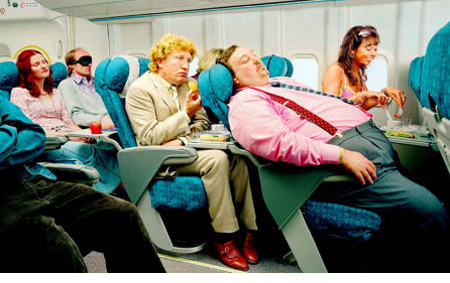
Air Passenger Etiquette: Who Gets the Armrests?
A site called Neatorama polled various ethicists, travelers and air flight experts regarding who should get the armrests when all three seats in a row in coach are occupied.
Actually, the graphic accompanying the column suggests that it also discusses two other flyingetiquette issues as well: do you recline your seat, and if you have a window seat and need to use the rest room when the other two passengers are asleep, what do you do?
I can’t find any answers to those in the column, though, and that’s fine I know them already: Continue reading
Unethical Vanity Plate of the Year
It was an Alaska plate, and I followed it all the way into Washington, D.C. this morning, gritting my teeth all the while. It read:
HIGHIQ
What kind of person puts a message like this on his or her car? It isn’t witty. It isn’t cute. It is gratuitously boastful, immodest, and lacking in humility. The message is very likely to annoy other drivers, as it did me, for its sheer bad taste and arrogance, and because displaying such a message is stupid in the extreme, it is also deceitful. The driver may indeed have an objectively high I.Q., but if so the message is literally true but misleading—-since anyone who would think this fact belongs on a license plate is an prima facie idiot.
Besides…if he’s so smart, why is he driving a 2003 Camry?
Don’t Knock “The Code of the West”!
A commenter just nominated the Republicans in the Montana State Legislature for “Incompetent Elected Official” status because they have proposed “The Code of the West” as Montana’s State Code.
Nomination rejected. I don’t want to argue about whether a state needs a State Code, although it seems a lot more useful and constructive than state birds, state songs and state pies. I also don’t feel like debating the political correctness attacks on the potential use of the Code of the West by Native American activists, who apparently think the Code glorifies cowboys and insults Indians (Oh, all right: the complaint is nonsense. Valid ideals are not sullied by the misdeeds of those who espoused them.) But I like the cowboy codes, all of them. One is already on the site. I might not choose the same ten tenets of the unwritten Code of the West that is being debated in Montana, but the Code of the West is a perfectly good statement of ethical principles, and any state that embraces it should be praised, not embroiled in a lot of political posturing. Continue reading
Wait…This Is MY Fault????
I have complained, more than once, about the naked greed and obvious incompetence displayed by the airlines charging $25 or more to passengers who check luggage. The results of this reverse incentive are that people carry on too many, and too large bags, boarding takes longer, and flights are delayed. Passengers talk about the idiocy of the policy all the time. So do the airline attendants. Anyone can see how dumb the policy is. The smart approach would be to charge for anything carried on other than a handbag or briefcase, and make checked luggage free. Boarding would be faster and there wouldn’t be passengers using the sneaky (but effective!) trick of carrying a piece of luggage through security only to check it at the gate at no charge when the airline personnel makes the routine plea for passengers to free up luggage bin space by doing so. Continue reading
Cranky Ethics Encounters In A Rotten Week
The unexpected death of my mom on Saturday tends to make everything else in my life the past week fade to insignificance, but the last seven days featured more than my usual quota of confrontations when thrust in the path of conduct that seemed just wrong to me:
- Staying at a Fairfield Inn and Suites, a Marriott chain, in Greensboro, North Carolina, I found myself running behind schedule for a morning presentation. Rushing to take my shower, I was stopped cold by the shower controls, which made no sense at all. The long handle didn’t seem to do anything, and the round knob inside it had no effect either. Since I have the mechanical skills of a rodent, and am constantly embarrassed by my ineptitude, I fiddled with the knobs longer than I should have before giving up in a panic and calling the front desk.
“I can’t get the shower controls to work, and I’m late!” I blurted out to the woman manning the desk. “Send someone up right away!” Continue reading
Comment of the Day: “Ethics Quote of the Week: Blogger Jeff Jarvis”
Karl Penny calls me to task here for yielding to another commenter’s premise (but not his conclusion from it) that celebrities lead more interesting lives than their typical fans. Since “interesting” has various meanings—in Charlie Sheen’s case, the ironic Chinese definition (as in “may you live in interesting times”) comes to mind, and I could argue that celebrities by definition lead lives that their fans find more interesting than their own, hence the fact that they are celebrities. Nonetheless, Karl’s point is critical, and I thank him for making it so eloquently. And Karl’s would have been the Comment of the Day even if he hadn’t mentioned my dad—but it didn’t hurt. Here is Karl on “Ethics Quote of the Week: Blogger Jeff Jarvis”:
“Now, Jack: “Nobody denies that rich stars have more interesting lives than their fans,…” Nobody? Hey, what am I? Chopped liver? But, seriously I do deny that celebrities lead more interesting lives than the rest of us. In my experience—and these days, I hear a lot from others about the details of their lives—everyone has a story to tell. Indeed, they have a narrative, and one that is way more interesting, and far more uplifting, than those of the celebrities whose stories are broadcast at us. Continue reading
A Shocking Farewell Confession From “The Ethicist”
In Randy Cohen’s farewell column for “The Ethicist” today—he was sacked by the new editor of The New York Times despite providing an entertaining, well-written and provocative column for many years— he makes a statement that I find shocking, and one that challenges the core assumption of this blog and indeed my occupation.
Writing the column has not made me even slightly more virtuous. And I didn’t have to be: it was in my contract. O.K., it wasn’t. But it should have been. I wasn’t hired to personify virtue, to be a role model for the kids, but to write about virtue in a way readers might find engaging. Consider sports writers: not 2 in 20 can hit the curveball, and why should they? They’re meant to report on athletes, not be athletes. And that’s the self-serving rationalization I’d have clung to had the cops hauled me off in handcuffs.
What spending my workday thinking about ethics did do was make me acutely conscious of my own transgressions, of the times I fell short. It is deeply demoralizing.
Amazing. Randy, we hardly knew ye, and we sure didn’t understand ye, either. How can someone possibly spend one’s working day “thinking about ethics” and not become more virtuous in his daily conduct? Continue reading