Pop quiz, Ethics Alarmers: if you worked for Nike, and learned that it was about to launch a new campaign promoting the brand’s Trail Running collection with this—“The Lost Cause…Because the lost cause will always be a cause worth supporting”—what would you do? I assume that most of you would immediately recognize that the Lost Cause, in American historical context, refers to the sentimental, romantic and troubling interpretation of the Confederacy’s defeat, in which slavery is recalled as a benevolent institution and the Civil War as a noble effort by the South to protect a civilization now “gone with the wind”—the title of the film which, coincidentally, I am watching as I type this.
“An apology motivated by the realization that one’s past conduct was unjust, unfair, and wrong, constituting an unequivocal admission of wrongdoing as well as regret, remorse and contrition, as part of a sincere effort to make amends and seek forgiveness.”
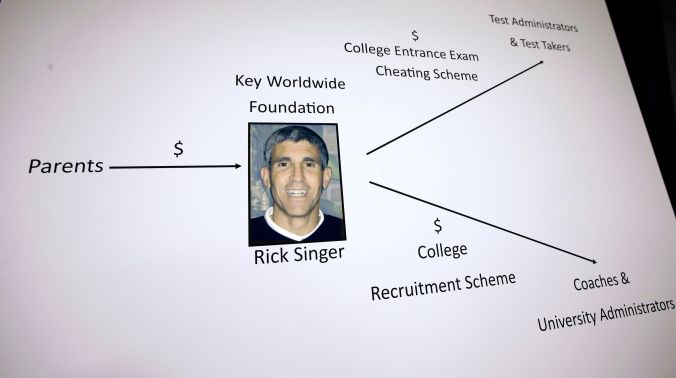
Here is what actress Felicity Huffman, one of the most prominent and famous among the wealthy glitterati accused of using their wealth to bribe and cheat their offspring into prestigious colleges, told the judge yesterday while pleading guilty to all charges:
I am pleading guilty to the charge brought against me by the United States Attorney’s Office.I am in full acceptance of my guilt, and with deep regret and shame over what I have done, I accept full responsibility for my actions and will accept the consequences that stem from those actions. I am ashamed of the pain I have caused my daughter, my family, my friends, my colleagues and the educational community. I want to apologize to them and, especially, I want to apologize to the students who work hard every day to get into college, and to their parents who make tremendous sacrifices to support their children and do so honestly. My daughter knew absolutely nothing about my actions, and in my misguided and profoundly wrong way, I have betrayed her. This transgression toward her and the public I will carry for the rest of my life. My desire to help my daughter is no excuse to break the law or engage in dishonesty.”
(That’s Jimmy’s old vaudeville partner Eddie Jackson singing with Jimmy. Eddie was a one-trick pony and never destined for stardom, though he did appear in the Zigfield Follies. After Jimmy became a big star, he still kept Eddie on his payroll, well into Eddie’s old age. Introduced by Durante as his “partner,” Jackson would come strutting out midway through the live or TV show, singing “Won’t You Come Home Bill Bailey?” in his unremarkable voice. Sometimes Jimmy joined in, sometimes Eddie just strutted off stage to end the number. This courtesy went on for decades, until Eddie was too feeble to perform.)
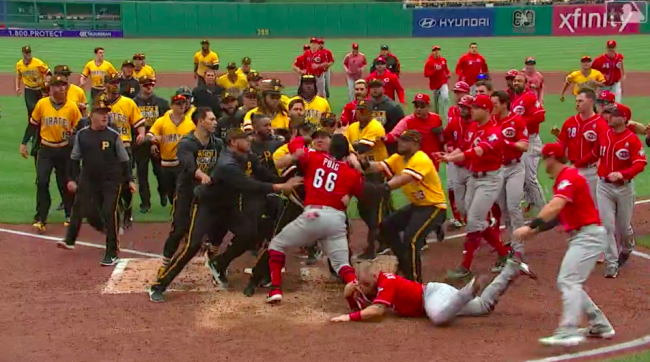
1. Baseball ethics: showboating. This happened yesterday…
Why? Well, Chris Archer, the Pirates pitcher, was peeved because the Cincinnati Reds’ Derek Dietrich hit a home run, dropped the bat, and stood stock still and stared at it as it left the field. This is known as showboating and showing up the pitcher; it’s a fuck you move. Archer retaliated in Dietrich’s next at bat by throwing a fastball behind Dietrich near his head, widely considered to be taboo as unacceptably dangerous. The fight ensued.
The episode raised questions about MLB’s controversial PR campaign with the slogan “Let the Kids Play!”, endorsing the flamboyant on-field celebrating and styling brought to the game by Latin players, Archer is one of the prime “playing” players, famous (or infamous) for dancing off the mound after a strikeout, kissing his arms, and other displays of self-admiration. Since that is his act, many, including me, feel that it is the height of hypocrisy for this pitcher to take offense when a batter treats him the same way he treats batters when he wins their duels.
On the other hand, what Dietrich did was the equivalent of taunting.
Exuberance is one thing, bad sportsmanship is another, and that’s what this was. The “kids”can play as long as they remember that real kids are watching and learning. I don’t think Roy Hobbs’ pennant-winning home run in “The Natural” was any less dramatic because he didn’t flip his bat, watch the ball go and pump his fist going around the bases.
2. Who’s the most unethical New York Times op-ed columnist? There are so many to choose from, but Michelle Goldberg is climbing fast. I highlighted her indefensible op-ed on the Mueller report recently, but I just stumbled an older column that was worse. In this one, Goldberg bemoans that Freedom House only give the United States an “86” score in ranking how democratic a nation is, dropping the US behind such places you wouldn’t want to live in like Croatia, Latvia, and Greece (Sorry, Yaya), and it’s all Trump’s fault. The score is down from 94 in 2009, when every international organization was hailing anyone and anything connected to Barack Obama, and using numerical scoring to measure something like democracy is obviously nonsense, unless the score furthers your agenda. This is similar to journalists calling organizations “hate groups” because the Southern Poverty Law center say so. It’s pure appeal to authority with an authority that has no credibility: a logical fallacy.
Does Goldberg persuasively explain why the U.S. is suddenly less democratic? Oddly, she doesn’t mention the collapse of a responsible, trustworthy press—sure that’s worth subtracting at least 12.38 points. She also doesn’t mention how the American Left has been trying for three years to undermine elections and the elected President , or as Victor Davis Hanson writes,
“Are such efforts in the future to be institutionalized? Will the Left nod and keep still, if Republicans attempt to remove an elected Democratic President before his tenure is up? Are appeals to impeachment, the 25th Amendment, the Emoluments Clause, the Logan Act, and a Special Counsel the now normal cargo of political opposition to any future elected president? Is it now permissible in 2020 for Trump’s FBI director to insert an informant into the campaign of the Democratic presidential nominee?”
What do you think, another—let’s see—18.47 points down? Goldberg doesn’t think so: she focuses on such things as Russiagate, though she nods that there have been some positive developments on that front: “Several of the criminals who helped Trump get elected either have gone to prison or soon will.”
Love it. Later Goldberg says that Trump’s attack on fake news somehow made other nations start censoring the news media there. That statement above is an outright lie. None of the individuals Mueller indicted had any role in “helping Trump get elected,” as we now know. But she writes that the report gives us two reasons to worry:
“The first is that it usually takes more than two years for a democracy to collapse. “Elsewhere in the world, in places like Hungary, Venezuela or Turkey, Freedom House has watched as democratic institutions gradually succumbed to sustained pressure from an antidemocratic leadership, often after a halting start,” the report said— an increase in corruption and a decrease in transparency — both hallmarks of this administration — are “often early warning indicators of problems in a democracy,” undermining public faith in the legitimacy of the system.”
What corruption is she talking about? The Secretary of State selling influence to foreign power through her fake non-profit? No, it can’t be that. An administration using its Justice Department to illegally try to sabotage an opposing party’s Presidential candidate? What about transparency? Even many liberal commentators say that Trump’s administration is more transparent than Obama’s. And who is undermining faith in the legitimacy of the system more than people like Goldberg, who support baseless Democratic conspiracy theories about a traitorous President and a stolen election?
And reason #2:
“Second, if Americans increasingly ignore Trump’s words, foreign leaders don’t. Authoritarianism is on the rise all over the globe — according to the Freedom House report, this is the 13th consecutive year that global freedom has declined. Trump’s presidency is a consequence of this trend, but it’s also become an accelerant of it.”
It’s the 13th consecutive year according to Goldberg’s dubious source, but Trump’s tweets the past two and a half years are really at fault.
Why is this “fit to print”?
3. If our democracy is failing, here’s one of the real reasons:
In Long Island, 11-year-old Bella Moscato said that she was going to choose the President for a sixth-grade assignment at Samoset Middle School to write about a personal hero. The teacher told her that President Trump was not an appropriate choice, and suggested–guess who!—Barack Obama instead.
Bella’s mother, Valerie Moscato says what the teacher did amounts to intimidation and censorship. Yes, and also indoctrination.
Sachem Central School District Superintendent Dr. Kenneth Graham issued a denial, saying,
It is not accurate that this student was told that they were not allowed to conduct research or report on any individual for a school assignment, including President Trump. To the best of our knowledge, by choice the student is still conducting their project of President Trump.
The school board is supposedly looking into the matter. The Moscatos want an apology, and if he is smart, the Superintendent will grab the chance to get off easy. That teacher, however, should be fired.
1. Are fake media stereotypes ethical if they are benign stereotypes? When my son was a young child, I watched a lot of children’s programming, and immediately noticed that almost every show had a computer nerd, tech genius character, and that character was almost invariably black. I get it: the idea was to fight pernicious stereotypes with opposite stereotypes, but neither stereotype was accurate. (Lots of prime time movies and TV shows for adults also perpetuated the black tech genius trope, like “Die Hard,” “Star Trek: The Next Generation,” and many others.)
Now Madison Avenue or their corporate clients apparently want American to believe that inter-racial marriage is the norm. I literally could not care less who people marry, but I just sat through four TV ads in a row featuring black and white couples. I failed at my admittedly limited attempt to find out what current percentage of American married couples are bi-racial, but the last study, which is nine years old, found that less than 9% of married couples consisted of a white and an African American spouse. That’s great, but the popular culture should be reflecting society, not using its power to manipulate it according to its own agenda.
Funny, I’ve been told that obesity has become a serious public health problem in the U.S. Fat-shaming is wrong—the Woke still constantly insult the President by calling him fat, and that babe in the photo makes him look like Chris Sale—but fat glorification is irresponsible. But hey, what’s consistency when the idea is to virtue-signal like crazy? “[We’re]committed to representing beautiful women of all shapes, sizes, and skin types because ALL types of beautiful skin deserve to be shown. We love Anna because she lives out loud and loves her skin no matter how the “rules” say she should display” says Gillette. Continue reading →
Pure as the driven snow! Especially if her breasts really look that THAT…
The Naked Teacher Principle(NTP) states that a secondary school teacher or administrator (or other role model for children) who allows pictures of himself or herself to be widely publicized, as on the web, showing the teacher naked or engaging in sexually provocative poses, cannot complain when he or she is dismissed by the school as a result.
Ah, would that it were always this simple! In the past, we have had to deal with the “naked teacher who paints with his butt and naughty bits on camera with a bag over his head” principle, for example. Another teacher got fired when the naked photos of herself she had on her own tablet inadvertently was sent to the students in her class. Continue reading →
Well, this in encouraging. Another court has slapped down a school’s attempt to punish a student for what she wrote online in a personal social media account. Ethics Alarms has protested the abuse of authority this increasingly common practice represents for many years—I don’t have the time right now to track all the posts down, but I will, and add a link to them here.
U.S. District Judge A. Richard Caputo ruled that the Mahanoy Area School District (In Pennsylvania) violated a student’s First Amendment rights when it kicked her off the junior varsity squad for writing “fuck” repeatedly in a Snapchat post. Do you use that mouth to cheer with, honey?
The teen made the vulgar post on a weekend in May, 2017, off school grounds. It pictured her and a friend holding up their middle fingers with the cogent text, “fuck school fuck softball fuck cheer fuck everything.” She was dressed in street clothes, not her cheerleading uniform, with no pom-pons. I don’t know how schools got the idea that they could control every aspect of a student’s life and speech to this extent, but too many try. And too many get away with it. Continue reading →
The question has been giving me a headache since I first read about the stunning results of the process that gives New York City students access to its elite public schools. Of the nearly 4,800 students admitted into the specialized schools for 2019, 190 are black, down from 207 black students admitted last year out of just over 5,000 offers. Stuyvesant high school, which is representative, gave 7 offers to black students (out of 895 slots), 33 offers to Hispanic students, 194 offers to white students, and Asian-American students received a whopping 587 offers. Overall, Asian-American students constitute 60% of the student bodies of the eight elite schools.
Students take a single exam that tests their mastery of math and English in order to gains entrance to the academically challenging school. Stuyvesant, which has the highest cutoff score for admission and is thus the most selective of the schools, now has the lowest percentage of black and Hispanic students of any of New York City’s roughly 600 public high schools.
What should the city do about this? Should it do anything? Continue reading →
I’m heading to San Diego tomorrow to talk about “Five Looming Ethics Issues for Lawyers and Their Corporate Clients” to a group of over 600 lawyers. THEY don’t think my analyses of ethics issues violate community standards…okay. I admit it, I’m getting paranoid. Despite a lot of, I humbly believe, useful, timely and well-presented content, the weekend traffic was terrible, and comments were sparse, if excellent. This year, so far, is lagging behind last year, which seriously trailed the year before. What’s going on here? Has Google secretly joined Facebook in its efforts to keep the posts here from reaching an audience? Of could it be that I just suck? Maybe Donald Trump really has killed all belief in ethics…that’s the ticket! Blame the President!
1. Pettiness and vindictiveness vanquished. Good. The Judicial Council of the 10th U.S. Court of Appeals has affirmed its December decision to reject 83 ethics complaints against Justice Brett Kavanaugh, all filed by bitter partisans who are determined to hurt the newest Justice because the Democrats’ slimy and unethical ambush tactics failed, as they should have. In a 6-1 decision, the judicial council affirmed its earlier finding that the federal law governing misconduct complaints against federal judges does not apply to justices on the U.S. Supreme Court. Many of the complaints filed against Kavanaugh argued he had made false statements under oath during hearings on his nominations to the U.S. Court of Appeals for the D.C. Circuit in 2004 and 2006 and to the U.S. Supreme Court last year—you know, like having an innocent recollection of what “boof” meant in his completely irrelevant high school year book. Other complaints accused Kavanaugh of making inappropriate partisan statements in his inappropriately partisan hearings, or claimed he treated members of the Senate Judiciary Committee with disrespect, or as I would put it, the disrespect they deserved for attempting to smear his good name and reputation through demagoguery and calls to reject the presumption of innocence.
Let me remind everyone that Ruth Bader Ginsberg, in her confirmation hearings, stated under oath that she had no pre-formed opinions that would affect her objectivity in abortion cases. Nobody filed any ethics complaints. Continue reading →
Any week that starts off with John Belushi’s immortal reflections on March just has to be a good week.
1. Connecticut: Judicial ethics and guns. Anti-gun fanatics are cheering this week’s ruling by the Connecticut Supreme Court reversing a lower court judge dismissing a lawsuit by the families of victims of the Sandy Hook shooting against Remington Arms Company, allowing the case to proceed. In the 4-3 decision the court possibly created a path that other mass shooting victims can follow to get around the federal Protection of Lawful Commerce in Arms Act, known as PLCAA, which has protected the manufacturers of the AR-15 assault rifle from lawsuits, thus setting the stage for a sensational “Runaway Jury”-type trial. The court’s reasoning is that the Sandy Hook families should have the opportunity to prove that Remington violated the Connecticut Unfair Trade Practices Act (CUTPA) by marketing what it knew was a weapon designed for military use to civilians. The problem is that the ruling ignores the law, as John Hinderaker explains (but he’s not the only analyst trashing the decision):
“Firearms of all kinds have been ‘designed for military use.’,” he writes. “The 1911, designed by John Browning, was the standard U.S. military pistol for many years and remains one of the most popular pistol designs today. So what? There is no such exception in the Second Amendment…Under the Supremacy Clause, federal law will govern over state law. The Protection of Lawful Commerce in Arms Act is intended to avoid precisely the result reached by the Connecticut Supreme Court. The PLCAA puts firearms manufacturers on the same plane with all others. If their products are not defective–if they do not malfunction–they are not liable. If someone stabs a victim to death with a knife, the victim’s heirs can’t sue the knife manufacturer. It is the same with firearms.”
Hinderaker correctly concludes that significance of the ruling is not that it opens a road for the Second Amendment to be constrained, or for ruinous liability to applied to gun-makers, but that it shows how courts will deliberately ignore the law to reach political goals. Continue reading →
This is a bit of a departure, a showcase for one of Ethics Alarms most active commenters (especially appreciated as the blog experiences boycotts, embargos, and Facebook blocking and other indignities), Michael R. The topic is the recent College Admission scandal, which has been covered here and here.
Michael, an educator, is well informed on this topic, and he shows it in three excellent Comments of the Day. And I forgive him for never, ever, making a typo.
I.
The college scandal has many, many facets. What has caused standards to slip so low? Well, athletics obviously has a corrosive effect, with students admitted based on athletic ability instead of academic ability. The grade inflation has also greatly degraded college standards. The almost lack of education occurring in our high schools is another factor.
An overlooked factor, however, is the public higher ed systems’ oversupply of colleges. Public college policy has mainly been about votes and prestige, not actual societal need. This has resulted in a lot more colleges than the country actually needs. A typical example would be Local Community College. Well, the President of Local Community College would rather not be the laughingstock of the College President’s Club, so he petitions the state legislature to authorize his school to offer 4-year degrees. He states that his community deserves a 4-year school like (insert rival town here). This proposal is mainly decided on its political merits, not the needs of the state as a whole. It goes through, along with new funding for new facilities, new faculty, and more students for the Local State College. With all the Community Colleges becoming State Colleges, the presidents of the Regional State Colleges petition to become Regional State Universities. They point out the prestige and grant money they could get if they had graduate programs. This too, is granted based on political merit. The National Science Foundation is then pressured to remove funding from the traditional research schools and transfer it to the new State Universities amid allegations of elitism for favoring longstanding research schools with top-notch researchers over the new State Universities with no significant research results and they cave. Now, with no community colleges left, a new round of community colleges is constructed. This increases the number of seats for college students by 30% or so, but there are not more high school students graduating. This is repeated all over the country, so out-of-state students are not an option. The only reasonable option is to lower admissions standards. Once the admission standards are lowered, retention suffers and the faculty are ordered to improve retention and graduation rates. The only reasonable way to do this is to make the classes easier and the race to the bottom is on.Continue reading →