Willful Amnesia And The Great Cat And Dog Massacre

Did you know that animal-loving British families killed an estimated 400,000 household pets—cats and dogs—in the first week after Great Britain declared war on Germany in September, 1939? Neither did I, and now a new book by Hilda Kean, “The Great Dog and Cat Massacre,” sets out to remind us of that ugly episode.

As the New York Times review of the book notes and Kean explains, the mass euthanasia was “publicly lamented at the time,” but has since been erased from memory.  But why has it been erased from memory, and how? This is a disturbing cultural phenomenon that Ethics Alarms has covered before, notably in the post about dance marathons in the U.S. during the Depression. One of the definitions of culture is what we choose to remember and what we choose to forget. Forgetting, however, while often psychically soothing and an easy way to avoid guilt and accountability, is a pre-unethical condition. That which has been forgotten can no longer teach us, and a society that collectively decides to pretend something cruel, horrible or traumatic didn’t happen risks allowing it to happen again.

This, of course, is one more reason why the recent progressive mania for historical airbrushing is dangerous, irresponsible and unethical. Keep that statue of “Joe Pa” on the Penn State campus. Leave  King Andy on the twenty dollar bill.  Don’t take down that bust of Bill Cosby in the TV Hall of Fame. All civilizations have fallen heroes, moments of panic, times when they forget their values and betray their aspirations. Of course it is painful and embarrassing to remember these things, but also essential if human ethics are going to progress instead of stagnating, or even going backwards. We associate the elimination of cultural memories with totalitarian regimes, and for good reason, for they are blatant and shameless about it.
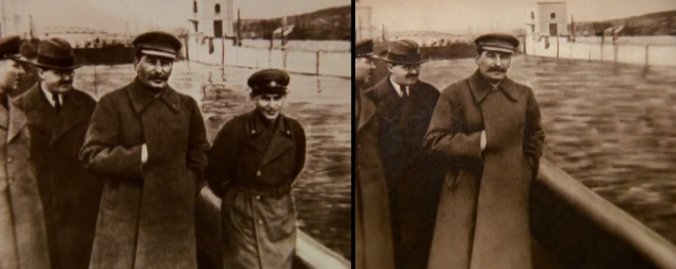
No nation is immune from the process’s appeal, however. When I was going to grade school and studying the Presidents of the United States, Jackson and Woodrow Wilson were routinely hailed by (mostly Democratic) historians as among the greatest of the great. The first Jackson biography I read barely mentioned the Trail of Tears. I read four well-regarded biographies of Wilson that ignored his support for Jim Crow, and the degree to which he deliberated reversed advances in civil rights, being an unapologetic white supremacist. The influenza epidemic that killed millions was excised from my school’s history books. Thomas Jefferson’s concubine, Sally Hemmings? Who? Continue reading
“Hey, Look! Professor Chung Has A Painting In The Exhib—-WHAT THE HELL?????”

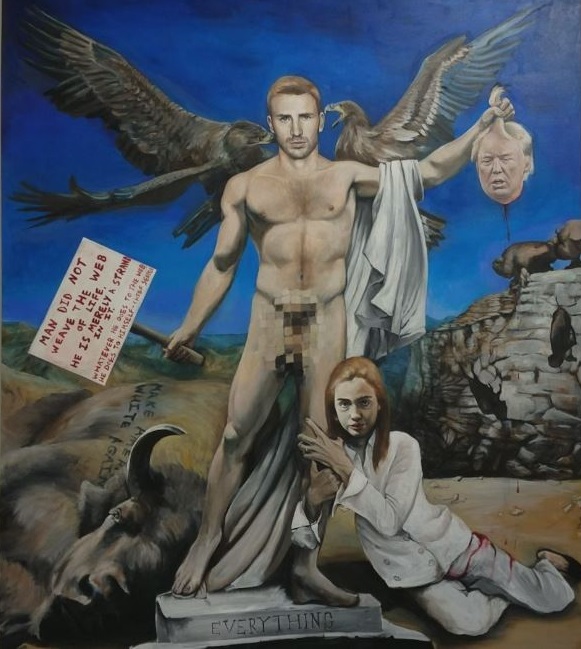
While we’re on the topic of  “hate speech”…how about “hate paintings”? At public universities? Painted by faculty members?

An art gallery at the University of Alaska-Anchorage this month displayed the painting above, depicting actor Chris Evans as Captain America and holding  the severed head of President Trump while Hillary Clinton grasps Cap’s  legs like she is a slave girl and he is Conan the Barabarian.  The artist is UAA Painting Professor Thomas Chung, who  created the masterpiece as part of a faculty art program. Naturally it was accepted, just as it would have been if he had painted Thor holding up President Obama’s severed head. Of course it would have been accepted. After all, art is art. Academic freedom. Right?

Chung explains the artwork as something he chose to paint because he was upset at the results of the 2016 election. “I spent days just weeping,” he has said. Campus Reform quotes him  explaining his decision:

“I was really torn about putting this piece up at a faculty show, because I would never talk about my own political beliefs to my students. But I realized that I feel very strongly about this, and I think even students that might be pro-Trump supporters could benefit from having a conversation with me about why I feel this way—why I painted this.”

(By the way, the actual painting shows Evans/Captain America’s sex organs. None of the versions on the web do, though. Sorry!)

Random ethics observations, since I fear that painting may have caused some brain damage and I can’t seem to organize a coherent paragraph: Continue reading

A Concise, Clear, Elegant, And Willfully False Unethical Tweet Of The Month From Howard Dean

Howard Dean wants to make sure the Left’s war on free speech and expression continues, so he decided to misinform trusting Democrats and progressives—who trust the damnedest people lately!—with a Big Lie level tweet. His immediate target was Ann Coulter, whose speaking gig at Berkeley was first cancelled because of the campus’s rampant embrace of “the heckler’s veto” (as well as the “the thug’s veto,” “the bully’s veto,” and”the rioter’s veto,” all increasingly au currant on the Left) by the school’s students, then cleverly re-scheduled by the University to a day when there would be no classes. [Full disclosure: I wouldn’t move from my living room into my dining room to hear Ann Coulter speak.] Dean is a former chairman of the Democratic National Committee, arguably the worst of a terrible lot, and is an expert on “hate speech”, or at least hateful speech, having engaged in it himself often. Notably, for example, he insinuated that President Trump was a cocaine user during the 2016 campaign because a badly set microphone picked up his sniffling during a debate.

The nice thing about the progressive definition of “hate speech” (it has no legal definition, which is also convenient) is that it only includes statements that progressives disagree with or find disruptive to their world view and fondly held beliefs. Hateful speech from Democrats is just the hard truth, so it isn’t “hate speech.” Hate speech from everyone else is unprotected, and should carry criminal penalties.

There is no question that Dean knows “hate speech,” whatever it is, is protected by the First Amendment, but it suits his purpose and his party’s to imbed the lie that it isn’t in the mushy brains of the easily confused. This will greatly assist the Left’s ongoing efforts to stifle debate and make any dissent with progressive cant as difficult as possible. That’s the plan.

And again: progressives and Democrats should be as offended by this kind of dishonesty by their leaders as I am. Why aren’t they? Do they think Dean is correct? Do they think he should be correct? Or is it just that they believe that the ends justify the means? Democrats? Progressives? Hello? Integrity? Honesty? The Constitution? Bueller?

What the hell is the matter with them?

Constitutional law expert and law professor Eugene Volokh mostly controls his exasperation as he tries to set Dean and his uneducated acolytes straight. He begins a thorough dismembering of Dean’s tweeted lie in the Washington Post thusly: Continue reading

Professor Who Most Needs To Get Over Himself Of The Month

Gilbert Kalonde, a Montana State University assistant professor of technology education, says an employee at the Bozeman, Montana Wal-Mart wrongly listed his occupation on a fishing license as “toilet cleaner” rather than “pompous assistant professor.” This, the toilet cl…er, professor says, constitutes libel, and he is suing for damages because the license has held him up to “hatred, contempt, ridicule.”

Boy, you can say that again. I know I always judge people by what it says on their fishing licenses. Come to think of it, I just judge people harshly if they have a fishing license. Actually, I’m not sure I wouldn’t regard a toilet cleaner as more admirable than a college professor. True, he doesn’t teach at Wellesley….

Why would anyone get upset over something like this? I would be hauling out that license at parties. Yes, that’s not exactly sterling service he got, but it’s Wal-Mart. Besides, based on the law suit, I bet the prof was so insufferable–“See here, my good man, make sure you place the correct occupation on that document, lest my credentials are obscured!”—that the Wal-Mart clerk decided to teach him a lesson in humility. I guess it didn’t work.

The ethical values involved here are proportion, compassion, humility, and kindness, none of which Gilbert Kalonde appears to possess.

At least he has a sense of humor.

______________________

Pointer: Fark

Higher Education Indoctrination Easter Sunday Continues: “The Least Diverse Place On Earth”

“College is a place where everyone is supposed to look different, but think the same.”

Can anyone honestly rebut this video?

Case Study: How Institutions Like Wellesley Get That Way

In the previous post about Wellesley programming its students to oppose free speech, we learned to our horror (I presume you were horrified) what the liberal college culture is doing to the minds and values of your young.

Now comes this: an anonymous account on the website Quillette on how “standards” are created and maintained at some universities. All? We better hope not.

I was appointed by the dean of General Studies to serve as the chair for a writing hiring committee, a committee charged with hiring one full-time writing professor, who not only could teach first-year writing classes but also offerings in journalism. The committee of three met late in the fall semester to discuss the first group of candidates, before undertaking the second set of Skype interviews. I mentioned that I had received an email from one of the candidates and shared it with the committee members. After reading the email aloud, I argued that the missive effectively disqualified the candidate. The writing was riddled with awkward expression, malapropisms, misplaced punctuation, and other conceptual and formal problems. Rarely had a first-year student issued an email to me that evidenced more infelicitous prose. I asked my fellow committee members how we could possibly hire someone to teach writing who had written such an email, despite the fact that it represented only a piece of occasional writing. The candidate could not write. I also pointed back to her application letter, which was similarly awkward and error-laden. My committee colleagues argued that “we do not teach grammar” in our writing classes. Sure, I thought. And a surgeon doesn’t take vital signs or draw blood. That doesn’t mean that the surgeon wouldn’t be able to do so when required.

In the Skype interview following this discussion, a fellow committee member proceeded to attack the next job candidate, a candidate whom I respected. In fact, before the interview, this colleague, obviously enraged by my criticisms of her favorite, announced that she would ruthlessly attack the next candidate. She did exactly that, asking increasingly obtuse questions, while adopting a belligerent tone and aggressive posture from the start. That candidate, incidentally, had done fascinating scholarship on the history of U.S. journalism from the late 19th through the first half of the 20th Century. He had earned his Ph.D. from a top-ten English department, had since accrued considerable teaching experience in relevant subjects, and presented a record of noteworthy publications, including academic scholarship and journalism. He interviewed extremely well, except when he was harangued and badgered by the hostile interviewer. He should have been a finalist for the job. But he had a fatal flaw: he was a white, straight male.

Continue reading

What Wellesley College Students Consider To Be Freedom Of Speech

A recent editorial in the Wellesley College student newspaper—Wellesley, as I’m sure you know, is the alma mater of Hillary Clinton—has justly set off ethics alarms across the political spectrum. That, at least, is good news: the hostility to free thought, expression and speech that I thought had decisively corrupted one side of that spectrum apparently is not as entrenched as I thought, or at least it is being diplomatically disguised.

The editorial with the Orwellian title of  “Free Speech Is Not Violated At Wellesley ” (it would have been accurate if the headline read “We Think Free Speech Is Not Violated At Wellesley Because Wellesley Hasn’t Taught Us What Free Speech Is”), contained several month’s worth of Ethics Alarms Unethical Quotes of the Week, such as

Many members of our community, including students, alumnae and faculty, have criticized the Wellesley community for becoming an environment where free speech is not allowed or is a violated right….However, we fundamentally disagree with that characterization, and we disagree with the idea that free speech is infringed upon at Wellesley. Rather, our Wellesley community will not stand for hate speech, and will call it out when possible.

Translation: We don’t oppose free speech. We just oppose speech we disagree with.

Wellesley students are generally correct in their attempts to differentiate what is viable discourse from what is just hate speech. Wellesley is certainly not a place for racism, sexism, homophobia, Islamophobia, transphobia or any other type of discriminatory speech. Shutting down rhetoric that undermines the existence and rights of others is not a violation of free speech; it is hate speech.

By this definition, the editorial itself is hate speech. This is the kind of rhetoric that Captain Kirk used to make evil computers blow their circuits on “Star Trek.”

The founding fathers put free speech in the Constitution as a way to protect the disenfranchised and to protect individual citizens from the power of the government. The spirit of free speech is to protect the suppressed, not to protect a free-for-all where anything is acceptable, no matter how hateful and damaging.

Now we know they don’t teach American History at Wellesley as well as philosophy and logic.

We have all said problematic claims, the origins of which were ingrained in us by our discriminatory and biased society. Luckily, most of us have been taught by our peers and mentors at Wellesley in a productive way. It is vital that we encourage people to correct and learn from their mistakes rather than berate them for a lack of education they could not control.  While it is expected that these lessons will be difficult and often personal, holding difficult conversations for the sake of educating is very different from shaming on the basis of ignorance.

Wait, wasn’t this endorsement of indoctrination written by Lenin or Stalin? Surely this section should be in quotes with attribution.

This being said, if people are given the resources to learn and either continue to speak hate speech or refuse to adapt their beliefs, then hostility may be warranted.

I’m sorry, I just ran screaming from my office and momentarily lost my train of thought.

Pointing to the worst sections of the editorial fail to convey its gobsmacking intellectual flaccidity, smug certitude and hostility to the open exchange of ideas. We know where this came from, too: the  education at Wellesley. This month, six Wellesley professors who comprise the college’s Commission on Race, Ethnicity, and Equity signed a letter maintaining that Wellesley should not allow challenges to the political and social views that the campus has decreed are the correct ones, arguing that speakers who are brought to campus to encourage debate may “stifle productive debate by enabling the bullying of disempowered groups.” Continue reading

From The “Saint’s Excuse” Files:The Catholic Church, Penn State, and Now Choate…What Have We Learned?

Protect the hive. Always protect the hive…

The renowned private boarding school school Choate Rosemary Hall, alma mater of such luminaries as John Dos Passos, Edward Albee, Glenn Close, multiple Kennedys and dozens more of the rich, famous and powerful, , just revealed that at least twelve former teachers had sexually molested, and in one case, raped, students without the crimes being reported to police. The pattern continued over decades. In some cases, teachers were allowed to resign after being confronted with evidence of abuse, and administrators wrote still letters of recommendations for them after they were fired. The predators then went to other schools, sometimes in positions of power and authority.

After the similar institutional conduct revealed by the Catholic Church and Penn State, does anyone believe that this is a rare occurrence in institution, including the most prestigious—and virtuous!—ones? The lesson is that established, powerful, iconic institutions are programmed to protect themselves above others, and regard their own missions and continued vitality more precious than any single individual, even a child.

Revisiting one of the most important of the Ethics Alarms’ 92 rationalizations:

13. The Saint’s Excuse: “It’s for a good cause”

This rationalization has probably caused more death and human suffering than any other. The words “it’s for a good cause” have been used to justify all sorts of lies, scams and mayhem. It is the downfall of the zealot, the true believer, and the passionate advocate that almost any action that supports “the Cause,’ whether it be liberty, religion, charity, or curing a plague, is seen as being justified by the inherent rightness of the ultimate goal. Thus Catholic Bishops protected child-molesting priests to protect the Church, and the American Red Cross used deceptive promotions to swell its blood supplies after the September 11, 2001 attacks. The Saint’s Excuse  allows charities to strong-arm contributors, and advocacy groups to use lies and innuendo to savage ideological opponents. The Saint’s Excuse is that the ends justify the means, because the “saint” has decided that the ends are worth any price—especially when that price will have to be paid by someone else.

Continue reading

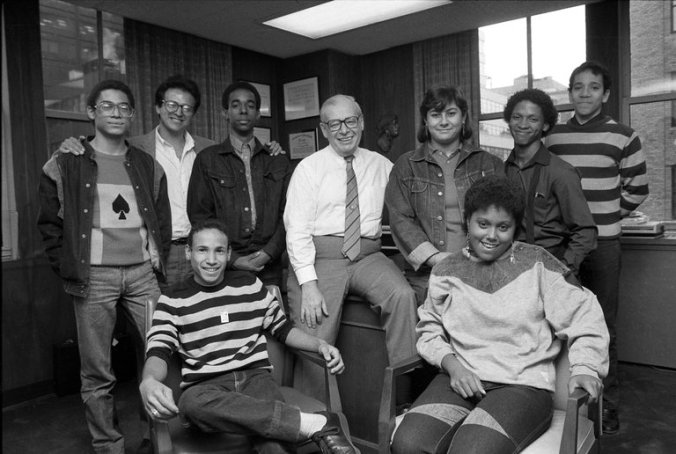
Ethics Hero Emeritus: Eugene M. Lang

A kind, courageous Ethics Hero died last week. To my shame, I had never heard of him. In 1996, President Clinton awarded him the Presidential Medal of Freedom, but that award has been so degraded and politicized that I no longer pay much attention to it. My mistake: in this case, the award was well-earned.

Eugene M. Lang was born poor and became  a successful and wealthy  investor. In 1981, he was invited to deliver a commencement address to 61 New Your City sixth graders at Public School 121, his alma mater.  “I looked out at that audience of almost entirely black and Hispanic students, wondering what to say to them,” he recalled years later. “It dawned on me that the commencement banalities I planned were completely irrelevant…So I began by telling them that one of my most memorable experiences was Martin Luther King’s ‘I Have a Dream’ speech, and that everyone should have a dream.”

Then, in a flash of inspiration, he decided on the spot to tell them that he would give a scholarship to every student in the class who was admitted to a four-year college.

That impulsive promise led to his establishment of the I Have a Dream Foundation, with an office in Manhattan. Lang hired a project coordinator and established a year-round program of academic support including mentoring and tutoring as well as sponsored cultural and recreational outings. In the meantime, he virtually adopted that 6th grade class, taking them on trips and restaurants, and personally counseling them through personal travails as well as school problems, often intervening with school officials on their behalf. By the time Eugene Lang died at age 98,  his dedication had changed the lives of more than 16,000 at-risk children nationwide.

Lang said the he knew, when he made his pledge to those 11 and 12-year olds, that giving poor and  troubled children money for an education would not ensure their success. He knew many would succumb to the cycle of poverty,  drugs, jail and irresponsible parenthood.  “When I made the original promise, the principal told me that maybe one or two students would take advantage of my offer,” he told  one interviewer. That’s why he dedicated himself to doing more.

Continue reading

Yale’s Core Values Betrayal: The Case Of The Student’s Unnecessarily Provocative Philosophy Essay

It certainly appears as if U.S. higher education is sailing toward the shoals of ethics bankruptcy, full speed ahead. It also appears that Yale, although it’s part of a tightly bunched armada, is leading the way.

A law suit called Doe v. Yale tells a jaw-dropping tale that once would have been unbelievable, “once” meaning “before a large segment of the culture accepted the proposition that free expression and thought were undesirable unless they met certain lockstep requirements that will ease the way to a progressive utopia.” The plaintiff, a male student, claims that Yale punished him for the offense of writing a class essay that offended a female teaching assistant.

According to his lawsuit, in late 2013 a philosophy teaching assistant filed a complaint with the university’s Title IX office, complaining about a short paper “Doe” had written in the class she was helping to teach.  The essay discussed Socrates’ discussion, recounted in Plato’s “Republic,” of the three divisions of the soul and their relationship to justice. It applied the Greek philosopher’s ideas to rape, arguing that the crime was also an irrational act in which  the soul’s appetites and spirited components overwhelm its reason, which must have primacy for mankind to be moral and just.

The Title IX coordinator, an associate dean in the Graduate School of Arts and Sciences named Pamela Schirmeister, told Doe that his essay was “unnecessarily provocative.” By daring to discuss rape, he had committed an offense against the teaching assistant. He was told to have no contact with the teaching assistant, and ordered to attend sensitivity training at the university’s mental-health center—re-education and indoctrination, in other words. “Doe” was now, he was told, a “person of interest” to Yale, meaning that that the college was now going to be watching him with a grounded suspicion that he was a potential danger to the campus.

What followed, a few months later, were two dubious accusations of sexual assault by female students, both handled with the slanted, pro-accuser, due process-avoiding  approach that has become epidemic on campuses since President Obama’s Dept of Education issued its infamous “Dear Colleague” letter in April of 2011.  Ethics Alarms has discussed some of these cases and the letter, but that is not the topic before us today.

Today the topic is the suppression of free speech, thought, and expression on college campuses.  Continue reading