The Provocative T-Shirt Problem

Dress codes+grievance-mongers+freedom to be rude...oh, it's hopeless.

An ethical dilemma occurs when a clear ethical principle clashes with a strong non-ethical consideration. An ethical conflict occurs when multiple ethical principles suggest diametrically opposed results. The question of what is ethical conduct when it comes to wearing apparel bearing controversial messages has the elements of both a dilemma and a conflict.

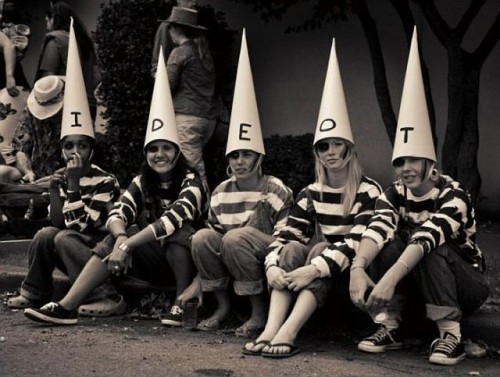
                                                                                Welcome to Dollywood!

A same-sex couple visiting Dollywood Splash Country with friends and their children was told by a park gatekeeper that one of the women had to wear her T-shirt inside-out because its message—“Marriage is so gay”— “might be objectionable” to some visitors at the “family-friendly” park.

   <Sigh.> Continue reading

Texas: Resisting Creationism, Embracing Enlightenment

Uh...NO.

Lost in the hysteria over the U.S. government’s self-created default crisis was some good news for integrity, education, and the advance of human knowledge.The Texas Board of Education unanimously (8-0) approved scientifically accurate high school biology textbook supplements from established mainstream publishers that cover the origins and implications of evolution theory and findings, rejecting the creationist-backed supplements from International Databases, LLC. (The creationist-crafted materials submitted by that group was not only “laced with creationist arguments,” said one reviewer, but was also “shoddy”, “teeming with misspellings [and] typographical errors,”and “mistaken claims of fact.”)

The efforts of creationists and Christian fundamentalist forces to ignore and discredit overwhelming scientific evidence of evolution on earth, along with the many biological, anthropological, geological and historical conclusions that spring from the body of research in the field, have created hurdles for educators, impediments to students, and embarrassment to organized religion for more than a century. Continue reading

Perplexing Oxymoron of the Month: the Unethical Ethics Fellow

You may want to fine tune that ethics program, guys....

From news reports: “A former Harvard University fellow studying ethics has been charged with hacking into the computer network at the Massachusetts Institute of Technology  to steal more than five million academic articles….Aaron Swartz, 24, was indicted on six counts including wire fraud and faces up to 35 years in prison and a million dollar fine if convicted.”

What?

Questions abound:

What do they teach in Harvard ethics classes?

What kind of grades did Swartz get?

Does this prove that the course of study was junk, or does it prove that he was studying the right subject, since he obviously has a lot to learn?

Is it reasonable to say, “Imagine how unethical he would have been if he wasn’t an Ethics fellow”?

Does this prove that one can be an Ethics Fellow and an Unethical Fellow at the same time?

Should an Ethics Fellow who proves himself to be unethical  be allowed to cite his credentials as an ethics fellow?

If those who can’t do, teach, is he still qualified to teach ethics?

Finally, if becoming an Ethics Fellow at Harvard can’t be relied upon to set the “stealing 5 million academic articles is wrong” alarm, what’s the point?

Shocking Report: “Zero Tolerance” Policies Are Stupid and Destructive. Who Knew?

If you wanted proof of the utter stupidity and recklessness of no-tolerance policies in the schools, your search is over.

A study of the effects of  ‘Zero Tolerance’ programs in Texas public schools by the Council of State Government’s Justice Center reveals that:

  • Six out of ten Texas high school students have been suspended for expelled or suspended from class at least once over the past six years.
  •  15 % of students were removed from the classroom eleven or more times for disciplinary reasons.
  •  83% of African-American students in Texas have been expelled at least once by the time they graduate
  •  African American students and those with educational disabilities experience a disproportionately higher rate of removal from the classroom for disciplinary reasons. Continue reading

We Know Enough about Ethics Already

If Shakespeare understood ethics so well, why are we still pretending to be ignorant about it?

I awoke to read about a breathlessly announced new work on ethics, a book called “Blind Spots: Why We Fail to do What’s Right and What to do About it.” Business Professor  Ann Tenbrunsel and co-author Max Bazerman write that we are unaware of the “ethical blind spots” that keep us from recognizing how we engage in unethical actions. The book cites tests and new research showing behavior that the authors call “ethical fading” and “motivated blindness.” They examine such case studies as Enron and the Madoff scam to show how people “believe they will behave ethically in a given situation, but they don’t. Then they believe they behaved ethically when they didn’t. It’s no surprise, then, that most individuals erroneously believe they are more ethical than the majority of their peers.”

Stop the presses! Conflicts of interest make us ignore core values and act in our own best interests, and we rationalize our actions to avoid confronting the true nature of our conduct!

Oops! I just stated the entire thesis of the book. I’m sorry, Ann! Apologies, Max! Continue reading

Explain to Me Why We Tolerate Illegal Immigration, Again?

Yes, I'm in a rotten mood today! Wanna make something out of it??

My cranky Saturday continues with an issue that I increasingly find bewildering: the tolerance, denial, and enabling by so many Americans of illegal immigration, although its unethical character cannot be denied or argued away. I know why Democrats support it—pure electoral cynicism—and I know why the business community encourages it—greed. What I don’t comprehend is why anyone else with a modicum of logic, fairness, and common sense isn’t confronting both of these self-serving institutions and demanding real enforcement of anti-illegal immigration measures. Instead, we get outrageous legislation like the Maryland Dream Act, which institutionalizes incentives for aliens to defy our laws. Continue reading

A Harsh Lesson We Must Learn From Atlanta’s Teachers

There isn’t much enlightening to say about the unfolding Atlanta teacher cheating scandal, but its implications must be faced, as difficult as that is.

Georgia Gov. Nathan Deal revealed this week that award-winning gains by Atlanta students were based on widespread cheating by teachers and principals. The Georgia Bureau of Investigation identified 178 teachers and principals – 82 of whom have confessed – in the biggest cheating scandal in US history. Not the first one, however; there have been a lot of them recently, across the country. The media is pointing to the U.S. education system’s increasing dependence on standardized tests as “the problem.”

I see: the testing made them do it. Continue reading

Ethics, Porn, and the Creepy Professor

The Ronald Ayers saga raises the intriguing, Weiner-esque ethical issue of whether a college professor being creepy is sufficient reason to fire him.

The former economics professor was fired by the University of Texas for viewing pornography on an office computer, which the University’s policies forbade. The chain of facts has the ring of Kafka: 1) a student claims he hears “sexual noises” emanating from Ayers’ office, which 2) is considered sufficient provocation (the professor denied the accusation that he was not “master of his domain” at work) for the school to search his computer, which 3) uncovers evidence that he looked at some pornographic sites, and 4) also that he searched for the term “teen,” which 5) the university deems sufficient to indicate that he was searching for child pornography, so 6) they fired him, after three decades and tenure on the faculty.

University records say Ayers at first denied the allegations that he viewed pornography, but when confronted with a printout of his computer records, admitted that it may have happened “at the end of a long work day.” Ayers later told administrators seeing the porn was for “academic research.”

Uh-huh… Continue reading

Ethics Hero and Dunce: A Tale of Two Windfalls


You can trust Robert Adams. Well, that's ONE....

Stephen Reginald McDow of Laguna Beach, California found an unexpected $110,000 federal tax refund in his bank account. He knew it wasn’t his; he also had to realize it was an error. But what the heck…he took a shot. McDow spent the money on foreclosure debts and  paying off his student and car loans.

He’s been charged with one felony count of theft of lost property, with a sentencing enhancement for taking property over $65,000, and faces a maximum sentence of four years in state prison.

There is a lot of sympathy for McDow; you can see man in the street interviews on cable where people say things like, “Hey, are you kidding me? If I found all that money in my bank account, I’d spend it too! Anyway, it isn’t his fault!” A lot of people apparently think this way, which means they are ethically inert. The issue isn’t who was responsible for the money landing in the wrong account (the rightful recipient of the refund had given the IRS the wrong bank account number), but that someone had lost money that rightfully belonged to her, not McDow, and it became his duty to fix the problem.Instead, he spent it, and crossed his fingers. Continue reading

Uno’s, Doing Its Small Part To Keep Americans Ignorant

A live, non-talking lobster

Uno’s is a pizza chain that for some reasonadded seafood to its repertoire. For a couple years now it has been peddling lobster dishes on its menu, and the TV commercials feature a black humor ad featuring clueless lobsters chatting by a boiling lobster pot, not suspect that they’re next.

The problem facing Uno’s ad agency was that most Americans, not being from lobster country (as I am), think lobsters are red. They are not red until they are cooked, however; when they are alive and talking, lobsters are a dark, menacing, blackish green. In fact, live lobsters look like big bugs, and if you’re expecting bright red creatures, that what you might think the crustaceans are. So, faced with wanting talking lobsters that are also appetizing, what did Uno do? They made their live lobsters red, even though that will perpetuate the crustacean ignorance of the vast number of mal-educated citizens.

Sorry; it’s a small ethics foul, but a foul nonetheless. A lot of Americans think the Civil War was fought in the 20th Century, but that wouldn’t excuse a commercial showing the battle of Gettysburg including aircraft. Ignorance of any kind is to be avoided, and those who know the truth have an obligation to illuminate, not to keep people dumb and happy by feeding their confusions. Live lobsters aren’t red, and it’s wrong to keep badly educated non-New Englanders  thinking otherwise.

And they don’t talk, either.