Child Abuse And The Genius

I don’t know what the ethical way to raise a prodigy is, but I am certain this isn’t it.

Laurent Simons is a 9-year-old Belgian genius,  and was finishing up on a brain-connected electrical chip for his final project at the Eindhoven University of Technology in the Netherlands. His goal was to get a diploma before he turned 10 on December 26, making him the all-time youngest university graduate. The child started primary school at 4, entered high school at 6 and began college at Eindhoven at 9.

Now his parents have pulled him out of Eindhoven, because the school determined that Laurent would not be able to graduate until after his birthday. In a statement, administrators said that the parents had insisted that Laurent receive his bachelor’s degree at  9, and  the university had determined that he could not take the necessary  the exams in that time. Laurent’s father accused the university of using his son “like a Christmas tree,”  a “glittering ornament that made the institution shine.”

The university is using the boy like a Christmas tree? Last month, the New York Times reports,  his parents announced to the news media that Laurent would graduate with a degree in electrical engineering by the end of the year. Continue reading

Comment(s) Of The Day: My Annual Christmas Music Lament: Parts I and II

Lots of excellent comments around the blog this week, perhaps because the number of quality comments tends to be inverse to the number of posts I’m able to put up. I haven’t even scratched the surface of Tuesday’s Open Forum, which, I am told, contains many treasures.

I’m putting up two Comments of the Day that resulted from the two Christmas music posts. The first is unusually short for a COTD, but it made me laugh out loud, which is hard to do these days. Joel Mundt was commenting on a Christmas song from Hell called “Fairytale of New York” that Steve-O was kind enough to plant on our brains. The upbeat ditty’s lyrics:

You’re a bum
You’re a punk
You’re an old slut on junk
Lying there almost dead on a drip in that bed
You scumbag, you maggot
You cheap lousy faggot
Happy Christmas your arse
I pray God it’s our last

Joel earned Comment of the Day honors by writing,

“Fairytale of New York” still sounds better than “Simply Having a Wonderful Christmastime”, which is the worst song – Christmas-related or otherwise – in the history of humanity.

If there was a Christmas song with the title of “I Chopped the Presents Up With an Axe on Christmas Day Before I Kicked the Neighbor in the Head and Burned the Churches Down and Spit on the Mistletoe and Let the Dog Pee in the Egg Nog”…that song would still be better than “Simply Having a Wonderful Christmastime.”

And I LOVE Egg Nog…

A bit harsh, perhaps (my son, who is an afficianado of all pop music written after 1963 likes Paul’s Christmas song), especially when the competition for Worst Song Ever is so fierce. By all means, submit your nominees.

Joel’s COTD was in the Part II thread, about modern Christmas songs. Paul Compton’s Comment of the Day was in reaction to My Annual Christmas Music Lament: Part I, The Worst Carols.

His addendum about Bing Crosby’s star power compared to his disciples Frank and Dean also went straight to my heart… Continue reading

Monday Ethics Kick-Off, 12/9/19: Christmas Music, Wildfires And…You Know.

What Christmas song will we play today?

How about one of my favorites, that only professional singers can pull off? It’s a little bit like the “Star Spangled Banner” that way…and nobody nailed that any better than Whitney…

1. Christmas songs and singers. Pet peeve: playing “My Favorite Things” as a Christmas song. The song’s context in “The Sound of Music” has no connection to Christmas; the lyrics don’t mention it. You might as well say the song is about geese. Then there’s Susan Boyle. One of her Christmas songs turned up on the radio. and I was shocked. The winner  of “Britain’s Got Talent” some years back was so hyped, I assumed that she was the second coming of Karen Carpenter. No, her voice was just OK—I know literally dozens of amateur singers who are as good or better—  but she looked like Tug Boat Annie, so her singing was called remarkable not because of the product, but the misleading packaging. A  Jim Nabors Christmas song also turned up: he was like that. We see the same phenomenon in the Oscars frequently:  perfectly average performances are hailed as brilliant and garners awards because nobody thought the actors could be credible in a part at all.  Ed Wynn in “The Diary of Anne Frank.”  Ann Margaret in “Carnal Knowledge.”

This one reason so few Americans really know what great performing is.

2. Wow–I have to give ethics props to the New York Times and CNN in the same week. CNN’s Dana Bash confronted House Judiciary Committee Chairman Jerry Nadler  over the position he asserted when Bill Clinton was facing impeachment in 1998. Nadler said:

There must never be a narrowly voted impeachment or an impeachment substantially supported by one of our major political parties, and largely opposed by the other. Such an impeachment would lack legitimacy, would produce divisiveness and bitterness in our politics for years to come.

Bash asked how Nadler’s current pursuit of impeachment wasn’t hypocritical, as not a single Republican has appears to support impeachment. Good for her.

“So, right now, you are moving forward with impeachment proceedings against a Republican president without support from even one congressional Republican,” Bash asked. “Is it fair to say that this impeachment, in your words from back then, will produce divisiveness and bitterness in our politics for years to come?”

Nadler literally ignored the question, and defaulted to insulting Trump.What could he say? “Sure it will, Dana, but remember, I’m a partisan hack. You expect consistency? Integrity? Don’t be silly.” He also uttered another example of an absurd hyperbole designed to mislead the ignorant members of the public. There’s been a lot of that spewing forth from the coup-mongers lately.   Nadler claimed that the Democrats’ case  against the President is so “rock solid” that any jury would return a guilty verdict “in about three minutes flat.” Continue reading

Even MORE Of The Kinds Of Things That Would Have Been On A Full-Time Impeachment News And Commentary Blog…

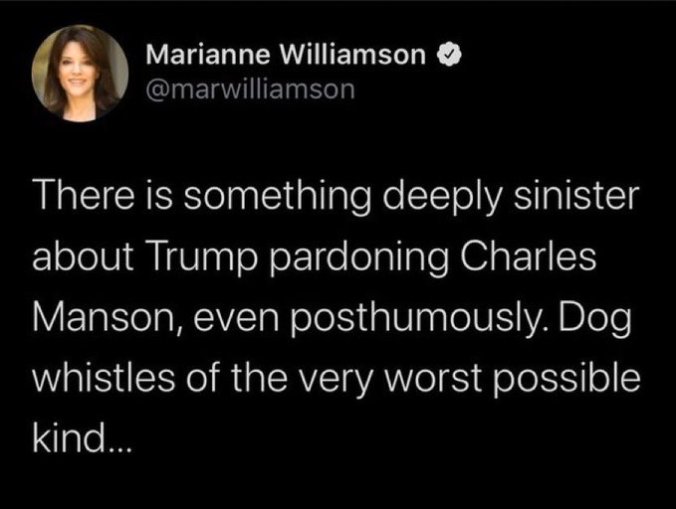
1 . You know I can’t let this pass: New Age guru and cool Democratic Presidential candidate Marianne Williamson tweeted out both fake news and, given her number of followers and <cough> far more effective disinformation for the kind of idiots who believe Russian bots than any foreign mischief-maker on Facebook:

She only could believe this absurd “report” if  a) she was so ready to believe anything bad about this President that literally nothing could be too absurd to swallow, and b) if she was so irresponsible that she would tweet it to her gazillion followers without checking.  It seems that she read a phony article published on Nov. 16 by MoronMajority.com. by the light of her lava lamp, after itwas then picked up by  the Daily Kos, which could easily use the name “MoronMajority.” After pulling down the tweet, Williamson had the chutzpa to write she wrote that we had to be vigilant against “big lies” in the coming campaign….you know, like hers.

2. Then there is this from Rep. Al Green, who was calling for Trump’s impeachment, and entered resolutions to that effect, long, long before there was any Ukraaine phone call:

Rep. Al Green (D-TX) said on Saturday during an interview on MSNBC that President Donald Trump needed to be impeached “to deal with slavery.”Green, who has previously stated that Trump must be impeached or else “he will get reelected,” said this week that there is “no limit” to the number of times that Democrats can try to impeach the president.

In other words, he is just like every other House Democrat, just not as subtle. And perhaps a little bit more stupid. Asked to explain what slavery has to do with impeachment, Green replied,

I do believe, ma’am, that we have to deal with the original sin. We have to deal with slavery. Slavery was the thing that put all of what President Trump has done lately into motion.We cannot overlook what happened when he came down the escalator and just demeaned people of color when he talked about the s-hole countries. It’s insidious … racism, the president has played on racism and he’s used that as a weapon to galvanize a base of support to mobilize people.So, I appreciate whatever we will do, but until we deal with the issue of invidious discrimination as a relates to [the] LGBTQ community, the anti-Semitism, the racism, the Islamophobia, the transphobia, and also the misogyny that he has exemplified, I don’t think our work is done.

Ah! Now he sounds more typical. This is, of course, Big Lie #4, “Trump is a racist.” John Hinderaker correctly notes on his blog:

Green’s rant is valuable, not because it makes any sense, but because it gives us a window into the Democrats’ real motive for wanting to impeach the president–sheer hatred over political differences. Combined, of course, with the realization that in all probability, he will be re-elected next year if they do not succeed in evicting him from office.

How long can the news media and the public fail to acknowledge this? Continue reading

The Damning Fake Video

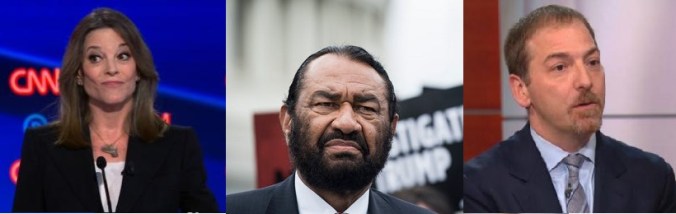
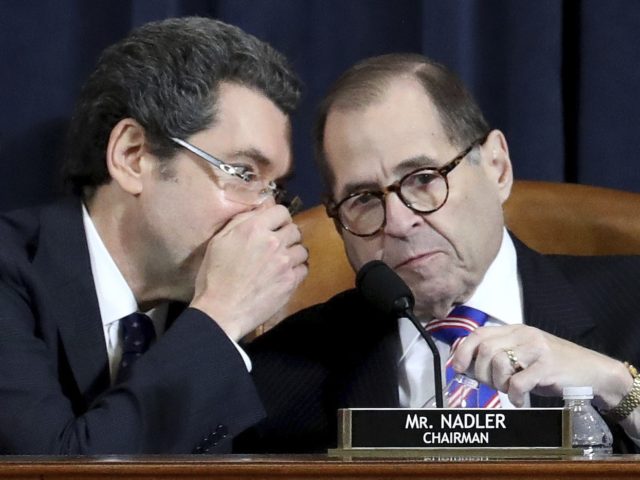
During last week’s  impeachment hearings, Democratic Judiciary Counsel Norman Eisen (above, on the left) presented a video clip showing President Trump  saying: “Then I have an Article II, where I have the right to do whatever I want as President.” Asked to comment on the video, Harvard Law School Professor Noah Feldman—you know, he’s the one who falsely told the committee and America that Nixon “sent burglars” to steal documents from the Democratic National Committee’s headquarters in 1972. That guy— replied, “As someone who cares about the Constitution,” the statement “struck a kind of horror in me.”

Jerry Nadler, Chairman of the House Judiciary Committee, referenced the same quotation as it was heard in the clip , concluding that President Trump “believes that in his own words, ‘I can do whatever I want.’” House Speaker Nancy Pelosi (D-Calif.) was referencing the same video when she said Thursday that Trump threatened  the Constitution by acting as a “king.”

Later in the week, CNN legal analyst Elie Honig twice cited the same clip.  So did MSNBC’s Chris Mathews during  “Hardball,” and  MSNBC host Joe Scarborough on “Morning Joe.” The Washington Post spread the same report about the video.

In all six cases, a video deceptively edited to misrepresent what the President was referring to was used to inflame and deceive.  Continue reading

Now THIS Is An Unprofessional Lawyer!

And juuuuust a bit uncivil, I’d say. I  may be wrong…

In a motion to dismiss an insurance law suit, Allstate’s lawyers revealed this remarkable conduct on the part of plaintiff’s attorney Christopher Hook in his communications during the case. According to the declaration of those attorneys in their motion, Hook said or wrote…

  • “Fuck you crooks. Eat a bowl of dicks.” (Declaration of Peter H. Klee, Ex. 1, p. 5)
  • “I’m going to let the long dick of the law fuck Allstate for all of us.” (Id., p. 7)
  • “Hey Klee you Cumstain the demand is now 302 million. Pay up fuckface.” (Id., p. 8)
  • “Peter when you are done felating your copy boy tell Allstate the demand is now 305 million.” (Id., p. 9)
  • “[Other Sheppard Mullin attorneys] may not be too smart but at least they have some fucking dignity and honor unlike you two limp dick mother fuckers.” (Id., p. 10)
  • “What is Wright going to do when he finds out Allstate is using people who are borderline retarded to adjust complex claims. That’s what I’m going to do. Demand increases tomorrow.” (Klee Decl., Ex. 1, p. 11)
  • “Anytime now faggot.” (Id., p. 13)
  • “I want my clients’ money gay boys.”

Continue reading

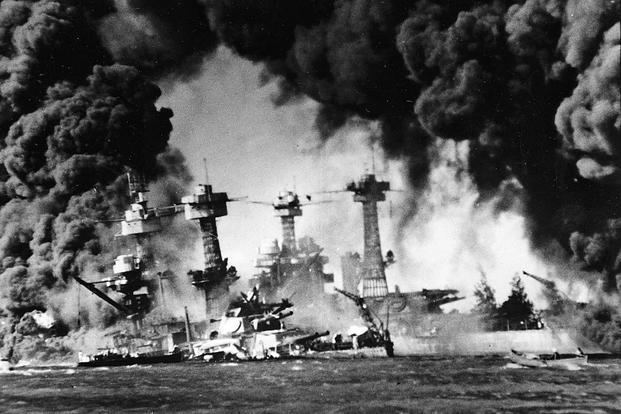
Saturday Ethics Warm-Up, Pearl Harbor Day, 2019: Actual Crimes, Misdemeanors And Other Despicable Acts Edition

Remember.

1. The Bad Guys. This email message was received by George Washington Law School administrators urging it to punish Prof. Johnathan Turley for presenting a factual analysis of the Democrats’ contrived case against Donald Trump:

“I am writing you all after listening to Jonathan Turley’s disgraceful statement defending the corrupt and impeachable actions of President Trump at the House Judiciary impeachment hearing today. I know you all cringe inside knowing that you are affiliated in some way with Turley and have to work or study at the same institution in which he is employed. He is defending the indefensible and I hope that all of the Deans at GWU Law and the students will recognize that he is not serving in the best interest of our country and is a detriment to the success of your school’s future reputation. His actions today were spineless and shameful. He is clearly a lackey for the Trump Administration I trust you will act appropriately and reprimand this sad excuse of a man.”

The email was unsigned, but the school says it did not come from a student. Meanwhile, on his blog, Turley has stated that his “office and home have been inundated with threats from people irate over the fact that I would question the sufficiency of this record for impeachment.” He also has felt it necessary to respond to intentionally false arguments against his positions. That Turley’s employers would be told by anyone that the public courage and erudition of Prof. Turley could possibly be “a detriment to the success” of the “school’s future reputation” show how completely the  mass determination to “get” President Trump has entered the realm of Bizarro World ethics, or perhaps for younger fans of “Stranger Things,” the Upside Down.

A commenter on the post about the email at Legal Insurrection writes,

In The Coming of the Third Reich (2003), historian Richard J. Evans explains how, in the early days of National Socialist Germany, Stormtroopers (Brownshirts) “organized campaigns against unwanted professors in the local newspapers [and] staged mass disruptions of their lectures.” To express dissent from Nazi positions became a matter of taking one’s life into one’s hands. The idea of people of opposing viewpoints airing their disagreements in a civil and mutually respectful manner was gone. One was a Nazi, or one was silent (and fearful).

Today’s fascists call themselves “anti-fascists.” Just like the Nazis, they are totalitarian: they are determined not to allow their opponents to murmur the slightest whisper of dissent. Forcibly suppressing the speech of someone with whom one disagrees is a quintessentially fascist act.

Exactly.

2. The Legacy of Marion Barry.  Usually crooked D.C. politicians who are caught stealing money or passing it along to cronies —and there have been oh-so-many of them, resign, long-time member D.C. City Council member Jack Evans, however, became the first local scam artist to be kicked off the body, which voted this week that he  be expelled after a series of investigations found Evans, the city’s longest-serving lawmaker, used his public office to benefit private clients and employers who paid him hundreds of thousands of dollars.

“He has betrayed each and every one of us,” said council member Mary M. Cheh (D-Ward 3), who is leading the internal investigation of Evans. “You would speak to him about council things, but he was speaking for the people who were buying him.”

This time, for a change, the elected crook is white, so there will be no demonstrations by D.C. residents claiming racism. Whew! Continue reading

Written Statement of Prof. Jonathan Turley: “The Impeachment Inquiry Into President Donald J. Trump: The Constitutional Basis For Presidential Impeachment” [PART V]

Note the date…

In his final section before concluding, Professor Turley covers other theories being floated as justification for impeachment, and finds them startlingly weak and contrived.

The Hill has Turley’s lament regarding the  the Alliance of Unethical Conduct’s attacks on his thorough and objective dismantling of their coup efforts. (The AUC—that’s the Ethics Alarm shorthand for the Democratic Party-“resistance”-mainstream media alliance to remove Trump from office by any means possible, not Turley’s.)  He writes,

Despite 52 pages of my detailed testimony, more than twice the length of all the other witnesses combined, on the cases and history of impeachment, [Washington Post columnist Dana Milbank] described it as being “primarily emotional and political.” Milbank claimed that I contradicted my testimony in a 2013 hearing when I presented “exactly the opposite case against President Obama” by saying “it would be ‘very dangerous’ to the balance of powers not to hold Obama accountable for assuming powers ‘very similar’ to the ‘right of the king’ to essentially stand above the law.”

But I was not speaking of an impeachment then. It was a discussion of the separation of powers and the need for Congress to fight against unilateral executive actions, the very issue that Democrats raise against Trump. I did not call for Obama to be impeached….

In my testimony Wednesday, I stated repeatedly [as I stated in my testimony during the Clinton impeachment] that a president can be impeached for noncriminal acts…. My objection is not that you cannot impeach Trump for abuse of power but that this record is comparably thin compared to past impeachments…. … Democrats have argued that they do not actually have to prove the elements of crimes…. In the Clinton impeachment, the crime was clearly established and widely recognized…. [W]e are lowering impeachment standards to fit a paucity of evidence and an abundance of anger…. 

Writes Ann Althouse in a post yesterday, “it seems to me that the real impeachable offense has always been that Donald Trump got himself elected.”

I wish Prof. Turley had dealt with that, the real justification, in their minds, for the House’s impeachment push.

Back to the professor:

C.  Extortion.

 As noted earlier, extortion and bribery cases share a common law lineage. Under laws like the Hobbs Act, prosecutors can allege different forms of extortion. The classic form of extortion is coercive extortion to secure property “by violence, force, or fear.”85 Even if one were to claim the loss of military aid could instill fear in a country, that is obviously not a case of coercive extortion as that crime has previously been defined.

Instead, it would presumably be alleged as extortion “under color of official right.” Clearly, both forms of extortion have a coercive element, but the suggestion is that Trump was “trying to extort” the Ukrainians by withholding aid until they agreed to open investigations. The problem is that this allegation is no closer to the actual crime of extortion than it is to its close cousin bribery. The Hobbs Act defines extortion as “the obtaining of property from another, with his consent, induced by wrongful use of actual or threatened force, violence, or fear or under color of official right.”87

As shown in cases like United States v. Silver, extortion is subject to the same limiting definition as bribery and resulted in a similar overturning of convictions. Another obvious threshold problem is defining an investigation into alleged corruption as “property.” Blackstone described a broad definition of extortion in early English law as “an abuse of public, justice which consists in an officer’s unlawfully taking, by colour of his office, from any man, any money or thing of value, that is not due him, or more than is due, or before it is due.”89 The use of anything “of value” today would be instantly rejected. Extortion cases involve tangible property, not possible political advantage.90 In this case, Trump asked for cooperation with the Justice Department in its investigation into the origins of the FBI investigation on the 2016 election. As noted before, that would make a poor basis for any criminal or impeachment theory. The Biden investigation may have tangible political benefits, but it is not a form of property. Indeed, Trump did not know when such an investigation would be completed or what it might find. Thus, the request was for an investigation that might not even benefit Trump.

The theory advanced for impeachment bears a close similarity to one of the extortion theories in United States v. Blagojevich where the Seventh Circuit overturned an extortion conviction based on the Governor of Illinois, Rod Blagojevich, pressuring then Sen. Barack Obama to make him a cabinet member or help arrange for a high- paying job in exchange for Blagojevich appointing a friend of Obama’s to a vacant Senate seat. The prosecutors argued such a favor was property for the purposes of extortion. The court dismissed the notion, stating “The President-elect did not have aproperty interest in any Cabinet job, so an attempt to get him to appoint a particular person to the Cabinet is not an attempt to secure ‘property’ from the President (or the citizenry at large).” In the recent hearings, witnesses spoke of the desire for “deliverables” sought with the aid. Whatever those “deliverables” may have been, they were not property as defined for the purposes of extortion any more than the “logrolling” rejected in Blagojevich.

There is one other aspect of the Blagojevich opinion worth noting. As I discussed earlier, the fact that the military aid was required to be obligated by the end of September weakens the allegation of bribery. Witnesses called before the House Intelligence Committee testified that delays were common, but that aid had to be released by September 30th. It was released on September 11th. The ability to deny the aid, or to even withhold it past September 30th is questionable and could have been challenged in court. The status of the funds also undermines the expansive claims on what constitutes an “official right” or “property”:

“The indictment charged Blagojevich with the ‘color of official right’ version of extortion, but none of the evidence suggests that Blagojevich claimed to have an ‘official right’ to a job in the Cabinet. He did have an ‘official right’ to appoint a new Senator, but unless a position in the Cabinet is ‘property’ from the President’s perspective, then seeking it does not amount to extortion. Yet a political office belongs to the people, not to the incumbent (or to someone hankering after the position). Cleveland v. United States, 531 U.S. 12 (2000), holds that state and municipal licenses, and similar documents, are not ‘property’ in the hands of a  public  agency. That’s equally true of public positions. The President-elect did not have a property interest in any Cabinet job, so an attempt to get him to appoint a particular person to the Cabinet is not an attempt to secure ‘property’ from the President (or the citizenry at large).”

A request for an investigation in another country or the release of money already authorized for Ukraine are even more far afield from the property concepts addressed by the Seventh Circuit.

The obvious flaws in the extortion theory were also made plain by the Supreme Court in Sekhar v. United States, where the defendant sent emails threatening to reveal embarrassing personal information to the New York State Comptroller’s general counsel in order to secure the investment of pension funds with the defendant. In an argument analogous to the current claims, the prosecutors suggested political or administrative support was a form of intangible property. As in McDonnell, the Court was unanimous in rejecting the “absurd” definition of property. The Court was highly dismissive of such convenient linguistic arguments and noted that “shifting and imprecise characterization of

the alleged property at issue betrays the weakness of its case.”94 It concluded that “[a]dopting the Government’s theory here would not only make nonsense of words; it would collapse the longstanding distinction between extortion and coercion and ignore Congress’s choice to penalize one but not the other. That we cannot do.”95 Nor should Congress. Much like such expansive interpretations would be “absurd” for citizens in criminal cases, it would be equally absurd in impeachment cases.

To define a request of this kind as extortion would again convert much of politics into a criminal enterprise. Indeed, much of politics is the leveraging of aid or subsidies or grants for votes and support. In Blagojevich, the court dismissed such “logrolling” as the basis for extortion since it is “a common exercise.” If anything of political value is now the subject of the Hobbs Act, the challenge in Washington would not be defining what extortion is, but what it is not.

D.  Campaign Finance Violation

Some individuals have claimed that the request for investigations also constitutes a felony violation of the election finance laws. Given the clear language of that law and the controlling case law, there are no good-faith grounds for such an argument. To put it simply, this dog won’t hunt as either a criminal or impeachment matter. U.S.C. section 30121 of Title 52 states: “It shall be unlawful for a foreign national, directly or indirectly, to make a contribution or donation of money or other thing of value, or to make an express or implied promise to make a contribution or donation, in connection with a federal, state, or local election.”

On first blush, federal election laws would seem to offer more flexibility to the House since the Federal Election Commission has adopted a broad interpretation of what can constitute a “thing of value” as a contribution. The Commission states “’Anything of value’ includes all ‘in-kind contributions,’ defined as ‘the provision of any goods or services without charge or at a charge that is less than the usual and normal charge for such goods or services.’” However, the Justice Department already reviewed the call and correctly concluded it was not a federal election violation. This determination was made by the prosecutors who make the decisions on whether to bring such cases. The Justice Department concluded that the call did not involve a request for a “thing of value” under the federal law. Congress would be alleging a crime that has been declared not to be a crime by career prosecutors. Such a decision would highlight the danger of claiming criminal acts, while insisting that impeachment does not require actual crimes. The “close enough for impeachment” argument will only undermine the legitimacy of the impeachment process, particularly if dependent on an election fraud allegation that itself is based on a demonstrably slipshod theory. Continue reading

Cultural And Societal Poison, Pumped Into Our National Bloodstream [Corrected]

When I worked for the U.S. Chamber of Commerce in the 1970s, I was once dispatched to an Amway convention at the Atlanta Omni  to speak to the packed arena about carious Chamber citizen activism projects. Right before I was scheduled, the Amway “Diamond” hosting the thing (it was so strange and cult-like that “thing” is the best I can come up with this early in the morning) rallied the glassy-eyed crowd with a speech the likes of which I had never heard before. Among the crazy assertions he made to cheers and  cries of “Amen!” was that Jimmy Carter, then President, was card-carrying Communist and an agent of the Soviet Union, preparing as he spoke to turn over America to the Russians He also said, Joe McCarthy-like, that he had authentic documents to prove this.

As I sat in the wings, my mind raced to determine what I should do. I did not want to endorse or support what I had just heard in any way, but I also was on an assignment from my boss, who, I was and am quite sure, would have been just as horrified by what I had just heard as I was. Amway’s founders, Jay Van Andel and Rich De Vos were Chamber board members and big contributors to the Chamber’s PAC. Nothing I was promoting there was sinister. Still, I seriously considered leaving immediately, or even using my huge radio mic to denounce what I had just heard as outrageous lies, at least until I was brought down in a hail of bullets, or torn limb from limb by the infuriated mob.

In the end, I gave a shortened version on my planned speech—the crowd was very receptive—and got the hell out of there. When I returned to D.C., I announced that I would not appear at any more Amway conventions, or, for that matter, any John Birch Society meetings or KKK rallies, and my wishes were respected. I remained disturbed by the incident, and especially by the extremist bile that was apparently circulating quietly among the public that was barely hinted at in what was then naively called the “respectable media.”

Sunday, I read a column by Thomas Friedman, a three-time Pulitzer Prize winner and best-selling author who writes for the New York Times. In a column called Iran Is Crushing Freedom One Country at a Time,”  this supposedly mainstream and eminently respectable pundit wrote, Continue reading

Written Statement of Prof. Jonathan Turley: “The Impeachment Inquiry Into President Donald J. Trump: The Constitutional Basis For Presidential Impeachment” [PART IV]

The press wanted Andrew Johnson impeached, too…

This section of Turley’s masterpiece covers the various “obstruction of justice” claims. The conclusion:

“Basing impeachment on this obstruction theory would itself be an abuse of power. . . by Congress. It would be an extremely dangerous precedent to set for future presidents and Congresses in making an appeal to the Judiciary into “high crime and misdemeanor.”

Boy, Turley did a terrific job…

B.  Obstruction of Justice

 Another crime that was sporadically mentioned during the House Intelligence hearings was obstruction of justice or obstruction of Congress. Once again, with only a few days to prepare this testimony and with no public report on the specific allegations, my analysis remains mired in uncertainty as to any plan to bring such a claim to the foundational evidence for the charge. Most of the references to obstruction have been part of a Ukraine-based impeachment plan that does not include any past alleged crimes from the Russian investigation. I will therefore address the possibility of a Ukraine-related obstruction article of impeachment. However, as I have previously written, I believe an obstruction claim based on the Mueller Report would equally at odds with the record and the controlling case law. The use of an obstruction theory from the Mueller Report would be unsupportable in the House and unsustainable in the Senate. Once again, the lack of information (just weeks before an expected impeachment vote) on the grounds for impeachment is both concerning and challenging. It is akin to being asked to diagnose a patient’s survivability without knowing his specific illness.

Obstruction of justice is a more broadly defined crime than bribery and often overlaps with other crimes like witness tampering, subornation, or specific acts designed to obstruct a given proceeding. There are many federal provisions raising forms of obstruction that reference parallel crimes. Thus, influencing a witness is a standalone crime and also a form of obstruction under 18 U.S.C. 1504. In conventional criminal cases, prosecutions can be relatively straightforward, such as cases of witness intimidation under 18 U.S. 1503. Of course, this is no conventional case. The obstruction claims leveled against President Trump in the Ukrainian context have centered on two main allegations. First, there was considerable discussion of the moving of the transcript of the call with President Zelensky to a classified server as a possible premeditated effort to hide evidence. Second, there have been repeated references to the “obstruction” of President Trump by invoking executive privileges or immunities to withhold witnesses and documents from congressional committees. In my view, neither of these general allegations establishes a plausible case of criminal obstruction or a viable impeachable offense.

In the Mueller report, Assistant Attorney General found no cognizable case was presented for an allegation of obstruction of justice. Many members of this Committee heralded the selection of Rosenstein as a consummate and apolitical professional who was responsible for the appointment of the Special Counsel. He reached this conclusion on the record sent by Mueller and, most importantly, the controlling case law. As with the campaign finance allegation discussed in this testimony, an article based on obstruction in the Russian investigation would seek the removal of a President on the basis of an act previously rejected as a crime by the Justice Department. Many of us have criticized the President for his many comments and tweets on the Russian investigation. However, this is a process that must focus on impeachable conduct, not imprudent or even obnoxious conduct. Continue reading