Ethics Hero Emeritus: Jack McDonald (1915-2013)

Jack McDonald

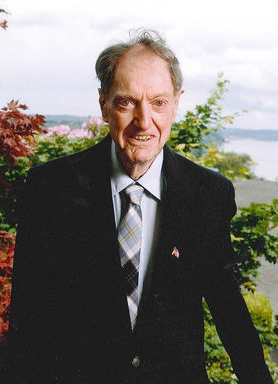
Before today, I had never heard of Jack McDonald, and outside of his co-workers , family and friends, not many had. That was the way he wanted it, for he was an unassuming man with a conventional career, including three decades as an attorney for the Veterans Administration. He clipped coupons, dressed humbly and allowed himself few luxuries. He got around his home town of Seattle using public transportation. Most who knew him thought he was struggling.

When Jack McDonald died this past September, his death received little notice in the local news, and none nationally—until about a week ago, when it was revealed that his will provided for the creation of a $187.6 million charitable trust for the benefit of Seattle Children’s Research Institute, the University of Washington School of Law and the Salvation Army. Continue reading

Ethics Hero, Thanksgiving Division: Scott Stuckey, Manager of Atlanta’s Omni Hotel

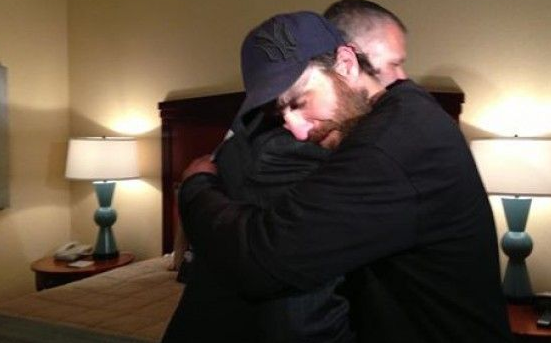
Scott Stuckey gets hugged by a grateful non-criminal Joel Hartman was homeless and surviving in Atlanta by dumpster diving, but when he found a lost wallet with the owner’s identification and credit card inside, he was determined to do the right thing. The wallet obviously belonged to a tourist, so the 36-year-old man checked the hotels in downtown Atlanta until he found out that the tourist (from France, for a conference) was staying at the Omni Hotel.

After Alanta’s Omni manager Scott Stuckey saw the surveillance video of Hartman—who looked as destitute as he was— turning in the wallet to the hotel’s  security guards, he decided that a reward was in order.  Hartman had given them a fake name, so it took some effort to track the shy good Samaritan down. Stuckey and his staff searched for a week, leaving messages with other homeless people that the Omni wanted to thank the man who recovered its guest’s stolen wallet. Eventually Hartman heard about their quest, and showed up at the hotel. He was shocked at what Stuckey had planned for him. Hartman was told that he would be the Omni’s guest in a luxury room through the Thanksgiving holiday with complimentary room service. The hotel also  gave him $500.

I think the gesture by Stuckey and the Omni was kind, appropriate, and in keeping with the spirit of the holiday….but: Continue reading

Ethics Hero: USA Today

News you can use!

News you can use!

Increasingly, all the Obama White House has in its tool box to limit the damage of fiascos  past, present and future is its ability to manipulate the President’s  public image.  For five years an infuriatingly uncritical and submissive press allowed this administration to avoid the consequences of mistakes, problems and misconduct that would have dominated front pages for months in past years, but some vague signs of backbone have been visible of late, so the White House is cracking down.

From the journalism website of the Poynter Institute:

“A coalition of news organizations, including the Associated Press, ABC News, The Washington Post and Reuters called for better access to the president and the White House today in a letter addressed to White House press secretary Jay Carney.

The letter says, in part:

“Journalists are routinely being denied the right to photograph or videotape the President while he is performing his official duties. As surely as if they were placing a hand over a journalist’s camera lens, officials in this administration are blocking the public from having an independent view of important functions of the Executive Branch of government.”

The National Press Photographers Association also put its name to the protest. “Media organizations including NPPA have been keeping track of all the times on the president’s schedule when something has been marked ‘private,’ or when there’s been a news lid issued by the Press Office, only to find a White House photograph from the event show up a short time later on its official Web site,” NPPA General Counsel Mickey Osterreicher said. “We have never been granted access to the President at work in the Oval Office accompanied by his staff,” AP Director of Photography Santiago Lyon said. “Previous administration regularly granted such access.”

Continue reading

Ethics Hero (Animal Lover Division): Janet Sinclair

janet+and+sedona

Janet Sinclair used United Airlines’ “PetSafe” service to fly her beloved greyhound Sedona cross-country from San Diego. The service assures flyers that their pets will make the journey safe and sound, with responsible care and personal handling. Sinclair, however, became alarmed when she saw a United employee kick Sedona’s crate six times to shove it under the shade of the plane’s wing instead of carefully moving it. She then began documenting United’s pet care. Her video  shows her dog being left outside in 94 degree heat at a mid-journey stop (in Houston), and not placed in a temperature-controlled vehicle as she had been promised. When Sinclair landed at Logan Airport in Boston, her dog was barking at death’s door.

“Sedona’s entire crate was filled with blood, feces, urine,” Sinclair told reporters. “Sedona was in full heat stroke. All of the blankets were filled with blood. She was urinating and defecating blood. She was dying, literally, right in front of me.” The veterinarian who saved Sedona diagnosed her with heat stroke, urinary tract infection and liver dysfunction, all arising from the over-heating the dog experienced during the United Airlines flight. The airline, for its part, claimed that the dog’s distress was due to pre-existing conditions, though Sinclair’s vet had declared Sedona healthy following a pre-trip exam. Continue reading

Ethics Heroes: The Al Ittihad Soccer Team

Spontaneous  sportsmanship  broke out in a recent international soccer match between Al Nahdha, an Omani soccer club, and Al Ittihad, a Saudi soccer club. I’ll take my encouragement from wherever I can get it these days.

Al Nahdha’s goalkeeper was about to make a clearance early in the second half of a 2-2  tie, but hesitated because his shoelace was untied, and seemed worried that his shoe would fly off. An opposing player, a Brazilian striker named  Jobson, noticed the goalkeeper’s dilemma  and  instead of taking advantage of the soccer equivalent of a wardrobe malfunction, tied his opponent’s shoelace for him. The surprised and grateful goalkeeper slapped Jobson on the back and gave him a high-five as the crowd cheered its approval, then he kicked the ball.

A ref, however, spoiled the moment by signaling that the goalie had delayed the game by taking too long with his clearance. He awarded an indirect free kick to Al Ittihad , and Al Nahdha lined up to defend.  Then, after talking the situation over, the Saudi team took what could have been its shot at a game-deciding goal.
The team just kicked the ball harmlessly past the goal, refusing  the penalty (and rebuking the referee), while also making certain that its earlier good sportsmanship wasn’t rendered pointless by a gratuitous ruling.

The crowd loved it.

I bet I would have too, if I would let myself be caught dead at a soccer match.

[Disclaimer: The title on the video above is the opinion of the video poster, and does not necessarily represent the views of Ethics Alarms.]

__________________________

Pointer: Jonathan Turley

Now THAT’S An Apology: Chuck Klosterman (“The Ethicist”) Shows The Way

Chuck Klosterman, "The Ethicist," stands tall.

Chuck Klosterman, “The Ethicist,” stands tall.

In the past I have been very critical of  The New York Times’ current writer of  its “The Ethicist” column,  but there is no denying that Chuck Klosterman knows how to make an apology. Indeed, responding to a sensitive situation, he may have offered the most exemplary apology I have ever heard or read.

“A Typical Son” is a perceptive and moving blog that documents the life experiences of a young boy with Down Syndrome and his parents. His mother occasionally  posted an open letter to Mr. Klosterman on the blog, citing his multiple uses of the words “retard” and “retarded” in various published works (Chuck was a film and TV reviewer prior to “The Ethicist” gig) over the past decade. She wrote in part…

“…Today people with cognitive disabilities and their allies are asking members of society to refrain from using the word “retarded” (along with all mutations of the word)… My question to you: Is it ethical to contribute to the denigration of the vulnerable? I am particularly interested because you, Chuck Klosterman, are The Ethicist for the New York Times” and the author of the following [examples of denigrating or mocking references to the mentally handicapped]…. Mr. Klosterman, you appear to be an unrepentant hater of people with cognitive disabilities. You are not using the word in an “I don’t mean it like that way…” sort of ignorance which I think would be much easier to redress. You are using the word in a “Those people are exactly who I am talking about” way.

Please enlighten me: What are the ethics of using the R-word? I am the mother of a seven-year-old son who has Down syndrome.  I believe your response to my question could make all the difference in the world.”

Here is Klosterman’s remarkable response: Continue reading

Ethics Heroes: The Mourners of Harold Jellicoe Percival

It’s a simple story.

Thanks Dad. Thanks, Harold. Oh, shut up. Justin!

Thanks Dad. Thanks, Harold. Oh, shut up. Justin!

From the Los Angeles Times:

When Harold Jellicoe Percival died last month, the British World War II veteran’s obituary mentioned that he had no close family to attend his funeral. But after the obituary went viral, hundreds of people showed up to honor him Monday. Percival, who served as a member of the Royal Air Force’s Bomber Command, died on Oct. 25 at the age of 99. His obituary requested that “any service personnel who can attend his funeral service would be appreciated.” It spread across social media brought it to the attention of service members and veterans organizations in Britain, They, in turn, rallied people to attend his funeral and honor his memory on Armistice Day.

There were reportedly 100 mourners in the church, and another 400 standing outside.

The ethical virtues demonstrated here are respect, gratitude, kindness, and citizenship. Somebody please explain this to Salon’s clueless, obnoxious, ungrateful and ethically, historically, logically and rhetorically-challenged writer Justin Doolittle, who argues that there is no reason to thank veterans for doing the dirty work of democracy and putting their lives on the line to protect his. Continue reading

Ethics Hero: Umpire Jim Joyce…Again

Obstruction play

Last night, a close and exciting Game #3 of the baseball’s World Series ended in the most unsatisfying manner possible, especially for Boston Red Sox fans. The winning run in the bottom of the ninth inning scored because of an obstruction call at third base, made by umpire Jim Joyce, giving the victory in a tense battle to the St. Louis Cardinals. Although fans saw baserunner Allen Craig tagged out at home for the final out of the frame, sending the game into extra-innings, or so they thought, Boston third baseman Will Middlebrooks was ruled to have obstructed Craig from getting up and scoring from third on an errant throw, though both runner and fielder were caught in a tangle after a collision at third due to no fault of their own. The relevant rule says that if in the umpire’s judgement a fielder, regardless of fault or intent, impedes a runner trying to reach the next base, and that the umpire also concludes that the runner would have reached the base safely without the fielder’s impediment, then the runner will be awarded the base. This meant that Craig was awarded home plate, his team was awarded the winning run, and the game was over.

The obstruction was clear and undeniable, but in many sports, such a technical call would never be permitted to decide a crucial or championship game, and even in baseball, there are umpires who might not have the courage to make such an unpopular call. Rules, however, are rules, and a sport that suspends or alters its rules for entertainment value lacks integrity.

Baseball was fortunate to have an umpire at third base who has proved his integrity before, veteran Jim Joyce. Millions of Boston fans hate him ( though not quite as much as they hated umpire Larry Burnett, whose failure to make an interference call in Boston’s favor cost the Red Sox Game #3 of the 1975 Series) this morning, but the game they care about so passionately, in my view, has never looked better.

_____________________

Pointer: Craig Calcaterra

Facts: NBC Sports


Comment of the Day: “Lessons of The Colorado ‘Trans Bathroom Harassment’ Hoax

Australian Ethics Alarms reader Zoe Brain is the site’s resident expert on transgender issues, having professional and personal experience in the field, and she pointed me to this story, which is disturbing and revealing. I know she will continue to help clarify the issues and events involved in the ongoing comment thread, but I wanted to highlight this comment, which also provides an update, as the Comment of the Day on the post, Lessons of The Colorado “Trans Bathroom Harassment” Hoax.Here’s Zoe Brain:

“A few comments –

“1) Christian Broadcasting Network (CBN), Fox News and others have neither retracted the story nor removed it, despite being informed that it’s false in both substance and in several technical areas. For example, this trans girl transitioned two years ago, she is not “a boy who sometimes dresses like a girl”.

“2) On the other hand, the San Jose Christian Examiner, after initially and uncritically reporting what the CBN had said (they considered it a completely reliable source) and with additional rather pungent commentary, subsequently fact-checked and retracted with apologies. They left the story up as a badge of dishonour, but prefaced it with words that did indeed amount to “WE MISLED YOU, WE WERE UNPROFESSIONAL, AND WE BEG YOUR FORGIVENESS.”. I therefore nominate them for an Ethics Hero award – section “What to do when you screw up by the numbers”.

“3) Regarding timing – Continue reading

Ethics Hero Emeritus: Sister Antonia Brenner, 1926-2013


Sister Antonia dies at 86

Sister Antonia caring for a prisoner in La Mesa in 2002

Once again, someone remarkable has died whose life was insufficiently celebrated while she was alive. I had never heard of Antonia Brenner until yesterday. I wish I had.

Mary Clarke was born on Dec. 1, 1926—we share a birthday!— the second of three children. Her father, Joseph, was a prosperous business executive; the family had a second home overlooking the Pacific. After her second marriage, to Carl Brenner, she was known as Mary Brenner, and was the mother of eight children, comfortably ensconced in Beverly Hills.  While struggling through her second divorce, she began doing charity work for the poor in Los Angeles.  A priest friend, Monsignor Anthony Brouwers, took  her to La Mesa state penitentiary in Tijuana, Mexico, which was filled with convicted murderers, thieves, gang members, rapists and other hardened criminals, all living in brutal and inhumane  conditions even by the horrible standards of U.S. prisons. Everything—her life, her name, and most of all, the existence of the prisoners, changed after that.

She became devoted to their plight as human beings, and brought the prisoners basics of comfort that were being withheld from them, at her own expense. She gave them aspirin, blankets, tooth paste, soap, even prescription eyeglasses. She carried spare toilet paper with her, and kep a lookout for other missing essentials. Brenner acquired a prison contract to sell soda pop to prisoners and then used the proceeds to post bail for minor offenders. She began spending more and more time with the prisoners, gaining their affection and trust, even singing in their church services. She treated them with dignity and kindness: when prisoners died, it was Mary Brenner who prepared him for burial. Continue reading