Ethics Heroes: The Mourners of Harold Jellicoe Percival

It’s a simple story.

Thanks Dad. Thanks, Harold. Oh, shut up. Justin!

Thanks Dad. Thanks, Harold. Oh, shut up. Justin!

From the Los Angeles Times:

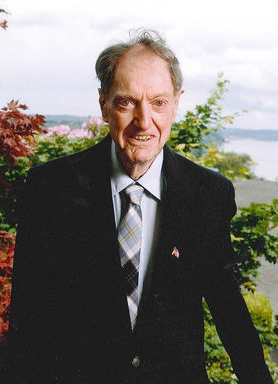
When Harold Jellicoe Percival died last month, the British World War II veteran’s obituary mentioned that he had no close family to attend his funeral. But after the obituary went viral, hundreds of people showed up to honor him Monday. Percival, who served as a member of the Royal Air Force’s Bomber Command, died on Oct. 25 at the age of 99. His obituary requested that “any service personnel who can attend his funeral service would be appreciated.” It spread across social media brought it to the attention of service members and veterans organizations in Britain, They, in turn, rallied people to attend his funeral and honor his memory on Armistice Day.

There were reportedly 100 mourners in the church, and another 400 standing outside.

The ethical virtues demonstrated here are respect, gratitude, kindness, and citizenship. Somebody please explain this to Salon’s clueless, obnoxious, ungrateful and ethically, historically, logically and rhetorically-challenged writer Justin Doolittle, who argues that there is no reason to thank veterans for doing the dirty work of democracy and putting their lives on the line to protect his. Continue reading

Ethics Hero: Umpire Jim Joyce…Again

Obstruction play

Last night, a close and exciting Game #3 of the baseball’s World Series ended in the most unsatisfying manner possible, especially for Boston Red Sox fans. The winning run in the bottom of the ninth inning scored because of an obstruction call at third base, made by umpire Jim Joyce, giving the victory in a tense battle to the St. Louis Cardinals. Although fans saw baserunner Allen Craig tagged out at home for the final out of the frame, sending the game into extra-innings, or so they thought, Boston third baseman Will Middlebrooks was ruled to have obstructed Craig from getting up and scoring from third on an errant throw, though both runner and fielder were caught in a tangle after a collision at third due to no fault of their own. The relevant rule says that if in the umpire’s judgement a fielder, regardless of fault or intent, impedes a runner trying to reach the next base, and that the umpire also concludes that the runner would have reached the base safely without the fielder’s impediment, then the runner will be awarded the base. This meant that Craig was awarded home plate, his team was awarded the winning run, and the game was over.

The obstruction was clear and undeniable, but in many sports, such a technical call would never be permitted to decide a crucial or championship game, and even in baseball, there are umpires who might not have the courage to make such an unpopular call. Rules, however, are rules, and a sport that suspends or alters its rules for entertainment value lacks integrity.

Baseball was fortunate to have an umpire at third base who has proved his integrity before, veteran Jim Joyce. Millions of Boston fans hate him ( though not quite as much as they hated umpire Larry Burnett, whose failure to make an interference call in Boston’s favor cost the Red Sox Game #3 of the 1975 Series) this morning, but the game they care about so passionately, in my view, has never looked better.

_____________________

Pointer: Craig Calcaterra

Facts: NBC Sports


Comment of the Day: “Lessons of The Colorado ‘Trans Bathroom Harassment’ Hoax

Australian Ethics Alarms reader Zoe Brain is the site’s resident expert on transgender issues, having professional and personal experience in the field, and she pointed me to this story, which is disturbing and revealing. I know she will continue to help clarify the issues and events involved in the ongoing comment thread, but I wanted to highlight this comment, which also provides an update, as the Comment of the Day on the post, Lessons of The Colorado “Trans Bathroom Harassment” Hoax.Here’s Zoe Brain:

“A few comments –

“1) Christian Broadcasting Network (CBN), Fox News and others have neither retracted the story nor removed it, despite being informed that it’s false in both substance and in several technical areas. For example, this trans girl transitioned two years ago, she is not “a boy who sometimes dresses like a girl”.

“2) On the other hand, the San Jose Christian Examiner, after initially and uncritically reporting what the CBN had said (they considered it a completely reliable source) and with additional rather pungent commentary, subsequently fact-checked and retracted with apologies. They left the story up as a badge of dishonour, but prefaced it with words that did indeed amount to “WE MISLED YOU, WE WERE UNPROFESSIONAL, AND WE BEG YOUR FORGIVENESS.”. I therefore nominate them for an Ethics Hero award – section “What to do when you screw up by the numbers”.

“3) Regarding timing – Continue reading

Ethics Hero Emeritus: Sister Antonia Brenner, 1926-2013


Sister Antonia dies at 86

Sister Antonia caring for a prisoner in La Mesa in 2002

Once again, someone remarkable has died whose life was insufficiently celebrated while she was alive. I had never heard of Antonia Brenner until yesterday. I wish I had.

Mary Clarke was born on Dec. 1, 1926—we share a birthday!— the second of three children. Her father, Joseph, was a prosperous business executive; the family had a second home overlooking the Pacific. After her second marriage, to Carl Brenner, she was known as Mary Brenner, and was the mother of eight children, comfortably ensconced in Beverly Hills.  While struggling through her second divorce, she began doing charity work for the poor in Los Angeles.  A priest friend, Monsignor Anthony Brouwers, took  her to La Mesa state penitentiary in Tijuana, Mexico, which was filled with convicted murderers, thieves, gang members, rapists and other hardened criminals, all living in brutal and inhumane  conditions even by the horrible standards of U.S. prisons. Everything—her life, her name, and most of all, the existence of the prisoners, changed after that.

She became devoted to their plight as human beings, and brought the prisoners basics of comfort that were being withheld from them, at her own expense. She gave them aspirin, blankets, tooth paste, soap, even prescription eyeglasses. She carried spare toilet paper with her, and kep a lookout for other missing essentials. Brenner acquired a prison contract to sell soda pop to prisoners and then used the proceeds to post bail for minor offenders. She began spending more and more time with the prisoners, gaining their affection and trust, even singing in their church services. She treated them with dignity and kindness: when prisoners died, it was Mary Brenner who prepared him for burial. Continue reading

Ethics Hero: Sergio Consuegra

Hero!

Hero!

The violent confrontation between a group of aggrieved bikers and the driver of a sports utility vehicle (with his family on-board) in Manhattan turned into an ugly incident that left both the driver and one of the cyclists seriously injured.  You can see the disturbing video of the attack—captured on one of the cyclist’s helmetcam—-here. Who precipitated the incident will have to be sorted out in court, but the there is little question that only the intervention of bystanders stopped further injury to the driver and perhaps his family—an inspiring example of witnesses to a wrong stepping in at personal risk to themselves and making a difference. One of the rescuers—there were others, not yet named—was Sergio Consuera. Continue reading

From Oklahoma, A Remarkable Ethics Lesson

hartmanparkinglot_610x458

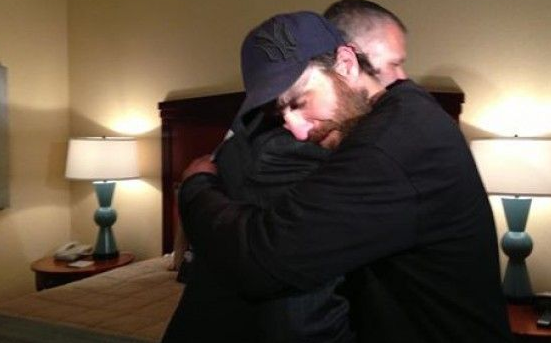
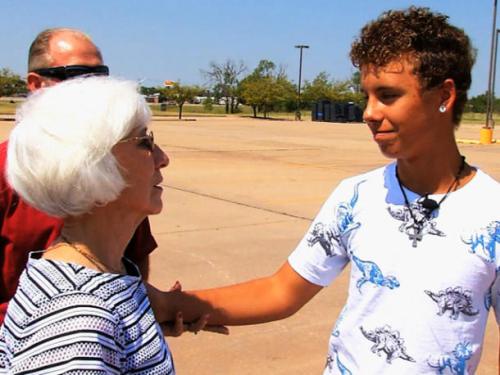
Young Christian Lunsford was disgusted when he saw the TV report about the mugging of seventy-eight-year-old Tona Herndon of Bethany, Oklahoma, robbed while visiting the gravesite of her husband of 60 years, who had died just two weeks earlier. It wasn’t merely that the mugger took a purse and $700 from a vulnerable and grieving woman, but that the culprit was Christian’s father. He had been quickly arrested, and his mug shot, shown on TV, was all-too-familiar to his fifteen-year-old son. Christian’s parents divorced when he was two, and his contact with his father had been minimal as the elder Lunsford kept ending up in jail. The teen had recently heard from his dad, however, when he sent Christian $250 to pay for his participation in a school band trip.

The latest crime, however, moved Christian to do something exemplary. He contacted Tona Herndon and asked her to meet him in a church parking lot. When she did, he mugged her too, as a tribute to his father.

No, that’s not what happened: I was just messing with you. Continue reading

Ethics Hero: Sid Bream

sid_breamYou all remember Sid Bream, don’t you? Well, probably not: he was a mediocre first baseman about 20 years ago who played for the Pittsburgh Pirates and the Atlanta Braves. He hasn’t been heard from in a long time, being quietly retired, but the Braves may be hosting the Pirates in an upcoming National League Division Playoff Series as the baseball post season gets underway, and they invited Bream to throw out the first pitch in Game #1 if that is the case—-Pittsburgh has to win a wildcard play-off game with Cincinnati first. You see, the one thing in his career that Bream is remembered for, at least in Atlanta, is scoring the run that won the National League Championship Series over the Pirates in 1992, in a close play that also lives in Pirates’ fans nightmares.

Throwing out the first pitch is fun: the team flies you in and pays for your hotel, gives you a prime ticket, and then announces your name as you trot on the field to cheers. If you have kept your arm in shape, you might even get off a throw to the catcher from the pitcher’s mound that doesn’t embarrass you, and that will acquire more cheers. from the packed stadium. Wait…this is Atlanta, not Boston. OK, from the two-thirds filled stadium. Even then, what’s not to like?

But Sid Bream turned the Braves down. Remember that I began by saying that he played for both the Braves and the Pirates. He said,

“Whatever their motive (for the invite) was, I don’t want to be involved. I wasn’t surprised (by the offer). Whether their motive was to rub it in the Pirates’ faces, I don’t know. I think it was just more of a gesture to commemorate those two teams getting back together in the postseason. But I’ll stay neutral. I’m not going to do anything to tell the fans in Atlanta or Pittsburgh that I’m (rooting) one way or the other.”

Oh, I think it’s fair to say that rubbing the Pirates’ faces in their last loss to the Braves in a postseason game was exactly what the Braves had in mind. This kind of voodoo has been a standard part of baseball gamesmanship for a long time: nobody believes that the Yankees had Bucky Dent throw out the first pitch when the Yankees had a crucial playoff game against Boston (which they lost) in 2004 “to commemorate those two teams getting back together in the postseason.” It’s psychological warfare, and more or less good-natured; there’s nothing wrong with it, and there would have been nothing wrong with Bream agreeing to play along.

But Sid Bream is, it seems, loyal. He was a Pittsburgh Pirate for a long time, a Brave only for a couple of years, and he doesn’t feel like being part of one of his former teams’ effort to unsettle the other one, even though its’ no big deal, and even though his old team won’t hold it against him. It just would feel right to him.

This is called integrity.

Good for Sid Bream.

_______________________

Pointer, Graphic and Facts: NBC Sports


Ethics Hero: Minneapolis Dairy Queen Manager Joey Prusak

"Good job, Joey!You made Dairy Queen proud and brought honor to the store, Here's 40 dollars."

“Good job, Joey!You made Dairy Queen proud and brought honor to the store, Here’s 40 dollars.”

It’s a simple story, trivial in a way, but with an important ethics lesson.

Joey Prusak, the 19-year-old store manager at a suburban Minneapolis Dairy Queen, watched as a female customer with a heart of ice saw a vision-impaired man drop a $20 bill, picked it up, and instead of returning the money to the unaware customer, slipped it into her own purse. When the certifiably awful woman got up to the counter to order, Prusak told her what he had seen and demanded that she return the bill as a condition of service. The woman, as one might expect from someone who would take money under such circumstances, refused, so Prusek reimbursed the visually impaired customer with $20 of his own.

A customer who saw the incident e-mailed Dairy Queen in praise, and now Prusak has become something of a folk hero.

The important ethics lesson is “Fix the problem.” If you are in a position to right a wrong or prevent one, it has become your obligation to do it. Don’t adopt  any of many rationalizations available to persuade you to do nothing— “It’s not my job,” “Mind your own business,” “Who am I to judge?”, “It’s not my fault”, “What if I’m wrong?”—or, in a case like this one, manufacture excuses for the vile miscreant who took the money—–“Maybe she’s desperate,” “Finders keepers”-–and just act. Fix the problem. Continue reading

Ethics Hero: Glen James

Glen James, role model.

Glen James, role model.

This is straightforward: Glen James, a Boston man who lives in shelters and has no money, found a backpack over the weekend that contained $2,400 in cash, $39,500 in traveler’s checks, passports, and other personal items. James flagged down a passing Boston police officer and gave him the backpack.  As is often the case with stories like this, he doesn’t think what he did was a big deal: after all, isn’t this what anyone would do?

We all know the answer to that question. Continue reading

Ethics Hero: Miss America Contestant Theresa Vail

theresa-vailMiss Kansas, also known as Theresa Vail, would be a standout in current 2014 Miss America pageant just based on her unusual set of experiences and talents: the 22-year-old student at Kansas State is a member of the Kansas Army National Guard’s Medical Detachment, a serious bowhunter, a former motorcycle racer, an  M16 marksman, a boxer, an auto mechanic, and an opera singer.* What is ethically of interest, however, is that she wore a bathing suit that  revealed her two tattoos.

This just isn’t done in beauty pageants, not that many contestants are the tatooing sort. Tatoos have traditionally been regarded as ruining a contestant’s “perfection,” and aesthetically, I have to agree: a beautiful woman is still beautiful with something scribbled on her side, but it is hardy an enhancement. But Vial, in announcing her decision on her blog, made a compelling ethical argument for letting her tats show:

“What a hypocrite I would be if I covered the ink. With my platform, how could I tell other women to be fearless and be true to themselves if I can’t do the same?…But I am who I am, tattoos and all.”

That is as good a definition of integrity as you will find. Brava.  Where integrity lies, you can usually find honesty, trustworthiness and courage as well. Continue reading