Unethical Quote of the Week: University of Wisconsin-Stout Chancellor Charles W. Sorensen

"Oh, HELP me, University administrators! A poster says that a fictional space cowboy from a TV series that isn't on anymore might kill me, or someone, under certain conditions!"

“UW-Stout administrators believe strongly in the right of all students, faculty and staff to express themselves freely about issues on campus and off.  This freedom is fundamental on a public university campus. However, we also have the responsibility to promote a campus environment that is free from threats of any kind—both direct and implied. It was our belief, after consultation with UW System legal counsel, that the posters in question constituted an implied threat of violence.  That is why they were removed. This was not an act of censorship.  This was an act of sensitivity to and care for our shared community, and was intended to maintain a campus climate in which everyone can feel welcome, safe and secure.”

—-

, one featuring a humorous quote from a cult TV science fiction series, the other a satiric poster opposing fascism, as in cases where speech-censoring university administrators remove harmless pop culture references they don’t understand. Continue reading

Ethics Quote of the Month: Clarence Darrow’s Closing Argument in the Trial of Nathan Leopold and Richard Loeb (1924)

When capital punishment is in the news, it's time to listen to Clarence Darrow.

I know I have previously quoted portions of Clarence Darrow’s famous courtroom plea for mercy in the “thrill killing” murder trial of teenagers Nathan Leopold and Richard Loeb. It can never be read too many times, however, and is an essential backdrop to any discussion of capital punishment. Darrow, who hated the death penalty and defended over a hundred clients facing it, never lost a capital punishment case. This, however, was the only time he articulated why he believed that capital punishment was wrong. 

Nathan Leopold and Richard Loeb were charged with the murder of fourteen year-old Bobby Franks. Both defendants were brilliant students (Leopold, the youngest graduate in the history of the University of Chicago; Loeb, the youngest graduate of the University of Michigan), Jewish and the sons of wealthy and successful Chicago businessmen. Neither showed any remorse for their act, which had been coldly undertaken as a demonstration of their superior intellects. Darrow was hired by the Leopold and Loeb families to keep their sons from dying on the gallows, and he decided to plead their case directly to the judge.

His summation on August 22, 1924, remains perhaps the most persuasive and eloquent argument against capital punishment ever made in court or anywhere else. And it worked: Judge Caverly spared Leopold and Loeb, and they were sentenced to life imprisonment. This is a somewhat shortened version, edited for The Essential Words and Writings of Clarence Darrow, a 2007 paperback compiled by historian Ed Larson with some help from me. Here is one of the great orators of the 20th Century, one of the great progressive thinkers in our history, and the greatest trial lawyer who ever lived, arguing for the life of two murderers and for the soul of our civilization. I do not share Darrow’s absolute rejection of the death penalty, but I wouldn’t want to have to argue against him either. Continue reading

Exposing America’s Dungeons: The New York City Bar Report on Supermax Prisons

“…The overriding rationale for supermax confinement is to impose order  and maintain safety in the prison environment.  The unmitigated suffering caused by supermax confinement, however, cannot be justified by the argument that it is an effective means to deal with difficult prisoners. The issue, we believe, is not whether supermax achieves its purposes or is effective at controlling and punishing unruly inmates.
Instead, the question is whether the vast archipelago of American supermax facilities, in which some prisoners are kept isolated indefinitely for years, should be tolerated as consistent with fundamental principles of justice. Even prisoners who have committed horrific crimes and atrocities possess basic rights to humane treatment under national and international law. Although the Constitution “does not mandate comfortable prisons,” it does require humane prisons that comport with the Eighth Amendment’s prohibition against punishments that are “incompatible with ‘the evolving standards of decency that mark the progress of a maturing society” or which “involve the unnecessary and wanton infliction of pain.” More recently, the Supreme Court stated that “[p]risoners retain the essence of human dignity inherent in all persons. Respect for that dignity animates the Eighth Amendment prohibition against cruel and unusual punishment.”

“Supermax confinement as extensively implemented in the United States falls short of this standard and must be substantially reformed.”

—-The New York City Bar in its just-released report on “supermax” prisons in the United States.  The report declares supermax imprisonment, which currently holds 80,000 prisoners, to be the equivilent of torture and a violation of international human rights standards.

The report is harrowing, horrifying, and a source of shame for all Americans. The lack of concern by the public and its elected representatives in maintaining humane conditions in our prisons is understandable but inexcusable nonetheless. The New York City Bar has performed  a great service by issuing the report; it is up to us to insist that it is acted upon without delay. The United States of America should not be operating dungeons.

You can, and must, read it here.

Unethical Quote of the Month: Canadian Judge Joanne Veit

“…While many Canadians undoubtedly view abortion as a less than ideal solution to unprotected sex and unwanted pregnancy, they generally understand, accept and sympathize with the onerous demands pregnancy and childbirth exact from mothers, especially mothers without support…Naturally, Canadians are grieved by an infant’s death, especially at the hands of the infant’s mother, but Canadians also grieve for the mother.”

—- Canadian Judge Joanne Viet, announcing that Katrina Effert, who strangled her newborn child and threw the body over a fence into the neighbor’s yard when she was 19, will serve a three-year suspended sentence with no jail time for the murder, reflecting a “fair compromise of all the interests involved.”

This is a cautionary ethics tale indeed for those who deny that a callous attitude toward human lives in the womb, giving them no standing against a mother’s desires and convenience, will gradually, inevitably, coarsen and warp a culture’s respect for life and its comprehension of wrong. [Addition: Many commenters have pointed out that Canada had designated infanticide as a relatively minor crime before fully legalizing abortion. That is a strange progression, though once infanticide had been declared “understandable,” abortions days were numbered. In the US, the gradual de-valuing of young life is moving in the more obvious way, from younger to older. The process, however, is the same.] Continue reading

Unethical Quote of the Week: Nutrition Advocate Marion Nestle

"First the came for the Frankenberry, and I said nothing..."

“The intent of the First Amendment was to protect political and religious speech. I cannot believe that the intent of the First Amendment was to protect the right of food companies to market junk foods to kids.”

—- Nutrition advocate, NYU professor and blogger Marion Nestle, arguing that the government should censor advertising “aimed directly at children,” in the interests of public health.

I should not need to lay out the slippery slope perils of accepting a definition of the First Amendment’s free speech guaranty that limits its protection only to “political and religious speech.” For a professor at a prestigious university to advocate this because it would make her own pet crusade easier should send chills up the spines of every citizen. Let’s see…what kind of speech isn’t political or religious? Commercial speech…artistic speech…workplace speech…academic speech… To zealots like Prof. Nestle, all of this, as well as the liberty it bolsters, should be put at risk in the pursuit of skinnier children, by designating the government to assume the parental function of teaching good eating habits. Continue reading

Unethical Quote of the Week: Rep. Michele Bachmann

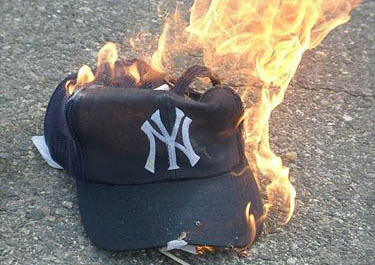
I think Hurricane Irene was sent by God to help the Red Sox. Hear me out! It makes mores sense than Michele's theory!

“I don’t know how much God has to do to get the attention of politicians. We’ve had an earthquake; we’ve had a hurricane. He said, ‘Are you going to start listening to me here?’ Listen to the American people because the American people are roaring right now. They know government is on a morbid obesity diet and we’ve got to rein in the spending.”

—-Rep. Michele Bachmann, GOP presidential hopeful and shameless demagogue, joining the discredited ranks of Pat Robertson, Glenn Beck and others to assert that weather conditions constitute proof that God agrees with her.

You can read my views on this arrogant, manipulative species of idiocy here, here and here.  I’ve written about it too much, and as an American living in the 21st Century, I’m embarrassed that I should have to write about it at all. Continue reading

Ethical Quote of the Week: Angels Pitcher Jered Weaver

Is enough ever enough?

“How much more do you need? Could have got more, whatever. Who cares? If $85 million is not enough to take care of my family and generations to come, then I’m pretty stupid.”

—Los Angeles Angels pitching ace Jered Weaver,after signing a 5 year, $85 million contract to stay with Angels.

Weaver hardly signed for chicken feed, but his statement should be heeded by greedy athletes and corporate executives alike. After next year, he probably could have demanded another two or three million dollars a year or more from the highest bidder for his services, in exchange for leaving a team and a city where he is appreciated and comfortable, putting additional pressure on himself, and using funds that otherwise could pay the salaries of many lower paid club workers who might end up with no jobs at all. Continue reading

Ethical Quote of the Week: Ed Koch

You're still doin' just fine, Ed!

“David Weprin is making phone calls trying to scare seniors. They’re nonsense. Weprin should be ashamed of himself . . . Bob Turner is running for Congress to protect your Medicare and Social Security. If anyone tries to scare you with lies about Bob Turner, tell ’em Ed Koch told them to knock it off!”

——Former New York Mayor Ed Koch, in a robocall on behalf of Republican Bob Turner, who is alarming Democrats by threatening to win Anthony Weiner’s vacant House seat in New York’s 9th Congressional District.  The State Democratic Committee, trying to bolster his opponent, Democrat David Weprin, had sent their own robocalls to senior voters, warning that Turner wanted to “dismantle” Social Security  (Translation: “You won’t get your checks!” This is a lie, as no politician has proposed any Social Security reform that would alter the benefits of any current or soon-to-be recipients of Social Security benefits.)  and end the program “as we know it.” Continue reading

Comment of the Day: “Comment of the Day: ‘The Barefoot Contessa and the Compassion Bullies'”


Does the truth matter?

No, that wasn’t a typo: Karl Penny just achieved a first for Ethics Alarms, a Comment of the Day in response to a Comment of the Day.

The COD at issue was Gary’s assertion that he had no obligation to align his ethical preferences according to my analysis (or any other) of the “Ina Garten rejects Make A Wish” dispute, and that to him it was “just a story” that he could use or ignore according to what he chose to believe.

This inspired Karl’s excellent Comment of the Day, which also contains one passage that would justify another Ethics Alarms first, an Ethics Quote of the Week in a Comment of the Day on a Comment of the Day. I bolded it. Thanks, Karl: Continue reading

Ethics Quote of the Day: Ken, of Popehat

“Listen to me: a law school calculated to make students feel good about themselves is as ridiculous as a Marine boot camp designed to make enlistees feel good about themselves. Law students, God help us, will one day be lawyers. When they are, nobody will care about their self-esteem. The prosecutors seeking to jail their clients will not be seeking to foster a sense of community. The opposing civil lawyers seeking to bankrupt their clients will not be promoting a culture of dignity and respect. Most law practice is about conflict. It’s a bloody, ugly street fight. Self-esteem borne of law-should-be-harmony is useless to clients. The only self-esteem useful to clients is self-esteem earned by hard work, determination, command of the subject matter, and the willingness to stand up to adversity. People who object to law professors being wickedly Socratic, and classmates being cutthroat, are missing the point. If you’re put off by a Socratic professor, Mr. Fluffy Bunny, a run-of-the-mill judge is going to make you soil yourself. If nasty, backstabbing classmates upset you, the first time you get into a nasty letter-writing campaign with an opposing counsel you’re going to have a breakdown. Law school is not a fucking spa day. It’s training to stand between your client and whatever the world throws at him.”

—– Ken, the astute lawyer/sage/Don Rickles of the libertarian social commentary website Popehat, excoriating the University of St. Thomas Law School for, among other things, extolling the values of self-esteem, collaboration, harmony and community among their students.

What Ken is really talking about is zealous representation, that once universally accepted bedrock of the  lawyer’s duty that has gradually fallen into disfavor with many academics and lawyers. Continue reading