As we face these challenging times, we at Ethics Alarms salute the heroes, the indomitable, the resolute and the vibrant, who endure with good will and good cheer for the well-being of the community. We are Americans, and we are in this together, and
IF I HAVE to listen to insincere, calculated, virtue-signaling crap like this many more times, something is going to ‘pop!’ in my head and I’ll be grabbing the nearest long, sharp implement and leaving the confines of these walls to begin the historic Alexandria Massacre.
Go ahead! Test me!
The rule in our house is that any channel that runs a commercial that begins with “In these..” or that shows someone wearing a facemask or looking at a webcam will be switched to another channel, never to be revisited during that day. If everyone follows this simple rule, and makes their policy known, maybe we’ll be able to halt this torture.
1. What’s going on here? Is the idea now to proclaim how biased the news media is and the double standards it uses and mock those of us who care by showing there’s not a thing we can do with it? Is that it? Governor Cuomo actually said at a press conference yesterday that the pandemic virus came from Europe in January and “no one knew” about it. “With all the sophistication, with all the public health organizations, with that whole alphabet soup of agencies, nobody knew the virus was coming from Europe,” the governor said, on the same day he finally retracted his deadly order requiring nursing homes to take in infected, elderly residents. Then he called the virus “The European Virus.” He really did. No, seriously. I’m not making this up.
The mainstream news media just ignored this idiocy yesterday, though President Trump calling the virus the Chinese virus, which except for the obscure papers Cuomo was apparently citing, is consistent with what most researchers have concluded about its origin, was attacked as racist because, you know, Big Lie #4. Cuomo’s atrocious decision to expose nursing homes has also been barely covered in the left-leaning media.
2. If you are wondering why Ethics Alarms hasn’t covered in any detail the apparent emerging evidence that President Obama was intimately involved in the scheme to frame Michael Flynn, it is because there is literally no news source I can trust. Conservative sources are stating outright that Obama is squarely in “What did the President know and when did he know it” territory, with declassified documents indicating that Obama was aware of the bogus investigation and efforts to railroad Michael Flynn. The mainstream media appears to be doing what it did during Obama’s entire 8 years, which is refusing to probe suspicious activities and events, and maintaining the illusion that our first black President must be seen to be as pure as the driven snow, because he was the first black President. Unless a non-right wing source or reporter plays the role of the Watergate era Washington Post and “Woodstein” to get the truth out, we will be kept in the dark…and you know what the Post says happens in darkness.Continue reading →
The first use of the tag “fake news” on this website was on March 4, 2015. That’s more than three months before Donald Trump announced his candidacy for President on June 16, 2015; the oft-published claim that Trump launched the term “fake news” to deride the news media for criticizing him and his Presidency is, ironically enough, fake news.
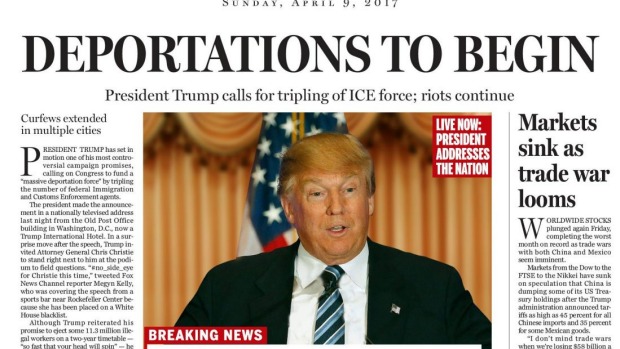
The 2015 piece was about CNBC publishing as legitimate news a press release by an anti-vaxx group, a category of fake news called “Hearsay news” in today’s directory to come. I posted three more articles tagged “fake news” before Trump was elected. One of them was the Mother of All Fake News episodes, when the Boston Globe hit the news stands and front walks on April 10, 2016 featuring a satirical front page with headlines about a fictional, dystopian Donald Trump Presidency. “This is Donald Trump’s America. What you read on this page is what might happen if the GOP frontrunner can put his ideas into practice, his words into action,” went the introduction. I wrote in part…
This is a spectacular failure of professionalism and a journalistic disgrace. A newspaper is pledged to report the news, not imagine it. It is not ethically entitled to morph into Saturday Night Live or the Onion because it really, really, really feels strongly about an issue….No paper published such a “future news” piece about the world under Nazi rule, or the race war if civil rights laws didn’t change. No respectable publication predicted a similar dystopian future under President Huey Long, or Joe McCarthy, or what a U.S. with open borders would look like, or what a Ron Paul style US with heroin for sale off drug store counters would lead to. That is because this means of political advocacy and commentary is reserved for the features and entertainment sections, not where facts are supposed to be, and where readers must be able to expect a reasonable attempt at truth, not a showboating effort to distort it.
The episode marked, as it turned out, the beginning of an epidemic of metaphorical canaries dying in the poisoned mine of American journalism. Continue reading →
1. More thoughts on “Meet the Press” and Chuck Todd. Pause now to reflect on last night’s post on the “Meet the Press” cheat, leaving out the key portion of AG Barr’s answer to an interview question, then having anchor Chuck Todd criticize Barr for not saying what he in fact said and that he withheld from his audience.
Does anyone think NBC’s “oops!” apology after being called on this by CBS (from whence the original interview came) and Justice (in a tweet by Barr’s spokesperson) is credible? The only way one could believe this was accidental is to assume there are no standards of review and oversight in network news. With all the preparation that goes into a weekly show, how could the anchor not review the entire interview he is planning on discussing? True, Todd is uniquely stupid for an anchor, somewhere in the Chris Cuomo range, but applying Hanlon’s Razor here strains the rule. This was almost certainly malicious.
The example ought to be aggressively and relentlessly shared on social media, with enablers and apologists being dealt with harshly. (I just posted it on my Facebook page. I know what’s coming. To hell with them.) This is a smoking gun and signature significance: a journalism culture where this happens is corrupt and agenda-driven The episode also ought to be a tipping point where the public, all of it, wakes up to how it is being manipulated by propagandists. Note I say “ought” but not “will.”
For this reason, the episode isn’t just about news, it is news. It should be a headline on every news broadcast and in every newspaper. “Meet the Press,” even as diminished as it is, still holds a symbolic place in the industry. This is a scandal, and an important one.
Is it of greater national and historical importance than most of the items on my Times front page this morning? Absolutely.
To those who will argue that Todd’s cheat was an innocent mistake that conservatives, Republicans and “Trumpers” are “pouncing” on, I would ask, “Where is the parallel instance of an Obama official, a Democratic leader, or a progressive being similarly misquoted on a network news show?” The closest example I can recall was when NPR falsely edited an interview with…Ted Cruz.
The standard increasingly becoming the norm in the mainstream media is not “how can we inform our viewers?” but rather “how can we advance our agenda by manipulating the content and get away with it?” The latter begins with the assumption that their partisan and ignorant audiences will tolerate being deceived, and that is how democracies die.
2. The point when I stopped reading Joe Biden’s op-ed in the Post: “President Trump is reverting to a familiar strategy of deflecting blame and dividing Americans. His goal is as obvious as it is craven: He hopes to split the country into dueling camps…”
The reason shifting blame and dividing the country is a familiar strategy is that Biden’s party has been doing this continuously from the moment Hillary Clinton called Trump supporters “deplorables.” Well, let’s reconsider that: maybe the strategy started when President Obama’s mouthpieces began using “racist!” as the default response to any criticism of him, and “xenophobe!” as the response to those wanting to enforce our borders. Either way, Biden’s attack ( or that of whoever wrote it for him while he was working on his coloring book) is gaslighting. Imagine anyone trying to divide Americans over public policy!
Post Post Script: Why look! “Dr. Gregg Gonsalves, who teaches about microbial diseases and law at the Ivy League school, took to Twitter recently to slam the administration, saying:
“How many people will die this summer, before Election Day? What proportion of the deaths will be among African-Americans, Latinos, other people of color? This is getting awfully close to genocide by default. What else do you call mass death by public policy?”
1. You know…Kool-Aid! Rep. Adam Schiff (D-CA) finally was forced into releasing the transcripts from the House’s investigation “collusion,” one of the more extensive of the multiple Democratic coup attempts. The Federalist explains, :
Former Obama administration defense official Evelyn Farkas testified under oath that she lied during an MSNBC interview when she claimed to have evidence of alleged collusion, a newly declassified congressional transcript of her testimony shows. Farkas testified before the House Permanent Select Committee on Intelligence on June 26, 2017, as part of the committee’s investigation into Russian interference in the 2016 presidential election between Donald Trump and former Secretary of State Hillary Clinton.
Lawmakers keyed in on an appearance Farkas made on MSNBC on March 2, 2017, in which she urged intelligence community bureaucrats to disseminate within the government and potentially even leak to media any incriminating information they had about Trump or his aides.
“I had a fear that somehow that information would disappear with the senior [Obama administration] people who left…[that] it would be hidden away in the bureaucracy,” Farkas said.
[…]
“Why don’t we go back to that sentence that I just asked you about. It says ‘the Trump folks, if they found out how we knew what we knew about their staff dealing with Russians,” [Rep. Trey] Gowdy said. “Well, how would you know what the U.S. government knew at that point? You didn’t work for it, did you?”
“I didn’t,” said Farkas, a former mid-level Russia analyst who left the federal government in 2015.
“Then how did you know?” Gowdy responded.
“I didn’t know anything,” Farkas said.
Writes Matt Vespa, in a distinctly partisan tone but completely accurately,
“Everyone who isn’t Trump deranged knew this was a pile of crap. How many “bombshells” have there been? How many have turned out to be nothing burgers, not even lasting 36 hours in the news cycle because there was never solid evidence to prove such a conspiracy? This is what happens when the entire myth was based on a political opposition research document—the Trump dossier—which was compiled by an ex-MI6 spook Christopher Steele, whose anti-Trump efforts were funded by Democrats and the Hillary Clinton campaign. It was probably never vetted by the FBI, given theglaring errors in it, and it was used as credible evidence to secure a spy warrant against Carter Page, a former Trump campaign official. It was biased political propaganda. This collusion delusion was already debunked in the original Mueller report, which said there was no evidence of Trump-Russia collusion and shredded what was left of the unverified Trump dossier. The Department of Justice Inspector General’s report on the FISA abuses during the Obama administration also took a tomahawk to the dossier. The core of this collusion myth was already dead, but with the exoneration of Michael Flynn, President Trump’s former national security adviser, more pieces are falling off this dead collusion carcass.
2. And no..I will not forgive, nor will I forget, the arrogant, biased and ignorant people who called me partisan and worse for fairly, objectively and correctly analyzing this historic attack on democracy and accurately calling it a soft coup attempt, one of many. Allowing people who behave this badly to expect forgiveness encourages them to keep being as destructive, reckless and lazy, and to assume there are no consequences for their conduct. There are, and there should be.
There is a great deal that I will forgive. Not that.
3. Nah, there’s no mainstream media bias! Here’s Friday’s Times headline: “U.S. Drops Pursuit Of Flynn, In Move Backed By Trump.” Shameful. The case was dropped because there was irrefutable evidence that it was illegal and a set-up; that it was the epitome of a wrongful and corrupt prosecution. Never mind: the Times chooses to fuel the desperate spin the AUC (“Axis of Unethical Conduct”) is trying to put on this despite unequivocal evidence and documentation. This is a cover-up by Barr and Trump! Except it isn’t. But the New York Times, the self-proclaimed paragon of American journalism, is using its reputation and visibility to deceive Americans that it is.
I’m not forgiving or forgetting this, either.
4. I finally watched “The Post,” the star-studded film hymn to the glory of our newsmedia that recounts the mostly accurate tale of how the Washington Post and the Times published the Pentagon Papers. The movie is dominated by progressive Hollywood icons Tom Hanks ( as Ben Bradley) and Meryl Streep (as Katherine Graham). The problem is that it falsely conveys to audiences—and, I believe, was intended to convey—the propaganda that the the Post and the Times are still serving the interests of the nation, the public and democracy by their relentless, courageous and objective search for the truth. As the entire “collusion” debacle proved, they are not (if they ever were). Let’s assume for the sake of argument that was what print journalism was like when the Pentagon Papers were published….in 1971. That was 50 years ago, a full half-century. Today’s journalism is as materially different from journalism then as today’s entertainment, drug laws, sexual mores and fashion would be unrecognizable to a Seventies time-traveler.
Former actress Rose McGowan, an alleged Harvey Weinstein rape victim, among the most dedicated #MeToo advocates, and a pariah in Hollywood for her penchant for calling out harassers (like Ben Affleck) and grandstanding hypocrites (like Alyssa Milano), directly accused Bill Maher of sexual harassment yesterday in a tweet:
This won’t trouble Maher or presumably his fans and viewers, because Maher has made it crystal clear for his entire, ugly career as a clown nose on/ clown nose off pundit that he doesn’t see anything wrong with sexual harassment. He believes women exist on earth for his convenience and pleasure. He is a pure misogynist, who has repeatedly called women who don’t conform to his ideological cast “cunts” and “twats” (as his audience guffaws). When Bill Clinton was battling through Monica Madness, Maher opined that Clinton should have said, ‘Yeah, I had sex with an intern, and I deserve to, because I’m President!” (Maher wasn’t kidding, just as Clinton wasn’t kidding when he essentially confirmed Maher’s assumption by writing in his autobiography that he exploited Lewinsky “because he could.”) It goes without saying that Maher also thinks that #MeToo is a crock.
And I guess, based on so many of its vocal supporters’ words and conduct recently, he must be right.
Do I believe that Maher said what McGowan claims? The former “Scream” star is perpetually furious, but she has also been consistently honest. Maher used (and probably still uses) his panels as a dating bar (Rose was really hot in the 90s), and his quote sounds like something he might say to an attractive female guest; heck, he’s said worse on the air. Bill hasn’t responded yet; I bet that if he does, he’ll say something like, “Sure, I said it. Why shouldn’t I? It’s true!” And his peanut gallery will cheer.
1. Now THIS is incompetence...The makers of Ritz crackers have issued a nationwide recall of mislabeled Ritz cracker boxes after discovering that some packages labeled cheese really contained pairs of crackers with peanut butter between them, according to a statement posted on the Food and Drug Administration’s website yesterday.
Oops!
Fortunately, almost all Ritz fans regularly check the Food and Drug administration site.
2. In the category of “professionals embarrassing themselves,” I offer this: Len Niehoff is a “Professor from Practice at the University of Michigan Law School” according to the editors at the Detroit Free Press. This is a bad start: I don’t know what a “professor from Practice” is. I assume they meant he teaches legal practice, or trial practice. Obviously they have no more understanding of law than the average guppy, which also explains why they published the professor’s article titled, “Law professor: Virus reveals we all need a class in evidence.” He begins,
“Numerous public officials and individuals have made dreadful decisions about how to assess and respond to the threat posed by COVID-19. Those errors reveal a fundamental flaw in our K-12 and collegiate education systems. We have failed to teach a subject of critical importance, and as a result have imperiled our health, our economy, and our republic. We teach it in law school. We call it Evidence.”
Hilariously, in his essay about evidence, the professor doesn’t offer a single piece of evidence indicating any of that assertion is correct, or might be correct. He does offer, without evidence, statements like, “National and local political leaders have made decisions that ignored the evidence. Members of the general public have proved slow to accept the evidence. Measures adopted to help flatten the curve have been met with virulent protests, despite the evidence that they are working.” Really? What is your evidence for those propositions? Those are opinions, not evidence.
Moreover, the rules of evidence he is extolling are specifically designed for trials, which involve very specialized forms of decision-making. Hearsay evidence, for example, is generally inadmissible in a trial, but in many other activities, it is valuable. Similarly, trials settle generally narrow issues. We don’t use trials, or juries, to settle more complex issues like “how long should we shut down the economy to minimize the effects of a pandemic?” The professor seems to be laboring under the delusion that it is clear what is and what isn’t relevant to such decisions.
One of my benighted Facebook friends posted this thing on Facebook as if it was meaningful. It is useful for one purpose: it is strong evidence for the proposition that if the only tool one has is a hammer, every problem looks like a nail.
3. Ringer ethics. In a famous 1992 episode of “The Simpsons,” evil nuclear power tycoon Montgomery Burns’ stacks his Springfield Nuclear Power Plant baseball squad with major league baseball players for the league championship game. Using “ringers” in such situations is unethical (but often permitted due to rules loopholes), but here is a story about something akin to Mr. Burns’ cheat that nobody seemed to mind.
In the late 1980s, a softball team known as Spike & Fat Boy was entered in a local softball beer league. The team included three active major leaguers, Kevin Mitchell, John Kruk and Randy Ready. Not only did they displace the regular players when they showed up (“You talk about pressure on a manager,” the team’s skipper says now, “What could I do? I had to put those guys in the lineup!”) and the three hit exactly as you would expect them to.
Says Ready, “We didn’t lose a single game. It was domination.”
Gee. What an achievement.
4. Laws and social distancing are for the little people. Great Britain had a juicy scandal when Neil Ferguson, a prominent epidemiologist who advised the UK government on its pandemic response and warned that it was possible that 500,000 British citizens would perish if the lockdown was disobeyed, defied the lockdown himself (and obviously social distancing <cough>) in a rendezvous with his married lover. He was caught, shamed, and resigned his government post. Opines Spiked! in a tough editorial, the episode is significant in that it reveals
“…a great deal about the 21st-century elites and how they view their relationship with the masses. It’s one rule for them and another for us. They can carry on enjoying sneaky freedoms because their lives and jobs are important; we can’t because we are mere little people, whose silly work lives can casually be disrupted, whose love lives can be turned upside down, and whose families can be ripped apart. The Ferguson affair provides an illuminating insight into the new elitism..Ferguson’s scaremongering, his predictions of mass death if society didn’t close itself down, was the key justification for the lockdown in the UK. It influenced lockdowns elsewhere, too…Anyone who questioned the wisdom of the lockdown, or merely suggested it should be very brief, would find themselves being battered by Ferguson’s figures. Almost overnight it became tantamount to blasphemy to question these models…. It was the political class’s dodging of moral responsibility for tackling Covid without destroying the economy, and the media’s searing intolerance towards anyone who questioned the lockdown, which led to the ossification of his models into tablets of stone that you queried at your peril.”
Sound familiar?
The U.S. has had its Fergusons too. Senior White House adviser and First Daughter Ivanka Trump traveled from D.C. to the Trump National Golf Club Bedminster in New Jersey to celebrate Passover, though she had posted social media videos urging “those lucky enough to be in a position to stay at home, please, please do so.” Michelle Obama lectured Americans to stay home as her husband was putting on the golf course. Chicago’s Mayor Lori Lightfoot had her hair done by a salon stylist while demanding that citizens of her city eschew such frivolous services. The mayor of Beaumont Texas locked her town down, then went to a nail salon. NYC Mayor Bill de Blasio put gyms on his “non-essential” business list, then went to one to work out. Williamson County Judge Bill Gravell and his wife attended his grandson’s birthday party (using county resources in the process, a nice touch ) after ordering residents to stay home amid the Wuhan virus outbreak. I do not doubt that plenty of other examples exist showing our betters behaving similarly, just more discretely.
The global elites really do think they’re better than us. They’re riding high and mighty, collecting their paychecks and visiting their mistresses, as they lecture to us from their golden pedestals. Meanwhile, small business owners are watching what they’ve toiled and sacrificed for years to build crumble, as they and others deemed “non-essential” wonder how they’ll feed their families tonight.
Progressives, who increasingly sound like they want another Depression—all the better to “re-engineer society” (and, of course, defeat Donald Trump) , deride such assessments in the news media and social media as “right-wing conspiracy theories.”
New York Governor Andrew Cuomo really does have “blood on his hands,” but thanks to the news media coverage, the public doesn’t seem to care.
In March, Cuomo, already overseeing the state that is the one U.S. local where the Wuhan virus could then be accurately described as out-of-control, adopted the policy of forcing nursing homes to take in elderly residents who were infected.
The edict horrified many medical authorities. Health experts warned this was a formula for disaster because such facilities didn’t have the ability to properly quarantine the infected. “This approach will introduce the highly contagious virus into more nursing homes. There will be more hospitalizations for nursing home residents who need ventilator care and ultimately, a higher number of deaths. Issuing such an order is a mistake and there is a better solution,” American Health Care Association President and CEO Mark Parkinson protested in March after Cuomo’s order went into effect.
Richard Mollot, executive director of the New York’s Long Term Care Community Coalition, said that the policy “put many people in grave danger.” Professor David Grabowski at Harvard Medical School, whose field is public health, was aghast, telling NBC, “Nursing homes are working so hard to keep the virus out, and now we’re going to be introducing new COVID-positive patients?”
Yes, that was the plan, but it is difficult to fathom why anyone would think it was a good idea. A lot wasn’t and still isn’t understood about the virus, but one thing that has been known all year is that it is especially deadly for the elderly and people with compromised immune systems.
‘Hey, let’s put all those discharged old people who we know are infected into cramped, confined nursing homes where trying to quarantine anyone is hard and where we already know dubious management and care is rampant!’
The city of San Antonio has passed a resolution outlawing words associated with the coronavirus that it deems to be racist or xenophobic.
The resolution states: “The City of San Antonio denounces antisemitism, anti-Asian bigotry, and all hateful speech, violent action and the spread of misinformation related to COVID-19 that casts blame, promotes racism or discrimination or harms the City of San Antonio Asian and Pacific Islander, Jewish, immigrant or other communities.”
According to reporter Jaie Avila, Councilman Jack Finger was speaking against the resolution when his mic was cut off. Well, that figures, right? One form of censorship is as good as another. Continue reading →
No, I am not satisfied with the current draft of Part II, but I trust it’s obvious what the resolution referred to is. The lock-down has to end, and before vaccines, cures, or adequate medicine are available. One of the components of my research has been reading as many of the pro and con articles as I can stand. It is quite striking: the arguments for continuing the lockdown indefinitely are almost entirely authored by progressives, and are without exception characterized by bad logic, emotionalism, manipulated facts, biased analysis, fearmongering, and suspect motives. The majority of the arguments for opening up the economy soon are markedly more logical, unemotional, and based on sound statistics and analysis. Certainly one cannot choose between two options based on the quality of the advocates for each. Nonetheless, the divide is striking.
Aha! We see what you’re doing! What a distraction! But I suppose that because slavery was invoked, I’m expected to listen without protest while Kendi’s solemn, censorious lecture is promoted by an over-excited Lithwick. I resist. Sorry. I do hear what you’re saying, and I see how well it works to justify depriving us of all freedom. There’s never enough freedom from all the things in the world that might hurt us if we’re not kept in eternal lockdown.
Excellent. Althouse is a liberal, much as she tries to hide it, but she is not an aspiring totalitarian, like such a large swath of the current mutated progressives and Democrats. Her last sentence echoes two of my favorite quotes, “In order to have enough liberty, it is necessary to have too much,” (Clarence Darrow), and “Those who would give up essential Liberty, to purchase a little temporary Safety, deserve neither Liberty nor Safety,” (Benjamin Franklin).
I have another screed to deconstruct: a New York Times editorial by Charlie Warzel titled “Open States, Lots of Guns. America Is Paying a Heavy Price for Freedom,” or in my print edition, “Will We Get Used To The Dying?” I’ll let you read it first without my comments, here. That’s only fair.
***
Done? Maybe you don’t even need this: eviscerating Warzel ‘s analysis shouldn’t be too hard. Rebutting most of these essays isn’t hard.
Away we go…
The coronavirus scenario I can’t stop thinking about is the one where we simply get used to all the dying. I first saw it on Twitter. “Someone poke holes in this scenario,” a tweet from Eric Nelson, the editorial director of Broadside Books, read. “We keep losing 1,000 to 2,000 a day to coronavirus. People get used to it. We get less vigilant as it very slowly spreads. By December we’re close to normal, but still losing 1,500 a day, and as we tick past 300,000 dead, most people aren’t concerned.”
How old is Warzel, 15? We accept the mortality of modern life, just as our ancestors accepted the mortality of their own periods. That tweet is simply making sinister the adjustments that human beings have to make to get on with civilization. To that, it adds scaremongering, and Warzel joins in the virtue-signalling. Anyone who isn’t willing to keep the lockdown in force indefinitely isn’t concerned.
That’s crap. I’m concerned: both my wife and I are in the high-risk category; so is my sister; so are most of our extended family. I do not advocate the destruction of American society for my own self interest, that’s all. That’s how members of a community and democracy are supposed to feel.
This hit me like a ton of bricks because of just how plausible it seemed. The day I read Mr. Nelson’s tweet, 1,723 Americans were reported to have died from the virus. And yet their collective passing was hardly mourned. After all, how to distinguish those souls from the 2,097 who perished the day before or the 1,558 who died the day after?
People die every day, and from predictable causes, many of them a direct result of our way of life and societal choices. The Times has been running a feature showing selected photographs of recently succumbed victims of the Wuhan virus with a biographical sketch. I have wondered each time I see it: why are these people more worthy of ostentatious memorials in the Times than anyone who has died in the same period? The answer is, they aren’t. This is part of the news media’s effort to build anxiety and hysteria, which will be weaponized for political purposes. Hardly mourned? Every American is supposed to mourn everyone who dies every day? We mourn our loved ones. I am still mourning Dennis Nollette, a former law school roommate who was among the best human beings I have ever had the honor of knowing. He was carried off by the epidemic within a few days. That’s plenty for me right now. I’m not becoming callous because the deaths of strangers don’t hit me as hard as the death of a cherished friend.
Furthermore, it is not “plausible” that the pandemic will continue forever; pandemics don’t. And indeed, if they did, it would be an irrefutable reason to open up now.
Such loss of life is hard to comprehend when it’s not happening in front of your own two eyes. Add to it that humans are adaptable creatures, no matter how nightmarish the scenario, and it seems understandable that our outrage would dull over time. Unsure how — or perhaps unable — to process tragedy at scale, we get used to it.
Talk about complaining about an unchangeable feature of human life, sanity, and reality! But that kind of lament is irresponsible progressiveness in a nutshell.
There’s also a national precedent for Mr. Nelson’s hypothetical: America’s response to gun violence and school shootings.
Here we go, down the rabbit hole.
We often talk here about incompetent analogies. This is a lulu. It is embarrassing that the New York Times would consider such a contrived and illogical argument to be published as an editorial—embarrassing, and signature significance.
You should skim the next part; I know my eyes glazed over. It’s standard CNN/Don Lemon/ David Hogg propaganda and emotionalism.
As a country, we seem resigned to preventable firearm deaths. Each year, 36,000 Americans are killed by guns — roughly 100 per day, most from suicide, according to data from the Giffords Law Center. Similarly, the Everytown for Gun Safety Support Fund calculates that there have been 583 “incidents of gunfire” on school grounds since 2013. In the first eight months of 2019, there were at least 38 mass shootings, The Times reported. Last August, 53 Americans died in mass shootings — at work, at bars, while shopping with their children. Some of these tragedies make national headlines; many don’t. The bigger school shootings and hate-crime massacres can ignite genuine moral outrage and revive familiar debates: over safe storage practices, gun show loopholes, red flag laws, bump stocks, comprehensive background checks, stringent licensing systems and, of course, the accessibility of endlessly customizable semiautomatic weapons like AR-15s. In every case, the death tolls climb but we fail to act. There are occasional marches and protests but mostly we continue on with our lives.
Yes, we are monsters for understanding the importance of the rights of self-defense and bearing arms to a functioning democracy. In reality, while there are usually, in hindsight, ways that any single abuse of firearms could have been prevented, gun deaths are not preventable as long as there are guns, law abiding citizens have access to them, and a police state doesn’t abuse its power to make us “safe.”
Notice that Warzel’s gun-virus analogy breaks down immediately. There is no societal value to pandemics. There is no right to get fatally ill. There are no Constitutional amendments preventing the government from eliminating a disease. Continue reading →
The second Comment of the Day to come out of Part 1 of the pandemic analysis ethics conflict analysis, like the first, does a lot of the work I would otherwise have to do to complete Part 2. A couple more like these, and the issue might be thoroughly covered without any input from me at all!
The global warming cult has conditioned leaders and the media to trust models over data. If the data doesn’t match the model, it is the DATA that must change, which is why they keep adjusting the temperature measurements more and more to match the model. As with global warming, the model does not match reality and we are being told to trust the model, not the data.
Just to put things in perspective:
—Roughly 2.8 million Americans die each year. Around march, that is roughly 8000 people/day.
—If 5% of the population has asymptomatic coronavirus, that means that 400 dead people with test positive for coronavirus each day, even though it did not contribute to their deaths. Under current practice, that means 400 coronavirus deaths that really weren’t coronavirus deaths (or 12,000/month).
—It is hard to tell, but the number of deaths/month does not seem to be rising over previous years. It seems that most ‘coronavirus deaths’ are due to reclassifying cause of death, not actual effects of the virus. You can view the California doctor’s censored interview about that somewhere, if you can find it anymore.
—The number of actual extra deaths from coronavirus appears to be within the yearly standard deviation of deaths. Meaning: Deaths from coronavirus are not statistically significant yet.
—The fatality rate appears to be less than 0.1%. The flu is about 0.1% and the flu without the flu vaccine is about 0.3%, so this appears to be not as dangerous as the flu. More people are getting it, however, because it is new and people don’t have an natural immunity to it yet. This is why everyone needs to get it.
—Roughly 500,000 people die each year from medical mistakes.
—Places that had more restrictive lockdowns did not suffer from worse outcomes. They seemed to have suffered less.
Verdict: It seems that our ‘experts’ are morons. Let’s look at some of the policies from those ‘best people’. Continue reading →






The second Comment of the Day to come out of Part 1 of the pandemic analysis ethics conflict analysis, like the first, does a lot of the work I would otherwise have to do to complete Part 2. A couple more like these, and the issue might be thoroughly covered without any input from me at all!
Here is Michael R’s Comment of the Day on the post, “The Pandemic Creates A Classic And Difficult Ethics Conflict, But The Resolution Is Clear, Part I: Stipulations”: