Yes, Poker Champ Phil Ivey Cheated, Even If He Didn’t Think He Did

baccarat2

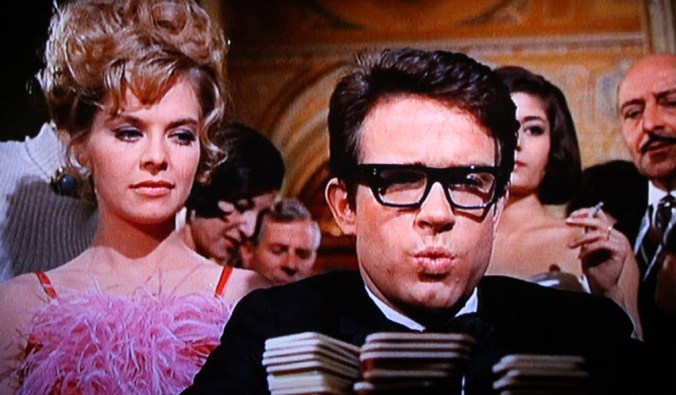
Phil Ivey is known as one of the best all-around professional card players in the world, in part because he notices things that other players, even great ones, may not. While playing baccarat at the Borgata Casino in Atlantic City in 2012, Ivey and a friend noticed  inconsistencies on the back of the cards that allowed him to read some of them as if they were marked. He even asked the dealer to position the cards so he could see them better, as in “see what nobody else noticed, giving him an unfair advantage.” Some advantage: he and his associate, Cheng Yin Sun, won $9.6 million at baccarat over four visits to the casino, then won an additional $504,000 betting their winning at the  craps table.

A federal judge has now ruled that the two must repay the $10 million. What they did is called “edge-sorting,” and it is considered cheating, though technically the ruling was that Ivey and Sun breached their contract with the casino.

In baccarat, players bet on the relative value of two hands of two cards each before the hands are dealt or the cards are revealed. The game is  played with six or eight decks of cards placed into a dealing “shoe,” and the object is to bet on the hand that will have a total value closest to nine. If a player knows the value of the first card in the shoe before it’s dealt, the player has a significant advantage over the house. Borgata accused Ivey and Sun of exploiting defects in playing cards manufactured by Gemaco Inc. that were not cut symmetrically during the manufacturing process, so Ivey and Sun were able to spot the manufacturing defects and  read the “marked”  cards without actually touching or defacing them themselves. The New Jersey Casino Controls Act requires that all casino games offer “fair odds to both sides.”  Without intending to or knowing, the casino was creating unfair odds against itself, and these two players made out like bandits as a result.

Ivey’s lawyer argued in a court filing that since his client never touched the cards, his advantage was like the casino trying to distract players with “free alcohol served by only the most curvaceous and voluptuous females in the industry.” Continue reading →
Are No Professions Safe From The 2016 Post Election Ethics Train Wreck? Now Even Restaurant Critics Have Gotten On Board!

circus-train-wreck

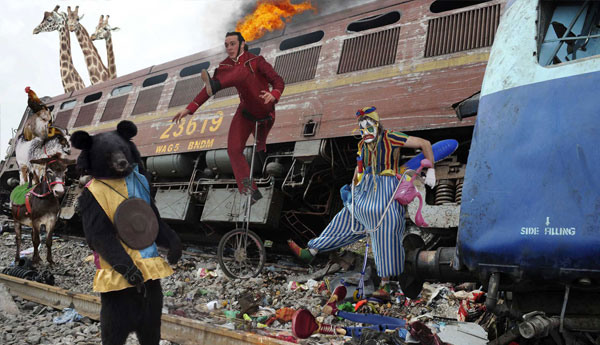
As a professional ethics specialist, I find the enthusiasm with which alleged professionals have used the election of Donald Trump to excuse their abandonment of such ethical values as fairness, responsibility, respect and citizenship deeply discouraging, and I am seriously considering becoming a beachcomber. I already knew that the journalism profession no longer could distinguish ethics from a hairy crab, so this wasn’t too surprising, nor was it too much of a shock that the New York Times has become a non-stop anti-Trump fear-fest and rant machine. Let’s see, in today’s edition alone  there is a hit piece on Trump advisor Steve Bannon called “Bannon’s Coriolanus Rewrite,” then  “Donald Trump’s Racial Ignorance,” “Where the Right Went Wrong,” (an amazing title, given the current balance of political power after Hillary’s botched campaign), “How the Truth Got Hacked,” “Is Democracy in Danger?” “Trump, the Russian Poodle,” and “Is This Collective Trauma?” The  last, I guess,  explains why mass trauma is inevitable for progressives, moderates and “Never Trump” Republicans when “the political order they long took for granted — defined by polarization, yes, but also by a commitment to basic principles of democracy and decency — is suddenly gone.”  One would almost wonder from that sentence which side of the political spectrum is calling for armed insurrection, pre-inaugural impeachment, and the overturning of the election results. The Times is also a showcase for columnists whose minds have snapped like dry branches in the wind,  causing them to leap manically onto the Trump Hysteria Express. Economist Paul Krugman has long been a hyper-partisan scold for whom fairness is alien territory, but this tweet was spectacularly vicious even for him:

“Thought: There was (rightly) a cloud of illegitimacy over Bush, dispelled (wrongly) by 9/11. Creates some interesting incentives for Trump.”

An ethical newspaper wouldn’t want someone capable of such a comment working for it.

Many broadcast journalists were stunningly unprofessional, indeed amateurish, on election night. Martha Raddatz choked up with emotion reporting Clinton’s loss; now there’s an objective reporter. Rachel Maddow described the evening as a “nightmare.”

Education has been racing journalism to the ethics barrel bottom for years, but I did not expect universities to send such intimidating messages to their students that they were expected to either be in mourning or on the verge of emotional breakdowns because the Democrats lost. Once, higher institutions of learning aimed to teach students critical thinking skills so they could make up their own minds regarding civic affairs. High school administrators and teachers also forgot their duties, and allowed students to skip school because, you know, TRUMP!!!!, and “ARRRGHHHHH!!!!”

Lawyers have lost their ethical bearings, of course, as have law professors, with perhaps the best example of the latter being the Georgetown Law Center adjunct who claims that the Constitution is unconstitutional, because following it will elect Donald Trump. My law alma mater isn’t faring too well in the train wreck: another professor, Paul Butler, argued that Supreme Court justices shouldn’t normally attack a President Elect, except when it’s Donald Trump.

Other academics have disgraced themselves. A prominent historian, for example, even resorted to making up history to provide an excuse for Democrats losing to such a horrible creature. Professor Larry Lessig of Harvard Law, who heads an ethics institute there, is encouraging electors to be “faithless,” as in “double-cross the voters who elected them.” Some ethics institute you have there, Harvard!

Artist, actors and show business professionals have debased themselves even more than usual, beginning with the Broadway cast of “Hamilton’s” breach of the Performer’s First Commandment: DON’T ABUSE THE AUDIENCE. They have even started turning on each other: Jon Voight, whose sin was that he expressed support for the man elected President, was booed at recent awards show by his fellow actors. Nice.

But as bad as this has been, I didn’t expect food critics to be corrupted. Continue reading →

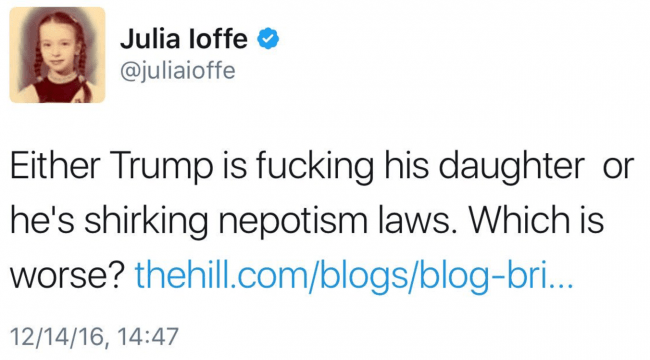
Julia Ioffe’s Vile Tweet: Now The Question Is Whether There Are Any Depths Of Unprofessional Conduct And Unhinged Bias That Disqualify A Journalist [UPDATED]

trump-incest-tweet

Julia Ioffe, a columnist at “Foreign Policy” and a contributing writer for “Politico Magazine” was moved to issue the above tweet by accounts that First Daughter Ivanka Trump would serve as First Lady while Melania Trump remained in New York to care for the Trump’s young son . Oh, nice! Keep it classy, news media!

Ioffe now joins John Oliver, Charles Blow, Harry Reid, The View, Harvard Law professor Larry Lessig and others on a growing list of nominees for the 2016 Ethics Alarms Award as the most unsavory passenger on the 2016 Post Election Ethics Train Wreck. The problem is that she isn’t a British comedian, a race-baiting Times columnist, a full-time asshole, a talk show hosted by celebrity ignoramuses, or an especially deluded academic. Ioffe is supposed to be a journalist whose analysis can be trusted, and the vicious character and unrestrained hate that her tweet reveals should disqualify her for that profession. Before Donald Trump—you know, the new President whom the New York Times decreed is exempt from ethical treatment?—such a public statement would have disqualified any journalist and ended her career immediately. This would have happened because journalism organizations once valued not just professional conduct and objectivity but the appearance of it.

The tweet wasn’t just disgusting, it was incompetent, misleading and stupid:

  • The news report has been denied by the Trump transition team, so the alleged journalist was spreading “fake news.”

There have been almost two dozen permanent or temporary First Ladies who had other family relationships with Presidents, including daughters, daughters-in-law, nieces, sisters, cousins, and aunts. Three daughters assumed the First Lady role when their mothers died: Letty Tyler Semple for President Tyler,  Mary Harrison McKee for President Benjamin Harrison, and Margaret Wilson for Woodrow. Oddly, none of them were accused of having sex with their fathers. Margaret Wilson shared First Lady duties with President Wilson’s cousin Helen Bones, who had worked for the first Mrs. Wilson as personal secretary. Thomas Jefferson, Andrew Jackson, Martin Van Buren and Chester Arthur were widowers, so their First Ladies couldn’t be spouses. Jefferson’s daughter Martha Randolph, Jackson’s niece and daughter-in-law Emily Donelson and Sarah Jackson were all First Ladies.  James Buchanan and Grover Cleveland were bachelors when they assumed the presidency,  so Cleveland’s sister Rose Elizabeth served as his First Lady until he married Florence Folsom fifteen months into his administration, and Harriet Lane, Buchanan’s niece, acted as his hostess and was the first Presidential spouse referred to as the “First Lady.” Many other non-spouses served in the capacity for limited amounts of time for reasons comparable to Melania’s conflicts.

In short, Ioffe is ignorant of American history and didn’t know what she was tweeting about, but did so anyway, misleading the public. Continue reading →

Remember California Attorney Mary Frances Prevost, Who Plagiarized Ethics Alarms? Guess What!

Yup, I saw THIS coming...

Yup, I saw THIS coming…

She’s been suspended.

For the third time.

Good.

To recap…Back in 2012, Mary Frances, who  describes herself on her website as “California’s Top Criminal & DUI Attorney,” posted an essay allegedly authored by her called  “The Trayvon Martin Case Trainwreck: George Zimmerman’s Attorneys Need To Shut Up!”

Oddly, it was posted the same day and shortly after my Ethics Alarms post, “Next To Board The Trayvon Martin Ethics Train Wreck? Why, The Lawyers, Of Course!”

Mary Frances’s was almost word for word the same post, plus some original material at the end. She had ripped me off. She hadn’t even tried to disguise it. This is called stealing, and I believe, shows that an individual lacks the honesty and trustworthiness to practice law.

I took three deep breaths, wrote a post about her plagiarism, e-mailed Prevost and required four things. First, an explanation if she had one; then an apology, a retraction, and proper credit. I didn’t demand damages, as I could have.

Mary Frances’s response was astounding. She didn’t have the courtesy to respond to my e-mail, but went on Facebook to accuse me of plagiarizing her, a neat trick, since my post pre-dated hers. Then she insulted me repeatedly, apparently unaware of how hypocritical it is to claim another lawyer is lacking in legal analysis skills and writing ability when you just published his essay as your own. I posted her whole rant here; it is deranged, making it especially funny that she accused me of being “off my meds.”

The Facebook post was defamation per se: malicious, and deliberately false. I contacted a California attorney, who agreed it was defamation, but said that based on her reputation, he felt it would  not be worth the money, the trouble or all the attacks she was capable of to go to war with her. He also dissuaded me from filing an ethics complaint, saying that unlike some states, California frowns on ethics complaints when there are grounds for lawsuits, and also tends to discount complaints from non-California lawyers.

“Just wait,” he said. “She’ll get hers. Lawyers like this almost always do.” Continue reading →

The CNN “Joke About Donald Trump’s Plane Crashing”: Now THAT’S A “Nothingburger”

But it’s nice to know that some people at CNN now know how Billy Bush felt.

A website called FTVLive  obtained video of CNN’s Suzanne Malveaux talking to her crew and her producer before going live on CNN, as they waited for Trump’s  press conference. His plane to yet land.

On the video, a producer can be heard saying “When I do this, it means his plane’s landed’ and later, she seems to be saying, dead-pan”That means his plane’s crashed….just kidding” There is some incomprehensible chatter briefly after that.

Thanks to some websites like Mediaite on a slow news day, this gourmet “nothingburger” was widely and critically circulated. “The crew decided to joke around about a pretty grisly topic,” intoned Mediaite’s  Justin Baragona.

This, believe it or not, prompted CNN to issue an apology! This…

“An unfortunate and inappropriate remark was made by one of our producers off camera yesterday. We have apologized to the Trump transition team, and the Producer has been disciplined.”

Oh, balderdash. There was nothing “unfortunate and inappropriate” about that comment, which was not an expression of hostility to Trump, or anything else but on the job self-mockery. I would make that joke. I have made essentially that joke in various settings. At a surprise party for my mother, for example: “OK, I’ll make this sign when she’s coming up the walk, this sign when she’s at the door, this sign if she trips at the door and falls down the stairs, and this sign if she’s attacked by the neighbor’s dog.”  So what? (It got a big laugh by the way. Would Justin have laughed? I don’t care.) Continue reading →

My Happy Birthday Ethics Quiz: The National Review’s Theory

flaming-cake

Today is my annual struggle (since 2009) to try to think of my birthday as something better than “Finding Dad Dead In His Chair Day,” and I must say, Facebook Friends have been especially helpful by sending along happy birthday wishes. Since none of them de-friended me for political differences during and after the campaign, I was intrigued by this essay in the National Review, titled “Ten Reasons Left-Wingers Cut Trump Voters from Their Lives.”

Now as I have made painfully clear, I was no Trump voter, having determined early on that I would sooner undergo a head-transplant from a warthog, even a Bernie-boosting warthog, but I was no Hillary Clinton supporter either, and was especially eager to shoot down particularly stupid memes from OccupyDemocrats, MOVE-ON, and the National Federation of the Brain Debilitated when my friends posted them, which was depressingly often. (Come to think of it, most of those FBFs who are addicted to progressive memes haven’t sent me birthday wishes, the bastards, but then the National Review piece wasn’t called “Ten Reasons Left-Wingers Won’t Say Happy Birthday To Facebook Friends Who Point Out That The Memes They Post Have Been Proven To Cause Retardation In Chimps.

The article is biased, of course: it’s the National Review. Obviously its assertion is over-generalized. But how fair is its general proposition, which is that the 2016 phenomenon of people cutting off friends and family is “one-sided”? Continue reading →

Trump, His Critics, And The Julie Principle

We return now to “The Julie Principle,” an ethics concept I introduced three and a half  years ago. “The Julie Principle lies at the center of tolerance in its most productive sense. It also will keep you from going crazy “ was how the post was introduced. Here is the guts of it.

When a characteristic or a behavior pattern appears to be hard-wired into someone, it makes no sense to keep complaining about it. You either resolve to tolerate it ( and accept responsibility for the consequences of doing so), or decide that it is too much to endure, meaning that the relationship has to end.  “Fish gotta swim, birds gotta fly…” [ Note: this is the most famous lyric in the second most famous song in “Showboat,” “Can’t Help Lovin’ Dat Man o’ Mine,” sung by the tragic, abused mulatto Julie.]

The Julie Principle comes in handy in resolving many ethical dilemmas. In making an ethical analysis requiring balancing, the illusion, when it is an illusion, that a major part of the equation can be removed by just a little more advocacy, education or pressure permanently warps the process. We have been debating same-sex marriage here in several threads, and the illusion that gays can change their orientation, that it is a choice rather than part of their essence, is a massive impediment to reaching a rational accord. The Julie Principle applies. Do we want gay Americans to be part, and feel like a part, of the American fabric, or do we want to make what is essential to their being a deal-breaker? We’re the ones with the choice, not them.

I think the Julie Principle makes the choice obvious. It makes the choice obvious in the immigration debate as well. All those illegals are here. They have ties to family, the economy and the community: they aren’t leaving. “Fish gotta swim, birds gotta fly…” Does it make sense to keep punishing million of people for what they can’t change, or do we accept them for the good they can do from this point on? Sure, it would be preferable if we hadn’t allowed so many to walk across our boarders…But it’s too late to do anything about that. 

“Fish gotta swim, birds gotta fly…”

The challenge in executing the Julie Principle is how you accept your bird or fish without letting that act corrupt your own values, or stop you from continuing to advocate and fight for them.

The left-wing media and still-bitter Democrats and progressives really need to learn the Julie Principle regarding Donald Trump, and fast. It might be too late to stop them from going crazy, but if they don’t learn it, they will drive everyone else crazy, and still accomplish nothing. Continue reading →

The Jerk On The Plane: Boy, I Hate It When My Hypotheticals Come To Life…

It would have been OK, if he was black and his rant was scripted by a genius...

It would have been OK, if he was black and his rant was scripted by a genius…

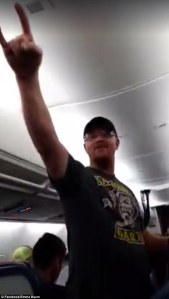
On a recent Delta flight from Atlanta, a young man stood up before take-off and started harassing his fellow-passengers with a pro-Trump rant,  yelling “Donald Trump baby!” and “We got some Hillary bitches on here?” while pointing at individual travelers. He also said, “Donald Trump is your President. Every god damn one of you. If you don’t like it, too bad.” Delta initially removed him, but returned him to the cabin. According to one witness, upon returning the man said, “This is what you get for being a patriot.”

He’s an idiot, of course, and there’s no excuse for his conduct. And yet…

How different is what he did, and what the “Hamilton” actors did? Not much. Neither the “Hamilton” audience members nor the passengers bought tickets to be subjected to this. Both were captive audiences. The conduct in both cases constituted harassment. The clearest distinction was that the jerk on the plane wasn’t an employee; if he had been a flight attendant, the incidents would have been even more similar. The jerk on the plane didn’t single out a particular passenger by name, making his conduct better, not worse, than what the “Hamilton” cast did.  On the plane, passengers hadn’t previously jeered the Hillary Clinton voters among them, so the intimidation factor Pence experienced was absent, and it was only one passenger, not a passenger with an imposing  line of others backing him up, like the wall of actors behind Brandon Victor Dixon. Continue reading →

Ethics Quiz: Trump’s Tweet On Fidel’s Demise

castro-tweet-trump

We are taught to speak only good of the dead in the immediate aftermath of one’s demise, and especially in the world of international diplomacy, restraint, respect and the Golden Rule are the accepted standards of ethical conduct on such occasions

This being the case, what is the right ethical diagnosis of President Elect Donald Trump’s tweet above about the announcement of Fidel Castro’s death, which includes an explanation point widely interpreted to suggest “GOOD!” of “Yippee!” ? Trump’s subsequent statement removed all doubt that he was not sorry to see Fidel go to that big sugar cane plantation in the sky, or better yet, well, you know:

“Today, the world marks the passing of a brutal dictator who oppressed his own people for nearly six decades,’ Mr Trump’s statement reads. “Fidel Castro’s legacy is one of firing squads, theft, unimaginable suffering, poverty and the denial of fundamental human rights. “While Cuba remains a totalitarian island, it is my hope that today marks a move away from the horrors endured for too long, and toward a future in which the wonderful Cuban people finally live in the freedom they so richly deserve. Though the tragedies, deaths and pain caused by Fidel Castro cannot be erased, our administration will do all it can to ensure the Cuban people can finally begin their journey toward prosperity and liberty. I join the many Cuban-Americans who supported me so greatly in the presidential campaign, including the Brigade 2506 Veterans Association that endorsed me, with the hope of one day soon seeing a free Cuba.”

Contrast that with President Obama’s equivocal statement, which said in part,

“We know that this moment fills Cubans — in Cuba and in the United States — with powerful emotions, recalling the countless ways in which Fidel Castro altered the course of individual lives, families, and of the Cuban nation. History will record and judge the enormous impact of this singular figure on the people and world around him.”

Then there was former President Jimmy Carter, who said,

“Rosalynn and I share our sympathies with the Castro family and the Cuban people on the death of Fidel Castro. We remember fondly our visits with him in Cuba and his love of his country. We wish the Cuban citizens peace and prosperity in the years ahead.”

Hmmmm!

Your Ethics Alarms Ethics Quiz for this Thanksgiving Day weekend:

Were Trump’s tweet and statement about Castro responsible, prudent and ethical?

I think so, and I’m surprised at my own response. I suppose I am tired of seeing and hearing public figures lie when everyone knows they are lying, and if Carter and Obama really don’t think Castro was a brutal, murderous dictator whose departure is a blessing to all, then the Democratic Party is in even worse shape than I thought it was.

I have a hard Left friend who actually expressed praise for Castro’s legacy today on Facebook. When a figure who is objectively and factually as bad as Castro was, our leaders should not hesitate to be frank and direct. Obama’s non-commital “History will record and judge the enormous impact of this singular figure on the people and world around him” is cowardly and evasive. Yes, and if history judges that Fidel’s ends justified his means, then civilization is doomed. Carter’s statement is even worse. “His love of his country”—that’s mitigation for oppression and murder, eh, Jimmy? If love of country your standard, you and Rosalyne must love Hitler.

Trump’s excessive candor and rogue mouth obviously are going to do a lot of damage in the next four years, just as they did during the campaign. Nonetheless, I don’t see anything unethical about calling a murderous dictator when he was, whether it’s on the day of his death or ten years later. This is one time when Trump’s refusal to be politically correct cuts through crap that should be cut through. As Edgar says at the end of “King Lear,”

“We should speak what we feel, not what we ought to say,”

…at least when bastards like Castro die.

Rather than using the occasion to find another excuse to attack Trump, Democrats should think about why it is that so many Castro admirers are in their ranks.


Holiday Ethics Assigment: Quick! Watch These 25 Great Old Ethics Movies Again Before You Go Bonkers Too!

movie-theater

I am compiling a new list of great ethics movies to help those troubled by the recently completed Presidential campaign, the election and its aftermath. I haven’t decided whether to reveal it piecemeal, or collectively as I have before, but I do need to begin by presenting the previous list of 25, actually the combination of several previous posts. Ethics films I have covered individually since those lists debuted, like Spotlight and Bridge of Spies, will eventually be added.

For now, here’s the top 25. Don’t pay attention to the order.

1. Spartacus (196o)

The raw history is inspiring enough: an escaped gladiator led an army of slaves to multiple victories over the Roman legions in one of the greatest underdog triumphs ever recorded. Stanley Kubrick’s sword-and-sandal classic has many inspiring sequences, none more so than the moment when Spartacus’s defeated army chooses death rather than to allow him to identify himself to their Roman captors (“I am Spartacus!”)

Ethical issues highlighted: Liberty, slavery, sacrifice, trust, politics, courage, determination, the duty to resist abusive power, revolution, love, loyalty.

Favorite quote: “When a free man dies, he loses the pleasure of life. A slave loses his pain. Death is the only freedom a slave knows. That’s why he’s not afraid of it. That’s why we’ll win.” [Spartacus (Kirk Douglas)]

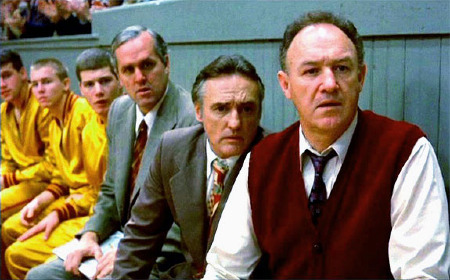
2.  Hoosiers (1986)

“Hoosiers” is loosely based on true story, but its strength is the way it combines classic sports movie clichés—the win-at-all-costs coach down on his luck, the remote superstar, over-achieving team—into a powerful lesson: it isn’t the final victory that matters most, but the journey to achieving it.

Ethical issues highlighted: Forgiveness, generosity, leadership, kindness, courage, loyalty, diligence, redemption.

Favorite quote: “If you put your effort and concentration into playing to your potential, to be the best that you can be, I don’t care what the scoreboard says at the end of the game, in my book we’re gonna be winners.” [ Coach Norman Dale (Gene Hackman)]

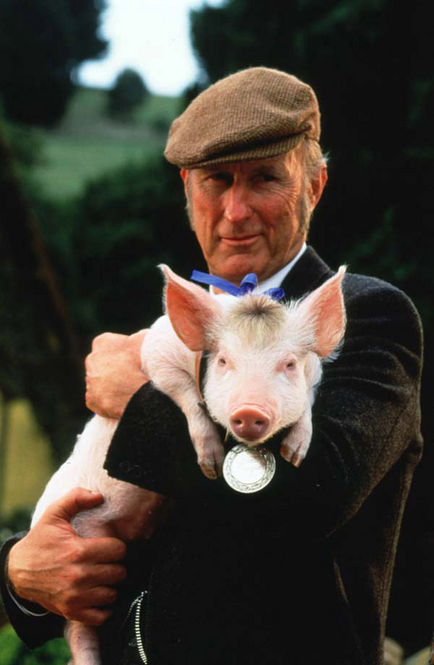
3. Babe (1995)

A wonderful movie about the virtues of being nice, the greatest civility film of all time. Second place: “Harvey.”

Ethical issues highlighted: Civility, kindness, reciprocity, loyalty, courage, love, friendship, bigotry, bias.

Favorite quote: “Fly decided to speak very slowly, for it was a cold fact of nature that sheep were stupid, and there was nothing that could convince her otherwise…The sheep decided to speak very slowly, for it was a cold fact of nature that wolves were ignorant, and there was nothing that could convince them otherwise”  The Narrator (Roscoe Lee Browne) Continue reading →