Saturday Ethics Warm-Up, 3/23/2019: Hypocrisy, Rationalizations, Spin, And Things Your Facebook Friends Will Hate To Pieces

Good Morning!

Doesn’t Barbra sing beautifully? Does knowing she’s ethically dead inside ruin her singing for you? (see #2)

1.  How arrogant and incompetent is this? UNBELIEVABLY arrogant and incompetent. Apparently Jared Kushner and the President’s daughter, Kushner’s wife, have been using private email accounts for official business. It’s against the law. it’s absurdly hypocritical, after the (deserved) criticism the President leveled against Hillary Clinton for her private server shenanigans. The Justice Department should prosecute both of them, and if the President had anyone else competent that he could trust as a close advisor—he fear he doesn’t—he should fire them both.

2. Wow! Barbra rationalizes sexual child abuse! Will this mean that Babs will no longer be welcome at Democrat fundraisers? Doubtful. Progressive never met a double standard they wouldn’t use.

Here is what the singing icon said to the The Times about Michael Jackson’s recent accusers (via documentary and lawsuits), Wade Robson and James Safechuck, and hold on to your heads:

“His sexual needs were his sexual needs, coming from whatever childhood he has or whatever DNA he has. You can say ‘molested,’ but those children[ now grown-up Robson and Safechuck] as you heard, say they were thrilled to be there. They both married and they both have children, so it didn’t kill them.”

Should I rename the infamous Rationalization #22. The Comparative Virtue Excuse: “There are worse things” after the Funny Girl? Her statement is a perfect example: a child being raped by a grown man isn’t a big deal if the kid doesn’t die. Then there is #42. The Irrelevant Mitigation: “He’ll/She’ll/They’ll get over it”:

” #42 is pure callousness mixed with consequentialism, and thus beyond redemption or ethical application.. It holds that wrongful conduct is somehow mitigated by the fact that the wound heals, forgiveness is granted, or time breeds forgetfulness. It isn’t. How and whether victims recover or get over their anger does not alter the original misconduct, mitigate it, and certainly does not erase it. Those who cite this rationalization are shrugging off accountability and are signalling that they will repeat their unethical conduct or worse, counting on their victims to give them an opportunity to harm them again. Anyone who employs The Irrelevant Mitigation cannot be trusted”

The despicable suggestion that Jackson’s alleged victims consented to being raped, however, because they wanted it, is really revolting. This is #48. Contrived Consent, or “The Rapist’s Defense”, which…

…aims to cleanse unethical conduct by imagining that the victim consented to it, or secretly sought the result of the wrongful act. The most infamous example of this rationalization is, of course, the rapist’s defense that the victim either was inviting a sexual assault by flirtatious conduct or provocative dress, or secretly “wanted it.”

It is, perhaps, the ugliest rationalization of all.

The good news is that these idiotic comments, signature significance for someone whose ethics alarms have turned to moldy cheese, are attracting appropriate condemnation. Good. [Pointer: Other Bill]

3. Here’s some dishonest leftist spin for the Mueller investigation, as the impeachment hounds try to somehow make the facts consistent with their delusions. From ThinkProgress:

“Mueller’s team has filed dozens of indictments and secured convictions and guilty pleas in the conspiracy to interfere in the 2016 election: Six of Trump’s close associates and employees have faced charges. George Papadopoulos, a former campaign adviser; Paul Manafort, Trump’s former campaign chair; Rick Gates, a campaign aide and longtime Manafort business partner; Michael Flynn, a former foreign policy adviser; Michael Cohen, Trump’s former lawyer and fixer; and Roger Stone, a longtime Trump adviser, have all been charged by Mueller. Manafort and Cohen have been convicted and sentenced to prison.”

That’s multiple lies framed by a lie. None of Mueller’s indictments involve any conspiracy to interfere with the election except the symbolic charges against Russians,  and if there had been any evidence of such a conspiracy, an American would have been inducted on those grounds. Manafort was indicted for his own crimes, not any related to the campaign. Flynn and Cohen had no involvement with Russia either. The others were charged with process crimes: lying to law enforcement, not “colluding” with Russia.

4. “Worst Nazi Ever!” That’s Instapundit Glenn Reynolds gag tag for Trump actions like declaring that Israel should  have sovereignty over the Golan Heights, ending decades of U.S. policy of tip-towing around the issue. It also fits here: The President issued an  executive order directing federal agencies to “take appropriate steps” to “promote free inquiry” at institutions that receive federal research and education grants, including thorough compliance with the First Amendment.  F.I.R.E. approves.

5. Surprise! Your Facebook friends are wrong, and don’t know what they are talking about...It is overwhelmingly likely that the supreme Court will approve the use of emergency powers to build “the wall.” Richard H. Pildes, professor of constitutional law at New York University, wrote a convincing article, “How the Supreme Court Weakened Congress on Emergency Declarations,” in which points out…

  • The National Emergencies Act (NEA), passed by Congress in l976, never defines that an emergency is, largely leaving that assessment to the President.
  • Presidents have used the NEA 58 times. In every case–every case!— the President spent funds not appropriated by Congress.
  • In no case did the Supreme Court overturn the action.
  • The Supreme Court decision in Immigration and Naturalization Service v. Chadha, which declared that “legislative vetoes are unconstitutional,”  including vetoes of Presidential actions under the National Emergencies Act.
  • Absent Congress overriding Trump’s veto of the bill designed to stop his declaration of the emergency at the border, a result that is unlikely, there is no legal way to block the Trump as he acts on the authority of the NEA.
  • Trump neither violated the Constitution nor violated the separation of powers. His unilateral action was a constitutional power ceded to him by an act of Congress
  • President Obama used the act to transfer funds without congressional authority to his health care act.

I didn’t think there was a chance that the President’s power to do this would not be upheld, and the article makes me more certain than ever.  I also agree with Ronald Trowbridge that if the Justices were capable of ruling only on the law rather than partisan politics, the decision would be unanimous.

 

Comment Of The Day: “A Visit To “The Ethicist””

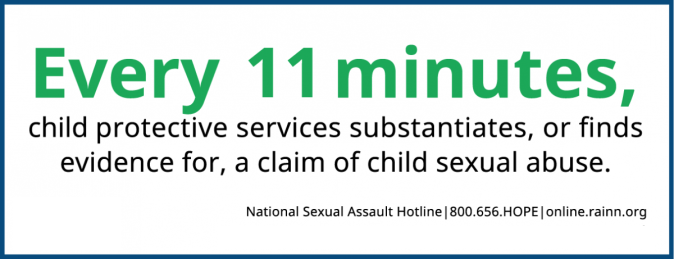
A disturbing Child Protective Services tale from slickwilly, and a Comment of the Day, on the post, A Visit To “The Ethicist”…

When my kids were little, we learned of the stories from friend and relatives where a CPS worker with a vendetta (or being paid off) would take someone’s kids and subject the parents to 7 kinds of hell just using the process against them.

A friend crossed (innocently enough) a CPS worker, who threatened to ‘get even.’ Several days later she was visited by stormtroopers who forcibly removed her toddler aged child and shipped him to Arizona, to a father who did not want him. This meant that the Arizona foster care system was where the child landed. Think dealing with ONE CPS agency is hard? Try two at once! It too all of the mother’s savings, and over a year, to get her child back. She did not get to even SEE her child for 3 months: a huge part of that child’s life. Terrible.

My relatives had a similar experience, after their daughter’s ugly divorce (where the father, who did not want the 3 year old boy, nevertheless made a mess by threatening to take away custody.) When the father sicc’d a friend from CPS on her, alleging abuse, the family sprang into action. A day after the initial call from the corrupt CPS worker, her apartment was raided to remove the child and document the alleged signs of abuse. Continue reading

A Visit To “The Ethicist”

I haven’t opined on posts by the current holder of The New York Times Magazine “The Ethicist” title as often as I used to, in part because Kwame Anthony Appiah, unlike his predecessors, is a real ethicist, and usually answers the questions to his ethics advice column competently. The February 18 column was especially interesting, however, because Appiah seemed to be ducking some issues. I don’t blame him; two of the three questions he received have no clearly right ethical answer.

The one out of the three that was relatively easy was the anonymous inquirer who discovered that his company was willfully violating labor wage laws and under-reporting wages for workers’ compensation purposes. “Should I report this company to the authorities?” The Ethicist was asked. My answer? YES. 1) Get a lawyer. 2) Document what you know and how you found out about it. 3) Quit. 4) Blow the whistle. “I hope you proceed. Obligations of confidentiality to your employer don’t include the duty to conceal fraud,” was Appiah’s conclusion.

The other two questions are more problematical, especially the first: A correspondent asks what she should do with relatives in desperate financial straits who are begging for her money to bail them out. “I love my family, and it is extremely painful to see them suffer, but at the same time it is difficult for me to fund their lifestyles when they seem like a bottomless pit. I feel guilty and uncomfortable, but also angry and annoyed. Yet how can I watch my sister be thrown out of her house and potentially end up homeless if I have the resources to help her?”

The Ethicist ducks. First he says that the woman should try to train her relatives in financial management, even to the extent of actively managing their budgets. Right: THAT’s going to work. His conclusion: “So the most important thing you and your brother can do is to be clear with her about what you are and are not willing to do if her grasshopper behavior brings her into financial difficulties. And that means first being clear about this matter yourself. Bear in mind that you owe more to family members than you do to strangers, but you don’t owe it to them to abandon all your hard-earned plans in order to pay for their mistakes.”

But that wasn’t the question. Of course family members can’t demand that you fix their financial mistakes. It isn’t a matter of “owing” them, either. The Ethicist also cheats by resorting to a straw man: she didn’t ask if she should “abandon all her hard-earned plans.” She asked how she could sit back and watch them suffer when she had the resources to alleviate some of that suffering. Continue reading

The Edison Contradiction, Or Why Great Achievers Are So Often Unethical People, And Civilization Is Still Better Off For It

When I noted Thomas Edison’s birthday recently, and pointed readers to the two classic old movies about Tom as a man and boy, reader Chris Marschner wrote,

Re Edison I have seen the films with Tracy and Rooney. Tracy’s portrayal was historically one sided depicting Edison as merely a slave to his inventiveness. I dont recall it showing him as an egotistical tyrant who put real meaning into unbridled competition with Nikolai Tesla. I believe the director conveniently left out the part when Edison electrocuted an elephant to show alternating current was dangerous.

Edison’s inventions are ubiquitous and spawned the growth of the American economy but I would suggest his understanding of ethics would be on par with Harry Reid.

After my response noted that Edison, “like most who reach the absolute top of a field or profession…was absolutely obsessed with one single mission, and was an indifferent father, husband, friend. That’s the sacrifice such people make; yes, ethics is not on their agendas. Nonetheless, they are essential to the advance of civilization. He was a great inventor, not a great man….and he would have never claimed otherwise.”

Reader Steve-O added,

It doesn’t stop with the great scientists and inventors. A lot of the great leaders, political, military, business, arts, and otherwise, were TERRIBLE at human relations and dreadful even as colleagues. A random sampling might include:

Political:

1. FDR – a sociopath and an adulterer.
2. Churchill – a heavy-handed functional alcoholic.
3. Clemenceau – anti-clerical bully who married one of his students.
4. Ataturk – Brute, racist, alcoholic, looked the other way on genocide.
5. Bismarck – “blood and iron.”

Business:

1. Rockefeller – intentionally drove competitors out of business, monopolist.
2. Henry Ford – anti-Semite, conspiracy theorist, Nazi sympathizer.
3. Andrew Carnegie – anti-religious bully, deliberate indifference to poor conditions on his watch.
4. George Pullman – tried to set himself up as king as well as boss of his workers.
5. James “Diamond Jim” Brady – glutton, playboy.
6. Howard Hughes – one word: Yikes!

Military:

1. Douglas MacArthur – the only difference between him and God was that God didn’t think he was MacArthur.
2. George Patton – a warrior who couldn’t live in peacetime, his own staff despised him.
3. Joseph Joffre – indifferent, borderline incompetent, very little regard for the lives of his men.
4. Horatio Nelson – extremely poor treatment of his wife, who never did him wrong.
5. Joe Stilwell – “Vinegar Joe.”

Music:

1. Richard Wagner – tenth-rate human being all around.
2. W.A. Mozart- tortured genius who sometimes tortured others.
3. Johannes Brahms – dark genius who was more at home with music than relationships.
4. Anton Bruckner – macabre, possible pedophile.
5. Rimsky-Korsakov – nasty drunk.

I nearly answered, “Don’t get me started on actors, singers, artists and directors!”

Or, for that matter, Presidents of the United States.

However, this is a serious and confounding problem in ethics. History teaches us that our greatest achievers often not only give very little priority to ethics, but that a strong argument could be mounted that a concern for ethics would have seriously curtailed their positive effect on human progress and society. Is this, in some ways, a direct challenge to the position, my position, that it is every human being’s duty to strive to live by ethical values and decision-making. It is indeed. Continue reading

‘Tis The Morning Before Christmas Ethics Warm-Up, 12/24/18!

Merry Christmas!

1 Christmas gift ethics. What’s your opinion of a relative who says that the only thing she wants for Christmas is for family members to donate to her favorite leftist candidate for City Council? I don’t recall the Christmas tradition being “Make people do whatever you would do” Day, do you? Let’s have a Christmas Eve poll!

2. Change: I now believe “the wall” is necessary and the President’s resolve is ethical. My change of heart comes after watching all Democrats and many Republicans simultaneously say they want secure borders and then continue to encourage illegal immigration with their rhetoric and votes. The wall is necessary to send an unequivocal message, which has been Trump’s message since he announced his candidacy: “Come here legally, or don’t come. If you get here by breaking our laws, you are not welcome and will never be welcome, no matter what you do.”

Correctamundo!

Anti-Trump GOP Senator Bob Corker claims that the showdown over authorization of funding for the Wall is a “made-up fight, so the president can look like he’s fighting, but even if he wins, our borders are going to be insecure.” It’s not a “made-up” fight at all. Republicans have been afraid to upset Hispanic-Americans and Democrats want nice, reliable, left-voting poor folks to swell the voting rolls, so they have sent deliberately mixed messages, particularly regarding the “Dreamers.” If a wall did nothing other than stop “migrant caravans,” it would be worth it.

Trump also promised a wall. Breaking promises is not the same as a lie, unless the promise was a lie when it was made, but Trump, who we have been told lies incessantly, has also been far more determined to fulfill campaign promises than any President within memory. (Obama promised to address the national debt. He promised to have the most transparent administration in history. He promised  that lthe use of chemical weapons by Syria would be the “red line.” He promised to be President of all the people, not just Democratic base demographic groups. He promised that if you like your heath care plan…well, you know the rest.)

It is the Democratic position on the wall that is a sham, because the money involved is a relative pittance. They are grandstanding, and the President is not.

3.  Slot machine ethics. How did I miss this? Three Las Vegas visitors who hit multi-million dollar jackpots playing slot machines are fighting the casinos’ efforts to void the pay-offs on the grounds that the machines “malfunctioned.” The episodes all occurred earlier this year. Unless there is a prominent notice on or around the slots pointing out that there is a limit to the payoff in any single play and specifying what the limit is, I think the casinos are obligated to live with losing whatever one of their evil, manipulative, Skinnerian machines cough up.

This isn’t like a malfunctioning ATM machine. Players are led to believe that whatever comes out when they pull the lever or push the button is theirs. If casinos can say that their machines malfunctioned and they are not responsible for the result, then gamblers should have the same option: “I’m sorry, but my limit on gambling losses was just $500. I shouldn’t be responsible for the additional $10,000 I lost on blackjack, because I malfunctioned.” Continue reading

Sunday Ethics Warm-Up, 12/16/18: As Bing And I Dream Of A White Christmas, Pre-Holiday Ugliness

Good afternoon!

[For some reason, Bing’s version of the song that begins the film “White Christmas”–accompanied by a music box–is completely off-key. This has bothered me for decades. How could this happen?]

1. Our trustworthy news media. How many news outlets reported this story? In 2016, Tribune Publishing Co. owner Michael Ferro met with corporate leaders from within his news empire, including chief news executives from the Los Angeles Times, the Chicago Tribune and The Baltimore Sun.  During the meeting, he engaged in old-fashioned Jew-bashing, railing about the “Jewish cabal” that ran Los Angeles. In 2018,  Tribune Publishing made the first in a series of secret extortion payments that totaled $2.5 million to avoid a threatened lawsuit filed by a fired newspaper executive who had been in that room, thus keeping Ferro’s anti-Semitic slur out of the news.

Yes, a news organization paid millions to suppress the news. The rest of the story is similarly disturbing.

2. KABOOM! This article made my head explode. Therein, CNN contributor Kate Anderson Bower attacks the First Lady, saying that “she doesn’t understand what it means to be first lady.” The article is perfect 10s all across the board: for arrogance, for bias, for Trump-bashing, for incompetence and historical revisionism. The accusation arose from statements Melania made in an interview with Sean Hannity, stating that the hardest part of her job was having to deal with her and her family being personally attacked by “comedians to journalists to performers[and]book writers.”  Bower writes that Melania was

“again making the job about herself and her family instead of taking the opportunity to talk about the challenges she sees other people facing…The entire moment was a lost opportunity to put attention on the families of struggling Americans she’s met in her role as first lady, especially since she spent time the very next day reading to children at Children’s National Hospital, some sitting in wheelchairs with IVs attached. And the Hannity interview took place on USS George H.W. Bush, a trip the first lady made to support members of the military and their families. Wouldn’t it have been heartening to hear her use that moment during the interview to talk about the women and babies she’s met struggling with opioid addiction, or the children who she has met as part of her “Be Best” campaign who have been bullied at school, or the people whose homes were destroyed in the California fires?”

I’ll tell you what, you presumptuous hack: when you’re First Lady, you show us how it’s done.

There is no job of First Lady for Melania to “understand.” Bower is imposing her values and priorities on the job, and claiming that she knows the job description, which has always fluctuated with the occupant and the times.  The job of the First Lady, to the extent there is one, is to do whatever is possible to help the President of the United States be successful and succeed, using whatever talents she has. There is no obligation for a First Lady to be Eleanor Roosevelt, nor is it written in ink or precedent that the President’s spouse has to concentrate on “the challenges she sees other people facing.”  Jackie Kennedy’s primary project was renovating the White House, where she lived. How did that help the poor and under-privileged?  Lady Bird beautified the shores of the Potomac. How was that a boon to the poor in Appalachia?  Nobody criticized their priorities. I wonder why? Continue reading

Unethical Quote Of The Month: Wheaton College

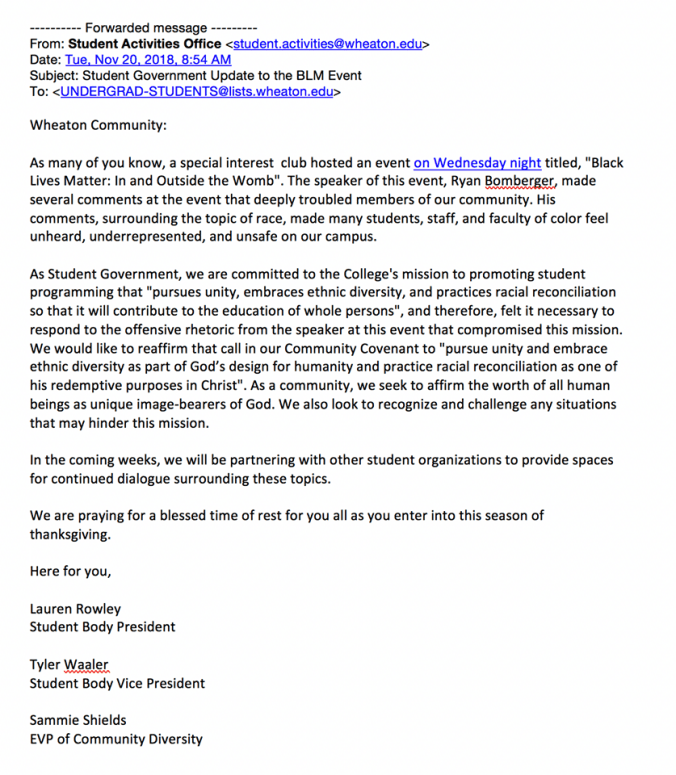
What prompted this anti-educational, anti-discourse “message to the Wheaton community”?

Ryan Bomberger of the Radiance Foundation gave a presentation entitled “Black Lives Matter In and Out of the Womb” at the evangelical Wheaton College (in Wheaton, Ill.) on November 14. He was the guest of the Wheaton College Republicans. Bomberger’s talk criticized  BLM leadership for announcing its solidarity with Planned Parenthood, the “leading killer of black lives.” Bomberger  is a biracial African American conceived in rape, adopted, and then raised in a mixed-race family. He responded  to the allegations in the letter by saying that Rowley, Waaler, and Shields had demonized him, and said he had been told that only Shields among the three signatories had attended his talk.

“I would think it would be against the college’s mission to intentionally mislead students,” Bomberger wrote in response to the student leaders’ backlash against him.

“I am a person of color, a clarifying fact which you conveniently left out of your letter of denouncement. I was primarily presenting a perspective of those who are never heard, always underrepresented, and are actually unsafe — the unborn,” he said. Continue reading

The Complete “It’s A Wonderful Life” Ethics Guide, Updated And With A New Introduction For 2018

Once again I am posting the Ethics Alarms Ethics Guide to Frank Capra’s 1946 masterpiece “It’s A Wonderful Life,” perhaps the greatest ethics movies of all time, as this blog’s official welcome to the holiday season. The film is commonly thought of as a Christmas movie, but it really is a Thanksgiving story. Unfortunately, the movie is so well known, so much imitated, so familiar in its tropes and cliches that we really don’t think about it very hard. We should.

The movie is exactly the kind of important shared cultural touch-point that I am advocating when I emphasize the importance of cultural literacy to our nation’s connective tissue. The film teaches about values, family, sacrifice and human failings unlike any other: its power and uniqueness disproves the assertion, made in one online debate here this year, that new cultural creations inevitably and effectively supersede older ones. No, they really don’t, and like copies of copies, eventually the cultural values conveyed get fainter and less influential. “It’s A Wonderful Life” would be an excellent basis for a middle school ethics course. I haven’t seen a better, richer film for that purpose come along since, and I’ve been looking.

I am also constantly amazed at how many people haven’t seen the movie. My son’s girlfriend admitted that she hadn’t at dinner today. A few months ago I gave a DVD to a pharmacist at our local CVS after I made a reference to the film and he had no idea what I was talking about. He said he would wait until the holidays to watch it with his family. I hope he does: he left the job soon after. There are some classic movies that parents have an obligation to make sure their children see. This is one. Despite the many ethics complexities and nuances that the film glosses over or distorts, its basic, core message is crucial to all human beings, and needs to be hammered into our skulls at regular intervals, far more often than once a year.

What I wrote about this message in an earlier posting of this opus still seems right to me:

Everyone’s life does touch many others, and everyone has played a part in the chaotic ordering of random occurrences for good. Think about the children who have been born because you somehow were involved in the chain of events that linked their parents. And if you can’t think of something in your life that has a positive impact on someone–although there has to have been one, and probably many—then do something now. It doesn’t take much; sometimes a smile and a kind word is enough. Remembering the lessons of “It’s a Wonderful Life” really can make life more wonderful, and not just for you.

I wondered about posting the guide again this year, as this feels like a year in which Ethics Alarms lost old readers rather than gained new ones. Then I read it again, and it reminded me of some important things I had forgotten, and I wrote it. I also, as is my yearly habit, edited and added to the commentary a bit. I’m smarter this year than I was last year, and I bet you are too…especially if you’ve been reading Ethics Alarms, just from figuring out how I’m wrong.

I hope you all had a terrific Thanksgiving, and that the holiday season is joyous for all.

And here we go:

1. “If It’s About Ethics, God Must Be Involved”

The movie begins in heaven, represented by twinkling stars. There is no way around this, as divine intervention is at the core of the fantasy. Heaven and angels were big in Hollywood in the Forties. The framing of the tale seems to advance the anti-ethical idea, central to many religions, that good behavior on earth will be rewarded in the hereafter, bolstering the theory that without God and eternal rewards, doing good is pointless.

Yet in the end, it is an ethics movie, not a religious one. George lives a (mostly) ethical life, not out of any religious conviction, but because step by step, crisis after crisis, he chooses to place the welfare of others, especially his community and family, above his own needs and desires. No reward is promised to him, and he momentarily forgets why we act ethically, until he is reminded. Living ethically is its own reward.

We are introduced to George Bailey, who, we are told, is in trouble and has prayed for help. One has to wonder about people like George, who resort to prayer as a last resort, but they don’t seem to hold it against him in Heaven. The heavenly authorities assign an Angel 2nd Class, Clarence Oddbody, to handle the case..He is, we learn later, something of a second rate angel as well as a 2nd Class one, so it is interesting that whether or not George is in fact saved will be entrusted to less than Heaven’s best. Some lack of commitment, there— perhaps because George has not been “a praying man.” This will teach him—sub-par service! Good luck, George!

2. Extra Credit for Moral Luck

George’s first ethical act is saving his brother, Harry, from drowning, an early exhibition of courage, caring and sacrifice. The sacrifice part is that the childhood episode costs George the hearing in one ear. He doesn’t really deserve extra credit for this, as it was not a conscious trade of his hearing for Harry’s young life, but he gets it anyway, just as soldiers who are wounded in battle receive more admiration and accolades than those who are not. Yet this is only moral luck. A wounded hero is no more heroic than a unwounded one, and may be less competent as well as less lucky. (This is not an observation that one should make in public, as President Trump learned when he made a lifetime enemy of John McCain.)

3.  The Confusing Drug Store Incident.

George Bailey’s next ethical act is when he saves the life of another child by not delivering a bottle of pills that had been inadvertently poisoned by his boss, the druggist, Mr. Gower, who is addled by grief and drink after learning about the death of his own son. George’s act is nothing to get too excited over, really—if George had knowingly delivered poisoned pills, he would have been more guilty than the druggist, who was only careless. What do we call someone who intentionally delivers poison that he knows will be mistaken for medication? A murderer, that’s what.  We’re supposed to admire George for not committing murder.

Mr. Gower, at worst, would be guilty of negligent homicide. George saves him from that fate when he saves the child, but if he really wanted to show exemplary ethics, he should have reported the incident to authorities. Mr. Gower is not a trustworthy pharmacist—he was also the beneficiary of moral luck. He poisoned a child’s pills through inattentiveness. If his customers knew that, would they keep getting their drugs from him? Should they? A professional whose errors are potentially deadly must not dare the fates by working when his or her faculties are impaired by illness, sleeplessness or, in Gower’s case, grief and alcohol.

One could take the position that Mr. Gower “just made one mistake.” But trustworthy professionals don’t get to make such mistakes, not and still be trusted the next time. Trust is easily destroyed, and should be.

Mr. Gower also slaps George on the head several times. Today hitting a child like that is regarded as child abuse by a parent; when another adult hits a child, it’s grounds for arrest. This is one of many examples of evolving societal ethics in “It’s A Wonderful Life.” When the film was made, Mr. Gower’s conduct in beating a child employee was considered forgivable. If the local pharmacist slapped my son, I’d swear out a criminal complaint, and he still might end up shambling bum like Mr. Gower in the film’s alternate reality section.

4. The Uncle Billy Problem.

As George grows up, we see that he is loyal and respectful to his father. That’s admirable. What is not admirable is that George’s father, who has fiduciary duties as the head of a Building and Loan, has placed his brother Billy in a position of responsibility. As we soon learn, Billy is a souse, a fool and an incompetent. This is a breach of fiscal and business ethics by the elder Bailey as well a classic conflict of interest, both of which George engages in as well, to his eventual sorrow.

5. George’s Speech.

Continue reading

Thanksgiving Day Ethics Warm-Up, 11/22/2018: Turkeys And Vampire-Slayers

Happy Thanksgiving!

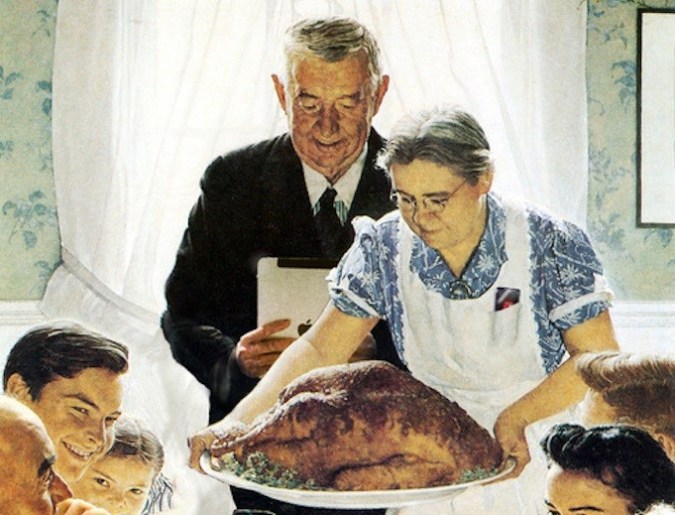
Now don’t let any “turkeys,” related or not, spoil it for you. This is a uniquely American holiday, celebrating our history, journey, values and culture, remembering the value of family, and extolling  qualities that Americans should all try to embrace in their daily lives: generosity, empathy, charity, loyalty, perspective, respect and gratitude. Once it was regarded as a religious holiday, but as the culture has gradually rejected religion, for better or worse, and not without the full complicity of organized religions whose conduct would repel anyone, the holiday has struggled to find new moorings. Its value as a yearly ethical touchpoint makes that struggle worth continuing.

1. Speaking of Thanksgiving “turkeys”...A helpful Twitter-user compiled these shots from various progressive websites and blogs:

Nice.

One of the things I have long been thankful for was the excellent training I received at our family dinner table from my proudly iconoclastic father, who could argue any side of any issues, and did, just to teach his kids that they better have a firm grasp of facts, logic, language, and critical thinking before making any assertion, lest they be made to look like fools. He also taught the value of an open mind, and resisting lazy conventional wisdom without foundation, like, say “Trump is a racist.”

2. This one is Obama’s fault. Though heated political arguments were always a potential part of family gatherings, it was Obama’s administration and his allies that made the disgusting decision to weaponize the holidays, commanding their human drones to arrive at gatherings ready to argue the benefits of the Affordable Care Act, and providing brochures and videos to help them accomplish the mission. (Bulletin from Justice Roberts: “There are no Obama Thanksgivings or Trump Thanksgivings!”) Continue reading

Sick-Bed Ethics Warm-Up, 11/14/18: Ethics Among the Sneezes [UPDATED]

Good whatever it is….

1. Bottom line” Don’t trust Facebook. From the Times: “Facebook failed to closely monitor device makers after granting them access to the personal data of hundreds of millions of people, according to a previously unreported disclosure to Congress last month.” Surprised? As with Google promising moths ago that it was no longer reading our mail, then admitting months later that it had resumed the practice, the big tech companies have proven repeatedly that that we cannot believe what they say, or their motives, or their pledges of good will and public service. More from the Times story:

Facebook’s loose oversight of the partnerships was detected by the company’s government-approved privacy monitor in 2013. But it was never revealed to Facebook users, most of whom had not explicitly given the company permission to share their information. Details of those oversight practices were revealed in a letter Facebook sent last month to Senator Ron Wyden, the Oregon Democrat, a privacy advocate and frequent critic of the social media giant.

In the letter, a copy of which Mr. Wyden provided to The New York Times, Facebook wrote that by early 2013 it had entered into data-sharing agreements with seven device makers to provide what it called the “Facebook experience” — custom-built software, typically, that gave those manufacturers’ customers access to Facebook on their phones. Those partnerships, some of which date to at least 2010, fall under a consent decree with the Federal Trade Commission drafted in 2011 and intended to oversee the company’s privacy practices.

Read the whole thing. I just assume that anything I put on Facebook, regardless of the alleged settings,will be sold to or otherwise obtained by potentially malign entities.

2. Just what we need now, a rogue First Lady. First Lady Melania Trump publicly called for the President’s deputy national security adviser, Mira Ricardel, to be fired.  In a word, well, two: Shut up. The felicitous circumstance of marrying someone who is later elected President of the United States confers no expertise or authority. The position of First Lady has no Constitutionally recognized duties, nor does it carry any real power. There is nothing anyone can do to diminish the influence and spouse may have with the President behind closed doors—and that is a problem—but she or the inevitable he must not confuse, confound or otherwise seek to influence affairs of state with public comments and opinions. Why Melania wants Ricardel fired is irrelevant. It’s none of her business.

I just want to point out that I sneezed six times while typing those last four words. Applause, please. Continue reading