
Read This To Your Mother…or Somebody’s Mother

The Nigerian Prince wants to meet your mother.

As my sister and I try to unravel the details and records of my mother’s nearly 90 years, we both have concluded that she would have been an easy mark for scammers and frauds if she didn’t have two lawyer offspring reviewing her decisions. The number of elderly, mentally-failing Americans who lose their life’s savings to these predators is a national tragedy. They are particularly prominent on the internet. I was very frustrated with my mother’s resistance to e-mail and the Web…now I’m not sure it wasn’t too dangerous for her to navigate.

The F.B.I. has an excellent and informative web page that should be shown, read to, and explained to every senior in your life. From the introduction:

“Senior citizens are most likely to have a “nest egg,” to own their home, and/or to have excellent credit—all of which make them attractive to con artists...People who grew up in the 1930s, 1940s, and 1950s were generally raised to be polite and trusting. Con artists exploit these traits, knowing that it is difficult or impossible for these individuals to say “no” or just hang up the telephone. Older Americans are less likely to report a fraud because they don’t know who to report it to, are too ashamed at having been scammed, or don’t know they have been scammed. Elderly victims may not report crimes, for example, because they are concerned that relatives may think the victims no longer have the mental capacity to take care of their own financial affairs.”

The site goes on to describe how various scams work and how to spot them; indeed, you don’t need to be a senior to be vulnerable. The list is daunting: Continue reading →
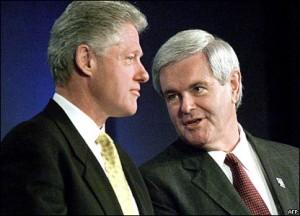
Unethical Quote of the Month: Newt Gingrich

“There’s no question at times of my life, partially driven by how passionately I felt about this country, that I worked far too hard and things happened in my life that were not appropriate. And what I can tell you is that when I did things that were wrong, I wasn’t trapped in situation ethics, I was doing things that were wrong, and yet, I was doing them. I found that I felt compelled to seek God’s forgiveness. Not God’s understanding, but God’s forgiveness. I do believe in a forgiving God. And I think most people, deep down in their hearts hope there’s a forgiving God.”

—–Former Speaker Newt Gingrich, preparing for a presidential run by attempting to explain and apologize for his serial marital betrayals, the most spectacular of which was visiting his first wife while she was in the hospital recovering from cancer surgery to announce that he was divorcing her to marry his mistress. Then he cheated on his second wife, the former mistress, with a member of his staff. He ditched Mistress #1, Wife #2, for Mistress #2, who became Wife #3. This is why he needs a forgiving God, or at least a forgiving electorate.

Newt’s defense now is that he felt so passionately about his country that it caused him to dump his cancer stricken wife (so much for all that “in sickness or in health” stuff), and later, while he was leading a party that was making the case that a U.S. President shouldn’t be having on-the-job sexual encounters with interns, using his staff and appointees to cover it up, and lying about it under oath in court, to commence a second extra-marital affair of his own. This, naturally, helped let President Clinton wiggle of his well-earned impeachment hook, and also helped cement the socially destructive public perception that 1) everyone cheats on their spouses, so it’s okay, and 2) you can’t trust any of our elected leaders.

Thanks for nothing, Newt.

God is welcome to forgive you; I won’t. You are obviously untrustworthy. Once cheating on a spouse may be a mistake; cheating on a second spouse is a behavior pattern. If a politician who likes to invoke God will lie to and betray two women who he swore, before God, to take “’til death us do part,” not to mention his children, I see no reason to assume that he won’t betray voters who has never met, loved, or lived with.

God’s forgiveness is irrelevant to the central issue of whether New Gingrich has the reliability of character and core values to justify entrusting him with great power. As his self-serving quote demonstrates, he does not.

But good luck with God, Newt.


The Naked Teacher Principle Strikes Again!

Once the class sees Teacher like this, it's over...

The Naked Teacher Principle holds, in essence, that once a teacher is seen by his or her students cavorting in the nude, school administrators and parents are not being unreasonable or unfair if they decide that the teacher can no longer teach effectively. From the classic example involving internet photos, to exceptions like the male teacher appearing in a community theater production of “The Full Monte”, to strange corollaries like “the Naked Butt-Painting Teacher with a Paper Bag Over His Head Variation,” naked teachers create headaches for their schools, giggles (at least) for their students, and anxiety for the teachers involved.

Now we have another variation. Continue reading →

Facebook Wars II: More School Abuse of Power and Privacy

"Hello? ACLU? Anybody there?"

In January, Ethics Alarms weighed in on reports from Illinois and New York about students being disciplined by their high schools for postings on Facebook about the sexual proclivities of female students in the community. The ethics verdict: the schools were abusing their power and the students’ privacy:

“When did schools suddenly acquire disciplinary control over what students do when they aren’t at school? There is no question that the websites involved were inappropriate, disrespectful, cruel and hurtful, just as the rumors and insults included in high school graffiti were, in those glorious days before the internet. Students so abused need to complain to parents, and parents need to talk to the parents of the offending students, and if they can’t or won’t address the problem, then the courts or law enforcement may need to become involved.”

The rationale offered by the schools at the time was that the students had violated rules against cyber-bullying, that ever-vague plague, although there is no more legitimate authority for a school to decree what a student can say about another student on a personal website than there is for a school to restrict what a kid can say at the dinner table.

Naturally, when an institution exceeds the natural limit on its authority, there is nothing to keep it from even more egregious abuse. Thus two Georgia students were just suspended and one another was expelled for negative Facebook postings about a teacher. Continue reading →

Ethics Quote of the Week: Ex-Con John Collins

Charlie made a different kind of mistake, too!

“We’re people, we’re not monsters. We’ve just made a different type of mistake than someone else.”

— 34-year-old John Collins, who announced his support for a provision being pushed forward by the Seattle Office For Human Rights, which believes that convicted criminals should be made a protected class.

Collins sure made a different kind of mistake, all right. He served four years in prison for drugging and raping his estranged wife. Continue reading →

The Prince, The Sex Offender, and the Ethics of Friendship

Prince Andrew with one of his friend's victims in 2001

The ethics of friendship is complicated.

President Bush claimed to be friends with Vladimir Putin. F.D.R. once said that Josef Stalin was his friend. President Obama was famously friendly with dubious characters like Rev. Wright and William Ayres.

History is full of heroes and near-heroes who had infamous friends, though the extent of the often friendship is difficult to know. Sammy Davis, Jr. and Elvis were supposedly buddies with Richard Nixon. Bill and Hillary Clinton were close friends with Dick Morris. Wyatt Earp was a life-long friend of “Doc” Holliday; Andrew Jackson may have been friends with pirate Jean Lafitte, who helped him win the Battle of New Orleans. We simultaneously celebrate loyal friends, and yet we also judge people by the company they keep. Should we condemn individuals who have friends with serious character flaws or a history of unsavory acts? Or should we admire them for sticking with their friends when everyone else is turning against them? Continue reading →

Liar of the Week: Mike Huckabee, as He Fails The Integrity Test

A Mike Huckabee advisor?

…and also the courage test.

Speaking unpopular truths and backing down once they prove unpopular is worse than what most politicians do, which is to avoid speaking the truth at all. In Huckabee’s case, he compounded the villainy by not only backing down, but by absurdly lying about what he had said, despite the fact that his words were recorded and his meaning was clear as a bell.

Huckabee, in case you don’t follow the remarks of former state governors under the delusion that he can they can be  elected President, had criticized Oscar winner Natalie Portman’s proud single mother-to-be act, saying, Continue reading →

Cranky Ethics Encounters In A Rotten Week

The unexpected death of my mom on Saturday tends to make everything else in my life the past week fade to insignificance, but the last seven days featured more than my usual quota of confrontations when thrust in the path of conduct that seemed just wrong to me:

  • Staying at a Fairfield Inn and Suites, a Marriott chain, in Greensboro, North Carolina, I found myself running behind schedule for a morning presentation. Rushing to take my shower, I was stopped cold by the shower controls, which made no sense at all. The long handle didn’t seem to do anything, and the round knob inside it had no effect either. Since I have the mechanical skills of a rodent, and am constantly embarrassed by my ineptitude, I fiddled with the knobs longer than I should have before giving up in a panic and calling the front desk.

“I can’t get the shower controls to work, and I’m late!” I blurted out to the woman manning the desk. “Send someone up right away!” Continue reading →

Comment of the Day: “Ethics Quote of the Week: Blogger Jeff Jarvis”

Karl Penny calls me to task here for yielding to another commenter’s premise (but not his conclusion from it) that celebrities lead more interesting lives than their typical fans. Since “interesting” has various meanings—in Charlie Sheen’s case, the ironic Chinese definition (as in “may you live in interesting times”) comes to mind, and I could argue that celebrities by definition lead lives that their fans find more interesting than their own, hence the fact that they are celebrities. Nonetheless, Karl’s point is critical, and I thank him for making it so eloquently. And Karl’s would have been the Comment of the Day even if he hadn’t mentioned my dad—but it didn’t hurt. Here is Karl on “Ethics Quote of the Week: Blogger Jeff Jarvis”:

“Now, Jack: “Nobody denies that rich stars have more interesting lives than their fans,…” Nobody? Hey, what am I? Chopped liver? But, seriously I do deny that celebrities lead more interesting lives than the rest of us. In my experience—and these days, I hear a lot from others about the details of their lives—everyone has a story to tell. Indeed, they have a narrative, and one that is way more interesting, and far more uplifting, than those of the celebrities whose stories are broadcast at us. Continue reading →

The Ethics Final: Ending My Mother’s Life Today

Some of our most important ethical decisions are made with the least analysis. At least that was the way it was for me this morning at 10:34, when my sister and I directed that my 89-year-old mom, Eleanor Coulouris Marshall, be taken off of life support. Continue reading →