It certainly appears as if U.S. higher education is sailing toward the shoals of ethics bankruptcy, full speed ahead. It also appears that Yale, although it’s part of a tightly bunched armada, is leading the way.
A law suit called Doe v. Yale tells a jaw-dropping tale that once would have been unbelievable, “once” meaning “before a large segment of the culture accepted the proposition that free expression and thought were undesirable unless they met certain lockstep requirements that will ease the way to a progressive utopia.” The plaintiff, a male student, claims that Yale punished him for the offense of writing a class essay that offended a female teaching assistant.
According to his lawsuit, in late 2013 a philosophy teaching assistant filed a complaint with the university’s Title IX office, complaining about a short paper “Doe” had written in the class she was helping to teach. The essay discussed Socrates’ discussion, recounted in Plato’s “Republic,” of the three divisions of the soul and their relationship to justice. It applied the Greek philosopher’s ideas to rape, arguing that the crime was also an irrational act in which the soul’s appetites and spirited components overwhelm its reason, which must have primacy for mankind to be moral and just.
The Title IX coordinator, an associate dean in the Graduate School of Arts and Sciences named Pamela Schirmeister, told Doe that his essay was “unnecessarily provocative.” By daring to discuss rape, he had committed an offense against the teaching assistant. He was told to have no contact with the teaching assistant, and ordered to attend sensitivity training at the university’s mental-health center—re-education and indoctrination, in other words. “Doe” was now, he was told, a “person of interest” to Yale, meaning that that the college was now going to be watching him with a grounded suspicion that he was a potential danger to the campus.
What followed, a few months later, were two dubious accusations of sexual assault by female students, both handled with the slanted, pro-accuser, due process-avoiding approach that has become epidemic on campuses since President Obama’s Dept of Education issued its infamous “Dear Colleague” letter in April of 2011. Ethics Alarms has discussed some of these cases and the letter, but that is not the topic before us today.
Today the topic is the suppression of free speech, thought, and expression on college campuses. Continue reading →
“I think he shouldn’t have settled; personally I think he shouldn’t have settled. Because you should have taken it all the way. I don’t think Bill did anything wrong. I think he’s a person I know well — he is a good person.”
Now President Trump is acting like President Obama. The President of the United States abuses his power and position by ever commenting upon or registering an opinion about matters that do not involve the national welfare or his direct responsibilities. These include local law enforcement episodes (Trayvon Martin, the arrest of an African-American professor in Cambridge by a white cop), employment matters, private lawsuits, pending criminal trials, TV shows (Saturday Night Live), media coverage (don’t get me started), legal business decisions and sports controversies (Colin Kaepernick). Obama never learned this (among other leadership basics, a problem fagged as “flat learning curve” on Ethics Alarms), and, not surprisingly, Trump is going to be even worse. Continue reading →
This goes in the “How in the world does someone get the idea that this is ethical?” file.
Coloradan Kate Criswell’s boyfriend Tom Alexander died over the weekend after having heart problems while the two of them were hiking. Then she had a great idea: why not have the hospital harvest his sperm, so she could be artificially inseminated and have his baby! Unfortunately, sperm viability only lasts 24-48 hours after death, the hospital didn’t have the equipment necessary to extract and preserve Alexander’s sperm, nor was there any legal documentation of his consent for such a procedure.
Criswell doesn’t understand why taking his sperm should be such a big deal. After all, she says, he’s an organ donor. Isn’t that the same thing as being a “give my sperm to any woman who asks for it” donor?
“Tom was amazing,” says his ex-girl friend. “He was always so generous and loved me so much and always made sure that I knew that. He took such good care of me.”
Yes, I would imagine that she needs a lot of taking care of, since she is an idiot. Criswell said she will take up the fight with state lawmakers, so this doesn’t happen to anyone else, “this” meaning ” a couple doesn’t get married, he dies, and the law stops her from unilaterally using his sperm to have his baby without his consent, thus gaining claim to his estate, and maybe even part of his family’s estate.” And what if he had more girl friends? What empowers her to be the only one to with a claim to his genetic material? How many of his babies can she have? Does she want the legislature to declare any dead man’s sperm to be a public resource? What constitutes being a “girl friend”? If he had wanted to have a baby with Kate, why didn’t Tom get her pregnant before he died? Since he didn’t, isn’t there a rebuttable presumption that he didn’t want to start a family with her? If you wanted a baby so much, Kate, why didn’t you two love birds get married? Or are you thinking of Tom’s baby as more of a souvenir?
Based on the fact that this woman thinks “organ donor” applies to sperm, there may also be a public policy argument against this pregnancy based on eugenics.
I saw an online article that called Bill O’Reilly the “Bill Cosby of Fox News.” That’s not entirely fair: O’Reilly is likely just a serial sexual harasser, whereas Cosby is a rapist. Then again, they are both named “Bill,” and there are other similarities. Both have paid hush money to accusers, both have had a series of accusations made against them by women, the watermark of the sexual harasser (though Bill Cosby, so far, is way ahead in that category), both angrily deny the charges against them, and both have indignant defenders.
Both also are probably sociopaths.
Is it possible that Cosby has been wrongly maligned? Let me think…NO. Of course not. Over 50 women (what is the current count now?) do not accuse the same innocent man of sexual assault. Is it possible that the other Bill is a victim, not a predator? My “no” here isn’t quite as emphatic, perhaps, but…no. The New York Times piece yesterday thoroughly covers the evidence, and the odds against all this being meaningless boggles the mind: Continue reading →
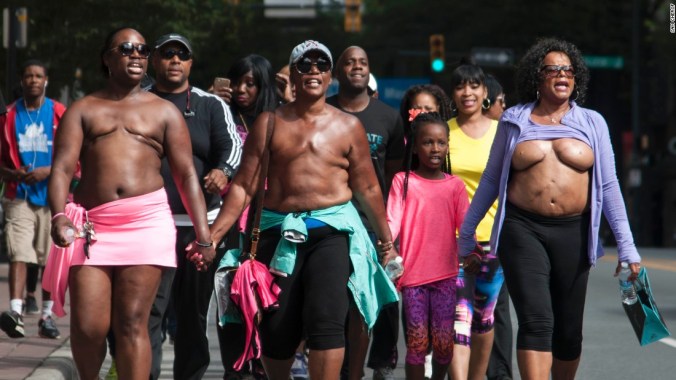
Glenn Logan took off from the post about Paulette Leaphart’s self-promoting breast cancer awareness 1,000-mile walk and CNN reporter Jessica Ravitz’s strangely equivocal exposé to muse on the toxic influence of social media. It’s a great post, as usual for Glenn, and I’m especially grateful because I’m behind on posts today but I have an ethical obligation to watch the Red Sox Opening Day game. (Pirates-Red Sox tied 0-0 in the 5th.)
This is yet another social media-driven disaster. We have proven ourselves unable to handle the medium, either as consumers or producers of content. In the grand scheme of things, social media has probably been the vehicle for more scams, dissociation from the real world, submersion into self-congratulatory alternate reality, fake news, and general mayhem than any innovation in my memory.
I have occasionally referred to Twitter as “the Devil,” and my loathing for Facebook knows no bounds. I still use it once a week or so just to check on friends and family (for which it is at least useful), but 99% of my input to Facebook consists of “Happy birthday, (first name here). Many happy returns” or to message Jack a link. No Luddite I, as I have been using the Internet since the early 1990’s Usenet days, and Linux as my primary operating system since 1997, so technology and I are old, old friends.
But the temptation of social media to generate attention in the name of good causes is, to me, the lesson here besides the obvious ethical wreckage caused by “the ends justify the means.” Many of us see the apparent benefits of fame, and want our 15 minutes of it very badly, usually for entirely selfish reasons. When we can achieve that in the name of a good cause, it becomes all the more insidious as a rationalization for otherwise self-serving and dishonest behavior. Continue reading →
At one point, profiling the double-mastectomied Paulette Leaphart’s 1,000-mile walk from Mississippi to Washington, D.C….topless…CNN reporter Jessica Ravitz writes,
“If even one woman’s life was saved thanks to a conversation Paulette started, wasn’t that enough? So what if our hero was flawed?”
Oh, no: the “just one child/just one life” rationalization again! (Which, I now notice, isn’t on the Rationalizations List, and it should be.)
Ravitz writes this to begin a long, detailed, infuriating narrative about the well-publicized and much-hyped crusade of Leaphart, whose journey, displaying her scarred chest, was to ostensibly demand more funds for cancer research cure and better and more affordable health care. She said she was a champion for women without breasts “to believe in their beauty and be proud of their strength.”
“By showcasing and embracing her scars, she hoped to inspire others to do the same,” Ravitz writes. “Her journey was bold, visual, moving. It offered a hero to admire and, given Paulette’s audacious decision to walk shirtless in the face of strangers, a rich spectacle to witness. It spoke to African-American women, who face the highest breast cancer mortality rate. It inspired legions of survivors. And it spoke to many who’d lost someone to the disease.”
Ravitz is conflicted, clearly, as she tells the complicated story of the woman whose official cause is admirable, but whose motives are murky, and whose credibility is non-existent. While explaining the mounds of evidence she uncovered that the woman has a record of deception, venality and financial flim-flam, that she sees the long walk as a ticket to fame and cash, and that she has lied and fabricated aspects of her ‘inspirational story” repeatedly while the efforts of journalists to pin her down. Yet Ravitz still ends up by being wishy-washy and equivocal:
“There’s no way to measure how much of a difference Paulette Leaphart made in shaping the conversation about cancer in this country. She touched many minds and hearts, but whether she did so in the most honest and transparent way remains questionable.”
What? There is nothing questionable about whether Leaphart has been honest and transparent—she hasn’t. Ravitz documents her deceptions impressively. She lied about her cancer treatment. She lied about her eligibility for Medicaid and financial resources. She lied to a documentary team that had arranged to follow her, leading them to end the relationship. She lied on her Facebook page, representing her health travails by using the experiences of a friend. Her unguarded comments suggest that she began the walk as a way to make money for herself as well as research. She accepted contributions under false pretenses. Yet the journalist still seems to want to say that all of this doesn’t matter, if some good resulted from it: Continue reading →
Do you still wonder how and why beloved Penn State football coach Joe Paterno and his superiors contrived ignorance while child predator Jerry Sandusky was using their facilities to trap his defenseless young prey? If so, you have a definitive answer in the recent statement of Penn State trustee Albert L. Lord, in an e-mail to The Chronicle of Higher Education. that he’s..
“Running out of sympathy for 35 yr old, so-called victims with 7 digit net worth. Do not understand why they were so prominent in trial. As you learned, Graham Spanier never knew Sandusky abused anyone.”
Spanier is the dismissed Penn State president who was convicted of one count of child endangerment last week for his handling—non-handling, really— of complaints about Sandusky. The verdict was correct: Spanier, like Coach Paterno, intentionally failed to investigate repeated claims that Sandusky was molesting young boys on campus, because he didn’t want to know if the allegations were true, That would have endangered Penn State’s beloved football program, which meant more to him, and obviously Paterno, than crime, truth, education, or harm to innocent children. Spanier probably was certain the Penn State board would endorse his priorities. Based on Lord’s jaw-dropping message, it still might.
Some of the victims of Sandusky, Penn State, and the tactical apathy of Paterno and Spanier have “seven figures” because Penn State is estimated to have paid out about $93 million to more than thirty Sandusky victims over twenty years. Lord—a moron— seems to think they got the benefit of the bargain. After all, what’s a little sexual molesting when you’re ten? Hell, he’d take a little diddling for three million bucks! Who wouldn’t? Go Nittany Lions!Continue reading →
Once again, a Hollywood film has political correctness furies attacking its casting. This time, it’s the sci-fi “Ghost in the Shell,” starring Scarlett Johansson.
The sad fact is, movie makers can’t win. If a black actor isn’t cast to play a white character in the source material, Hollywood is engaging in bias by eschewing “non-traditional casting,” which is necessary to remedy de facto segregation and prejudice in movies. If Charlton Heston is cast as a Mexican, as in “Touch of Evil,” it’s “whitewashing”—prejudicial and racist casting of whites to play non-whites. Of course, when Morgan Freeman, an African American, is cast to play a dark skinned Semitic character in “Ben Hur,” nobody calls that “blackwashing,” for there is no such thing as blackwashing. Casting Denzel Washington as a white character from “The Pelican Brief”: great! Who doesn’t like Denzel? Casting Denzel as the white hero of “The Magnificent Seven” in the remake, when the white hero was non-traditionally cast with the sort-of Eurasian Yul Brenner in the original, was also great, because—who doesn’t like Denzel? Casting Andy Garcia, a Cuban-American, as member of the Italian Corleone family in “Godfather III” was also fine and dandy, but not the casting of sort-of Eurasion Brenner as the King of Siam in “The King and I,” (even though he won the Tony and the Academy Award for an iconic performance)—, especially with all those great Thai musical comedy stars available. So that was–what, “sort-of-whitewashing”?
All right: how about a musical conceived with the novel conceit of having the Founding Fathers played by young black and Hispanic performers? Is that non-traditional casting? Minority-washing? Is it racist to stay with the original (brilliant) concept and tell white actors they can’t audition to be Hamilton, Jefferson, and Aaron Burr? Of course it’s not racist. After all, those actors are white. Screw ’em.
Are you seeing a theme here? Neither am I. What matters in casting a play, film or writing an adaptation is whether the final result works: How well do the actors play their roles? Is it entertaining? Does it make money?
Now the casting of Johansson as an originally Japanese character in a Japanese manga comic and animated film is being attacked as racist. Whitewashing, you know. No, in fact the words applicable here are “adaptations,” “movies,” “cultural cross-pollination” and “commerce.” In this case, not always, but in this case, the accusation of “whitewashing” is pure race-baiting.
More than forty years ago, the real life German prison camp escape engineered by captured WWII British fliers was made into the film “The Great Escape.” Brits were annoyed as production got underway, however, by the presence of heroic American prisoners in the cast, the characters played by U.S. stars James Garner and Steve McQueen. This was, British critics and veterans said, an outrage: Americans had nothing to do with the real escape. The answer by the producers contained three segments:
1. We own the film rights, and can do whatever we think will make the best movie.
2. The film is fictionalized, and makes no representations to the contrary.
3. Garner and McQueen will ensure that the film makes a profit in the U.S, plus they are both great and entertaining young stars.
Good justifications all. “The Great Escape,” as we now know, is a classic, still honored the real event, and made lots of money. Somehow, British self-esteem recovered.
The Brits also didn’t complain when Japan’s great film auteur director, Akira Kurasawa, made an all-Japanese cast adaptation of “King Lear,” which is about a Celtic king. Wasn’t this–what, “yellow-washing”? Don’t be silly: all good stories can be told in myriad ways, in many cultural contexts. “Ghost in the Shell” is a science fiction fantasy. It is not about real people, and the characters were Japanese because the author and intended audience were Japanese—you know, like the original “King Lear” was in Elizabethan English.
“Ghost in the Shell” director Rupert Sanders cast Johansson as the cyborg assassin named Motoko Kusanagi in the original and renamed the character “Mira Killian.” It is the “Who doesn’t like Denzel?” non-traditional casting principle, except the even more understandable “Who doesn’t like Scarlet, especially when she looks naked for much of the movie?” variation. The perambulations of critics trying to find something racist about the most obvious box office casting choice imaginable border on hilarious. At some point, actress Johansson decided it was more lucrative and fun being the next female action movie star than starring in solemn costume drama bombs like “The Girl With The Pearl Earring” and “The Other Boleyn Girl.” Since then, she has been rising as a bankable star in blockbusters like “The Avenger” films and “Lucy.” Quick: name another hot (I mean, of course, popular and bankable) female action star?
The post about the TSA agent’s excessive “patdown” of a young boy, caught on video, prompted spirited debate with many high quality comments.
Before presenting John Billingsly’s COTD, let me note up-front two of John’s points that I disagree with. First,while refusing to follow an illegal order is mandatory, the fact that one is given an order to do something unethical—and this patdown was unethical—does not reduce the responsibility to refuse if the harm to another is clear, obvious, and objectively unjust, as in this case. Second, everyone involved in a wrongful act is accountable, from the top of the chain of command to the bottom. I also have a third and fourth, but I’ll let others cover those.
According to a report at Dallasnews.com, “Afterward, the TSA officer was instructed by his supervisor, who was observing, to complete the final step of the screening process.” My emphasis added. This suggests to me that the agent himself was going to break procedure and omit “the final step” of the screening process, which I believe to be the genital grope, until he was directly ordered by his supervisor who was there in person to do it.
I understand the “just following orders” issue per the Nuremberg Trials. It looks like he was going to disobey the order (procedure) until he received the direct order from his supervisor. I don’t think there are many low level employees who would immediately disobey a direct order of a supervisor in that situation. When you are a grunt at the bottom and your boss tells you to do things the way you have been taught to do them, it is going to be very difficult to make the decision to disobey.
This is the incredibly ridiculous United Airlines/dress code/ leggings story. I don’t want to write about it: there are no good guys, lots of miscreants, and I have a well-earned bias against United already.
Fortunately, the travel site One Mile At A Time did a thorough and ethically astute analysis, here, ending like this:
I see non-revenue passengers asked to follow different rules nearly every time I fly — you probably do too. Nothing about two non-revs being asked to change clothes and/or take a later flight is shocking or newsworthy or even interesting to anyone with an ounce of perspective.
Exactly: not even interesting. So how did this become a hot story on cable news and social media? Well..
1. Two employees of United didn’t follow company policy regarding proper dress when they fly free. They were Wrong.
2. A family behind the two employees in line and who didn’t understand what was happening leaped to conclusions, and made their daughter change what she was wearing too, completely unnecessarily. They were Wrong.
3. A prominent publicity-seeking social justice warrior, Shannon Watts, was an observer of all this, and began furiously tweeting, misrepresenting what was going on, and claimed that United was engaged in sexist and discriminatory conduct, when it was not. She was Wrong.
4. United’s Twitter team responded by referencing the §21 of the company’s Contract of Carriage, stating that passengers can be denied boarding for being “barefoot or not properly clothed”. This was confusing, since that provision had nothing to do with why the two non-revenue passengers were told to change. Typical of the crack United staff, however. Incompetent. Also Wrong.Continue reading →





Before presenting John Billingsly’s COTD, let me note up-front two of John’s points that I disagree with. First,while refusing to follow an illegal order is mandatory, the fact that one is given an order to do something unethical—and this patdown was unethical—does not reduce the responsibility to refuse if the harm to another is clear, obvious, and objectively unjust, as in this case. Second, everyone involved in a wrongful act is accountable, from the top of the chain of command to the bottom. I also have a third and fourth, but I’ll let others cover those.
Here is John Billingsley’s Comment of the Day on the post, From The Ethics Alarms “Res Ipsa Loquitur” Files: Now THAT’S An Unethical TSA Patdown: