So…Carl Bernstein Really Thinks President Trump Is Innocent Of Collusion With Russia After Telling Us For A Year That He Is Guilty. Nice.

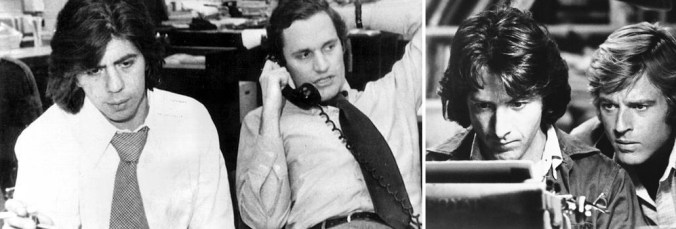
A bad month for Carl Bernstein: first the film Bernstein, Dustin Hoffman, is revealed as a sexual predator, and now the real one is revealed as a lying partisan hack.

Brava to Ann Althouse for catching this.

I’ll let Ann describe her own scoop…

I was stunned by this amazing slip this morning on CNN’s “State of the Union.” The moderator Dana Bash had this question:WOODWARD: You have to look at the crimes.

[T]he investigation has been going on for over a year, at least in the Justice Department, the FBI. We still don’t know about any evidence that the president knowingly colluded with Russia. Does that give the president’s claim that this is a witch-hunt some credence?

Bernstein’s answer:

“He believes it’s a witch-hunt. There’s no question he believes it’s a witch-hunt.”

What?! The only way that Bernstein can make those assertions about what Trump believes is if Bernstein is sure Trump is not lying. Trump knows what he did with respect to Russia, but he’s saying it’s a witch-hunt. Trump’s saying that it’s a witch-hunt could happen if: 1. He knows there’s nothing there (i.e., Mueller is searching for for something, like a witch, that doesn’t exist), or 2. He’s worried about something that he did and he wants to hide it. Bernstein’s remark excludes #2. But Bernstein doesn’t have access to the inside of Trump’s head, so why did Bernstein say that? I’d say Bernstein, on his own, knows that there’s nothing there, and he blurted out an answer without thinking about what he was saying about what’s in his own head.

Continue reading →

Morning Ethics Warm-Up, New Years Day, 2018: The Year On Ethics Alarms, The College Sports Scam, And A Poll That Is Less Than Meets The Eye

1 Stats and things. For the first time, Ethics Alarms had less traffic than the year before, down almost 10%. I was expecting at least a 10% jump, so this is disappointing, though I probably should have seen it coming. The 2016 campaign drew a lot of interest to the site, and that year was a major jump from the previous one. The blog ends the year with more followers than it had at the beginning, and the number of comments were up over 2016. I would also say that the quality of comments was dramatically better, with the most Comments of the Day ever.

The post that had the most comments in 2017 was a COTD, in fact: Comment of the Day: “Morning Ethics Warm-Up, 11/13/17: Rushing In Panic Around My Boston Hotel Room Because I Didn’t Get My Wake-Up Call Edition” with 324, among the most ever.

The author? Zoltar Speaks!

It’s just vanity and ego to worry about traffic fluctuations. I’m competitive by nature; it’s a flaw. I’d love Ethics Alarms to have sufficient name recognition and exposure to have a measurable influence in public discourse, but that’s always been unlikely, given the subject matter. What I should care most about, and do, when I’m being rational, is that the discussions here are uniformly of high quality, avoid the idiotic “Yeah, well what about Bush, you repug?” back and forth threads of most websites, and that there is a daily colloquy here that I can be proud to host. Besides, if Ethics Alarms were widely quoted, I’d have to put up with being called a “self-proclaimed ethicist” more often.

I also banned far fewer commenters this year than last year. That’s a good thing.

Next to the search engines and WordPress, the most referrals came through the Washington Post and the New York Times. The Althouse blog sent more readers here than any other blog, which is nice, especially since Ann still doesn’t bother to include me in her blogroll.

Not counting stand alone pages, like the About page and the Rationalizations List, the top viewed posts in 2017 were 1) the 2016 anti Snopes post; 2) the 2013 workplace ethics post, 3) “Wanetta Gibson is Worse Than I Thought” (2014); 4) the initial VW scandal post from 2015;  5) the 2015 post about ventriloquist Jeff Duham’s marital problems (Don’t ask me why; it’s a mystery); 6) the Listerine and alcoholics post from way back in 2010; 7) the Foundation for a Better Life post (2011); 8) The anti-“What Would You Do?” post, also from 2011, and it is depressing that the thing is still being broadcast; 9) finally a 2017 post, The Naked Teacher Principle, Ex-Porn Star Variation, and 10) also from last year, my take-down of Sally Yates.

That last was also the first politics-related post to turn-up on the list, which tells you something, though I’m not sure what. The Ethics Alarms post that I have most linked to in 2017 was buried deep on the list at 136: 2015’s, A Nation Of Assholes: The Ultimate, Undeniable And Crucial Reason Donald Trump Must Never Be President.

As in every year, I think, none of the posts that I thought were the most important or my best work were among the most read.

Thanks to all the readers and commenters who have made this past year a rewarding and challenging one.

Next year will be even better.

2. While you watch those Bowl games, think about this...College sports critic Mike McIntire explains the absurd status of big money in college sports in his article, “The College Sports Tax Dodge.” An excerpt: Continue reading →

Ethics Quote Of The Month: Times Columnist Bret Stephens

“Of all sad words of tongue or pen, the saddest are these: it might have been…” Wait, WHAT?

“Tax cuts. Deregulation. More for the military; less for the United Nations. The Islamic State crushed in its heartland. Assad hit with cruise missiles. Troops to Afghanistan. Arms for Ukraine. A tougher approach to North Korea. Jerusalem recognized as Israel’s capital. The Iran deal decertified. Title IX kangaroo courts on campus condemned. Yes to Keystone. No to Paris. Wall Street roaring and consumer confidence high.

And, of course, Neil Gorsuch on the Supreme Court. What, for a conservative, is there to dislike about this policy record as the Trump administration rounds out its first year in office?

That’s the question I keep hearing from old friends on the right who voted with misgiving for Donald Trump last year and now find reasons to like him. I admit it gives me pause. I agree with every one of the policy decisions mentioned above. But I still wish Hillary Clinton were president.”

—-New York Times Bret Stephens, in a column titled “Why I’m Still a NeverTrumper”

Stephens, since joining the Times left-heavy columnist stable as its token wishy-washy cnservative, has been occasionally perceptive, often incoherent, and obviously conflicted. In this case, he is ethically confused.

I wrote the equivalent of this column in the post called Roger Simon Says The NeverTrumpers Owe The President An Apology. Well, He’s Not Getting One From Me…(Mine was also better, and I wasn’t paid for it.)

Like Stephens, I do not regard Trump’s largely successful first year (by his own standards, and certainly by the standards of those who predicted a national catastrophe) sufficient to bring me to retract my original objections to Trump. I wrote,

“Competent and responsible leadership is not only made up of what a leader does, but how he does it. How Donald Trump operates as President is divisive, obnoxious, politically self-destructive, undignified, chaotic and scary, just as I expected. This conduct, which is entirely a product of his character deficits and near complete lack of interest in ethical values, does harm far beyond the benefits any policies he may advance that I agree with, or that are improvements over the mess left by Barack Obama. He is, day by day, week be week, diminishing that strength and credibility of the Presidency by lowering it to his thuggish, crude, juvenile level. He is also provoking his opposition and the news media to lower themselves to his level or lower, doing further damage to our democracy.”

This essentially what The Times columnist is saying when he writes, Continue reading →

More Comment Of The Day Weekend… Comment Of The Day (4): “An Ethics Alarms Holiday Challenge! Identify The Rationalizations, Logical Fallacies, Falsehoods And Outright Errors In This Essay…”

Luke G ends this  Comment of the Day writing,   “Hm, that was longer than I expected, but what’s a good analogy if you can’t follow it through to the end?”

He’s right: it’s an excellent analogy for the value of freedom of speech, and one I don’t recall having encountered before.

Here is his COTD on the post, An Ethics Alarms Holiday Challenge! Identify The Rationalizations, Logical Fallacies, Falsehoods And Outright Errors In This Essay Advocating Limits On Speech…?

This argument is a clash between two viewpoints. For those of us who value free speech, the structure and procedure are immutable, and the outcomes proceed from there. We see free speech, along with the various other liberties guaranteed in the US, as an intrinsic part of a free and open society. The freedoms themselves have intrinsic value, and the national culture that rests on them is a SIGN that they are good, rather than the REASON they are good. Rich soil is healthy and good, whether it’s growing anything or not- we don’t say good soil is useful because of the beans it grows, we look at the beans as proof that we chose our soil well. The fact that rich soil also allows weeds to spring up is an unfortunate side effect.

For those like the author of the article, their outcome is immutable, and the procedure to get there is malleable depending on their goal. Their worldview defines what outcomes are good or bad- structures that produce bad outcomes are bad structures, and those that produce good outcomes are good structures. These people see cultural cause and effect not like a field but like a factory, where there’s no such thing as a good machine that makes some good and some bad parts… if it produces any bad parts it’s a bad machine that should be upgraded or eliminated at the first opportunity so only the desired product is created. Universal free speech may have been the best machine available, but now there is the perceived power to fix it so only the desirable speech is free and the defective speech is suppressed, so it’s only logical to do so. Continue reading →

Morning Ethics Warm-Up, 12/31/2017: The Too Many Year Ending Ethics Issues To Handle In One Day Edition

Happy New Year!

1 Arrgh! In an op-ed called “Higher Ed’s Low Moment, Farnk Bruni bemoans the fact that colleges “found themselves on the defensive.” Citing the Pew Center’s findings that I discussed here, he writes of declining opinions about the value of college,

“That’s not so surprising, given Americans’ intensifying resentment of anything that smacks of elitism and given Republicans’ attacks on science and intellectuals. As Ron Daniels, the president of Johns Hopkins University, recently told me, “Even if we were completely unblemished in the way in which we pursued our mission, it would be hard to imagine that in Trump’s America, we wouldn’t be targets for scorn.”

Incredible. (Or, as my late, schizophrenic cousin Trefon would say, “Umba!“, as in “Umbelieveable!” I always found that funny, and I would love to see his slang word enter the popular lexicon. Trefon was a great kid who had a short, empty life, and ended it by jumping off an overpass into an oncoming truck. It would be nice if he left some enduring contribution to the culture, even if it was a silly one.) No, the reason so many Americans no longer think college is a wonderful thing is that they can see and hear. Students aren’t being educated. Graduates have minimal knowledge of history, literature, government and culture. They can’t write, and they can’t argue. Their professors get on social media and issue things that would destroy trust in any institution that employed them.

The campuses are increasingly hostile to free speech, free thought, democracy, capitalism and the United States of America. None of these factors penetrate Bruni’s biases and conventional wisdom. He keeps repeating the mantra that caused me to resign from an education board many years ago: ” a college degree is one of the surest harbingers of higher earnings and better economic security.” That’s how college has been regarded as a reflex for a century now, and the policies that followed that starting point–a degree,  means jobs and money—have created the sick system in which students who are not qualified to attend college are accepted anyway, and tuition has soared to obscene level., all while the actual content of the curriculum and teaching have become an afterthought. It’s the diploma that matters!

No, it’s the education. Bruni says, ” [T]he continued competitiveness of the American economy depends on the skills of our work force, the intellectual nimbleness of our citizens, the boldness of our scientific research and the genius of our inventions. Our colleges and universities are central to that.”  If getting as many people diplomas as possible is the mission, however, seeking “intellectual nimbleness” is obviously an afterthought.

This emperor has no clothes, and hasn’t had for a long time. The disturbing development isn’t that so many conservatives have finally realized that the golden ideal of an American college education no longer comports with reality. It is that so many opinion makers and policy makers hold on to that ideal when it is so evidently false. If college degrees don’t prove that  graduates have core knowledge, writing and critical thinking skills, then they are  just high-priced tickets to be incompetent.

And they don’t. Continue reading →

It’s A Comment Of The Day Weekend! First Up…Comment Of The Day (3): “An Ethics Alarms Holiday Challenge! Identify The Rationalizations, Logical Fallacies, Falsehoods And Outright Errors In This Essay…” AND, In Related News, Another Bakery Gets Slammed In Oregon

I’m not exaggerating: I have at least four Comments of the Day stacked up on the Ethics alarms runway after this one, and there are usually COTDs arriving on Saturdays. I can’t promise to get all of them up today, especially since I’m hacking away at the 2017 Ethics Alarms Awards, and this is a long working weekend at ProEthics. Still, I will get a lot of them to you, and it’s a provocative group, as you will soon see.

But first, a prelude and some context.

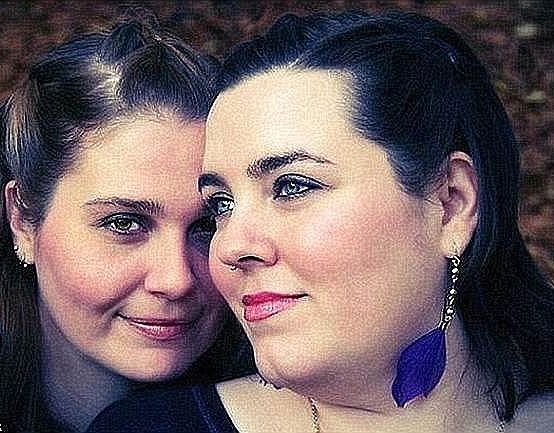
An Oregon appellate court this week upheld a ruling against the owners of the since-closed Sweetcakes by Melissa,  Aaron and Melissa Klein, forcing them to pay emotional-distress damages of $135,000 to Rachel and Laurel Bowman-Cryer, a lesbian couple for whom they refused to design and sell a wedding cake almost five years ago. The Klein’s argued that state Labor Commissioner Brad Avakian violated state and federal laws and their rights as artists to free speech, their rights to religious freedom and their rights as defendants to  due process.

The Oregon court ruled that the Kleins’ argument that their cakes entail an artistic expression is “entitled to be taken seriously,” but it’s not enough for the couple to assert their cakes are pieces of art:

“Although we accept that the Kleins imbue each wedding cake with their own aesthetic choices, they have made no showing that other people will necessarily experience any wedding cake that the Kleins create predominantly as ‘expression’ rather than as food.”

This mess commenced  when Rachel Bowman-Cryer went to the suburban Portland bakery with her mother in January of 2013. When Aaron Klein was told that the wedding did not involve a male partner,  he said that the bakery did not make cakes for same-sex weddings. They left, but soon the mother returned to argue with Klein as Rachel sat in the car, weeping. her mother went in to speak with Klein. The mother told Klein she had once thought like him, but having two gay children forced her to see the error of her ways.  Klein retorted with Leviticus: “You shall not lie with a male as one lies with a female; it is an abomination.”

The complaint and action by Oregon’s Bureau of Labor and Industries followed. You can read the opinion here.

Ugh.

This case is even worse than the one currently before the Supreme Court, discussed here. Continue reading →

Morning Ethics Warm-Up, 12/30/2017: Is Robert Mueller Biased? Are The Patriots Cheating Again? Is Larry Tribe Deranged? Is President Trump A Robot?

Good Morning!

(Nothing better than waking up to a light dusting of snow!)

1 When you can keep your head when all about you are losing theirs…Alan Dershowitz, a Democrat and legal expert who has prominently avoided the ravages of anti-Trump mania that have crippled so many of his distinguished colleagues, tried to clarify several issues in the Mueller investigation on Fox News.

On Special Prosecutor Mueller personally and professionally: “I don’t think he’s partisan, I don’t think he cares whether the Democrats or the Republicans benefit from this.I think he’s a zealous prosecutor and if he were going after Hillary Clinton, he’d be going after her with as much zeal.”

On his investigative team: “Now that’s not true for some of the people on his staff. He should never have allowed these people to serve on this investigative staff, if they had the points of view that they’ve had towards Hillary Clinton and towards Donald Trump. That was a mistake…when you’re going after a president or a presidential candidate, you have to be ‘Caesar’s wife,’ you have to be above reproach, and he didn’t do a good enough job in vetting the people that he brought on to the prosecution and the investigative team, and that hurts his credibility.”

Correct, and obviously correct. So why is the White House and Fox News being criticized daily for questioning the legitimacy, fairness, objectivity, and independence of the investigation? It doesn’t matter if Mueller is personally fair and objective if he appoints biased and conflicted lawyers to do the work. That still means the investigation is compromised and untrustworthy. It also means that Mueller undermined the investigation exactly the way he could not afford to if he wanted its results to be accepted.

There is nothing inappropriate about those being investigated pointing out bias, incompetence and conflicts of interest by the investigators. Criticism of a legitimate complaint, backed up by facts, indicates that those critics  don’t care about bias, incompetence and conflicts of interest, if they lead to the result they crave.

2. Suspicion! Why would the NFL’s New England Patriots sign a washed-up, 39-year-old Pittsburgh Steelers veteran, James Harrison, with only one game left in the regular season, at a cost of about $60,000 for that game and for any play-off games the Patriots participate in? Harrison has barely played all season, is no longer a top performer, and was a discordant and disruptive presence in the locker room. Many sportswriters and fans believe that he is being paid by New England to be a turncoat, and to reveal  Steelers’ secrets that might provide an edge if the Patriots, as many expect, have to defeat Pittsburgh on the way to another Super Bowl. The Patriots have been caught cheating more than once. Would this be cheating?

I assume not, unless Harrison had an enforceable non disclosure clause that prohibited him from revealing Steelers plays and strategies even after he was no longer on the team. Indeed, it would be unethical for Harrison not to help his new team in any way possible. When New England signed him, they signed his body, mind and accumulated experience. Continue reading →

Ethics Quote Of The Week: Peggy Noonan

“Why does all this matter? Because we are losing history. It is not the fault of Hollywood, as they used to call it, but Hollywood is a contributor to it. When people care enough about history to study and read it, it’s a small sin to lie and mislead in dramas. But when people get their history through entertainment, when they absorb the story of their times only through screens, then the tendency to fabricate is more damaging. Those who make movies and television dramas should start caring about this. It is wrong in an age of lies to add to their sum total. It’s not right. It will do harm.”

—-Former Reagan speechwriter and current columnist Peggy Noonan, after citing the material historical misrepresentations in the Netflix series “The Crown” and the new Spielberg film, “The Post.”

I have written about the ethics of misrepresenting history in films many times, always facing the “Lighten up! It’s just a movie!” chorus. As Noonan explains deftly, the stakes are different now, in an age of rotten public education, mass media and internet indoctrination. The first time I wrote about this issue was 2010, in the post “Titanic” Ethics. It concluded in part,

I don’t blame Cameron for not basing his portrayal on evidence that only was clarified years after his film. I fault him for discounting the testimony of survivors, and misinforming the public by plastering a false version on a giant screen for millions to see, knowing that they would trust that a man who would insist that the doomed ship’s china pattern was accurate…Now the film is back, bigger than ever, and false representations of Officer Murdock, “Unsinkable” Molly Brown, the sinking itself, and other aspects of the iconic event will be embedded even deeper into our historical understanding. It didn’t have to be that way, and it is wrong that it is. History, the public, and the 1500 who died that night in 1912 deserve better.

I’ve seen “The Crown,” and like it a lot. The portrayals that Noonan complains about, however, especially the suggestion that Jack Kennedy abused Jackie, rang false immediately. As for “The Post,” which I haven’t seen, Noonan calls out a misrepresentation of a cultural villain whom the film-makers probably thought nobody would rise to defend: Continue reading →

Comment Of The Day (2): “An Ethics Alarms Holiday Challenge! Identify The Rationalizations, Logical Fallacies, Falsehoods…”

Well, still more Comments of the Day on this post turned up today, so I better get cracking. The first one is here. Next up is adimagejim‘s excellent comment that focuses on the concept of hate speech. But first, I want to give a special honorable mention to Aleksei, who was the only reader to follow the terms of the challenge as issued, which was to identify the rationalizations used by  Noah Berlatsky in his Essay That Will Live in Infamy. 

Aleksei perused the Ethics Alarms Rationalizations List and properly identified these:

1. “Everybody does it”
1A. “We can’t stop it”
13. “It’s for a good cause”
13A. The Road To Hell
23. “I’m just giving the people what they want”
27. The Victim’s Distortion
28. “These are not ordinary times”
29A. The Gruber Variation
30. “It’s a bad law/stupid rule”
31. “Ethics is a luxury we can’t afford right now”
35. “Better late than never”
48. “Haters gonna hate”
51. “That’s in the past”
57A. “If it save just one life”
58. “I’m all right with it
59. “It’s the right thing to do”

I’m still waiting for the logical fallacies. Obviously Noah employed “appeal to authority” (I am pretty sure that a law professor or two can be found to stand for just about any proposition, no matter how bizarre), “the ends justifies the means” (speaking of Nazis!), the “straw man,” and “post hoc ergo propter hoc.” I have to confess: I don’t want to linger enough on this piece of offal long enough to do a definitive analysis myself. Reading it makes me angry—oh not the article itself: stupidity doesn’t make me angry. What I find infuriating is that NBC would give it the legitimacy publication as a “thought experiment,” leading others as weak-minded as its author to give his arguments the same level of  credibility he gave to the addled professors.

Here is adimagejim‘s Comment of the Day on the post, An Ethics Alarms Holiday Challenge! Identify The Rationalizations, Logical Fallacies, Falsehoods And Outright Errors In This Essay Advocating Limits On Speech…:

To be just and transparent, self-proclaimed conservatives such as George Will in his doctoral thesis defends the notion of excluding others, like Nazis, from the formal political process due to their explicit seeking to undermine or eliminate the constitutional rights of others. This is not classically liberal thought nor does it appropriately defend the rights of political minorities, as abhorrent as they may be.

The problematic issue is the notion of hate speech itself. Who is to determine what is and is not hateful speech? Who is to codify it? Who will enforce it? Who will adjudicate it? Who will pronounce the types of sentences for it? It is apparent those advocating for hate speech regulations wish to be all of the above. And, again, by the annals of their thoughts, move the goal posts of right and wrong, illegal and legal as they see fit.

Proponents of this kind of thought advocate for the notion of those they view as currently empowered as the only people capable of doing harm and therefore are one crucial step closer to conviction in the kangaroo court of their minds.

Has anyone seen what are proposed to be microaggressions by the hate speech law proponents? It is both amazing and unintelligible. Your job as the allegedly empowered is to unceasingly bow to the offended for offenses committed by you by your existence.

The result of all this would likely be an intellectual, if not actual, concentration camp. A camp to be run by erstwhile comic book editors.

Ethics Observations On Pew’s “17 Striking Findings From 2017”

#1Partisan divides dwarf demographic differences on key political values. The average gap between the views of Republicans and Republican-leaning independents and Democrats and Democratic-leaning independents across 10 political values has increased from 15 percentage points in 1994 to 36 points today. Two decades ago, the average partisan differences on these items were only slightly wider than differences by religious attendance or educational attainment, and about as wide as differences across racial lines. Today, the partisan gaps far exceed differences across other key demographics.

I attribute this ominous development to both parties crossing previously observed lines of appropriate political tactics and rhetoric, picking at the seams that hold our society and democracy together. The GOP-advanced Whitewater investigation of the Clintons’ financial shenanigans began the criminalization of politics. President Clinton’s arrogance and recklessness as a sexual predator placed Democrats in the position of defending unethical conduct especially repugnant to conservatives, and the furious (and dishonest) efforts of both Clinton and Democrats to deny the legitimacy of his impeachment drove the parties further apart.

The essentially tied election of 2000 came at the worst possible time, but Democrats made its wounds to public comity worse that they had to be by using the false claim that the election was “stolen” to energize its base for years. The rise of hyper-partisan leaders in the House and Senate—Gingrich, Pelosi, McConnell, and worst of all, Harry Reid—continued to poison discourse.  The Iraq War fiasco, a Republican mistake, and the false Democratic mantra “Bush lied…” in response to it exacerbated the divide. Then the bi-partisan botches that led to the 2008 crash were widely attributed only to Republicans. Spurred by the prospect of a black President, the news media, always heavily tilted leftward, abandoned large portions of its ethical values to be an unapologetic cheerleader for the Democratic candidate, because having a black President elected would be so darn wonderful for everybody. Thus did the media fully embrace “the ends justifies the means” as an operating principle/

The inevitable racist response of a minority—but a vocal one—in conservative and Republican circles to the prospect of a black President caused further division, and Obama’s alliance with an openly racist Reverend Wright caused more racial polarization. Once elected, President Obama could have healed much of the damage since 1994 (as he promised to do) , but instead he chose to leverage divisions among races, genders, ages, classes, gays and straights, and legal and illegal immigrants for political advantage. His supporters, meanwhile, including those in the news media, began using accusations of racism to smother and inhibit legitimate criticism. Obama broke with Presidential tradition by repeatedly blaming his predecessor for problems he proved unable to solve, keeping partisan resentment hot.

Even with all of this, Obama could have healed much of the accumulated partisan antipathy if he had been an effective leader. He wasn’t. In contrast to his predecessor he was an effective (though over-praised) communicator,and in marked contrast to the current POTUS, he played the part beautifully, and that’s not inconsequential. The rest, however, was an ugly combination of misplaced priorities, incompetence, laziness, racial bias and posturing, with awful results. This hastened the divide, because Obama’s core base, the African American community, was inclined to view him uncritically no matter what he did. As other groups called out the President on his failings, that group’s loyalty and bias drove it, and allied groups, into defensive, knee-jerk ideological opposition, as the growing power of social media exacerbated hostility between the ideological polls.

Obama’s divisive administration, rhetoric and poor governing habits begat Donald Trump.

And here we are. Continue reading →