The “I Have A Dream” Speech Ethics Train Wreck

Dr. King's familiy says this was a "performance" not a speech. Funny: I thought he was just speaking the truth. I guess I was dreaming.

Take Martin Luther King Day, turn right at the “Stopping Online Piracy Act” (SOPA/ PIPA) protests, and you get to the ridiculous fact that you are breaking the law anytime you circulate a recording or video of the Martin Luther King’s immortal “I Have A Dream” speech.

Through a baroque combination of expediency, legal maneuvers, luck and greed, this vital part of American thought, rhetoric, culture and history is restricted by the copyright laws, and will not be in the public domain until 2037, or more than 70 years after King’s words were spoken in front of the Lincoln Memorial. Now, under SOPA/PIPA, if it passes, any educational website that includes a video of the King Video could be taken down by the Feds, but that’s a side issue. I am no expert on the bill, but you can brief yourself on what all the fuss is about here, here, here, and here, the bill itself. Similarly, if I tried to explain the legal process by which courts agreed that a critical chapter in American history should be unavailable to Americans unless they pay a fee, it would 1) bore you stiff, 2) confuse you, and 3) probably be wrong. So I recommend this post by Alex Pasternak over at Motherboard, who does a great job laying out the whole, tortuous, tragic story.

I’ll concentrate on the ethics train wreck feature, of which the basic elements are these: Continue reading →
Creating Captain Costanzas

Metaphor

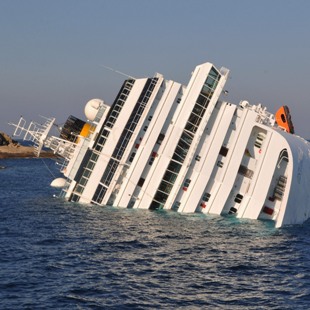
I think I stopped finding George Costanza funny when I saw the “Seinfeld” episode in which he panicked at a kids party after smelling smoke and trampled the children rushing to be the first out the door. (His callous reaction to his fiancée’s death from licking envelopes had paved the way for my inability to laugh at George.) The thought of a real-life George Costanza, the most unethical character on a show about unethical characters, serving as the captain of an imperiled ship full of passengers is horrifying, but that’s basically what befell the unsuspecting tourists on board the cruise ship that tipped over after hitting a rock off the coast of Italy. Having caused the accident, it appears, by irresponsibly changing course, captain Francesco Schettino hit the life boats before most of his passengers, and claimed to be directing the evacuation from the relative safety of a lifeboat as he defied orders from the Italian Coast Guard to return to the ship. Continue reading →

Mitt’s Gift

South Carolinian Ruth Williams says she was praying for divine guidance as to how she would pay a late electric bill when she found herself in the crowd around the Mitt Romney campaign bus. When she told the Republican presidential front-runner about her plight, he reached into his wallet and handed Ruth around $50 to help her keep her power on.

That bastard!

He only did it for the publicity, of course. (Though there were no cameras present.) Or he did it to show he was better than her. Romney gave her the money because he’s such a rich SOB that it was throwing crumbs to a peasant. Yesterday on CNN, a Democratic operative cited the incident as proof of how out of touch Romney is with the needs and feelings of regular Americans. After all, she said, he just carries all this cash around with him—it was like his betting Rick Perry that $10,000. (Williams says Romney emptied his wallet and gave him everything he had. Wow…the tycoon carries 50 bucks around.)

Over on MSNBC, where every act by a Republican is evil personified,  guest Joy-Ann Reid, a blogger for theGrio.com, was furious; she said that the hand-out proves Romney is a racist. Continue reading →

Ethics Quote of the Day: Drew Curtis’ Fark

Mitt Romney is not a player.

“The stupid tax just doubled.'”

—Drew Curtis’ Fark, in a typically perceptive jibe, at the announcement by Powerball officials that in order to increase the attractiveness of the multi-state super-lottery, it will be raising the levels of jackpots, lowering the odds against winning, and to make more money, doubling the cost of a ticket.

Fark. com was a guilty pleasure before I started an ethics blog, but is now a daily assignment, as Drew Curtis’s clever link collection where he simultaneously uncovers interesting news items and attaches one-line jokes to them has proven to be a rich source of ethics stories.

The various lotteries are all unethical, as state governments too cowardly to pass taxes on those who can afford it duck their duties by enticing the desperate, the poor, the  gambling addicted, and, as Fark correctly notes, the stupid, to spend money they should be saving or spending on necessities. Their foolish objective, nourished by state promotions, is to buy a remote chance at a life-changing stroke of luck—which, statistics say, is more likely to ruin their lives than to fix them. The original argument for these cynical and degrading devices was that they would balance state budgets and improve the schools. You can see how well that is working out.

So, times being tough, the biggest government pocket-picking scheme of them all,  Powerball,  is trying to suck in more people who shouldn’t be playing and who are grossly irresponsible to waste their money, while charging them more to do it. It’s unfair to have a tax on being stupid—being stupid in the 21st Century costs too much already.

But Fark is right. That’s exactly what Powerball is.

Recent Race Card Rankings: Trying Out The Knight Scale

I can see Michael Moore from here!

Ethics Alarms recently proposed the Knight Scale, a way to rank attempts to play the race card or otherwise accuse politicians, satirists, writers, pundits and others of racism in order to silence them, ruin their credibility, or score cheap political points in the media. The Knight Scale was made possible by blogger Christopher Knight, who somehow managed to find a cartoonist’s substitution of Michelle Obama for Marie Antoinette ( as a commentary on the First Lady’s ill-timed–some say—taste for lavish parties and social activities) in a famous painting. Despite the fact that the French queen was not, to my knowledge, black, Knight somehow found this to be blatant racism, thereby establishing the tippity-top of the Knight Scale: you just can’t come up with a more far-fetched, unfair, factually indefensible accusation of racism than that. With that outrageous complaint as a 10, the most outrageous, where would other, necessarily lesser bogus racism claims rank?

Let’s look at last week. From here on, we can count on an ever-increasing number of Knight Scale candidates, since an African-American President  presents such an irresistible temptation for unscrupulous race-baiters, and the entire Obama Administration is seemingly conditioned to cry race bias whenever criticism get hot, so consider this a trial run: Continue reading →

Saluting the GOP’s Most Ethical Candidate, Distrusted For Doing the Right Thing

We'll miss his daughters, too...

Jon Huntsman is gone, finally quitting the hunt for the Republican Presidential nomination long after the futility of his quest had been established. Huntsman was easily the ethics favorite in the competition, though Ron Paul’s candor and integrity also get high marks. He began his campaign with a call for civility, and seldom missed the high standard he set out for himself. Best of all, he correctly identified the ethics core of our nation’s various problems: the trust deficit. Huntsman began hitting this theme hard in Iowa, but perhaps not hard enough. The collapse of public trust in all our institutions is a very real threat to our democracy, for democracy, more than any government philosophy, requires trust to survive. Whatever it is that Republicans want right now, however, trust isn’t very high on the list, and neither is civility. Continue reading →

Ethics Hero AND Ethics Dunce: Secretary of the Interior Ken Salazar

U.S. Interior Secretary Ken Salazar scores a rare twin honor: He is an Ethics Dunce and an Ethics Hero in the same week.

Occupier, or just a vistor, Mr. Secretary?

First the good news, the Ethics Hero part.  Salazar has given the National Park Service  30 days to fix the inaccurate, misleading and truncated quotation on the Martin Luther King Jr. National Memorial. He did this after giving the inept King Memorial Foundation plenty of time to do its job. It didn’t, and he took the initiative. Harry Johnson, president of the Foundation, told the AP he wasn’t sure what changes could be made. Well, how about using a real quote instead of a made-up one that makes Martin Luthor King sound like a preening Newt Gingrich?

Chiseled into the monument’s left flank because there wasn’t room for the actual quote is “I was a drum major for justice, peace and righteousness.” What King really said in a 1968  speech was: “If you want to say that I was a drum major, say that I was a drum major for justice. Say that I was a drum major for peace. I was a drum major for righteousness. And all of the other shallow things will not matter.” When Maya Angelou and others complained that the pompous-sounding non-quote make King sound like a boasting egotist (and one speaking from the grave!), the Foundation shrugged and erected the monument unchanged. Continue reading →

A Ban on Threatening “Spiritual Injury”: Unconstitutional But Ethical?

There you go, Bill, letting people be unethical again...

Eugene Volokh, a First Amendment  provocateur, notes that Minn. Stat. Ann. § 211B.07 makes it a gross misdemeanor to

“….directly or indirectly use or threaten force, coercion, violence, restraint, damage, harm, loss, including loss of employment or economic reprisal, undue influence, or temporal or spiritual injury against an individual to compel the individual to vote for or against a candidate or ballot question.“

The professor opines that the spiritual injury part, at least, is unconstitutional. Interesting.

Prohibiting the interference and manipulation of a human being’s rights of autonomy and self-determination by using threats to compel his voting choices is a legitimate area for the law, because ethics is notoriously inadequate at preventing electoral abuses. It is also an area where the law is an especially blunt instrument, and many conceivable violations of § 211B.07 would seem to risk colliding with free speech. “If you don’t vote for Ron Paul, I’ll never speak to you again!” comes to mind. The threat of “spiritual harm”—“Vote for Mitt Romney, my flock, or I condemn you to Hell!” adds the  free exercise of religion to the mix, particularly when the threat is linked to a position of a candidate that violates religious doctrine.

I have no difficulty concluding that any and all threats to force a citizen to vote according to another citizen’s desires are wrongful and damaging to democracy, and should be condemned and discouraged to the maximum extent possible. Ethical though such prohibitions may be, some, like the use of threatened spiritual injury, are impossible under the Bill of Rights.

So threatening to send someone to Hell if they vote for Newt Gingrich—a reasonable result, when you think about it—is unethical, but a law punishing that threat is unconstitutional.

Sorry, Ethics…looks like it’s all up to you!


The New York Times Asks: “Should We Be Truth Vigilantes?” Ethics Alarms Answers: “No, Because You Can’t Be Trusted.”

Should Times reporters be like Wonder Woman's lasso of truth?

In an appeal to New York Times readers that is at once alarming, naive, arrogant and ominous, Arthur Brisbane, the Times’ “public editor” (Translation: ombudsman) asks whether the paper’s reporters should be “truth vigilante(s)… should challenge ‘facts’ that are asserted by newsmakers they write about.”

The answer is no, no, no, and for the obvious reasons. Times reporters are biased, and not inclined to challenge dubious statements they agree with or that come from political figures they like, and are inclined to find statements “non-factual” because of their own preferences and biases. Helpfully, the two examples cited by Brisbane are exactly the kinds of statements the Times, and most of the press, are completely incapable of handling fairly. Here’s the first: Continue reading →

Romney, Firing, Leadership, and Ethics Bob’s Lament

Yes, yes, firing people is one thing Donald Trump does well too. Shut up.

Ethics Bob Stone sent in a comment late last night that I replied to, but that I think deserves more discussion, on several points. Responding to my Ethics Hero designation for Ron Paul for coming to his adversary’s defense over Romney’s now infamous remark about firing people, Bob wrote:

“…I think Romney’s “I like to fire people”–even taken IN context–displays an inner heartlessness. I know about creative destruction, and I myself have taken actions to lay off people, and even fired a couple face-to-face. I did what needed to be done. No apologies.

“But did I like it? I HATED it.

“Romney’s comment seems of a kind with his strapping the family dog on his car roof for a 500-mi trip, or his advocacy of breaking up families to deport the parent or child who’s illegal. Gingrich was right.”

There are several issues here, some minor. Continue reading →