Hi everybody! It’s time to play everyone’s favorite play-at-home ethics quiz show,
“Icky or Unethical?”
…where you, the audience, have to decide whether our guest’s conduct is truly unethical, or just so disgusting, strange or creepy that it just seems like it!
Ready to play? Great! Let’s all welcome our special guest, Dr. Michael Niccole, founder of the CosmetiCare Plastic Surgery Center in Newport Beach, California! Thanks for being here, doctor! Now let’s show our studio audience and those playing at home what you have done to bring you to the show! Here it comes:
“Dr. Niccole gave his daughter Brittani breast implants when she was just 18. He also gave her a nose job. Dr. Niccole performed surgery on his other daughter, Charm,* to turn her “outtie” belly button into an “innie ”when she was 10. Now that both daughters are 23, he regularly gives them Botox injections to prevent wrinkles as well as performing other cosmetic procedures on them!”
All right, there you have it!
Show that picture of Brittani, Don Pardo!
What a lovely young woman! You sure did right by her, Doc! Hubba-hubba! And now, it’s time to answer:
Is Dr. Niccole’s work on his daughters just icky, or is it unethical? Continue reading →
I thought about a lot of possible headlines for this post. “Most Muddled Ethics Statement of the Century” was a real contender. I thought about making it an Ethics Alarms quiz, with the plaintive query,“Can anyone please tell me what the heck Paul McCartney thinks he is saying?” And, yes, I thought about skipping the story completely, as I am not eager to rattle the cages of the zealous pot enthusiasts, several of whom bombarded me, my business and my wife with vicious and threatening e-mails last week.
But this cannot pass without comment. Paul McCartney has given an interview to Rolling Stone in which, among other things, he announces that he is giving up smoking pot as a responsible father of an eight-year-old girl.
“I did a lot, and it was enough,” the co-writer of “With a Little Help From My Friends” (“I get high with a little help from my friends…”) and “Lucy in the Sky With Diamonds” tells the interviewer. “I smoked my share. When you’re bringing up a youngster, your sense of responsibility does kick in, if you’re lucky, at some point. Enough’s enough – you just don’t seem to think it’s necessary.”
This is completely bewildering. Is Paul saying he’s had his fill, and now that he has, come to think of it, it’s irresponsible to smoke pot? Is he expressing regret? Continue reading →
Not an hour had passed since I posted my lament about small incidents being blown up into national controversies, and suddenly a perfect Ethics Quiz presented itself on the same trend, from a pre-school yet, just as in the lunch police flap. This one is a tempest in a tea cup, except instead of a tea cup the tempest is in a teeny, tiny beer stein, made out of plastic, that was given to 4-year-old Braden Bulla to represent Germany. His class was studying various countries and their culture, and the teach gave out little plastic artifacts as part of the lesson.
I’m not even sure it qualifies as a stein; it looks exactly like a creamer I’ve had forever. But it was clearly supposed to represent a stein. The children drank apple juice out of these as they learned about Bavaria. When Braden brought the 2-3 inch plastic thing home, his mother was furious. She told the school and reporters that it is irresponsible to have students pretend to drink alcohol, even if it is apple juice. “It is entirely inappropriate,” Bulla said. She argued with the teacher and principal, and then pulled her child out of the pre-school. Naturally, someone asked Mothers Against Drunk Driving to get into the act, and they complied, while noting that they couldn’t be authoritative without having been in the classroom. “We would say this: MADD is concerned anytime that a minor is involved in any activity that centers around alcohol consumption,” a spokesperson said. “Even in a case like this one, when there is no actual alcohol.”
So your Ethics Quiz for the day is a multiple choice question:
What best describes the Case of the 4-Year-Old’s Beer Stein? Continue reading →
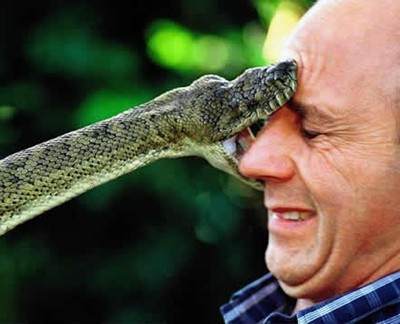
"Heck, sure, pal, I'll suck the venom out of your face--what's that? You were bitten WHERE????"
Irish tourist Jackson Scott was engaged in a necessary bodily function while vacationing in the Australian outback, when he was bitten—on the testicle. The biter was a tiger snake, and its venom can be fatal.
Panicked, Scott begged his camping companion, Roddy Andrews to suck the venom out. Roddy, however, said, “Ewwwww!”
Also, “No.”
But he drove Scott in a race against time to the nearest hospital, where doctors administered an antidote in time, barely, to save Scott’s life. Continue reading →
Whitney Houston, she of the musical gift we may see only once in a lifetime, is dead at 48. There has been no final determination, but there is little doubt: drugs killed her.
Houston, they say, and I have no reason to doubt it, was troubled by the pressures of show business, celebrity and stardom, and with a little help from her dead-beat, abusive husband, singer Bobby Brown, sought to relieve the stress with a variety of illegal substances, including cocaine. Over the past 15 years or so, Americans have been able to watch the relentless deterioration of Houston, once the epitome of a beautiful, intelligent, ebullient and charismatic presence, into an emaciated, ruined shell with only a hint of the glorious instrument that once, in the middle of a war abroad, delivered the most stirring rendition of the Star-Spangled Banner I have ever heard, or ever will hear.
This happened to Whitney Houston because when illegal drugs were among the options she could have chosen to accept or reject as a way to get through difficult days and troubled times, she did not have the instant reaction, hard-wired in her brain, that has to stop all of us from doing terrible, dangerous, irresponsible and anti-social things. There can be little doubt that some theoretical options would have triggered that reaction. They would be the options that did not seem like options at all, because the culture Whitney Houston lived in was unequivocal and unshakable in its verdict, a verdict virtually all members of that culture naturally adopted and accepted—because that’s what cultures do. And when that option presented itself, Whitney Houston, like the culture she was a part of, would have said “No.”
That she didn’t say no to drugs, and is dead because of it, was the direct result of an American culture that does not give its constituency a clear message and verdict. Instead, the clearest and most unequivocal signal from the culture, the fact that recreational drugs are illegal and that America enforces the laws against them, is progressively weakened by ridicule, attack, popular culture, and the defiance or hypocrisy of role models and public figures. Incredibly, though the deaths by drug-abuse among the tiny proportion of the world that is famous and talented—Michael Jackson, Amy Winehouse, Whitney—should make it obvious how massive the number of anonymous victims of drug abuse there must be, the destructive refrains grow louder: Legalize drugs! End the War on Drugs! And those calls weaken the cultural resolve further. Actually doing what they advocate would cripple it….and that day might come.
Whether they are preventing the culture from rejecting drug use because enforcement is expensive, or because they have a relative or friend in prison for drug-dealing; whether they are calling for legalization because they are libertarians and academics or Ron Paul, or because they are public officials who see a new revenue source; whether they are longing for the halcyon days of Haight-Ashbury and the Strawberry Alarm Clock, or just like getting stoned, these are the people whose advocacy continues to nurture a competing culture that killed Whitney Houston, as surely as if she had been shot her between the eyes.
I would say that if their insistence on legalization is followed, and the nation’s laws join the popular throng in pronouncing addictive and life-destroying drugs as legitimate “options,” many more like her will die….except there aren’t many more like her. But there are countless lives to destroy, and unimaginable losses to families, businesses and America to be endured.
I just watched the video of Whitney Houston’s glorious performance of our National Anthem at the Super Bowl, before the drugs had finished their work. She radiates confidence, strength and character, as well as that special joy that the fortunate few with magical gifts have. She brings a stadium full of Americans to their feet in cheers, with an exhibition of artistry that will continue to inspire forever. Drugs took all of that away, from Whitney Houston and from us.
Because our culture could not say no with enough conviction to save her.
Update (2/15/12): With some regret, I am closing comments on this post. Too many commenters refused to discuss the issue it was intended to raise, which was how cultural approval and disapproval of conduct is more powerful, ultimately, than the law in establishing standards. I have committed on this blog to responding to as many comments as possible, but the onslaught of pro-drug zealots whose tactic was to keep repeating the same arguments no matter how many times I gave my response led me into too many frustrated responses, too many nasty exchanges, and too many hasty replies that I wish I had stated more clearly. For those I apologize, both to the visitors involved and other readers. I also apologize for ending the discussion here, but I don’t have the time to monitor it. You are welcome to e-mail me personally.
Interested Blogger, or “IB,” makes some interesting observations about professional ethics enforcement generally and medical ethics in particular in the Comment of the Day, responding to the post, The Legal Profession’s Muddled Standard For “Fitness To Practice.” Her insight regarding the reasons why professionals are so reluctant to pull the licenses of misbehaving colleagues is astute, I think. Lawyers and doctors are hesitant to punish individuals for doing something they could imagine themselves doing, though the Golden Rule is being misapplied. It’s a disturbing thought, but an illuminating one: perhaps John Edwards keeps his law license because other male lawyers think, “Boy, that could happen to me: get smitten by some hot babe in the office, we fool around, she sandbags me on birth control…heck, I might panic. I might try a crazy scheme to cover it up, especially if it was all going to be played up in the tabloids. Poor guy! How can we disbar him?”
Actually, this is just a cartoon of the former Congresswoman from Erie, but then a Toon could have cast a vote for a bill without reading it too.
Former Democratic congresswoman Kathy Dahlkemper, a Catholic from Erie, Pennsylvania, voted for the health care mega-law in 2010. Now she says she would have never voted for the bill had she known that the Department of Health and Human Services would require all private insurers, including Catholic charities and hospitals, to provide free coverage of contraception, sterilization procedures, and the “week-after” pill .
In a press release sent out while the HHS ruling was still pending, the pro-life Dahlkemper said,
“I would have never voted for the final version of the bill if I expected the Obama Administration to force Catholic hospitals and Catholic Colleges and Universities to pay for contraception,. We worked hard to prevent abortion funding in health care and to include clear conscience protections for those with moral objections to abortion and contraceptive devices that cause abortion. I trust that the President will honor the commitment he made to those of us who supported final passage.”
The Christian Soldiers are on the wrong side of this argument.
A controversial rule, announced last month as part of President Obama’s health-care overhaul, requires religiously affiliated colleges and hospitals to provide female employees the full range of contraceptive coverage, including contraceptives, the “morning-after pill” and sterilization services. The measure has Catholic Church-run institutions up in arms over a system that would force them would to offer plans that contradict their teachings. Catholic bishops have been leading the growing criticism of the rule, distributing letters and other materials for distribution to millions of worshipers. Talk radio is abuzz with talk of Obama’s escalating “war on religion.” Even the Washington Post editorial staff criticized the move.
As for simple-minded me, I don’t think this is an especially difficult problem from an ethical point of view. Politics? Practicalities? Culture wars? Yes, those are all extremely difficult considerations in this argument, but they are also not my proper realm. The ethics are clear.
Unlike the 26 U.S. Senators who are unethically abusing their positions by presuming to demand that an independent non profit organization expend its funds according to their interests, I am not going to tell the board of the Susan G. Komen Foundation how to pursue its mission…because as with the Senators, it is none of my business. Ethics is my business, and the full-blown ethics train wreck surrounding the Foundation’s decision to end its substantial financial support of Planned Parenthood has been created by dishonesty, misrepresentation and a lack of fairness from all directions.
Here are some unpopular ethics truths in this fiasco. Continue reading →
“Soul Train” creator and pop culture icon Don Cornelius took his own life at 75 yesterday, using a gunshot to the head to do it. Suicide always conjures up feelings of special sadness for the deceased, sometimes mixed with anger. The act can be cruel and devastating to family members and friends; often it leaves behind crushing problems, financial and otherwise, that the living have to deal with. Suicide is stigmatized in our culture as a coward’s way out of earthly problems; many religions consider it a sin, and many legal systems consider suicide a crime. Yet it may be that American culture will have to undergo a major cultural transformation in the matter of taking one’s own life. While morality tends to ossify, ethics is fluid and adaptable. Changing conditions and new realities can, in rare circumstances, cause societies to conclude that what was once considered right is really wrong, and what was once condemned as wrong is in society’s best interests. I think we may reach that point with suicide. Continue reading →







 Ethics Alarms