Ethics Quiz: Apologies For A Sandusky Joke?

My uneasy relationship with the TSA continues.
Yes, I've sunk so low that I actually seek this out...

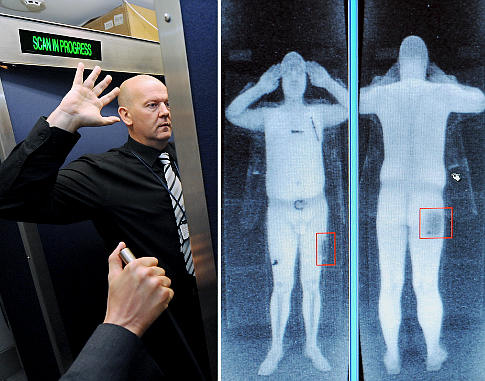
Today I was returning home from Atlanta, and its monster of an airport has one the cattle pen systems for going through security–a long, ling, line to all gates that keeps dividing and dividing, ultimately sending you down one of about 20 chutes to be scanned, stripped and yelled at. It is difficult to pick your chute, but in my case, it is crucial: Atlanta doesn’t have the full-body scanning devices in every line, and without it, I get gated, beeped, and sexually molested, thanks to my artificial hip.

It took ducking under a couple of barriers, but I finally got to an x-ray conveyor belt near a scanner, and had removed my laptop (separate bin) belt, jacket and shoes (not allowed in a bin in some cities, allowed in others) and lined them all up with my bag and brief case when an agent (none too politely) told me that they were closing that line, and directed me to another one, two lanes over. I lugged the three bins, bag and brief case over to that line, only to discover that it didn’t have a scanner.

That did it. I erupted at one of the agents, telling her that I did not care to be felt up at 8 in the morning, thanks, and had made a good faith effort to direct myself to a scanner, being foiled by the agent and by the fact that there are no signs warning people like me where a testicle massage is the only option.

“Why aren’t there signs?” I asked.

“I don’t know. There should be,” she said, as she helped me move my stuff to a scanner accessible line. “You should write the TSA and the airport.”

I laughed bitterly. “I’m sure that will do a lot of good. Do you all jsut like feeling up passengers? Is that the reason?”

A woman behind me laughed and said, “It sure seems like it!”

“Well, you know,” I said to her, “I hear Jerry Sandusky is trying to get a job as a screener!”

Her guffaw was interrupted by 7’8″ TSA agent, who said, loudly, “No he’s not, and I’m offended by that statement.”

My response, after a second’s consideration, was this: “I’m sorry I offended you. But I’m not apologizing.”

Your ethics quiz of the day: Should I have apologized? Continue reading →

Not That It Will Do Any Good To Say So, But U.S. Acceptance of Prison Rape Is An Ethics Outrage

LOL?

I keep an informal score each television season of how often one of the heroes in a cop or other law enforcement drama will pointedly tell a finally-cornered criminal that he can now look forward to being raped in prison. Of course, this is only representative of the shows I actually see. Even counting only them, however, I have heard such a speech four times in 2011. (The all-time champs in this celebration of prison rape are Dick Wolf’s Law and Order dramas.)

Think about what this means. The scriptwriters are presuming that such a forecast of impending sexual abuse will be enjoyed by the audience, a case of just desserts for the wicked. The casual acceptance of prison rape in America’s penitentiaries is a continuing scandal, and an indictment of our society’s compassion and commitment to the Constitution. Continue reading →

“Excuse Me, Sir? You’re About To Die” Ethics

I had a strange experience as I was leaving a plane a couple of weeks ago.

A distinguished-looking man, older than I, tapped me on the shoulder, and said, “I apologize for the intrusion, but I have been sitting behind you, and I noticed that your earlobes have clear creases in them. This is a sure sign that you either have heart disease or will have it, and are at risk of a heart attack. I just thought you should know.”

Now, as it happens, I know about the supposed link between heart attacks and earlobe creases, and even asked my cardiac specialist about it. He said that 1) some studies had found a statistical link; 2) no study had proposed any good reasons for the link, if there was one; 3) it wasn’t worth worrying about; and 4. one can only address the cardiac risk factors that can be changed, and one can’t change the creases in one’s earlobes. Continue reading →

McDonalds, Germs, and the Zealot

Be afraid. Be very afraid.

Erin Carr-Jordan went to a McDonald’s with her children this summer, and was horrified by the condition of the restaurant’s play area. The professor of child development then set out to shame the McDonald’s into cleaning up, posting a video she made showing her findings and the lab results of samples she took, showing a space teeming with pathogens and bacteria.

McDonald’s corporate finally got into the act, agreeing with the mother and explaining to the Los Angeles Times that the conditions were “unacceptable, completely unacceptable … but not reflective of our business and our restaurants” and that the company had “immediate corrective action to thoroughly sanitize the PlayPlace.” That might have qualified as a victory for most moms, but not Prof. Carr-Jordan. She began a full-fledged crusade, investigating McDonald’s and other fast food restaurants in 11 different states in recent months to test them for cleanliness. These were her family vacations: “Kids, forget about Walt Disney World. We’re going to spend the next three weeks going to  filthy fast food joints!”  What fun. She swabbed  at each location and sent the samples off to a microbiology professor who analyzed the samples and usually stated his results as “OH—MY—GOD!!!!” Continue reading →

Getting Scrod* in Boston: The Ravages of Seafood Fraud

“Why, certainly that’s a red snapper, sir! Just came off the boat today!!”

If there is an opportunity for profitable dishonesty that nobody is paying attention to, the overwhelming likelihood is that it will flourish to the point of becoming standard practice.

Isn’t that discouraging? I hate to write that sentence, as I hate to think or accept the conclusion behind it. Yet when I come upon a topic like seafood fraud (or fish fraud), it is hard to deny.

The Boston Globe just published the results of a wide-ranging, five-month investigation into the mislabeling of fish in the Greater Boston area and other parts of Massachusetts. The shocking results showed that Bay State consumers:

“…routinely and unwittingly overpay for less desirable, sometimes undesirable, species – or buy seafood that is simply not what it is advertised to be. In many cases, the fish was caught thousands of miles away and frozen, not hauled in by local fishermen, as the menu claimed. It may be perfectly palatable – just not what the customer ordered. But sometimes mislabeled seafood can cause allergic reactions, violate dietary restrictions, or contain chemicals banned in the United States.

“The Globe collected fish from 134 restaurants, grocery stores, and seafood markets from Leominster to Provincetown, and hired a laboratory in Canada to conduct DNA testing on the samples. Analyses by the DNA lab and other scientists showed that 87 of 183 were sold with the wrong species name – 48 percent.” Continue reading →

Herman Cain’s Unethical Abortion Doubletalk

Republican presidential contender Herman Cain’s explanation of his position on abortion while chatting with CNN’s Piers Morgan is causing his growing legion of fans and supporters discomfort, and with good reason. It was ethically incoherent at best, unethical at worst. In either case, his comments show that he hasn’t devoted sufficient serious analysis to the issue to allow him to have a responsible and consistent approach. That is status quo for most Americans. It is not acceptable for a President of the United States.

Here is the relevant section of the interview (emphasis mine):

PIERS MORGAN: Abortion. What’s your view of abortion?

CAIN: I believe that life begins at conception. And abortion under no circumstances. And here’s why —

MORGAN: No circumstances?

CAIN: No circumstances. Continue reading →

Genome Sequences, Consent, and Scientist Ethics

What...you don't trust this guy???

Few things are scarier than when scientists start debating ethics.

A current debate in the scientific community involves whether it is ethical to publish your genome sequence without asking permission from family members. It is increasingly common for people to pay to have their genome scanned for the presence of traits, including genetic diseases. Scientists agree that releasing this information without the permission of the individual whose genes are described would be a clear ethical breach. The controversy involves whether an individual is ethically obligated to get consent from family members before publishing his or her own genome sequence, since to some extent that means publishing theirs as well.

The argument proceeds from the unauthorized release of someone’s genome sequence by a third party to the plight of an identical twin whose sibling wants to publish his own sequence, which, of course, also describes his twin’s.  This is ethically clear too: it would be wrong not to seek permission. But what about the rest of the family? Continue reading →

Stacy Crim, Ethics Hero…and the Hardest Choice

Last week in Oklahoma, Ray Phillips fulfilled a promise to his sister Stacy, taking home from the hospital 5-pound Dottie Phillips, born prematurely in September, to become the newest member of his family.  Stacy died last month of brain cancer, just three days after holding her infant daughter for the first and only time. Dottie was able to come into the world only because Stacy, 41, had made the choice to reject chemotherapy for her rapidly spreading cancer that was diagnosed after she learned that she was pregnant.

When life places one of us in a “Sophie’s Choice” dilemma like Stacy’s, no one has standing to question or challenge whether the ultimate choice is “right.” There is no right choice. Stacy was faced with deciding whether to sacrifice the unborn child she had never met, a child whom many in America choose to regard as a neither a life or a being with any individual rights, but rather only as an ephemeral potentiality made of cells, similar to a pay-off at the races or a stock dividend. Even those who take the opposite view, that Dottie was a human life even at the earliest stages of her development in the womb, would never assert that a mother would be wrong to choose life-saving cancer treatments for herself at the risk of the unborn child. In such a case the right to choose is nearly unanimously accepted, and it is the hardest choice of all. Continue reading →

Ethics Dunce: The American Cancer Society

According to the Foundation Beyond Belief, a secular charity “funded by atheists, freethinkers, and humanists,” the American Cancer Society has rejected its offer to raise up to a half million dollars for cancer research through the American Cancer Society‘s Relay for Life program. The ACS declined to allow the Foundation to field a national relay team, though every other non-profit that has applied has been allowed to participate.

Talk about “beyond belief”: I have a hard time accepting this story as true, though it is being reported by respectable sources. Why wouldn’t the Society, whose mission is to help those with cancer, including helping them by finding a cure, turn down any group’s generosity, as long as its donation wasn’t going to be raised through illegal means? Bank of America, CitiBank, Goldman Sachs, Wal-Mart and other companies whose reputation is hardly without tarnish are among the ACS’s listed donors…and as we know, a lot of the people who run these companies worship Mammon, not God. Continue reading →

Abusing Stutterers: I Am Surprised and Disappointed

A prominent stutterer. She managed to be rather popular in groups despite the problem, or so I hear.

The New York Times related the story of County College of Morris student Philip Garber Jr., who stutters badly. He is also confident and inquiring, and likes to participate in class discussions, though naturally his speech problems make that process challenging for him, his teachers, and his classmates.

One instructor, an adjunct professor named Elizabeth Snyder, simply refused to call on him, and informed him that his stuttering was disruptive, and to keep his questions to himself or write them down. He reported this to the Dean, who told him that he should transfer to another class.

What? Continue reading →