 I enjoy all of Ken Burns’ documentary series, and I am grateful for them. They do a better job of teaching history than the schools, and they are always thought-provoking and, of course, beautifully executed. At the same time, I am aware of the limitations in Burns’ approach, beginning with his genre. Documentaries are inherently misleading works, more misleading in the hands of some, like Michael More, than others. The sifting of which material to use, how to balance issues, choices of photographs and film footage and even the inflections of voice betrayed by narrators (To his credit, Burns has all of his narrators deliver their script in the exact same measured and deliberately-paced tones; I found myself wondering how many times Burns forced “Prohibition” narrator Peter Coyote to listen to previous Burns stand-ins David McCullough and John Chancellor in “The Civil War” and “Baseball” until he sounded as much like their clone as they sounded like identical twins) unavoidably slant the final product, sometimes unintentionally, but usually with a motive. To the extent that viewers realize this, it is an ethical medium, but for most, especially those unfamiliar with the subject matter and with no independent knowledge to draw on, it is not.“Prohibition,” Burns’ latest PBS series that debuted last week, has a more obtrusive agenda supported with more dubious logic than his previous documentaries, reminding me, at least, that his historical conclusions should always be taken with a measure of skepticism. Continue reading
Health and Medicine
1. Now THAT’s Unethical 2.Yuck! 3. Is There Hollandaise With That?

From his pants to your mouth
Details of a hostile work environment law suit from the Courthouse News service:
“A sous-chef at Morton’s of Chicago in Boca Raton claims managers encouraged employees to sexually harass one another, and that the kitchen high-jinks endangered the public, as one worker would “place stalks of asparagus inside his underwear, next to his anal/genital area in order to simulate his penis,” then would “serve that asparagus to Morton’s unsuspecting paying customers.”
If the plaintiff is making that up, he is spectacularly malicious, and also has a future writing Farrelly Brothers screenplays. If he is not making it up, I may never eat asparagus again.
The Media Pundits’ Bigoted Preemptive Attack on Chris Christie

THIS seems to be a logical method for choosing a President.
Democrats and progressives are apparently terrified that a Republican will enter the presidential race who isn’t a religious zealot, a libertarian ideologue, a political tyro, a Mormon or a Texan, but a charismatic governor of a big northeastern state who is pragmatic, credible and successful. That would be Chris Christie, Governor of New Jersey, who may be about to throw his hat in the ring. So the word has gone out to the media, or the media is just sufficient trained to protect Democratic presidents without further instruction, that it needs to define Christie before the American public has a chance to form its own opinion, and the definition it has arrived at is fat.
You know, fat. As in Rush Limbaugh fat, fat like the political cartoonist Herblock always drew lobbyists and “Big Business.” Diamond Jim Brady fat; fat like Sydney Greenstreet, the villain in all those Humphrey Bogart movies. Fat means bad; fat means lazy; fat means unhealthy, and ugly. Fat people consume more than their share, and are disproportionately responsible for global warming and soaring health care costs, don’t you know. They have no self-control; they don’t have self-respect. We dread being stuck next to one of these porkers in an airplane. You can’t trust fat people. That’s really all you need to know about Chris Christie. This is America—we worship beautiful people. Fit people. Thin people….like, say, President Obama. Do we want to be led by someone who is fat? Of course not! Continue reading
Law, Ethics, and the One-legged Baby Who Never Should Have Lived But Is Glad He Did

It's a wonderful, wrongful, life. Wait..what?
A Palm Beach County jury has awarded $4.5 million to couple Ana Mejia and Rodolfo Santana in an unusual “wrongful life” lawsuit. Their child Bryan was born with only one limb, a leg, and their lawsuit on his behalf alleged that Dr. Marie Morel and OB/GYN Specialists of the Palm Beaches Hospital botched an ultra-sound procedure that should have detected the abnormality.If it had accurately told them what Bryan would be like, they argued, they would have had him aborted.
The jury-awarded damages will cover prostheses, wheelchairs, operations, attendants and other needs it is assumed that Bryan will have during his estimated 70-year life. “It will give piece of mind to these people that no matter what happens to them, their son will be all right,” Mejia’s attorney told the jury.
The legal issues are interesting; the ethical issues more so. Continue reading
Wolf’s Question and the Ethical Answer

"Upon reflection, perhaps failing to buy health insurance was a mistake..."
Wolf Blitzer’s question to Rep. Ron Paul at the CNN/Tea Party Express Republican debate in Tampa, Fla. has received most of its publicity because of the idiotic response it elicited from the audience, or some of it. That is good fodder for the Tea Party-slimers, but it was the query itself that raised the most interesting ethical issue.
What should happen, Wolf asked, when a healthy 30-year-old man who can afford insurance chooses not to buy it, and then goes into a coma and needs intensive care for six months? Ron Paul, true to his libertarian soul, muttered unhelpfully that we should all take responsibility for ourselves, which is true, but non-responsive. Blitzer followed up: “But, Congressman, are you saying the society should just let him die?” (This is where the barbarians at the gates added their bloodthirsty shouts of “Yeah!”)
Slate’s Jonah Goldberg has written about what he calls the three possible options available to American society to handle the comatose slacker: Continue reading
NOW Do You Get It, Bachmann Fans?

Bachmann finally jumped it, as we knew she would!
When I called Rep. Michele Bachmann unethical for her repeated uses of erroneous information in her speeches—announcing that the Battle of Concord occurred in New Hampshire, declaring the Founders spent their lives fighting slavery (and later justifying this whopper by saying that Founding Father’s Son John Quincy Adams qualified as a Founding Father himself), the Bachmanites were furious. “Anyone can make a mistake!” they argued.
Not these kinds of mistakes. As I wrote in July: Continue reading
The Worst Humanitarian Award Winner of the Year
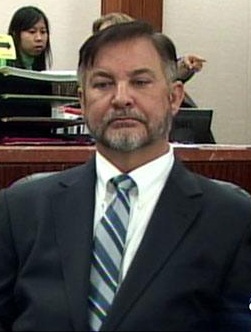
Michael Brown---wife-beater, humanitarian.
Michael Brown founded Houston’s Brown Hand Center, which specializes in the treatment of carpal tunnel syndrome. He is now on trial for assault, after being arrested last year for attacking his his wife, twisting her arm behind her back and, among other things, hurling his 2010 Joanne King Herring Humanitarian Award at her.
I have often thought that those who give out humanitarian awards for specific instances of good conduct have an ethical obligation to make sure that recipients conform to the definition of “humanitarian” in their overall conduct. One of the definitions of humanitarian is “ethical.” Official pronouncements that an individual is ethical can be very effective false advertising for the character of someone who is anything but. Mr. Brown illustrates my concerns.
By 2010, when Brown received his award, he had already pleaded no-contest in 2002 to aggravated assault for beating then-pregnant wife, Darlina Brown, with a bed post. Call me a stickler, but I think there should be an automatic “Beating a pregnant woman with bedpost” disqualification provision for humanitarian awards. Then, in 2006, Dr. Brown’s medical license was revoked after he tested positive for cocaine use. So to summarize, at the time he was deemed worthy of the honor of being the 2010 humanitarian of the year, Brown was already an admitted wife-beater and an ex-doctor found unfit for the continued practice of medicine.
What a guy!
How about a rule that if you try to kill someone with your humanitarian award, it is automatically revoked?
Too strict?
Unethical Quote of the Month: Canadian Judge Joanne Veit
 “…While many Canadians undoubtedly view abortion as a less than ideal solution to unprotected sex and unwanted pregnancy, they generally understand, accept and sympathize with the onerous demands pregnancy and childbirth exact from mothers, especially mothers without support…Naturally, Canadians are grieved by an infant’s death, especially at the hands of the infant’s mother, but Canadians also grieve for the mother.”
—- Canadian Judge Joanne Viet, announcing that Katrina Effert, who strangled her newborn child and threw the body over a fence into the neighbor’s yard when she was 19, will serve a three-year suspended sentence with no jail time for the murder, reflecting a “fair compromise of all the interests involved.”
This is a cautionary ethics tale indeed for those who deny that a callous attitude toward human lives in the womb, giving them no standing against a mother’s desires and convenience, will gradually, inevitably, coarsen and warp a culture’s respect for life and its comprehension of wrong. [Addition: Many commenters have pointed out that Canada had designated infanticide as a relatively minor crime before fully legalizing abortion. That is a strange progression, though once infanticide had been declared “understandable,” abortions days were numbered. In the US, the gradual de-valuing of young life is moving in the more obvious way, from younger to older. The process, however, is the same.] Continue reading
Unethical Quote of the Week: Nutrition Advocate Marion Nestle

"First the came for the Frankenberry, and I said nothing..."
“The intent of the First Amendment was to protect political and religious speech. I cannot believe that the intent of the First Amendment was to protect the right of food companies to market junk foods to kids.”
—- Nutrition advocate, NYU professor and blogger Marion Nestle, arguing that the government should censor advertising “aimed directly at children,” in the interests of public health.
I should not need to lay out the slippery slope perils of accepting a definition of the First Amendment’s free speech guaranty that limits its protection only to “political and religious speech.” For a professor at a prestigious university to advocate this because it would make her own pet crusade easier should send chills up the spines of every citizen. Let’s see…what kind of speech isn’t political or religious? Commercial speech…artistic speech…workplace speech…academic speech… To zealots like Prof. Nestle, all of this, as well as the liberty it bolsters, should be put at risk in the pursuit of skinnier children, by designating the government to assume the parental function of teaching good eating habits. Continue reading
Hole-in-the-Roof Ethics: If Obama Asks For Massive Infrastructure Renewal, the GOP Must Support It.
 Seldom is a solution to a problem so obvious, and so conducive to bi-partisanship. It is a solution to two problems, really: America’s dangerously rotting infrastructure, and the nation’s dismal unemployment rate. Spend the money, trillions if necessary, to repair and replace existing roads, railway beds, waterways, sewer systems, airports and bridges. It still won’t get us where we need to be, but we’ll be much better off than if we let the current deterioration continue, and we’ll save money in the long run, too—real savings, not phony health care reform savings that evaporate once reality kicks in.
There is no justification not to do this, nor is there any legitimate excuse for any elected official not to vote for it. (And no, not wanting to give the President a victory is not legitimate…or ethical, or patriotic.) Repairing the infrastructure isn’t “discretionary spending,” it is essential, unavoidable and cost-effective spending, unless it is diverted into new boondoggles and pork. No new structures, unless they replace unrepairable old ones. No light rail systems or bullet trains; what is needed is basic maintenance and repair….everywhere. It is already late, but “better late than never” has seldom been as appropriate. Continue reading

