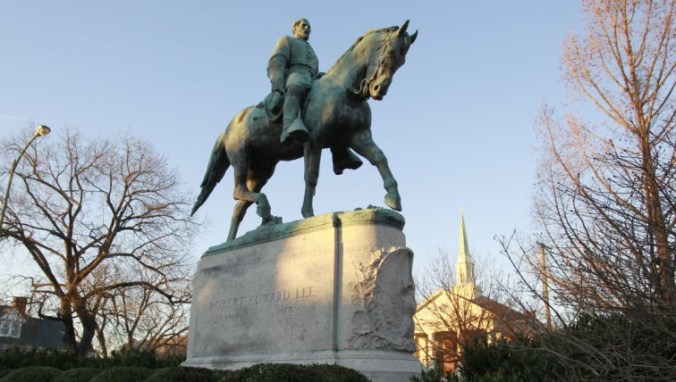
Yesterday a Virginia judge ruled that the statues of Stonewall Jackson and Robert E. Lee were removed in Charlottesville were war memorials—I would thin that was obvious—and thus were removed illegally. Gee, I guess that means that those evil, racist, white supremacists who marched to block the statue-toppling were right. Imagine that.
State law holds that only the state legislature can remove a Virginia war memorial, which seems reasonable. Illegal or not, it’s the position here that tearing down statues of historical figures whose lives and deeds may not comport with modern day sensibilities is akin to Soviet-style historical editing, a to in the water of thought-control and indoctrination, and to be avoided at all costs. As you may have noticed, I’m not giving up on this issue, because the integrity of the historical record, including the heroes of past generations, is worth fighting for. (You can review the extensive musings on this topic by clicking on the “Confederate statuary ethics train wreck” and “historical air-brushing” tags below, and by searching for “statues” and “Robert E. Lee.”)
Thus I welcome Steve-O-in NJ’s typically passionate commentary on the simplification of the Civil War into good and evil, and the denigration of Lee. Here is his Comment of the Day on the post,Morning Ethics Warm-Up, 4/29/2019: The White House Correspondents Dinner, Robert E. Lee, And The Boy Scouts:
At this point the Left has pretty much dismissed any and all other grounds for the south to fight other than slaver, saying other grounds are just bullshit to cover that. They also won’t hear you out if you disagree. A lot of them agree with Jim Wright of Stonekettle Station who said “Fuck Robert E. Lee, he was a traitor, pull down his statue, melt it down, recast it into urinals. Piss on the Confederacy.”
I don’t repost this to emphasize the angry or profane nature of what was said. There is a (limited) place for anger and profanity in life. I repost it instead to illustrate the ignorance and arrogance that have become the left’s stock in trade. Historical figures and history are properly the province of scholarship or at least of reasoned discussion. Books upon books have been written about Robert E. Lee’s life. There are books upon books about the various aspects of his life, including that fateful day at Arlington three days after Virginia seceded and two days after he was offered command of the Union Army when, after much thought, he wrote the short enough missive to General Winfield Scott, his old commander which I here present in its entirety: Continue reading



 Ethics Alarms