This would have a KABOOM! tag, but my head is all exploded out today.
But think about it as you read: Haberman has been the primary reporter for the New York Times on “Russiagate,” and she is obviously Trump Deranged, infected by crippling confirmation bias, and to be crude because sometimes crudity is called for, a total dumb ass.
New York Post reporter Nikki Schwab tweeted today, “Edelweiss” was being played as we walked into the @WhiteHouse”
The woke and culturally literate Haberman responded in horror, “Does…anyone at that White House understand the significance of that song?” Yes, Haberman, who has been crippled by the “resistance” narrative that the President is a Nazi, thinks “Edelweiss” is a Nazi anthem, because, well, see the descriptors above.
No, you lazy, biased, musical theater-challenged moron, “Edelweiss” is the anti-Nazi anthem sung by Baron Von Trapp at the climax of “The Sound of Music,” the artistic creation of two Jews, Richard Rodgers and Oscar Hammerstein, Jr. The paternal head of the singing family defiantly sings the song as a sentimental salute to Austria before the Nazi’s took over, as the Austrians sing and the Nazis scowl. It’s a scene much like the famous Marseillaise scene in “Casablanca.” Maybe Maggie also thinks the French national anthem is pro-Nazi. Why not? It’s no more ridiculous than her misunderstanding of “Edelweiss.”Continue reading →
1. Notre Dame fire ethics: Michael West, whose rare (of late) comments are valued as pearls, offered a proposed poll regarding the proper response to the destruction of the ancient cathedral’s spire. Here it is, with a few tweaks from me:
At the risk of tainting the voting, I have a pretty strong opinion about this. The structure should be left as it is. Did they repair the Great Sphinx’s nose? Did they cover up the crack in the Liberty Bell? Once a part of an ancient structure or monument us gone, it’s gone. Replacements and restorations are ersatz and deceptive. The fire is part of the cathedral’s history, and what remains should reflect it. There are far better—and more ethical– uses for the many millions it will take to restore the spire.
2. Thanks for all the kind comments in light of Ethics Alarms hitting two major milestones on the same day. In commemoration, the blog will launch a new series, Ethics Alarms Retrospective (EAR), focusing on one or more of the 10,000+ posts I have immodestly placed here, most of which even I have forgotten.
For the first installment of EAR, I offer “The Unethical Humiliation of Sister Rita X”from August 10, 2010. The topic was Sean Hannity’s practice of allowing clearly deranged progressives to have extended exposure on his radio call-in show, so he could engage in cheap mockery with the implication that they are representative of the Left generally. The comments are especially fascinating, almost all of which were Hannity fans who concocted all manner of distortions and rationalizations to justify what was the equivalent of exploiting the mentally ill for laughs. Comment highlight? This:
Again- I don’t expect you to respond- because you already said you would cut this conversation off. Again- typical lib. And I have facts. What have you got besides a hollow ideology and kool aid?
That’s me, all right: a typical lib! By the way, that (minor) post was shared 4 times on Facebook, where as the last several hundred or so have received none.Continue reading →
It’s funny: over at Ann Althouse’s blog, she’s complaining about how there’s nothing to write about. From an ethics perspective, I am finding too much to write about, especially since, unlike Ann, I still have to work for a living.
1. Quick: what does Patriots Day commemorate (and no, it’s not Tom Brady)? My home state of Massachusetts, Connecticut, Maine (which was once part of the Bay State), and Wisconsin observe the holiday, which honors the twin battles of Lexington and Concord, the confrontations with the British (on April 19, 1775, the day after “The Midnight Ride of Paul Revere”) that launched the Revolutionary War. I visited both battlefields more times than I could count when I was living in Arlington, Mass., right next to Lexington. That battlefield, what’s left of it, is in the middle of busy streets on all sides; it’s hard to imagine the scene as described in the song above from “1776.” Concord’s battlefield, in contrast, is almost exactly as it was in 1775.
All the publicity, even in Boston, about today will be dominated by the running of the Boston Marathon, but attention should be paid to the inspiring story of how ragtag groups of volunteers faced off against the trained soldiers of the most powerful country on Earth, sending the message that this rebellion would not be so easy to put down. 49 Colonists died, 39 were wounded, and five were unaccounted for. The British lost 73, while 174 were wounded,and 26 were missing.
2. It’s also Jackie Robinson Day. In every MLB game today, every player will wear Jackie’s number 42. The best way to honor Jackie for the rest of us is to tell his story to someone who doesn’t know who Jackie Robinson was, and it is shocking how many such people there are. The film “42” does an excellent job of dramatizing how Jackie broke the color barrier in baseball, simultaneously weakening segregation everywhere. The Ethics Alarms post about Robinson is here.Continue reading →
Pop quiz, Ethics Alarmers: if you worked for Nike, and learned that it was about to launch a new campaign promoting the brand’s Trail Running collection with this—“The Lost Cause…Because the lost cause will always be a cause worth supporting”—what would you do? I assume that most of you would immediately recognize that the Lost Cause, in American historical context, refers to the sentimental, romantic and troubling interpretation of the Confederacy’s defeat, in which slavery is recalled as a benevolent institution and the Civil War as a noble effort by the South to protect a civilization now “gone with the wind”—the title of the film which, coincidentally, I am watching as I type this.
Well, it was nice while it lasted. Thanks to prurient interest in a minor “Naked Teacher Principal” post, traffic on Ethics Alarms this week resembled those heady days of 2016, before ultra-Trump polarization, liberal commenter cowardice and Facebook’s ban took over. Incidentally, despite many thousand of “clicks,” the post in question didn’t get a single comment from the first-time visitors, meaning that said clicks were meaningless and useless.
1. About “Ma” Fergusen. As promised yesterday in my note about “The Highwaymen”, here is the “Ma” Fergusen saga, which is an ethics feast, though not a tasty one. (Source: Texas Politics)
Miriam Amanda Wallace (“Ma”) Ferguson (1875-1961), was the first woman governor of Texas. She served as the first lady of Texas during the gubernatorial terms of her husband James Edward Ferguson, who was impeached during his second administration for extensive corruption. When James failed to get his name on the ballot in 1924, Miriam entered the race for the Texas governorship, promising that if elected she would essentially be guided by her husband and that Texas thus would gain “two governors for the price of one.” She defeated the Republican nominee, George C. Butte, and was inaugurated fifteen days after Wyoming’s Nellie Ross, Miriam Ferguson became the second woman governor in United States history. Thus “Ma” helped set the precedent for future examples of wives being elected (irresponsibly) to offices they were not qualified for as substitutes for their husbands. “Ma” wasn’t the feminist pioneer she has sometimes been represented as. She was the opposite–you know, like Hillary Clinton.
Ma Ferguson (the “Ma” comes from her initials) pardoned an average of 100 convicts a month, and there was considerable evidence that she and her puppeteer husband were taking bribes of land and cash payments. The Fergusons also appear to have leveraged highway commission road contracts into lucrative kickbacks. Though an attempt to impeach Ma failed, these controversies allowed Attorney General Daniel James Moody to defeat her for renomination in 1926 and win the governorship. She (that is, puppetmaster Pa) was back in office in 1932, as she won the governorship again on the wave of discontent over the Great Depression.
The portrayal of “Ma” as a strong, independent executive in “The Highwaymen” would have to be judged misleading.
2. Speaking of women, sort of...An intersex hero and role model may have emerged through the dim fog of history. Scientific researchers at Georgia Southern University claim that after years of study, their examination of skeletal remains of Revolutionary War hero, General Casimir Pulaski, ‘the Father of the American Cavalry’ has revealed that he was biologically female.
Imagine if these had been George Washington’s remains… Continue reading →
I would give you all a big hug, a squeeze, and maybe a sniff, but that’s not me...
1. This is fake news, you know. Today’s headline on the Times front page: “Barr Understated Mueller Findings, Some on Team Say.” Naturally, “some” are never identified. All this headline means is that some involved with the Mueller investigation wouldn’t have summarized the report as the AG did, and some had a different opinion, and, presumably, some disagreed with them. Who didn’t assume this? This isn’t news. This is just pot-stirring and innuendo in service of a political agenda. Now if the Times’ sources went on the record and explained what findings they are referring to and why, that would be news. This isn’t.
2. Maybe just Ick, not ethics, but still, ICK! Kendall Jenner, who is famous exclusively because her half-sister sister bared all in a sex video that launched the Kardashian reality show empire, made $26.5 million for just 53 sponsored Instagram posts, according to Captiv8, a marketing firm that connects brands to “social media influencers.” Let’s see: is there anything wrong with Jenner letting companies pay her to send out social media hype? As long as she isn’t lying in her posts, I guess not...but if she becomes part of a fraud without doing her due diligence, its not just unethical, it’s illegal. Is there anything unethical about paying a narcissistic waste of space who would lose a game of Scrabble to a sea sponge millions to promote a company’s product or event? No, if it works. Is there anything unethical about trusting a barely-educated celebrity because of her looks? Unethical, no…stupid, but not unethical.
3. On the suspension of ethics during wartime. Freddie Oversteegen, who died September in her native Netherlands, was just 14 when she joined the Dutch resistanceTogether with her older sister Truus and their friend Hannie Schaft, she murdered as many Nazis as she could, using a firearm hidden in the basket of her bike. The women had a method: first approach a Naz in bars, seduce them, ask if they wanted to “go for a stroll” in the forest (wink-wink, nudge-nudge) and then, shoot the bastards, or as Freddie put it, “liquidate” them.
“It was a necessary evil, killing those who betrayed the good people,” she told one interviewer. When she was asked how many people she had killed or helped kill, she demurred: “One should not ask a soldier any of that.”
Freddie also blew up bridges and smuggled Jews out of concentration camps, so she was more than a black widow assassin. Is she justly regarded as a hero?
4. “The Highwaymen” My wife and I watched this new Netflix release starring Kevin Costner and Woody Harrelson as the real life aging Texas Rangers who were handed the assignment of “stopping” Bonnie and Clyde’s deadly rampage through Texas in 1934. We liked it a lot, but then it’s an ethics movie, raising and debating the question—see #3 above—of how far one can ethically go to fight evil. Bonnie and Clyde were evil despite their folk hero status at the time, and despite the sick glamorizing they received in the 1967 film starring Faye Dunaway and Warren Beatty, which made them the romantic rebels fighting a corrupt establishment—you know, like the arrogant creeps who shut down my college a year later.
The Highwaymen barely shows the two psychotic love-birds until they are being riddled with bullets, focusing on the real heroes of the saga, the law enforcement officials who hunted them down.
The two ex-Rangers break quite a few laws in the pursuit of the greater good, and it is odd that there seems to be a resurgence in sympathy in the entertainment media for brutal police methods. In Dick Wolf’s “Chicago PD,” for example, Sergeant Hank Voigt (Jason Beghe) regularly threatens, extorts and beats people up to solve crimes–and he’s the moral center of the show. Is law enforcement more like war than we like to admit, where the ethical rules can be, are, and maybe need to be suspended?
Best line in “The Highwaymen”: Kathy Bates, as Texas Governor “Ma” Ferguson—I’ll tell her weird ethics story tomorrow—tells reporters that she is making sure that Bonny and Clyde are hunted down, and one of them references their image as Robin Hood figures. “Did Robin Hood ever shoot a gas station attendant in the head for four dollars and a tank of gas?” she asks.
5. Now THIS is weird…Twin ethics! In Brazil, when identical male twins refused to say which one of them had fathered the child (DNA test proved inconclusive because they their were identical twins) assuming they would then be able to escape having to pay, a judge ordered that they both had to pay child support. Each twin was ordered to pay 230 reais; ($60; £45) a month, or 30% of the minimum salary in Brazil. Judge Filipe Luís Perucaalso ruled that the names of both men would be on the girl’s birth certificate.
The twins had used their resemblance to impersonate each other and date as many women as possible, and then defend themselves from allegations they were cheating on girlfriends. Ah, memories! I see a reboot coming!
But they’re irresponsible illegitimate fathers!
Identical illegitimate fathers, and you’ll find
The look alike, deny alike, they go in court and lie alike!
Picking on typos, obvious errors and botched rhetoric is the lowest form of political criticism, but the Get Trump! forces have not been able to resist, given the President’s careless tweeting, 7th grade vocabulary and addiction to hyperbole and hearsay. Now such cheap shots are considered standard fare.
Over the weekend, CNN and others made a lot of fun of Fox News for showing a chryon that stated “TRUMP CUTS AID TO 3 MEXICAN COUNTRIES.” The Fox News talking heads correctly reported the story ( about the President cutting aid to three Central American countries), but the Left’s Fox News-bashers couldn’t help themselves.
Some wrote that the error was typical Fox News ignorance. Adam Serwer, a staff writer for The Atlantic, tweeted that “this is less an error than an expression of Fox News’ underlying sentiment towards most Latinos.” RAICES, a group that provides immigrants with legal services, called it “a new low for Fox News, when we thought they couldn’t go lower.” Journalists even suggested that “Fox & Friends Weekend” needs a more diverse staff. Continue reading →
1. Why is this result considered good news? McLaughlin & Associates, a research firm, conducted a poll online March 18-25 asking the question, “Would you favor or oppose an executive order ensuring that free speech would be protected on all college campuses?” With 1,000 likely 2020 voters thus polled, the results showed 73% in favor of protecting free speech on campus, 18 % opposing, and the typical 9% of slugs who said they were “unsure.” McLaughlin and Associates found “no statistically significant difference by education level, with college graduates favoring the executive order 72 percent to 21 percent and non-college graduates favoring 74 percent to 16 percent.” Similarly, men and women both favored the executive order at a rate of 73%, and there was no significant difference by party affiliation either.
The fact that less than 75% of American citizens whole-heartedly support freedom of speech in higher education is no less than horrifying, and shows how badly the ahte speech and thought-control termites have gotten into our foundation.
2. Speaking of those inherently untrustworthy polls… a Washington Post-Schar School poll found that nearly two-thirds of registered Democrats reject special counsel Robert Mueller’s finding of no collusion between President Donald Trump’s campaign and Russian meddling in the 2016 election. It’s a “Don’t confuse me with facts, my mind’s made up!” classic, and also demonstrates how believing the mainstream news media agitprop because their biases fit neatly with yours—except you’re not paid to be objective and indep…oh, never mind. Why do I bother?—eats your brain. What in the world to these alleged (poll assertions are always alleged at best) skeptics base their beliefs on, other than the fact that, like Rachel Maddow, they so,so,so want our President to be an impeachable traitor? Mueller spent three years shaking down people and crushing them with his prosecutorial boot to get evidence of Trump collusion that would stand up in court, and failed. And those Democrats know better? Continue reading →
It would be nice if this grandstanding lawsuit engineered by professional race-baiting lawyer Benjamin Crump was summarily thrown out of court as the junk it is, but unfortunately, too many judges, when woke sentiment beckons, bend over backwards so far that they can lick their heels.
Here is the gist of it:
Tamara Lanier filed a lawsuit in Massachusetts claiming that she is a direct descendant of Renty and Delia, two slaves who were the subjects of a harsh photo session as part of an anthropological inquiry into the differences between blacks and whites. The images of the father and daughter were commissioned by renowned Harvard professor Louis Agassiz 170 years ago, and are now stored in the ancient Peabody museum on the Harvard campus. (Full disclosure: I love the place, and spent many afternoons as a kid wandering through the exhibits.) The lawsuit claims the images are the “spoils of theft,” because as slaves Renty and Delia were unable to give consent to being photographed., and that Harvard is illegally profiting from the images by using them for “advertising and commercial purposes.” By keeping the photos, the lawsuit claims, Harvard has perpetuated the hallmarks of slavery that prevented African-Americans from holding, conveying or inheriting personal property.
Observations:
I’m sure—aren’t you?— that Mrs. Laneir came up with this wild Hail Mary lawsuit all by herself. Her lawyer, as I already note, is Benjamin Crump, a legal racial shake-down artist who excels at creating public pressure that forces defendants to pay copious settlement money to his clients who often don’t deserve it. He represented the family of Trayvon Martin, and in so doing poisoned the public narrative so thoroughly that the actual facts of Martin’s death are permanently distorted in the nation’s collective memory. he represented the parents of Michael Brown, ensuring them a big pay-off because their angelic son charged a police officers and got himself shot. Ben Crump helped promote “Hands up! Don’t shoot!,” the lie that is still poisoning race-relations to this day. He’s a mission lawyer, someone who uses the law to pursue an agenda: he is to race relations what Gloria Allred is to feminism. He profits by stirring up discord, whether there’s really an injustice or not.
That doesn’t mean that some of his crusades won’t have merit. I only means that there is just cause for suspicion if he is involved.
“It is unprecedented in terms of legal theory and reclaiming property that was wrongfully taken,” Crump says. I guess that’s one way of putting it. It’s unprecedented because no previous lawyer had the gall to try such a stunt, but with Democrats and progressives beating the hollow reparations drum again, he cleverly chose a good time to take a flyer. “I keep thinking, tongue in cheek a little bit, this has been 169 years a slave, and Harvard still won’t free Papa Renty,” said Crump. Good one, Ben! Except that Renty is long dead, and a photograph isn’t a human being…
Yet give him some credit: Crump is explaining why this isn’t a technically frivolous law suit. If a litigant and the litigant’s lawyer are arguing for a new legal principle, knowing that under existing law the claim is dead, then the action isn’t frivolous. Horrible and dangerous Crump’s lawsuit is; frivolous it isn’t.
Harvard and other universities set themselves up for this by caving to historical airbrushing demands by the students they have helped indoctrinate, such as when Georgetown University established a policy giving an edge in admissions to descendants of slaves who were sold to fund the school. I would say they have this coming and let them sleep on the bed of nails their laziness and cowardice have made, but therein lies a real danger. Harvard, which of late has been devising and defending one bad progressive idea after another (like discriminating against Asian Americans as Harvard’s own way of helping African Americans get admitted to the college), might just decide to be woke rather than responsible, and let Mrs. Lanier take the photos, thus setting a precedent with endless potential to cause havoc.
I wouldn’t bet against it.
Lanier’s (that is, Crump’s) lawsuit is an extension of the Mao/Soviet Union -style historical airbrushing and re-writing tool of social change that 21st Century progressives have adopted as they march inexorably toward beneficent totalitarianism. If we don’t like the laws our ancestors put in place, let’s just declare that they weren’t laws at all. If applying legal principles that have been in place and effective for hundreds of years doesn’t assist the social change we desire, than suspend those principles. Make the law a subject to “the ends justifies the means” whenever it’s convenient.
I’m sorry to be blunt, but if you don’t comprehend the existential danger inherent in this approach, you’re an idiot.
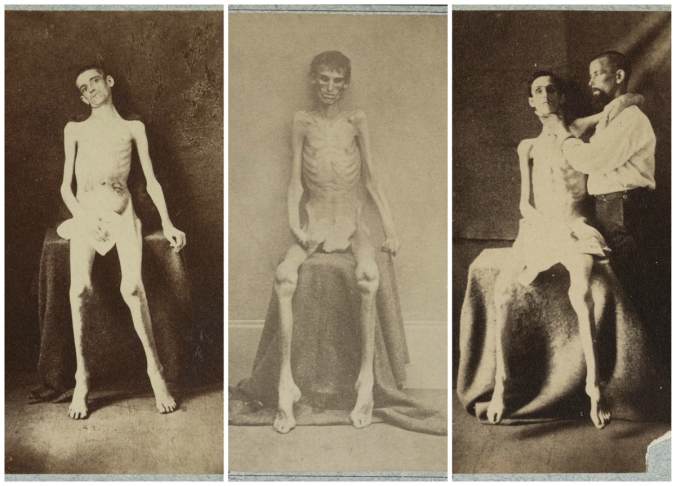
Legal problems? What legal problems? Well, let’s see: 1) Renty’s lack of consent to the photos is irrelevant, because under the laws of the time, he had no right to consent. That may be unfair, and wrong, and cruel, and horrifying, but the way society works is that laws, even bad ones, are valid until they are repealed and replaced. Without that certainty, no law can function, and the rule of law becomes impossible. 2) The theory that Harvard is profiting from slavery because of the value of its photograph of a slave would mean that the owners would be profiting from war crimes because of the value of a photograph like this…
(And no, I don’t think those half-dead Andersonville prisoners were capable of giving meaningful and valid consent to be photographed either.) The lawsuit is designed to open the door to censorship of history and historical records that “offend” anybody. 3) The distant relatives of the subject of a photograph are the real owners of the photograph, not the photographer, and not the individual who commissioned the photograph, even if the original subject gave legally valid consent to be photographed or received compensation for such a photograph if a court at any time in the future deems that such consent was invalid under current law, or the compensation is similarly deemed inadequate.
Brilliant.
4) If this theory prevails, then wouldn’t Ken Burns, and PBS, and everyone who profited from showing Burns’ “The Civil War” be required to pay damages for “profiting” from the use of slave photos similarly taken without consent? Would that segment of the documentary, which is crucial to Burn;s narrative, have to be excised?
Then there’s this little problem: it is virtually impossible to determine with any certainty that “Renty” really is Tamara’s Lanier’s ancestor.
Yet Harvard may capitulate anyway—to signal its virtue, to be able to publicly condemn slavery, to be “woke, ” and mostly to avoid pickets in Harvard Yard. Ben Crump is no fool…a race-hustler, sure, but he’s no fool.
Want to know why people are mad as hell and aren’t going to take it any more, so they decide to vote for anyone who appears to be outside the elite cabal that pretends to deliver “democracy?” Here’s a striking example.
During a public comment period during a Seattle city council meeting, Richard Schwartz came to the podium to make his case. He was troubled, as he should have been, that most of the council members were not looking at him, or appeared to be listening. Most were looking at their computer screens or smart phones, scrolling and apparently doing other tasks, or looking at porn, for all he knew. So instead of meekly accepting the disrespect and rudeness of his elected municipal representatives, he called them on it.
“It’s real discouraging to come up here and see all the heads down…,” he began, but Councilwoman Debora Juarez, who was presiding, interrupted , saying “You’re on a two minute timer here, so let’s go.”
Schwartz professed puzzlement at the response, and after standing silently for several seconds, he asked,
“So it was unreasonable for me to ask that people look up and give me their attention?” Juarez answered by telling him that he only had only a minute and 30 seconds left, and lying, saying that he had their attention, when he obviously did not.
Discarding his prepared statement, since it was obvious that the City Council would only observe its obligation to take public comments in form rather than in good faith, Schwartz said that this was why he came to comment: “the state of our democracy.” He pointed out that when State Rep. Pramila Jayapal (D-Seattle) spoke in a public comment session the previous week, she was four or fine minutes and the council was attentive, while everyone else at that session was limited to a single minute.
“It reminded me of George Orwell’s famous line from ‘Animal Farm’ about how all animals are equal, but some animals are more equal than others,” Schwartz continued. And that’s how I feel like I’m being treated now, just because I was kind of asking for your attention, like I noticed you all were very attentive to Ms. Jaypal last week. And I immediately got a hostile response back from you. I don’t understand that.”
With no response, he asked the council members if they ever responded to constituents. Juarez told him his time was nearly up, as her colleagues either tended to their phones or looked bored.
“Well, it’s all on tape and I think it’s a pretty sad commentary that you think that asking for you guys to look up off of your computers and give attention during the short period of time was an unreasonable thing,” Schwartz said. “I really feel bad about that.”
He should feel bad about that. We all should. Democracy doesn’t work when elected officials treat the public this way; it can’t. This is democracy in name only. The stunning thing is that Seattle’s city council is so corrupted by their own sense of entitlement, wisdom and certitude that no ethics alarms pinged when an engaged voter begged them to pay attention to him for a couple of minutes.