Observations On S.F. 49ers Quarterback Colin Kaepernick’s Anti-America Protest

Colin-Kaepernick-24

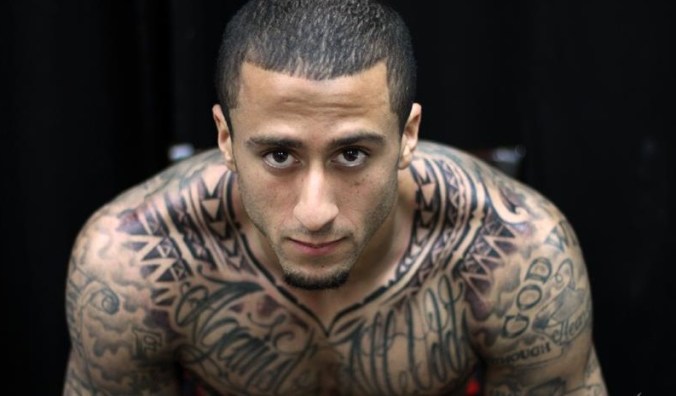
San Francisco 49ers quarterback Colin Kaepernick refused to stand for the playing of the national anthem before Friday night’s 49ers-Green Packers exhibition game as a protest against the United States. He has apparently been doing all NFL preseason, but it wasn’t noticed until the most recent game.

Questioned about his certain to be controversial gesture, the mixed race athlete—he had one white parent, and was raised by a white adoptive parent—explained thusly:

“I am not going to stand up to show pride in a flag for a country that oppresses black people and people of color.To me, this is bigger than football and it would be selfish on my part to look the other way. There are bodies in the street and people getting paid leave and getting away with murder.”

Observations:

1. Give him credit for one thing: he isn’t trying to take advantage of the King’s Pass. His star immunity is at low ebb, since Kaepernick’s status with his team is shaky and his job as a first string quarterback is in doubt, not because of his political views, but because he has been injured too much and not all that great when healthy. What he did was not in his own best interests. It took guts.

So does leaping naked into a zoo’s tiger exhibit.

2. His action wasn’t a protest. It was grandstanding. It generated publicity for a message that was incoherent. All his gesture said was “Colin Kaepernick is upset and has an irrationally inflated concept of how much anyone cares, or should care.”

3. Kaepernick could have salvaged his act by being ready with a well-reasoned, well-stated, articulate and persuasive explanation. Based on what he said, which was ignorant, counter-factual and foolish, we must assume that he actually gave thought to his response, and that this pathetic statement was the best he could come up with. That shows him to be incompetent, ill-informed, and not very bright. Continue reading

About That Obviously Dishonest Disclaimer On Movies And TV Shows

“The story, all names, characters, and incidents portrayed in this production are fictitious. No identification with actual persons, places, buildings, and products is intended or should be inferred.”

The character of Jake LaMotta is fictional, and any similarity to Jake LaMotta is purely coincidental...

The character of Jake LaMotta is fictional, and any similarity to Jake LaMotta is purely coincidental…

This and disclaimers like it on movies and TV shows have driven me crazy for a long time. So often the text is an obvious lie. I first began obsessing about it during the early days of “Law and Order,” when Dick Wolf’s show would herald the fact that its episodes were “ripped from the headlines,” then end with a disclaimer that said it was completely fiction. Sometimes, an episode was obviously based on a specific crime and specific individuals, and the actors were made up to look like the actual criminals. The disclaimer was and is a lie, and since it was obvious, why did they bother? Legally, it does no good to publish a boilerplate disclaimer that says, “We’re not really doing what any fool can see we are doing, ” except to discourage potential lawsuits by stupid people. I am of the (minority, unfortunately) position that it’s unethical for lawyers to author legally meaningless language like this for the sole purpose of misleading the ignorant.

The background of the disclaimer is interesting; Slate just published the story, which I realized I once knew but had forgotten.

The 1932 MGM film “Rasputin and the Empress”, was based on the events leading up to the fall of the Romanovs, and starred John, Ethel and Lionel Barrymore. Its most famous sequence was a version of the antic assassination of Rasputin, an event largely known because of the book written by one of the assassins, Prince Felix Yusupov, portrayed as “Prince Paul Chegodieff” in the film. The film also suggested that the Prince’s wife, “Princess Natasha,” was raped by Rasputin—suggested but not shown, since Rasputin was played by John Barrymore (Drew’s grandfather) and the princess was played by his sister, Ethel.  Princess Natasha was the avatar for Princess Irina Alexandrovna of Russia, who, like her husband Prince Felix, had escaped Russia before all the royals were killed.

Yusupov, living in Paris, heard about the film and decided that since audiences would recognize him as  the fictional killer of Rasputin, they would also assume that his wife was raped by Rasputin. She wasn’t, or if she was, only she and the Mad Monk knew about it. Officially, Irina and Rasputin had never met. An MGM researcher had pointed out this factual discrepancy to the studio during production and warned that the Yusupovs could sue, but was pooh-poohed off the lot. She was correct, however, for Irina Yusupov sued the studio, and after watching the movie twice, the British jury awarded her £25,000, or about $125,000. MGM took the film out of circulation for decades, and when it turned up on Turner Classic Movies, the pseudo-rape scene was gone. Continue reading

Major League Baseball Cares About Integrity And I Wish This Proved It…But It Doesn’t

I know this will be a shock, Henry, but there's forest here, not just trees...

I know this will be a shock, Henry, but there’s forest here, not just trees…

On Baseball Prospectus, one of the scholarly baseball sites, Henry Druschel has a provocative, inspiring and ultimately silly post pointing out that if baseball teams were only concerned with winning, they would forfeit games for strategic purposes, yet they literally never do. He writes…

“Teams are almost certainly harming their long-term win rates in a meaningful way by playing until every out of every game has been recorded. For example, the Red Sox encountered a grueling quirk of the schedule on Wednesday night, when they were scheduled to play the Orioles at 7:05 p.m. before traveling to Detroit and playing the Tigers at 1:10 p.m. the next day. When it began to pour in Baltimore at roughly 9:00 p.m., the Red Sox were leading 8-1 after six innings, but imagine if the situation was reversed, and Boston was instead trailing 8-1 with three innings to go. Their odds of coming back to win such a game would be something like 0.5 percent. In such a scenario, they could either wait in the clubhouse until the game was either resumed or officially cancelled, or they could forfeit as soon as the rain began, and head for the airport and Detroit right away. In the non-hypothetical game, the rain delay lasted about 80 minutes before the game was officially called; it seems obvious that an extra hour and a half of rest before the next game would add more to a trailing Boston’s total expected wins than remaining in Baltimore and hoping for a miracle would. That might seem like a corner case, and truthfully, it is; I bring it up to note that no one would even consider a forfeit in such a scenario, despite the strategic logic of the move. This isn’t limited to corner cases, however; every time a position player enters a baseball game as a pitcher in a blowout, teams are harming their long-term expected win totals by not forfeiting instead….”

The writer concludes:

Given that forfeitures would be win-maximizing in certain cases, and given that teams choose never to strategically forfeit regardless, there are two possible conclusions. One: Teams are behaving irrationally. Given the immense value even a single win can have to a franchise, I feel confident stating that this is not the case. That leaves the second conclusion: There is something the team values more than winning as much as possible. There is a societal norm that places something—a competitive ideal, maybe, or just completion—over winning, a norm that would be violated by a strategic forfeit, and a norm that teams invariably follow.

As someone who values other things over winning, this excites me…

Don’t get too excited, Henry.

Yes, I believe that baseball teams take considered actions sometimes that do not maximize their chances of winning. I was roundly pilloried in baseball circles for an article I wrote in 2008 (for another scholarly baseball site)  which argued that Barry Bonds, the shameless steroid cheat and home run champion who was suddenly a free agent and who could, based on his recent exploits, still hit though well past 40, would not be signed by any team—not even the Yankees!—because doing so would signal to that team’s fans, city, players and organization that the team endorsed flagrant dishonesty as well as a willingness to disregard fairness, integrity and sportsmanship for a few extra wins. I was on a MLB radio show where the host laughed at me. “Of course he’ll be signed! You’re crazy!” were his words. “Just wait,” I said. “If he isn’t signed, it will mean that baseball colluded against him!” he said. “Just wait,” I said.

Bonds, who said he was dying to play, that he was healthy, that he’d play for the Major League minimum, that he’d sue MLB if someone didn’t sign him, never swung a bat in anger again. There was no collusion, either. It was pure cognitive dissonance, you see. Remember the scale? Continue reading

Nipplegate Ethics: No, We Don’t Owe Janet Jackson Any Apology At All

nipplegate

A wonderful, if infuriating, example of race- and gender-baiting was delivered earlier this year by pop culture pundit Emmanuel Hapsis, and a more ridiculous analysis you will seldom see. I missed it, but the post was no more valid then than it is now.

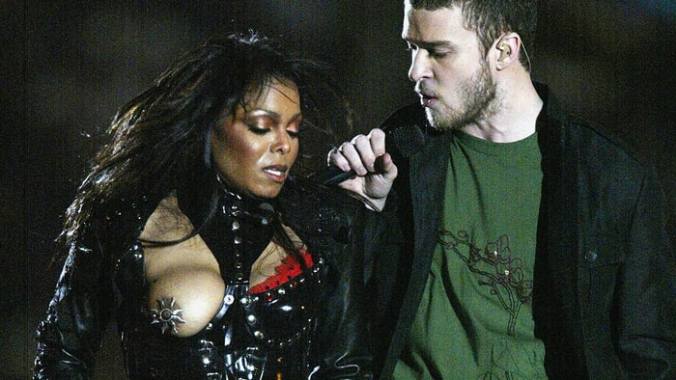
Returning, for some reason, to the infamous episode during the 2004’s Super Bowl halftime show, when Janet Jackson and Justin Timberlake conspired to turn the supposedly family-friendly Super Bowl into a strip tease, Hapsis’s piece is called “Nipplegate Revisited: Why America Owes Janet Jackson a Huge Apology.” During a choreographed duet with Jackson  and while singing “Better have you naked by the end of this song,” (talk about rape culture!) Timberlake ripped a pre-rigged portion of Jackson’s bustier to reveal her naked breast. Jackson was severely criticized, as she should have been: after all, it was her breast, and she obviously agreed to allow it to make a surprise appearance, however brief.

Never mind. Hapsis sees the episode as exemplifying America’s “patriarchy,” “racism” and “sexism,” because obviously no white singers flashing ten-year-olds in TV land would be criticized, and no male singer who decided to let Mr. Wiggly make a guest appearance would be similarly pilloried. Continue reading

Health And Survival Rationing Ethics

cointoss

Beginning in 2012, Dr. Lee Daugherty Biddison, a critical care physician at Johns Hopkins and some colleagues have held public forums around Maryland to solicit the public’s opinions about how life-saving medical assistance should be distributed when there are too many desperately ill patients and not enough resources. The exercise was part of the preparation  for Biddenson’s participation in preparing official recommendations for state agencies that  might end up  as national guidelines regarding when doctors should remove one patient from a ventilator to save another who might have a better chance of surviving, or whether the young should have priority over the old.

Ethically, this is pure ends justifying the means stuff. The Golden Rule is useless—How would you like to be treated? I’d want to be left on the ventilator, of course!–and Kantian ethics break down, since Immanuel forbade using human life to achieve even the best objectives…like saving a human life. Such trade-offs of life for life (or lives) is the realm of utilitarianism, and an especially brutal variety….so brutal that I doubt that it is ethics at all.

When Dr. Biddenson justifies his public forums by saying that he wants to include current societal values in his life-for-a-life calculations, she is really seeking current biases, because that’s all they are. On the Titanic, it was women and children first, not because it made societal sense to allow some of the most productive and vibrant minds alive to drown simply because they had a Y chromosome, but because that’s just the way it was. Old women and sick children got on lifeboats;  young men, like emerging mystery writer Jacque Futrelle (and brilliant young artist Leonardo DiCaprio), went down with the ship. That’s not utilitarianism. That’s sentimentalism.

The New York Times article mostly demonstrates that human beings are incapable of making ethical guidelines, because Kant was right: when you start trading one life for another, it’s inherently unethical, even if you have no choice but to do it. Does it make societal sense to take away Stephen Hawking’s ventilator to help a drug-addicted, habitual criminal survive? Well, should violating drug laws sentence a kid to death? TILT! There are no ethical answers, just biased decisions. Continue reading

Ethics Heroes: The Nixon Foundation And The Richard Nixon Presidential Library

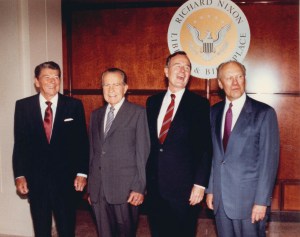
Pop Quiz: Who is missing from this picture from the dedication of the Nixon Library in 1990, and why?

Pop Quiz: Who is missing from this picture from the dedication of the Nixon Library in 1990, and why?

I can’t stand the Kennedy Library in Boston, with all its triumphal, sentimental hagiography of both Jack and Bobby. A presidential library will naturally try to put the best spin on the accomplishments, failures, and character deficits of its subject, but it has an obligation to history too. I once was determined to visit all of the libraries, but after the first few I decided that these structures were more like the pyramids than fair and enlightening representations of the men they honored.

The worst in this respect, as you might guess, was the infamous Richard Nixon Presidential Library in Yorba Linda, California, which opened 26 years ago.The Watergate exhibit, approved by Nixon himself, painted Nixon as an innocent and heroic victim brought down by the media  and his sinister foes. This was certainly Nixon’s view, but it has no relationship to reality. So convinced was Congress that the Richard Nixon Presidential Library would display the same lack of ethics as its namesake that it passed a law in 1974 requiring his presidential records to be stored with the National Archives and out of the library’s control, where they might be altered or “lost.”

Nixon’s library entered the official presidential library system under the auspices of the National Archives in 2007, and to finally make it more than the presidential library equivalent of  Fantasyland, the Nixon Foundation ordered the old Watergate exhibit to be overhauled. Continue reading

Now THIS Was Zealous Representation! The Incredible, Unethical, Zealous, Crooked And Courageous Bill Fallon

Fallon

I’m giving an ethics seminar for a group of government lawyers this morning. I think I’ll tell them about Bill Fallon.

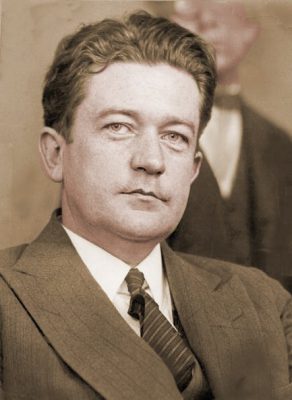
Bill Fallon (1886-1927) was a very successful New York criminal defense attorney, and a contemporary of Clarence Darrow. He was called “The Great Mouthpiece,” because he represented some of New York’s leading pimps, narcotics dealers, embezzlers, swindlers and gamblers.  One famous client was Arnold Roth, who was the architect of the 1919 Black Sox scandal, bribing eight Chicago White Sox stars to throw the World Series. Another was Nicky Arnstein, the gambler husband of Fanny Brice. That was Omar Shariff playing Nicky in “Funny Girl.”

Fallon often bribed his juries, and got away with it: the one time he was caught and indicted, a jury found him non guilty. He probably bribed that jury, too. Clarence Darrow was proud of the fact that he represented over a hundred men and women facing the death penalty and none were ever executed. Fallon could top that: he represented over 120 homicide defendants, all of them guilty as hell, and not one was convicted.

Dashiell Hammett referred to Fallon in his novel, “Red Harvest,”, when he wrote,

He’s the guy that the joke was wrote about: ‘Is he a criminal lawyer?’ “Yes, very.'”

Continue reading

Observations On The Gadsden Flag Controversy

Gadsden Flag

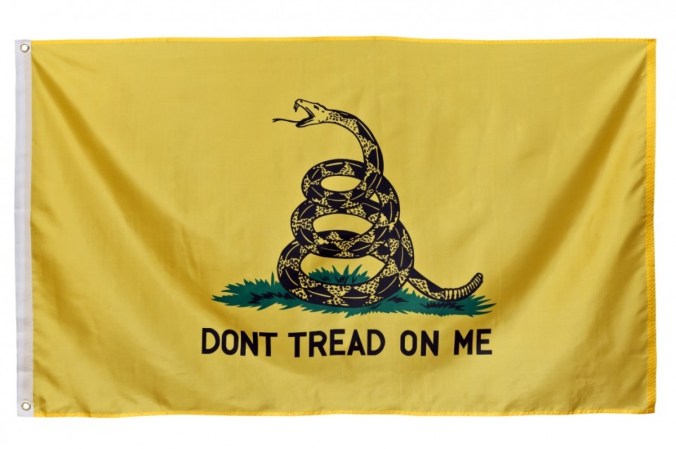
On the Volokh Conspiracy, now featured on the Washington Post website, Prof. Volokh applies his First Amendment expertise to a recent EEOC decision which ruled that a complaint from an African-American that a fellow worker who repeatedly wore a cap with the famous “Don’t Tread On Me” insignia from the Gadsden flag may have created a hostile work environment at the federal agency both worked for. The Equal Employment Opportunity Commission called for further investigation, including an interview of the cap-owner’s intention in wearing the symbol, concluding,

“In light of the ambiguity in the current meaning of this symbol, we find that Complainant’s claim must be investigated to determine the specific context in which C1 displayed the symbol in the workplace. In so finding, we are not prejudging the merits of Complainant’s complaint. Instead, we are precluding a procedural dismissal that would deprive us of evidence that would illuminate the meaning conveyed by C1’s display of the symbol.”

Observations:

1. Now this is the slippery slope. Because murderous racist Dylan Roof posed with the Confederate flag, a tipping point was reached that resulted in the symbol and the flag being effectively and in some respects officially banned. The EEOC had already ruled the wearing a Confederate flag T-shirt constituted racial harassment,. Now the banning of historically significant symbols is threatening to spread to a flag that had no relationship to race whatsoever, in large part because of who has chosen to display it.

2. There is a whole website devoted to the Gadsden flag, from which we learn that…

  • It first appeared in October of 1775, as the British were occupying Boston and the desperate Continental Army was dug in in nearby Cambridge, lacking sufficient arms and ammunition.  In October, a merchant ship returning to Philadelphia from a voyage to England brought private letters to the Second Continental Congress informing it that  England was sending two cargo ships to America loaded with arms and gunpowder for the British troops.
  • Congress decided Washington’s troops’ plight required that those ships and their cargo be captured. It authorized the creation of a Continental Navy, then only four vessels, to take the ships. Congress also authorized the mustering of five companies of Marines. Some of the Marines enlisting that month in Philadelphia carried drums painted yellow, emblazoned with a  rattlesnake with thirteen rattles, coiled and ready to strike, accompanied by the motto “Don’t Tread on Me.”
  • That same December, a citizen calling himself  “An American Guesser,” anonymously wrote to the Pennsylvania Journal, saying in part:

“I observed on one of the drums belonging to the marines now raising, there was painted a Rattle-Snake, with this modest motto under it, ‘Don’t tread on me.’ As I know it is the custom to have some device on the arms of every country, I supposed this may have been intended for the arms of America…the Rattle-Snake is found in no other quarter of the world besides America….She never begins an attack, nor, when once engaged, ever surrenders: She is therefore an emblem of magnanimity and true courage. … she never wounds ’till she has generously given notice, even to her enemy, and cautioned him against the danger of treading on her..

I confess I was wholly at a loss what to make of the rattles, ’till I went back and counted them and found them just thirteen, exactly the number of the Colonies united in America; and I recollected too that this was the only part of the Snake which increased in numbers. …Tis curious and amazing to observe how distinct and independent of each other the rattles of this animal are, and yet how firmly they are united together, so as never to be separated but by breaking them to pieces. One of those rattles singly, is incapable of producing sound, but the ringing of thirteen together, is sufficient to alarm the boldest man living.”

It is generally agreed that the writer was really Benjamin Franklin. Ben had a hand in the design of the flag, since the first use of a rattlesnake to represent the colonies was his own “Join or die” cartoon,

800px-Benjamin_Franklin_-_Join_or_Die

…published years earlier. Continue reading

Ten Ethics Observations On The Democratic National Convention

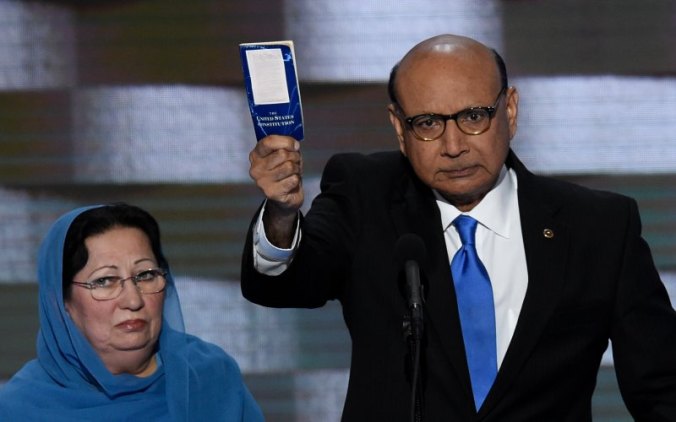
Khan DEM

1. The unrestrained cheer-leading from the news media in contrast to its week-long sneer at the Republican is so shamelessly biased that American journalism risks crippling its ability to use its giant megaphone to sabotage Trump. They might at least pretend to be fair and objective. I get it: I find it horrifying that Trump is running too. The immediate and unrestrained effort to go stop him, however, is so openly unprofessional, and shows how far the news media’s ethics have deteriorated just since 2008.

2. We could see and hear, during the course of the convention, how Donald Trump’s boorishness and propensity for ad hominem attacks and personal insults have degraded both parties and political discourse generally. And to think, in 1988, Ann Richards was criticized for her George H.W. Bush attacks at the Democratic Convention, and her famous jibe that Bush was born with a “silver foot in his mouth.” The Democrats could have taken the high road, and would have benefited, as well as done the culture a favor. Nah.

3. The most unethical aspect of the convention was the party’s tacit embrace of Black Lives Matters, while the BLM protesters outside were directing white journalists  to “stand in the back” while covering its protests, around the country police officers were facing increasing abuse, and in Baltimore, Marilyn Mosby was graphically illustrating BLM’s attack on the rule of law.

Democrats deserve to pay a high price for this, and I am confident that they will.

4. I owe Senator Eugene McCarthy an apology. I was among the many young  supporters of the rebellious anti-war Democrat who felt betrayed when McCarthy refused to address his beaten troops at the 1968 Convention. He stayed in his Chicago hotel room, angry and resentful of how the party had steam-rolled him and his movement. I thought it was cowardly and selfish. Now, after thinking ill of Clean Gene  all these years, I realize he might have been right after all. Being gracious isn’t ethical when you are required to become a symbolic pawn  to the same dark, unethical forces that you have been telling your throngs to resist and battle despite long odds. If you pull a Cruz instead of a Sanders, you look like you are trying to torpedo your own party. Better, perhaps, to do what Gene did. His integrity told him that the best response was to neither to capitulate, nor be petulant, but just to retreat to fight another day.

I’m not sure he was right, but  I’m no longer sure he was wrong.

I’m sorry, Senator. Continue reading

Is It Fair To Question The Democratic Party’s Values When It Has No American Flags Visible During Its National Convention?

Yes.

Of course yes.

One of these things, is not like the others...

One of these things, is not like the others…

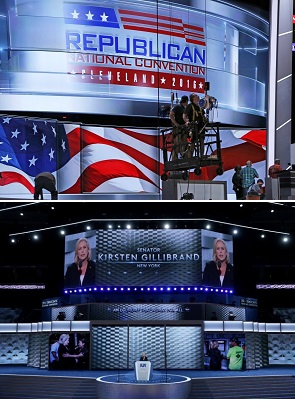
Opening night of the Democratic National Convention—that gathering of the historic institution created by Thomas Jefferson and Andrew Jackson to facilitate democracy by fulfilling the idealistic vision of the Founders, who bravely led the original colonies, represented by thirteen red and white stripes, to rise up against a hereditary monarchy and through courage, sacrifice and enterprise create the most successful and humanist nation ever seen on earth…you know, that Democratic National Convention?—showed no American flags on the stage, no red, white and blue symbolism, and an apparently flagless crowd.

Was the American flag actually banned from the convention? That can’t be…but it certainly looked like it.  The absence of any flags can’t be an accident, or unintentional.

What’s going on here?

Nothing good.

Nothing healthy.

In the eight years since Barack Obama was nominated…by the way, here is the scene of his second nomination, just four years ago…

Obama Accepts Nomination On Final Day Of Democratic National Convention

…the Democratic Party has morphed into an organization that is increasingly dependent on the pleasure and approval of anti-American groups. The supporters of illegal immigration, some of whom advocate returning the Southwest to Mexico; angry black liberation movement activists, who regard the United States as a racist nation and culture; radical internationalists, who believe the United States should not only behave like “other first world nations,” but allow itself to be governed by them; progressives whose view of the United States, nourished by indoctrination in the public schools and colleges dominated by far left faculties, is relentlessly negative; growing numbers of socialists, anti-capitalists, anti-law enforcement activists and fans of soft totalitarianism—-these are increasingly the voting blocs that the professional politicians who  run the Democratic Party feel they must pander to and satisfy. Continue reading