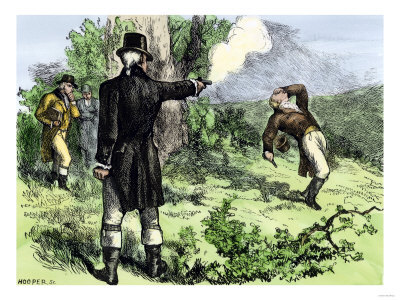
Unethical Web Post of the Week: “Screw Civility” by Rick Robinson

Tell Alexander Hamilton how much fun incivility is...

That an ethics dolt like Rick Robinson has spent so much time advising those in the Halls of Power speaks volumes about why our government institutions are dysfunctional and corrupt. His biography says he even ran for Congress. With ethical values like his—weak, dubious, and confused—it is a miracle he wasn’t elected.

In an essay for Tucker Carlson’s conservative news site The Daily Caller, Robinson defends the uncivil rhetoric of Jimmy (““Let’s take these sons of bitches out …”) Hoffa Jr and Rep. Joe ( “You lie!”) Wilson on the historically false and ethically idiotic grounds that “America was built on a solid foundation of uncivil political discourse.” It is ethically idiotic because this is consequentialism (“Everything turned out all right, so it was the right thing to do”) and a rationalization (“They did it, so we can too!), and it is historically false because no nation, indeed no functioning organization of any kind, was built on incivility….especially this one. Continue reading →

Obama’s Fractured History

"Don't know much about history..."

I have been, some say, too hard on Sarah Palin, Michele Bachmann, and Herman Cain, for their various gaffes related to our American heritage. The reason I believe that these politicians are especially blame-worthy for their fractured history is that they are all constantly evoking America’s historical past, especially its founding. If you are going to take on the responsibility of educating Americans about the Constitution (which Cain mixed up with the Declaration), Paul Revere (whose ride Palin mangled) and the Founders (to whose number Bachmann added John Quincy Adams), you better get your facts straight, because the public trusts what you say.

What then, is the proper and fair reaction when a President the media has anointed as brilliant states in a nationally televised speech before Congress that Abraham Lincoln was the “founder of the Republican Party”? Continue reading →

Comment of the Day: “Flying the Confederate Flag…”

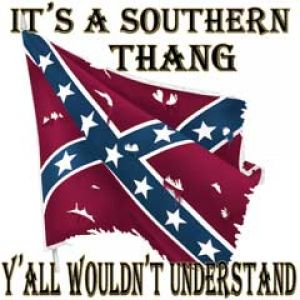
Blogger Edward Carney, who writes about the revelations of daily life (check out his blog here) put his finger on a central issue in the Confederate flag debate in his Comment of the Day.  Flying or displaying the provocative banner sends multiple messages simultaneously, and the individual responsible for the flag  is also responsible for the consequence of all of them. Claiming that one means no offense while knowing that one of the messages is unequivocally offensive is disingenuous,  naive, or willfully rude.

Here is the Comment of the Day on the post, “Flying the Confederate Flag..”:

“I’ll say this for those citizens and politicians who insist on flying the Confederate flag at local monuments and public events: at least they can make the argument that it represents history and a set of values that is still acceptable, even laudable, today. They can make that argument, however disingenuous it may be. The same cannot be said of everyone. Continue reading →

Flying the Confederate Flag: Protected Speech? Of Course. Unethical? Absolutely.

Honor them for their valor if you must, but there was nothing honorable about their cause or their flag.

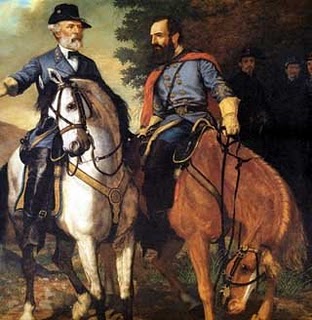
Once again, emerging from under-ground like a the seven-year locust, a controversy over the flying of the Confederate Flag is raging, this time in Lexington, Virginia, burial place of two Confederate heroes, Stonewall Jackson and Robert E. Lee. A proposed city ordinance would prohibit the flying of the Confederate banner on downtown poles, and some Southern heritage buffs as well as Jackson and Lee fans are upset. “By all means [Jackson and Lee] should be honored,” said Brandon Dorsey, commander of Camp 1296 of the Stonewall Brigade of the Confederate Veterans. “I look at the flag as honoring the veterans.”

The problem is, Brandon, that a large number of Americans look at that same flag as honoring slavery and racism, and for good and historical reasons. Continue reading →

Ethics Hero Emeritus: Stetson Kennedy (1916-2011)

And he gave his book to Superman...

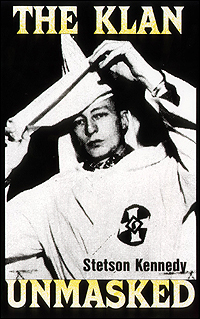
Author and folklorist Stetson Kennedy, who died this week,  is another important and courageous American that most of us never heard of. Let’s try to catch up.

After a back injury kept him out of World War II, Kennedy began a lifetime career of crusading against bigotry and what he called “homegrown racial terrorists.” He served as director of fact-finding for the southeastern office of the Anti-Defamation League and as director of the Anti-Nazi League of New York.

In his 1954 book “I Rode With the Ku Klux Klan,” Kennedy wrote that he gained entrance to the Klan by posing as an encyclopedia salesman and using the name of an uncle who was a Klan member. While posing as a member, he learned many Klan secrets that he put to use undermining the organization’s reputation and support. With evidence he snatched from the Grand Dragon’s wastebasket, he gave the Internal Revenue Service what it needed to collect an outstanding $685,000 tax lien from the Klan in 1944, and he helped draft the brief used by the state of Georgia to revoke the Klan’s national corporate charter in 1947. He also testified in other Klan-related cases. Continue reading →

Ethics Train Wreck Warning: Affirmative Action for the Hideous

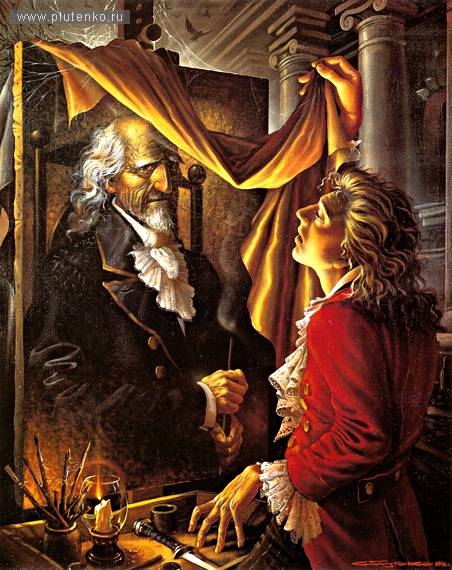
You won't need that portrait any more, Dorian...the Americans with Disabilities Act has you covered!

It is rare that an ethics train wreck of culture-wide proportions can be prevented with a firm, “Shut up, and go away!” This appears to be one of those times, however, and if anyone is reluctant, I hereby volunteer for the job.

Daniel S. Hamermesh, a professor of economics at the University of Texas, is shilling for his book, “Beauty Pays,” in which he proves the unremarkable fact that being attractive is an advantage in society , and being unattractive is an impediment. He recently hit the op-ed pages of the New York Times, writing, among other things, this:

“Why this disparate treatment of looks in so many areas of life? It’s a matter of simple prejudice. Most of us, regardless of our professed attitudes, prefer as customers to buy from better-looking salespeople, as jurors to listen to better-looking attorneys, as voters to be led by better-looking politicians, as students to learn from better-looking professors. This is not a matter of evil employers’ refusing to hire the ugly: in our roles as workers, customers and potential lovers we are all responsible for these effects.”

“How could we remedy this injustice?”

Whoa! There it is, the magic words that open the door for ham-handed social architects to do what they always to do, try to remedy the results of natural human proclivities and preferences with laws. Continue reading →

More Quotation Ethics: The Martin Luther King Memorial Strikes Again…But It’s Maya Angelou’s Fault

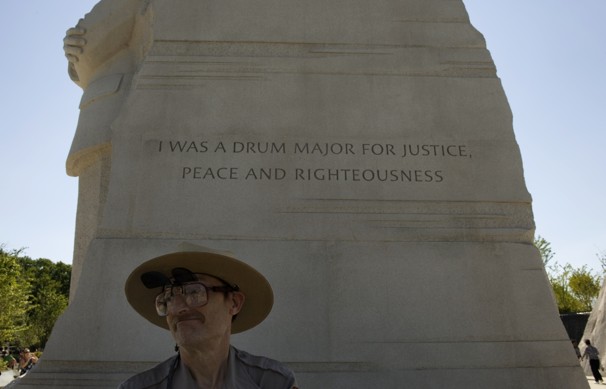
Who said that quote inscribed on the MLK monument? Not Rev. King! Maybe that guy in the hat...

When I saw the Martin Luther King quote engraved on the north face of his monument at the Martin Luther King Jr. Memorial, my immediate thought was: “A little full of ourselves there, are we, Marty?”

It reads: “I was a drum major for justice, peace and righteousness.”

Personally, I’ve always hated drum majors—prancing, flashy show-offs with big hats. I never thought of Martin Luther King as a drum major, or as someone prone to self-glorifying descriptions. I was relieved, therefore, to learn that what he really said was this, in a sermon two months before his death, speculating on what his eulogy might sound like:

“If you want to say that I was a drum major, say that I was a drum major for justice. Say that I was a drum major for peace. I was a drum major for righteousness. And all of the other shallow things will not matter.”

Ahh! Now that’s the Rev. Martin Luther King I remember! Unfortunately, it’s not the one future generations of America will know, because a false quote, mischaracterizing his meaning and his character, is immortalized in stone on the National Mall. Continue reading →

Richard Cohen, National Interests, and the Ethical Duties of the US to the World

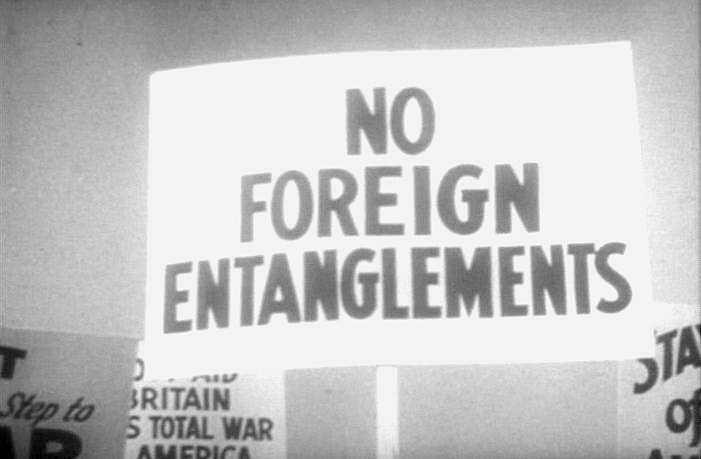
There used to be no columnist who infuriated me more consistently than Richard Cohen. Those were the hazy, golden days before I discovered E.J. Dionne, Paul Krugman and Harold Mayerson, however, whose rigid ideology virtually precludes objective analysis. Cohen isn’t biased, he’s just wrong more often than not. But he is also capable of bursts of moral and ethical clarity. Today was an example, as he took on the isolationist voices on the left and the right that make up a large component, if not the majority, of our elected leadership today.

Cohen begins by recounting a section from  Erik Larson ‘s book,“In the Garden of the Beasts,” about how the American foreign policy establishment in the Thirties resisted efforts by William Dodd, then ambassador to Germany, to protest the Hitler government’s increasing persecution of Jews. Humanity, and the U.S., paid a steep price for its inward-turning perspective after World War I, as we abdicated our traditional role as defender of liberty, freedom, democracy and human rights on the world stage. Continue reading →

Historical Theft at the King Memorial

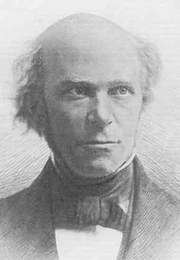
Rev. Theodore Parker

The new Martin Luther King Jr. Memorial is not just the King-in-Carbonite monolith that has caused so much controversy. There is much more to the National Mall’s latest addition, including inscriptions in marble of quotes from the martyred civil rights leader’s writings and speeches. There are more than a dozen examples of his oratory, a quotation from King’s 1963 “Letter From a Birmingham Jail,” and an excerpt from King’s Nobel Peace Prize acceptance speech in 1964.

Among them, this:

“The arc of the moral universe is long, but it bends toward justice.”

But Rev. King didn’t say it. Theodore Parker, an influential and eloquent Boston minister and abolitionist, did. King never pretended otherwise; it was one of his favorite quotes, and he used it often, but he usually credited its originator. Continue reading →

George Washington’s Vision of Religious Freedom

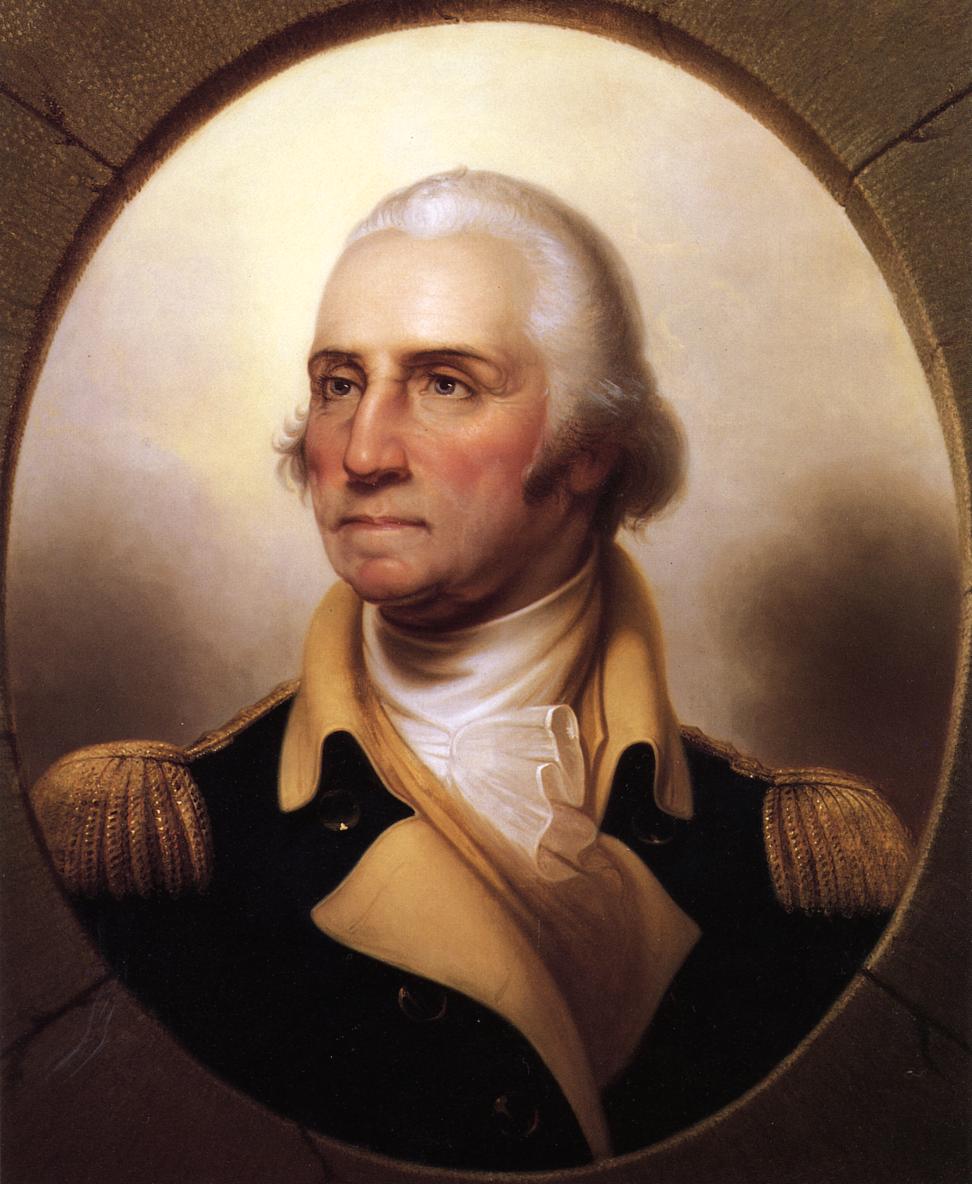
George Washington continues to be a source of wonder, wisdom, and ethical clarity.

Every year in August, Touro Synagogue in Newport, Rhode Island hosts a reading of President George Washington’s 1790 letter to “the Hebrew congregation in Newport, Rhode Island.” Before this month, I was unaware of either the celebration or the letter, I am ashamed to say. In it, the first President laid out clearly the ideals of religious freedom to be embraced by our fledgling nation, to a group that had reason to do doubt whether they would be welcome to worship as they pleased.

For generations, the Hebrew community that ultimately  settled in Newport had been fleeing religious persecution. The same year Christopher Columbus arrived in the New World, in 1492, Spain enacted a policy forcing Jews to convert to Christianity or leave the country. Thousands sought refuge in the Netherlands, the Caribbean Islands and South America, only to be pursued by the Spanish Inquisition. Continue reading →