The Strange Case of the Opportunistic Fugitive

The ethics call on this story is easy, though it is tempting to say otherwise.

Anthony S. Darwin was on the lam for six years in Wisconsin, eluding law enforcement authorities who were seeking to arrest him on pending charges of aggravated battery, bail jumping, battery, robbery with use of force, substantial battery and identity theft. Then he suddenly surrendered… because he realized he needed treatment for a life-threatening cancer. Continue reading →

Comment of the Day: “Next: A Version of “The Mikado” Without Execution References”

I promise I won’t do this often, but this Comment of the Day is by me, a reply to a comment by Ichneumon, which you will find at the end. I have been involved in this debate elsewhere, and a common “gotcha!” being employed against me is the argument that I jumped the gun defending the production of “The Mikado,” because I didn’t (and don’t yet) know what the exact lyrics were. I think this is worth expanding on, since Ichneumon and others have accused me of being “unethical” for calling the critics of the Palin lyric, whatever it was, ignorant.  Saturday is usually quiet, and this seems to be all that is going on other than the Middle East blowing up; by tomorrow I’m hoping to be able to move on to issues having nothing to do with Sarah Palin, Missoula, or “The Mikado.” So here is my reply to Ichneumon, with sample verses, on the original post, “Next: A Version of “The Mikado” Without Execution References”:

“The fact is, everyone from the Wall Street Journal to local websites to conservative commentators have been slapping around the production without an exact quote from the production. I am in touch with someone in the cast, and am hoping, waiting, to learn exactly what the lyric was. So what, exactly, would you have me do, when the vast majority is citing this, and only this, as the basis for its condemnation: the production put Sarah Palin, by name on Ko-Ko’s list, and this constituted a declaration that she should be killed? Continue reading →

Further Ethical Musings on Ko-Ko’s Little List’s “Eliminationist Rhetoric”: the Duty to Fight the Insanity

The more I think about the controversy over the Montana production of “The Mikado,” which I discussed in the previous post, the more it bothers me.

The fact that some conservative Missoulans were disturbed by Sarah Palin’s inclusion on the iconic “little list” carried by the fictional Ko-Ko, the Lord High Executioner in Gilbert and Sullivan’s classic musical comedy “The Mikado” is disturbing. The fact that the Missoula Community Theater actually caved-in to ignorance and hypersensitivity and removed the lyric is more so.  but the fact that some sensible commentators, like the Wall Street Journal’s usually perceptive and witty James Taranto, have had their brains addled by the current attempt at language, metaphor and humor purging by politically correct hysterics is genuinely terrifying. Continue reading →

Next: A Version of “The Mikado” Without Execution References

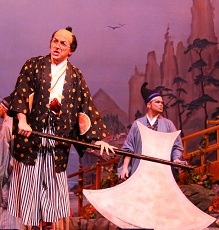
For a text-book example of how political correctness, ideology, ignorance and a humor deficit can undermine speech, culture and entertainment, we need look no further than Montana, and its public critics of the Missoula Community Theater’s production of “The Mikado,” perhaps the best of all Gilbert and Sullivan operettas and one of the very best musical comedies ever written. Continue reading →

Unethical Quote of the Week: The White House

“Any suggestion that this was an insult to the United States is just flat wrong.  As Lang Lang has stated before, he plays this song regularly because it is one of his favorite Chinese melodies, which is very widely known and popular in China for its melody.  Lang Lang played the song without lyrics or reference to any political themes during the entertainment portion of the State Dinner. He simply stated the song’s title and noted it was well known in China.”

—White House Spokesman Tommy Vietor, arguing that Chinese pianist Lang Lang’s  playing of a Chinese  song that referred to Americans a “jackals” at a White House dinner was as innocent as the day is long.

The song was well-known in China all right—well-known as an anti-American song. Continue reading →

Where We Miss Morality: The Unmarried Mothers Disaster

USA Today included an editorial yesterday about the explosion of births to unmarried mothers in America that has exacerbated many societal problems. It’s a stunning story : in 1960,  the figure was 5.3%; by 1970, in the teeth of the cultural upheaval launched in the late 60’s, it had  more than doubled to 10.7%.   In 2009, 41% of children born in the USA were born to unmarried mothers,  including a frightening 73% of non-Hispanic black children.  The editorial suggested that reversing the trend is a priority, but was short on ideas for how to address it. Notably absent was the method of social control that had served the United States well since 1776, and had been effective world-wide since the institution of marriage: calling it wrong. Continue reading →

Ethics Heads-Up: When the President Talks About “Investment in Infrastructure,” Pay Attention

Yesterday, a massive water main rupture shut down part of the Washington area Beltway, tying up traffic and swamping cars. From the Associated Press story:

“At one point, water from the broken main shot eight or nine feet in the air, said Lyn Riggins, a spokeswoman for the Washington Suburban Sanitary Commission. There was significant damage to the office park, with chunks of asphalt strewn across the parking lot, building windows shattered and three cars filled with water.

“It looks like somewhere where you would go white water rafting,” Riggins said.”

Advance reports discussing President Obama’s State of the Union message tonight note that he will be talking about, among other things, investing the nation’s resources on infrastructure renewal: roads, sewers, bridges and more. Already, Republican budget hawks and the conservative talk shows are mocking this as simply a euphemism for more “out of control spending.”

Addressing this country’s dangerously decrepit infrastructure will be expensive all right, but it is definitely an investment, and not undertaking it immediately is irresponsible, short-sighted, dangerous and foolish. For a quick refresher on why the neglect of U.S. infrastructure has been a scandalous breach of duty  of duty by generations of U.S. leadership, read this.

China’s Secret White House Insult

Lang Lang, the Chinese pianist who played for guests the White House State dinner on Jan. 19 honoring Chairman Hu Jintao, apparently regaled the crowd with an unfamiliar melody (to the Americans) that was really a famous anti-American propaganda song from the Korean War, the theme  to the movie “Battle on Shangganling Mountain.”  Continue reading →

“Finishing the Hat”: Sondheim, W.S. Gilbert, and Expert Malpractice

Stephen Sondheim’s “Finishing the Hat” is a fascinating reflection on a remarkable career and the craft of making musicals by the greatest living master of the form. In the course of recounting his formative years, triumphs, failures, and duels with producers, authors and composers, Sondheim also critiques the lyrics of his predecessors, contemporaries and role models—as long as they are dead. In a nod to gentility or cowardice, the only living lyricist he subjects to his expert critiques is himself.

Sondheim is a tough judge, as one might expect from a composer/lyricist who meticulously measures each vowel sound and stressed syllable for maximum effect. He is also, by virtue of both his reputation and technical expertise, an influential one. The lyricists he grades highly in the book, such as Frank Loesser, Cole Porter and Dorothy Fields, are likely to have their reputations burnished by his praise, and those he slams, like Lorenz Hart and Noel Coward, will suffer by comparison. Because of this, Sondheim had an obligation, as a respected expert in his field, to make each case carefully and fairly. To his credit, Sondheim seems to recognize this, and all of his critical discussions of an individual lyricist’s style and quirks include specific examples and careful analysis. We may disagree with Sondheim as a matter of personal taste, but it is difficult to argue with his specific points, because they are backed up by examples, technical theory, and the weight of his authority.

It is therefore surprising and disappointing to see Stephen Sondheim slide into expert malpractice when he undertakes, clearly half-heartedly, a critique of the lyrics of W.S. Gilbert, of Gilbert and Sullivan fame. Continue reading →
Tucson Aftermath: Don’t Let The Barn Door Close On Freedom, Please

In the wake of Jared Loughner’s attack, the “barn door fllacy” is in full operation as intensely, and foolishly as I’ve ever seen it. Everyone from social reformers to yellow-bellied Congress members are proposing changes and suggesting “dialogues” aimed at stopping Jared Loughner’s completely unpredictable conduct, which, they seem to forget, has already occurred. Almost always, when everyone rushes to lock the metaphorical barn door after the horse is gone, they make the barn and everything around it uglier, less useful, more expensive, and less respectful of basic human dignity and freedom: witness the TSA’s outrageous new pat-down procedures, designed to stop 2009’s exploding underpants terrorist, who was unsuccessful. Continue reading →