In the introduction to this post, Ethics Alarms mentioned the passing of “Star Trek” icon Nichelle Nichols, whose obituaries prominently noted her participation in TV’s first inter-racial kiss. I wrote in part,
“She was more model than actress, and as her role developed, much to her disappointment, the part of “Uhura” became little more than set dressing. But she played one of the first black female characters on TV to have a non-subservient role, indeed Uhura was fourth in the “Enterprise” chain of command…. In her autobiography, Nichols wrote that Martin Luther King told her that she was advancing civil rights objectives, and convinced her not to quit when William Shatner was getting too obnoxious” …
They got away with putting a beautiful woman in a minidress in the background of as many shots as possible, but what did she do other than provide eye candy for the little boys and little men who watched? She was the secretary, seated at the switchboard, receiving calls.
Come on. The sexual politics was ridiculous, and blackness was the device to make it seem progressive, or at least to shut up the critics.
And I mean no disrespect to Ms. Nichols or to any other black actor who accepted a role constrained by stereotypes. There should have been more offers. There should have been more roles.
Once again, I have proven to be a lousy prognosticator when it comes to which posts will generate the liveliest discussions. The Ethics Quiz about the propriety of buying Adolf Hitler’s watch provoked many excellent comments and trenchant observations, and Steve-O-In NJ’s Comment of the Day is certainly among them.
Here it is…
***
Something as unique and personal as Hitler’s watch probably belongs in a museum, but if a private person owns it, he has the right to sell it. My question is why would anyone want something like that and what would he do with it once he had it? Doesn’t that say something about the buyer? People collect all kinds of odd things, but collecting something like this is odder than most.
As a Roman Catholic, I was brought up on the idea that certain amounts of power remained within certain objects, especially physical remains. That’s why Church altars often hold holy relics, the more important the church, the more important the relics it holds. There was some serious fear when the cathedral of Notre Dame in Paris had that fire a few years back that the crown of thorns, supposedly worn by Christ Himself, and the tunic of St Louis, worn by that saintly King on crusade, would be destroyed and with them the physical link to those personages. I don’t think the belief in relics and similar items is unique to Catholicism, I think it was around long before that. Supposedly the tree that Siddhartha achieved enlightenment under, the burning bush where Moses received his mission from God, and the three items that the sun goddess Amaterasu gave to the first emperor of Japan all exist still. You can see the first two if you are willing to travel, the three items are kept at the Great Ise Shrine in Japan and none but the appointed guardian clerics are allowed to see them.
I think that the human belief that after revered or reviled figures are no longer in this world that something of them remains and can be accessed via whatever physical links there are transcends modern religion and goes back to very early beliefs. The belief that certain symbols have certain power is also a very ancient belief, and why, to this day, we all seem to believe that the display of the cross will repulse a vampire or similar creature. Does any of this make logical sense? Not really, but we are humans, not Vulcans, and therefore the feelings associated with these beliefs remain part of us.
Those feelings can be played upon and amplified, of course, and a lot of individuals do just that, to harness them and hopefully lead others into doing as they say or making the leap from feeling to action. Symbols can serve as points to rally around or against and focusing points for causes. That’s why in the various crusades and jihads it was common for the victor to throw down symbols of the defeated.
Supposedly, in this modern era, we are supposed to have moved past giving these symbols inordinate amounts of power. However, certain political figures have found that rallying against certain symbols is a shortcut to power and mob rule. There is a certain level of dopamine rush that goes with feeling like you’re a righteous member of a righteous cause, and another kind of thrill that goes with destroying a symbol that someone says is bad. The problem is that, like any other kind of addiction, it becomes harder and harder to get the same amount of high with the same actions. Eventually you graduate to hurting and even killing others that you associate with whatever is opposed to your righteous cause.
There is nothing per se unethical about dealing in historical artifacts, whether they be associated with those were thought of as very good or those who are thought of as very evil. Any unethical actions lie within the use of those artifacts. Would I personally want to own some item that was personally possessed by a genocidal dictator? Not really. Do I have a problem with someone else owning such an item? No. Do I have a problem with such an item being displayed in a museum? No. Destroying the physical reminders of History is ultimately unhelpful.
Do I wonder what the owner or buyer of such an item is thinking? Yes. However, unless I actually discuss it with him, I don’t get to assume he’s a bad guy. Am I going to empower someone who claims victimhood to insist on the concealment or destruction of anything? No. I think the sanctification of victimhood ultimately leads to the pussification of society.
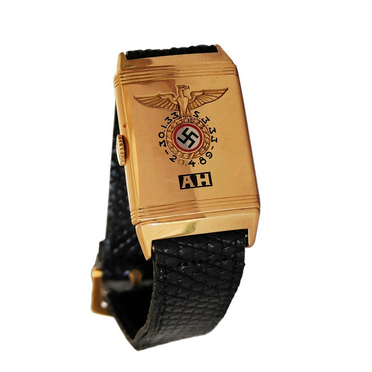
Adolf Hitler’s watch, shown above, recently sold at auction for over a million dollars. (The auction house had been expecting more, between 2 and 4 million.) The sale provoke some angry rhetoric online: many believe that it is unethical, indeed immoral, to acquire, keep or sell artifacts from Nazi Germany. In several countries, putting such things up for sale is illegal.
Your Ethics Alarms Ethics Quiz of the Day is this:
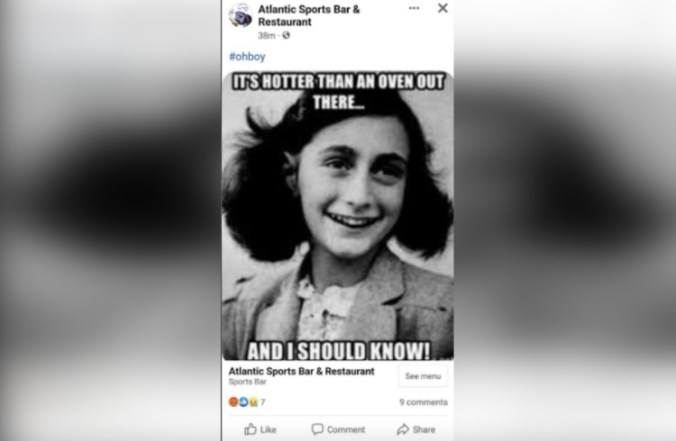
And now for something completely appalling!The Tiverton, Rhode Island eatery posted this meme to Facebook:
Now what?
What occurred after the meme went up was that a local talk radio host called to investigate. She says the restaurant owner told her that he thought the meme was funny and then cut off the call. The employee who posted the gag alleged that he didn’t know who the girl in the photo was.
After the post had been taken down by the restaurant, a contrite apology went up in its place:
July 20 should be permanently recognized as Conspiracy Theory Day. It’s the anniversary of Neil Armstrong walking on the moon in 1969, and the event spawned one of the most hilarious of all conspiracy theories, that the whole thing was faked by NASA. Many believe it still. This one is an anti-government conspiracy theory, so perhaps the “Truthers” fantasy that George W. Bush bombed the Pentagon and Twin Towers on 9/11 has passed it. Or maybe the theory that a Kennedy assassination conspiracy involving President Johnson and the CIA is at the top of the list. My 8th grade history professor told our class that it was a fact that FDR conspired to let the Japanese bomb Pearl Harbor so the U.S. would enter the war.
A friend from childhood, smart to the point of brilliance, who once commented here often, sincerely believes that Barack Obama’s natural born citizenship is a hoax.
These conspiracy theories that cause people to believe their own government is a malign force are very harmful. More harmful yet is the current environment, where both political parties are vigorously pursuing conspiracy theories against the other.
It does not help the situation that some conspiracy theories, like the one that long held that the government was withholding evidence of unidentified flying objects, turn out to be true.
1. Condign justice dept. “Condign justice” was a term I never heard or read before George Will started using it. Then I stopped reading George Will, whose NeverTrumpism revealed him to be a classist hypocrite, requiring me to use it. Today’s example is the mayors of New York City and Washington D.C. complaining bitterly about being inundated with illegal immigrants. New York is suffering in great part because of its proud position as a “sanctuary city,” thus encouraging illegals to violate our laws. NYC Mayor Eric Adams demanded yesterday that the federal government help pay for what he said was a wave of illegal immigrants pouring into the city, as he whined about the city’s “safety net” being strained by busloads of people coming from border states and elsewhere. (CBS News helpfully apes Adams in calling the border-breachers “asylum-seekers,” hoping to cover-up what they really are.) Awww. Well gee, Mayor, if you didn’t openly invite them and say they would be welcomed and protected from our mean old laws, maybe there wouldn’t be so darn many.
Some old saw about making beds seems to be appropriate here. Idiot. Continue reading →
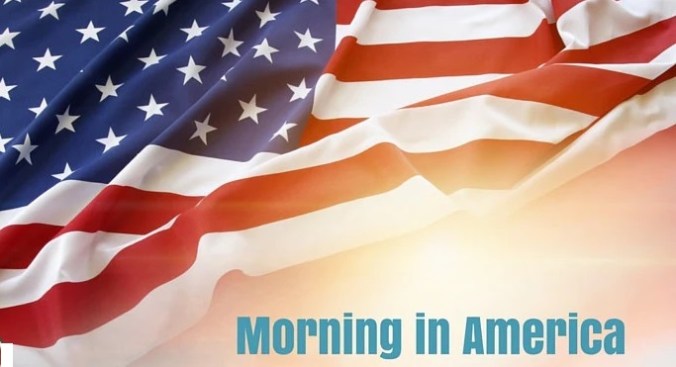
A lot of people find images like this, and the motto, offensive, presumably because of the association with Ronald Reagan, who brilliantly appropriated optimistic patriotism as a conservative value in response to Jimmy Carter’s “malaise” vision of the nation. Being negatively triggered by one’s own flag and expressions of pride and enthusiasm regarding the nation it represents is not a healthy state of mind, and therefore it is unethical conduct to actively promote such an attitude…which we now see being done every day.
1. It may be unethical, but Harvard at least has gall…In April, Harvard University set out to exceed its previous record for virtue signaling, committing $100 million to “redress its ties to slavery” after a report concluded that slavery played an “integral” role in shaping the University. This is the Cambridge version of reparations, and the flagrant act of misusing donated non-profit funds wasn’t even controversial. The whole board signed on without dissent, which shows how Borg-like the Harvard leadership is. “Diversity” of thought when wokeness is at issue is not welcome. In this month’s alumni magazine, amusingly, Harvard begs for contributions to keep the magazine operating at a high level (it is an excellent alumni magazine), as if tossing away 100 million dollars on non-educational matters didn’t make the appeal ridiculous. As one contrarian alum noted in a letter to the editor, if Harvard can give away all that money to assuage its conscience about supporting and benefiting long ago from a legal and predominant practice that had gone on for centuries, “it doesn’t need mine.”
In other damning news from Old Ivy, the Harvard web site calls Students For Fair Admissions v. Harvard, currently pending before the Supreme Court, as a “politically motivated lawsuit.” That’s the case in which Asian-American students allege that Harvard discriminates against them (like it discriminates against whites) in its admissions policies. The web site states, “Harvard College does not discriminate against applicants from any group in its admission processes.” This is pure “it isn’t what it is” gaslighting. One can argue that affirmative action, which is the real issue in the case, should continue and that it passes ethical standards via utilitarian balancing, but it cannot be denied that the practice isn’t discrimination. The statement is a lie. Continue reading →
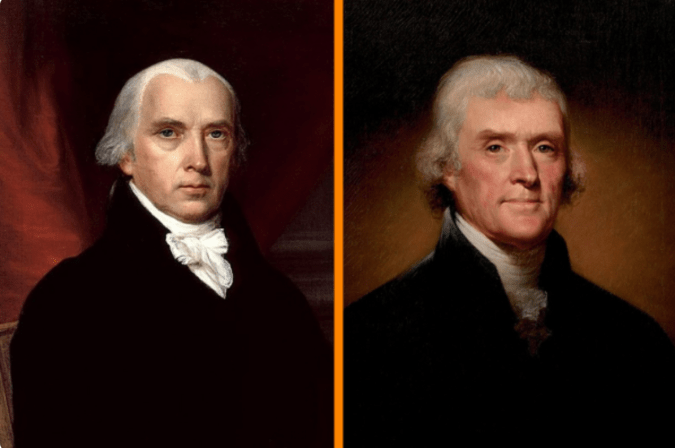
Apparently the Mad Left’s historical air-brushing mania that began with toppling statues of important American figures from the Confederacy such as Robert E. Lee, moved on to removing statues of Teddy Roosevelt and banning benign college mascots that evoked the Revolutionary era (like George Washington U’s “Colonial”), and generally has sought to “cancel” any American patriot or President who owned slaves, is now turning tours of Thomas Jefferson’s and James Madison’s homes in Virginia into attacks on the two essential figures in our democracy.
At Monticello, Jefferson’s self-designed home that is a tourist attraction in Charlottesville, Virginia, the non-profit operating the site is using its progressive political agenda to make a visit less a pilgrimage of respect than indoctrination into anti-Jeffersonism. A recent visitor described the experience as “depressing and demoralizing and truly upsetting,” with Jefferson-hostile tour guides claiming that his reputation is “wildly overblown.” Of course, this is all because Jefferson was a slave-holder, in direct contradiction of the values and rights he espoused in the Declaration of Independence. Arguably, Jefferson’s slave-holding was more revolting than that of other men of his time, as it included treating one of his slaves, Sally Hemings (and his dead wife’s half-sister) as his concubine. Ick. But Jefferson was a weak and conflicted man with a brilliant and perceptive mind; his slave-holding and other personal flaws, and there were many, are not why he must be celebrated and honored as one of those most responsible for the nation’s existence.
Dr. Jill is having a difficult month. I almost put her latest post-breakfast taco remarks under the “Unethical Quote” heading, but her infuriating comments during a private Democratic National Committee fundraiser in Nantucket, Massachusetts qualify as more ignorant and incompetent than anything else.
Attempting to defend her husband’s miserable performance as President over the past 18 months and to rebut the public’s overwhelmingly negative assessment of his Presidency so far, the First Lady whined—and yes, that is a fair characterization—
“[The President] had so many hopes and plans for things he wanted to do, but every time you turned around, he had to address the problems of the moment…He’s just had so many things thrown his way. Who would have ever thought about what happened [with the Supreme Court overturning] Roe v Wade? Well, maybe we saw it coming, but still we didn’t believe it. The gun violence in this country is absolutely appalling. We didn’t see the war in Ukraine coming.”
Awww, poor Joe! He’s had to deal with the same challenge as every other President since the beginning of the Republic! Damn! It’s just one thing after another! Who could have predicted it?
I really do wonder at what point the vast majority of Americans who have not become irreversibly deranged by the confluence of the Trump Freakout, the George Floyd Freakout, the Trans Freakout ,the Wuhan Virus Freakout and the Roe Reversal Freakout sharply slap their foreheads “I could have had a V8!” style and ask, “Why are we letting these unstable, untrustworthy people dominate our discourse and manipulate our culture?”
For the provocation keep escalating. The Washington Post’s editors actually thought that a Poe’s Law evoking piece headlined “My name is a Confederate monument, so I cross it out when I write it” was worthy of publication. In an orgy of narcissism, U.S. history-hatred and virtue-signalling, a writer named Bayard Woods saluted his ridiculous habit of crossing out his own name, which he says, “had stood as a Confederate monument over every story I had ever written.” See, the Bayards and the Woodses had owned slaves. By this brilliant logic, I should cross out my name too, since Chief Justice John Marshall was a slaveholder and “Jack” honors Jack the Ripper.
The answer is: Because its information seems accurate in inverse proportion to how much you know about the subject matter already.
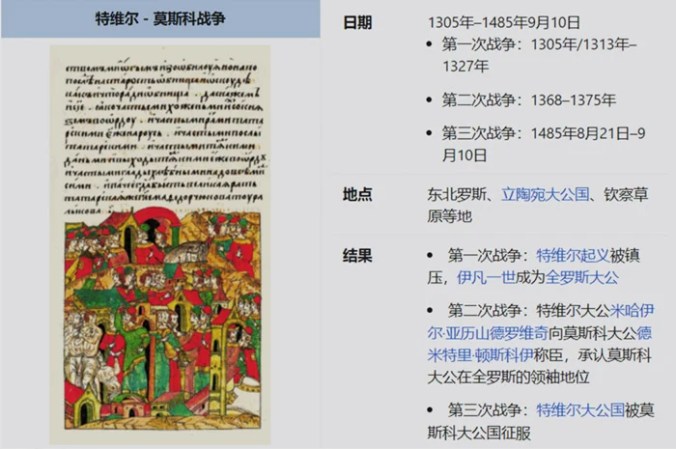
A recent example from China: Yifan, a Chinese fantasy novelist, started browsing Chinese Wikipedia for inspiration for a new book. happening upon Russian medieval history, the writer learned about the great Kashin silver mine, originally owned by the Tver, an independent state from the 13th to 15th centuries, and then by the Grand Duchy of Moscow, until it closed down in the 18th century after the silver was all mined out. The Kashin silver mine, the articles revealed, were operated some 30,000 slaves and 10,000 freedmen at its peak. Wars and human drama surrounded its history, and Yifan felt this might be a fertile topic for a novel. After the Kashin information was as exhausted on Chinese Wikipedia as the silver was in the mine’s dying days, he turned to the Russian version of Wikipedia, but he was surprised to see that the Russian Wikipedia. Strangely, most of what he had read about the famous silver mine wasn’t there at all, and this was Russian history.


 Ethics Alarms