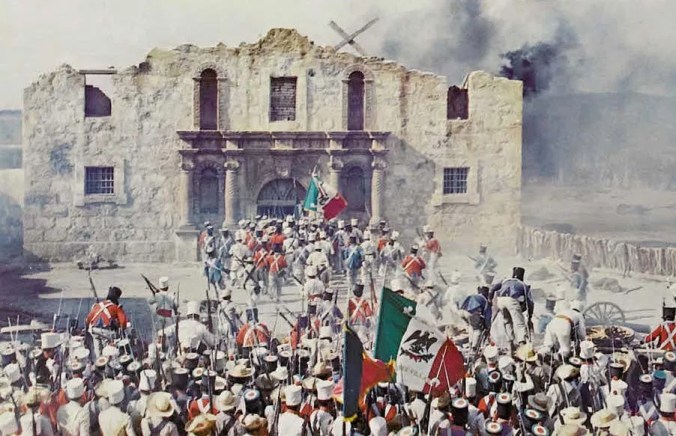
On this date in 1836, the Battle of the Alamo and the courageous 12 day stand that preceded it began its journey into memory. The day before, March 6, near dawn, saw the fortress fall in a bloody but hopeless battle in which the Texans were overwhelmed in less than an hour.
Here is Texan and Ethics Alarms stalwart Michael West’s account of the final days, March 5 and March 6:
March 5, 1836
After the previous day’s war council (on March 4), Santa Anna was content that his glorious assault would occur. But evidently, according to several reliable Mexican sources, a civilian woman from the town, who had retreated to the Alamo with the Texans, made it out of the Alamo during the night and gave dire information to the Mexicans. Evidently the Texan garrison was increasingly despondent. According to the lady who escaped, Travis and the garrison had discussed their options and one of the more forceful arguments made was that they should consider surrender.
Santa Anna wanted none of this, and accelerated his assault time-table (which he hadn’t necessarily meant for the 6th of March but for the 7th or even the 8th).
The Mexican soldiers would have received their orders in the morning and spent the rest of the day making preparations. There was little physically they had to do other than check the locks of their muskets, ensure they had the requisite number of extra flints (which would occasionally break in battle – testing the coolness of even the most experienced soldier), or assist in the production of several ladders Santa Anna had commanded each battalion to have prepared.
No, most of the preparation would have been mental. A deeply Catholic people, the Mexican soldiers would have spent their energies on prayer and confession. New soldiers would have been nervous about how they would perform under fire, simultaneously trying to hide their nerves from the experienced soldiers, who would have recognized the unique challenge before them. Almost none had been asked to climb tall walls after traversing several hundred yards under fire against an enemy who had, in the previous 12 days, proven that their rifled muskets out-ranged the standard Mexican issue musket by nearly 300% Continue reading →