Some people are now conditioned to see racism in everything, and they are a menace to society, sanity, and the pursuit of happiness.
But I’m getting ahead of myself…
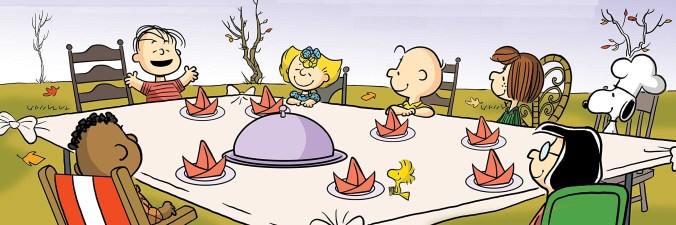
What does it mean that the above scene from ” A Charlie Brown Thanksgiving,” first aired on November 20, 1973 and every year since, suddenly struck some Americans as “racist” in 2018?
Hint: it doesn’t mean that the public is becoming more “woke” to actual racism in America. It means that the relentless effort by one segment of society and many in the news media to use the accusation of “racism” as a political wedge and a weapon to achieve power has officially reached the most dangerous level yet, and is gradually poisoning society. The idea is to make virtually anything potentially “racially insensitive”—choice of words, clothing, casting in TV shows, law enforcement, voting, socialization choices, literally anything and everything, including innocent composition choices in animated cartoons. The objective is to produce fear….fear of making a mistake, fear of offending anyone with hypersensitivity to racial slights, real or imaginary, fear of being labeled guilty of “racism,” which is now the worst crime on earth. This is a sick development that will create a sick society and a dysfunctional culture.
Here is how one critic describes the evidence of racism in the above picture:
“Franklin, the one and only black friend in the group, is seated by himself on one side of the table while the other is crowded with the rest of the friends. On top of that, he’s sitting in a lawn chair as opposed to everyone else’s proper furniture.”
This is deceit and trouble-making:
- There are six human beings at the table, one of whom is black. In fact, the diversity exceeds the percentage of blacks in the U.S. population. There is nothing racist about him being “the one and only.”
- Franklin is not sitting “by himself.” He is sitting at the same table with his friends as a welcome guest at a community gathering. Is Linus, who also has one side of the table to himself, sitting “by himself” too? No, he’s a member of the group, at the same table as his friends. Is Marcy, at the opposite end, sitting “by herself?” No, she is also sitting with the group, just like Franklin.
- Is having one side of a communal table considered some kind of insult? Not at any table I’ve been seated at. I love having a side to myself. It is also an advantage to be able to look at your family and friends across a table, rather than to have to talk to them by turning your head and craning around. There is a strong argument that Franklin is being treated with special consideration.
- Why did the artist set up the table like that? I guarantee it was not to make a racist statement. How can I guarantee that? I guarantee that because 1) the “statement’ would be idiotic 2) because nobody out of millions of viewers saw any such statement for four decades 3) because if you wanted to be hostile to blacks, you could just skip Franklin. Franklin, a minor, (indeed transparently token) “Peanuts” character added to the comic just five years earlier, is at the gang’s celebration in place of Schroader, Violet, Pigpen, and even Lucy, all more prominent characters. So what’s the theory, that the cartoonists gave the black kid a place at the table over major, long-standing characters in order to insult him? How racially paranoid do you have to be to think like that? The answer is “pretty damned paranoid,” and that’s the state of mind malign political forces here want to promote.
- Here’s why the table was set like it was:




 Ethics Alarms