An Adolf Hitler costume worn to a community Halloween event in Boulder City by the son of a Clark County teacher raised an uproar that spread far beyond the confines of the “Best City By A Dam Site.” Photos of the costume — consisting of brown pants and leather coat, a red arm band bearing a Nazi-style swastika and a brush mustache — went viral after being posted on social media after the Boulder City Chamber of Commerce-sponsored “Trunk or Treat” event on Saturday.
The reaction was harsh, with commenters’ outrage primarily focused on the child’s mother, identified as Janet Arsanian, and the fact that she is a teacher at Cortney Junior High School.
“Interesting to see a #CCSD teacher pridefully dressing her 13-year-old as Hitler,” wrote one Facebook poster. “These nazi sympathizers are supposed to be educating our kids.”
Wait: dressing your child as a monster or villain demonstrates support for the figure portrayed or his or her habits and conduct? Since when? I dressed up as a pirate in elementary school. Were my parents supporters of piracy? When kids dress up as Dracula, does that mean the parents are blood-suckers? Funny, when kids rang my door bell last year wearing Trump masks, I didn’t think that meant their parents voted for him. Were all those people wearing Nixon masks in the 70s Nixon supporters? I did not know that! Continue reading →
A scholarly journal called “Sex Roles” published what t thought were the results of a two-year study involving “thematic analysis of table dialogue” to uncover the mystery of why heterosexual men like to eat at Hooters. A journal of feminist geography, whatever that is, featured research om “human reactions to rape culture and queer performativity” at dog parks in Portland, Oregon. Another paper was deemed worthy of publication in a journal of feminist social work: titled “Our Struggle Is My Struggle,” it merged current feminist cant into passages lifted from Hitler’s “Mein Kampf.”
Last week, the three authors of these and many other hoax papers revealed in an article for the online journal Areo explaining that their fakery was part of a project to expose the lack of integrity in academia. “Scholarship based less upon finding truth and more upon attending to social grievances has become firmly established, if not fully dominant, within these fields,” they wrote. James A. Lindsay, Helen Pluckrose and Peter Boghossian (above) said that they wrote 20 fake scholarly papers and had several accepted and published in journals. The embarrassed publications rushed to retract the fake scholarship…
…while many scholars praised the hoaxers. for casting a harsh and revealing light on the “peer-reviewed research” scam.
3. If I were the producer of Saturday Night Live…I would strongly push the show to do what satirical shows are supposed to do: make fun of everyone. It is just good business, as well as comedic integrity: make everyone watch to see who gets skewered. But no: despite the over-abundance of potential and indeed near mandatory targets of parody and mockery, SNL took sides—the same one it has been taking now, virtually exclusively, for years. There was no Spartacus sketch, despite the preening of the absurd Cory Booker, and a skit that virtually writes itself. Lindsay Graham was cruelly mocked, but not Kirsten Gillibrand, nor Diane Feinstein. Ah, but Senator Susan Collins, who made a brave, clear, invaluable speech about her choice–women get choices, I hear—to buck the #MeToo bullies and lynch mobs and confirm Brett Kavanaugh, was mocked for THAT last night, aan portrayed as weak dupe. Yet despite the mannered, baby-talking, confused presentation by Blasey-Ford, whom I would deem a satirist’s dream, the show’s writers didn’t have the guts to touch her.
4. Speaking of jokes…Georgetown prof C. Christine Fair, who the college thinks can be trusted to be neutral and fair to white men in her classroom despite her racist and violent tweets, had an explanation after her Twitter account was suspended. She had written, you will recall,
“Look at [this] chorus of entitled white men. All of them deserve miserable deaths while feminists laugh as they take their last gasps. Bonus: we castrate their corpses and feed them to swine? Yes.”
Come on! Don’t you get the joke? She was kidding! Fair told the Washington Post, whose reporter didn’t have the integrity to respond, “How stupid do you think I am?”…
“Maybe this was not my most eloquent attempt,” Fair said. “And I will certainly concede I was attempting to make people feel uncomfortable,” but “this idea I’m somehow calling for actual violence is preposterous.”
Gee, why can’t white supremacists and racists excuse their “jokes” the same way?
The Post’s writer, however, completely accepts Fair’s alibi, and impugns anyone who took offense at it as “extreme right wing.” Read the article.
It’s kind of like following O.J. slow-mo escape, but more interminable, and lot more ominous...
I. No, Matt Damon is not a hypocrite because he mocked Brett Kavanaugh on SNL.
Why is this so hard to grasp for those not in show-biz? Actors act. They don’t have to believe in or live by what their roles stand for? Damon said earlier last December, speaking of the situation where he was falsely accused of harassment or sexual abuse…
“If you make the same claim to me today. it would be scorched-earth. I don’t care if it would cost me $10 million in court for 10 years, you are not taking my name from me, you are not taking my name and reputation from me, I’ve worked too hard for it, I’ve earned it, you can’t just blow me up like that.”
Now conservative pundits are writing that Damon is a sell-out and a hypocrite for helping a TV satire show attack Kavanaugh for standing up for his name and reputation. Morons. Damon didn’t write that script, and very few actors, especially fading, aging leading men like Damon, can afford to demand that they personally agree with the vehicles they appear in or the characters they play. Even actors who have the money and clout to do that usually kill their careers. [See: Foster, Jody; Clooney, George; et al.] Continue reading →
It’s the last day of the regular season for baseball, or should be: there could be two tie-breakers tomorrow, and they are officially considered part of the season. There were more baseball ethics posts this year than ever before. You can review them here.
1. And now for something completely stupid. I was temped to make this a free-standing post, but it triggered my stupid alarm, and doesn’t deserve it.
In Los Angeles, Boguslaw Matlak and Laura Quijano decided to stage a “social experiment” to determine whether bystanders would act to protect an endangered child. As their hidden cameras ran, they stuffed their 3-year-old son Leo into the trunk of their car. In truth, the back of the trunk had been rigged so Leo could climb into the back seat. He was in no danger.
“I was thinking maybe I should do a video to show people that they should do something about it when they see something wrong, to get involved,” Matlak said. They got involved, all right. Witnesses called the cops, who arrested the couple and took Leo into protective custody. The Illinois Department of Children and Family Services placed the child with a relative. For the last three weeks, the couple has been trying to get him back.
“They are hurting my son emotionally at this point,” Quijano told reporters. “He’s not home with his parents who love him very much and what else do they want from us? I just don’t understand at this point.”
The agency recently informed the parents that it would would be returning Leo to their custody. Matlak now faces one count of misdemeanor child endangerment.
Observations:
Ethics lesson #1: Don’t use human beings as props.
Ethics lesson #2: Three-year-olds can’t consent to such treatment.
Ethics lesson #3: Police have enough to do dealing with real crimes. Staging fake ones to see what will happen should be illegal, if it isn’t already.
What’s there to complain about? The social experiment was a success!
Is proof that parents of a small child are idiots sufficient to remove him? No, I suppose not.
The problem with this episode is that the child, who was innocent of wrong doing, is the primary one being punished.
Memory I: As a junior, I engineered an elaborate prank to steal a sofa from two classmates and friends who had swiped a sofa from two other students in their dorm. It almost worked, too: the pay-off was going to be when they visited our suite and saw their sofa there. The plan fell apart, and the original owners even got their sofa back.
Question: Should this episode, which technically involved attempted theft, disqualify me for some positions as an adult and professional?
The polls results:
Several commenters have admitted that their votes were tongue in cheek, so I don’t believe for a minute that there were really 13% of voters who believe that the episode when I was 20 should bar me from being an ethicist, a lawyer, or a SCOTUS judge, and needed to be investigated by the FBI. Just in case, however, I feel I should tell the whole, sordid story about what came to be called “The Great Sofa Caper,” and which is a tale told and retold at every reunion of my room mates.
It was the end of winter, and spring cleaning of sorts at the Harvard dorms. I lived in a suite at Lowell House with five other juniors, and was visiting friends and fellow classmates “Oscar” and “Felix” across the campus in the high rise dorms, Leverett Towers. “Oscar” was a theater friend who looked like a dissipated cross between Omar Shariff and Teddy Roosevelt; “Felix” looked like a pint-size Rodney Dangerfield. Shortly after I entered their abode, Felix said, “Hey, what do you think about the new sofa we swiped?” Indeed, prominently displayed in the main room was what appeared to be a very new, very nice, fully upholstered sofa.
“You swiped it?” I said, and Felix laughed. “No, I was just kidding. Some upperclassmen were changing rooms, and this was left out in the hall for anyone to take. Nice, eh?”
“You swiped it! That’s brand new! Nobody would throw that out. Come on!” I said. Indeed, furniture and other junk was often being left out for communal expropriating in such moves, but this seemed like wilful, contrived ignorance by my friends to me. Nonetheless, Felix and Oscar swore that they would never steal anything, and that the brand new sofa was abandoned property.
Right.
I went back to Lowell House deep in thought and ethics conflict, wondering what the right thing to do was. I couldn’t report my friends for what was, even if it was theft in the real world, pretty standard college silliness. Still, I felt this was excessive. Then I hit on my plan. It would be both a good practical joke and a lesson for Felix and Oscar. Continue reading →
I have some major ethics issues to explore in other areas, and oh how I wish this one would go away...
1. As predicted, conservative gadfly Ed Whelan woke up, slapped his forehead, and, perhaps after talking to his lawyer (though he is one), decided that he needed to apologize, and quick. Thus he tweeted,
“I made an appalling and inexcusable mistake of judgment in posting the tweet thread in a way that identified Kavanaugh’s Georgetown Prep classmate. I take full responsibility for that mistake, and I deeply apologize for it. I realize that does not undo the mistake.”
As apologies go, this is an excellent one. Unfortunately, it does not undo the mistake, and the mistake was so egregious and obvious that, as Whelan knows, the fact the he would make it undermines his authority and credibility. People have come back from worse, but not often, and it isn’t easy. It shouldn’t be easy. Then there is the fact that his victim has a very strong case for a defamation law suit.
2. The question now is whether any currently recognized standards of fairness or justice excuses rejecting Judge Kavanaugh on the basis of the evidence. A left-tilting professor, Christine Blasey Ford, has stated that she and four other people attended a small party over thirty years ago, during which which she was allegedly assaulted by a 17-year-old Brett Kavanaugh. Three of those people, PJ Smyth, Mark Judge, and Kavanaugh, have no w said that they have no recollection of attending such a party or of such an incident. Last night the fourth “witness,” a classmate of Ford’s at Holton-Arms named Leland Ingham Keyser issued a statement denying any recollection of attending a party with Brett Kavanaugh.
“Simply put, Ms. Keyser does not know Mr. Kavanaugh and she has no recollection of ever being at a party or gathering where he was present, with, or without, Dr. Ford,” lawyer Howard J. Walsh said in a statement sent to the Senate Judiciary Committee. Keyser is not, like Mark Judge, a likely Kavanaugh ally. In fact, she is is reportedly a lifelong friend of Ford’s.
Thus this is no longer a “she said/he said,” but a she said/ he said, and he said, and she said, and she said. Those who say “We believe Christine Blasey Ford” have no ethical or logical basis for doing so, just gender bias, a partisan agenda, and political animosity toward Kavanaugh. If it were a legal case, this one would be dropped as potentially embarrassing and a travesty of justice.
“Garrett was one of several temporary staff brought on to assist in the committee’s consideration of the Supreme Court nomination, a team that has done outstanding work,” a Judiciary Committee spokesperson said in a statement. “While he strongly denies allegations of wrongdoing, he decided to resign to avoid causing any distraction from the work of the committee.”
I see no reason not to expect that in due time, every male politician, commentator, lawyer, judge, journalist, business executive and crossword puzzle champion will have one or more past allegations of sexual harassment or other sex or gender-related misconduct in their past, present or future, and since all women must be believed on this particular topic, the males will be permanently handicapped in any career or life objective they pursue. I have been scrupulously respectful of women in my personal and professional life since before I could vote, but I have been forced to try to imagine any incident as far back as high school that could be re-interpreted as nouveau sexual misconduct by a long-forgotten acquaintance or object of lust who wants to harm me. So far, I can’t think of any, nor of anyone in my past so full of hate and ideological mania that she would do such a thing. But today people are trying to ruin baseball players using tweets they authored in their teens. Actors have been suspended or lost jobs based on unsubstantiated accusations, and other performers have seen themselves turned into unemployable pariahs for expressing views about #MeToo a lot milder than some of my ethics posts. The idea is to make people afraid to talk, write, or think.
Occasionally I request a comment from a regular reader who has special expertise; for example, I have asked “Curmie,” a drama teacher, director and superb blogger when he has the time, to weigh in on theater and casting ethics controversies. (And I just remembered that the last time he commented, he submitted a Comment of the Day that I neglected to post! Arghhh! I’m sorry, Curmie…it will be up today.) This time, the surprisingly lively debate over the allegedly racist Serena Williams cartoon prompted me to send out a Bat Signal for the reactions of King Kool, aka Jeff H., who is a long-time reader and a cartoonist himself. (His submission for “Everybody Draw Muhammad Day” periodically appears in the Ethics Alarms header.) He answered the call, and did so superbly.
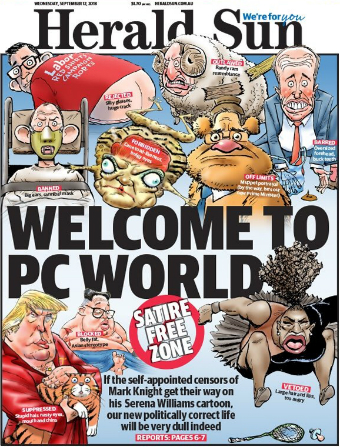
There have been some new developments. The cartoonist, Mark Knight, has suspended his Twitter account because of all the hate coming his way. Knight said he was amazed at the reaction to his drawing. “I drew this cartoon Sunday night after seeing the US Open final, and seeing the world’s best tennis player have a tantrum and thought that was interesting,” he said. “The cartoon about Serena is about her poor behavior on the day, not about race.”
Popular Australian Broadcaster Neil Mitchell, among others, defended Knight, saying, “This shows an awful misunderstanding of Mark Knight and this country. I looked at that cartoon and it didn’t even cross my mind it was about race. It was a sports bully, a petulant child throwing a tantrum about losing…I drew her as an African-American woman. She’s powerfully built. She wears these outrageous costumes when she plays tennis. She’s interesting to draw. I drew her as she is, as an African-American woman.”
As I have explained elsewhere on the Ethics Quiz thread, the reason I made the issue a quiz rather than an ethics position post is that Knight’s cartoon struck me as raciallyprovocative.
I believe it is racially insensitive, but I am not certain that in the field of opinion cartooning racial sensitivities should be ignored. If a white, male player who behaved like Williams—it is astounding that so many pundits are defending her—a mocking, tough cartoon, showing ugly conduct by portraying its perpetrator as symbolically ugly would be appropriate. I do not think it is fair or healthy for special immunity to be granted to a similarly misbehaving player, especially a repeat offender like Williams, because of her race and gender. This why my vote in the poll accompanying the quiz was the somewhat tongue-in-cheek, “Whatever it was, she deserved it.”
That response has gleaned 13% of the votes, with over 72% voting for the position that it’s just a cartoon. Against the 85% that are inclined to support Knight (all old white men who are constitutionally unable to recognize sexism and racism, according to one unbiased, unbigoted commenter), 14% agree that the cartoons is “racist.”
To its credit, Knight’s paper, the Herald Sun, took the remarkable step of devoting its entire front page to Knight’s defense, which you see above.
One of the reasons I didn’t pursue doing political cartoons is because… no matter how much I practiced at it, I am absolutely awful at caricature. I tried drawing John Kerry dozens of times, and could never get it down. (Not that it ended up mattering.)
The image of Serena Williams has been called ‘something out of 1910,’ which I think it an exaggeration. However, the large lips, even the ponytail pointed straight up… to me, it does invoke some insensitive imagery of old caricatures and similar things. Maybe even the pose itself, her being completely in the air, maybe that is bothering some people for possibly comparing her motion to that of primitive man, or even that particular animal that racist jerks compare persons of color to. But that might be a stretch.
Again, that’s just my interpretation. I am not ascribing blame or intention. All I’m saying is… if the cartoon looked indubitably like Serena Williams, people would have a lot less to complain about, even if you could focus on part of it and say it parallels older racist art.
If it were me drawing this cartoon, I would have had Serena facing away from the ‘camera’ if I couldn’t make it look like her. The whiny facial expression isn’t important visually. We see her stomping the racket to pieces and the pacifier. The intention is clear. And thus, now that face is all we’re talking about. Continue reading →
1. Serena ethics updates An indignant Facebook friend appeals to authority by telling me that Chris Evert and Billie Jean King are defending Williams, and that they know more about professional tennis than I do. That’s a classic appeal to authority, and a very lame one. What a surprise that female tennis superstars have each others’ back! Chris and Billie Jean sure aren’t ethicists. I’d love to interview them. “So you believe that coaching from the stands, even though forbidden by the rules, should be allowed? Do you think that an unknown player who behaved like Serena did would have been treated any differently? Do you think that anyone would be supporting her if she were penalized? Since the record shows that Ramos does not treat men any differently than he treats women on the court, doesn’t Serena owe him an apology? Can you comprehend why calling a ref, whose reputtaion depends on being regarded as fair and unbiased, a “thief” is worse that calling him a “four-letter word”?
I can play the biased expert witness game too: here’s Martina Navratilova’s op ed, which is comparatively ethically astute and tracks with my post in many respects.
The polls about Mark Knight’s “racist and sexist” cartoon has these results:
85% side with Knight. I’d love to hear the explanation of the one voter who said the cartoon was sexist but not racist.
The reason I made the issue an ethics quiz is because I’m really torn in the issue. Yes, cartoons of blacks employing exaggerated features naturally evoke Jim Crow and minstrel show racist images. But political cartoons exaggerate features, often in unflattering ways. That’s the art form. Does this mean that blacks are immune from ever being portrayed cruelly in a political cartoon? I think that’s what the anti-Knight contingent is arguing.
My view is that double standards are destructive and unethical. By the by, were Jimmy Carter’s lips that big?






 Ethics Alarms