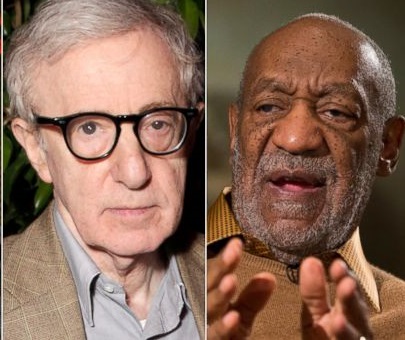
No, There’s No Comparison Between Bill Cosby And Woody Allen And No “Double Standard”

One of these things is not like the other....

One of these things is not like the other….

Newspapers should make us more informed and smarter, not less informed and dumber. Thus a Washington Post feature this morning qualifies as journalism malpractice, incompetence exemplified. Its theme: “Gee, why is Woody Allen signing a new deal to do a streaming comedy series for Amazon, while Bill Cosby lost his deal with NBC?” The print edition sub-heads: “Crisis responses may explain…”

No, they don’t. This is a false comparison based on superficial similarities: two comics who initially peaked in the same era, both in their seventies, shadowed now by sex scandals. The effort to use one to question the treatment of the other is either intellectually dishonest or so analytically unsound that it should forfeit the authors’ privileges of being assigned to write anything for mass consumption (the Post piece is by Stephanie Merry and Amy Argetsinger, and shame on them). The question of why Allen and Cosby are being treated differently in the court of public opinion isn’t worth asking, but since they asked, here are the obvious answers:

1. Woody Allen’s art, comedy, and persona have never had anything to do with virtue, stable families or being any kind of a role model. As a performer, he has presented himself as perpetually horny, neurotic, obsessed with sex and masturbation, prone to lying, and open to adultery, betrayal, stealing friends’ lovers; in “Manhattan,” he happily romanced a virtual child. In real life, he says things like “The heart wants what the heart wants,” which is a  rationalization for any act unethical or illegal, involving sexual or romantic desire. If you were ever a fan of Woody Allen after the age of 13, you were so because he was funny, accepting the fact that he is at best a sexually obsessed, maladjusted creep.

None of this is true of Cosby, who has always aimed his comedy at innocence, functional families and traditional virtues, and represented his own values as consistent with these when speaking for himself. Sex was not any part of Cosby’s art or image. He was an iconic good guy. Continue reading
Unethical Web Site Of The Month: No Hate Speech Movement

hand over mouth

Right before the Paris terrorist attack on “Charlie Hebdo” I was going to post about No Hate Speech and decided, “Eh, this is too stupid.” Then, reflecting upon it in the light of the occurrences in subsequent days, I realized most of the many, primarily  young people, mostly well-meaning, sensitive, loving individuals who are represented on this almost unnavigable website—I hate that— would be making excuses for the Islamic terrorists who executed the French cartoonists, since by their definition, they engaged in “hate speech.”  ( “Of course terrorism is wrong, but...”)  They ended it too, didn’t they? At least they ended those particular speakers.

Free speech is being whittled away by the attempts to define free speech as excluding “hate.” Democratic Senator Ed Markey from Massachusetts—you know, that cradle of freedom, democracy, protestm ringing words, and me—has  introduced legislation calling for the government to investigate “hate speech” on broadcast, cable, and Internet outlets. As Alan Derschowitz noted, the effort and the logic surrounding the bill endangers liberty:

“It is a worthy effort, but my prediction is that it either leads to the conclusion government cannot do it, or that they will do it and that will infringe on First Amendment rights. Governments are trying to also make changes to hate speech law and debating the issue in Canada, at the United Nations, and even right now in Israel. It is a worldwide trend, but it is a really dangerous trend.”

I guess because Derschowitz is an upstanding Democrat, he can’t bring himself to say that it is not a worthy effort. It is an irresponsible trend, with a campaign that depends on ignorance, historical amnesia, naivete and hypocrisy. I was trying to remember why I, last year, allowed a passionate and prolific commenter who was prone to rash and obscene language, often attacking other commenters. NOW I recall: This was the reason. The movement to censor “offensive” speech is a leap onto Markey’s slippery, censorious slope. Hate is a legitimate, if ugly sentiment, and it has its place. That place is in our heads, and sometimes, out of our mouths or pens. You don’t like it?  I’m listening. I lost a lot of readers who were offended by Scott’s remarks. Well, I decided that that the ethical thing was to let those who objected 1) learn not read his comments or 2) talk him out of it. Continue reading

Ethics Quote Of The Month: Washington Post Film Critic Ann Hornaday on “Selma”

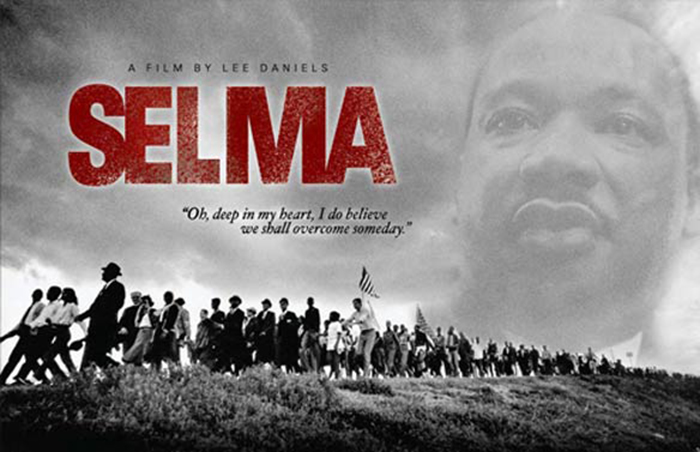
selma-movie

“How to reconcile facts and feelings, art and fealty to the truth? When filmmakers recall with pride about the deep reporting and research they’ve done for their projects, then they deserve to be held accountable for their projects. For fact-based films, accuracy becomes a formal element, along with acting, design and cinematography. It’s up to each viewer to identify the threshold where artistic license compromises the integrity of the entire endeavor. Cinema has more responsibility in this regard precisely because of its heightened realism, its ability to burrow into our collective consciousness and memory, where the myth has a tendency to overpower settled fact. But viewers have responsibilities, too. If accuracy has become a formal element of historical dramas, then the ensuing fact-checks have become just as integral a part of how we view them. That means it’s incumbent on audiences to engage in a mode of spectatorship that, rather than decide who’s right, can listen to and respect expert critiques, and still open themselves up to a piece of filmed entertainment that speaks to less literal, more universal truths.”

—–Ann Hornaday, Washington Post film critic, on the controversy regarding the counter-factual treatment of President Lydon Johnson in the new film, “Selma.”

The question of whether film makers have an ethical obligation to fairly represent history, and particularly individual historical figures, in their movies has been a topic visited frequently at Ethics Alarms, and I’m not going to re-hash conclusions that have been thoroughly discussed before, such as

…here, regarding the casting of “The Impossible” with a gleamingly light-skinned central family and the changing of the real life heroine from Spanish to British

…here,  discussing complaints that a fictional event was not portrayed accurately in “Noah”

…here, exploring the many falsehoods, some quite despicable, in James Cameron’s “Titanic”

…here, regarding unfair criticism of “Argo”

and here, discussing “Lincoln” screenwriter, playwright Tony Kushner’s inexcusable choice to represent a real life former Congressman voting against the Thirteenth Amendment abolishing slavery when in fact he voted for it.

The conclusion of that last one sums up the lessons of the rest, I think. Kushner’s defense against criticism of the collateral damage his invented facts wreaked was to argue that they were legitimate tactics in the pursuit of drama and “greater truths.” He then compared smearing the reputation of a Congressman, to the detriment of his descendants, to misrepresenting the kinds of socks Lincoln wore. (Kushner can be a brilliant writer, but his ideological utilitarianism is repellant.) I wrote:
Continue reading

“Doonesbury’s” Unethical Late Hit On The University of Virginia

Doonesbury

The Rolling Stone-“Jackie”-University of Virginia ethics train wreck has claimed another victim, and an unlikely one: “Doonesbury’s” characters, who have been led astray by cartoonist Gary Trudeau and the newspapers that carry his popular strip.

In the episode that ran yesterday, the campus bimbo-turned-feminist “Boopsie” ranted about sexual assault cover-ups of by institutions, and singled out the University of Virginia as a culprit, forbidding her college age daughter from attending school there. [ Notice of correction: I am informed by a reader that “Sam” is Boopie’s daughter, not her son as I wrote originally. Thus she is forbidding her daughter from attending a school where she thinks she is likely to be raped, rather than forbidding her son from going to a school where major magazines will unjustly accuse his fraternity of being a cult of rapists. I apologize for the error.] The premise was based on the anonymous allegations of a fraternity campus assault that were turned into a sensational expose by a feminist reporter with an agenda, and guilelessly published in Rolling Stone without confirmation, fact-checking, or a minimal level of ethical journalistic practices. “Jackie’s” rape accusations have been shown to be substantially or completely fabricated, and story has been thoroughly discredited for more than three weeks.

Why are Trudeau and his fictional creations still calling UVA a hotbed of sexual assault? There are several reasons: Continue reading

Ethics Dunces: Bitter, Spoilsport, Fuddy-Duddy Republicans and Conservatives

Nope, no Republicans there...

Nope, no Republicans here…

A grand welter of celebrities ranging from Pussy Riot and Paul Krugman to Willie Nelson and Big Bird joined comic Stephen Colbert in his farewell to Comedy Central, as he prepares to step into David Letterman’s shoes and hopes to do a Jimmy Fallon as Dave’s (overdue) replacement, rather than a Conan O’Brien. Obviously the producers and Colbert sought a ridiculously diverse group symbolizing U.S. culture and whimsy, and sent out invitations far and wide. Instead, the got an overwhelmingly liberal and progressive group that may make up half of MSNBC’s total viewership, a group that would almost all have been at home on the floor of the Democratic National Convention.

Don’t blame Colbert. It was clear that ideological animus with Colbert’s almost entirely anti-conservative schtick was no bar to the option of participation. Republicans and conservatives, however, almost unanimously decided to sulk, stay home, and boycott the party. Continue reading

Cellphone Videos Of Stand-Up Comedy Routines Are Unethical: Ban Them

no cell phonesVulture features an interview with Chris Rock, on which he waxes forth on many topics.I don’t especially care what Chris Rock has to say about Ferguson, but I care a lot about his views on stand-up comedy, where he qualifies as an expert, and the disastrous effect unauthorized videos are having on his art.

Rock has walked off the stage in appearances when he couldn’t stop audience members from filming him, and for very good reasons. He doesn’t want untested, half-baked material to get out to the public via YouTube:

“There are a few guys good enough to write a perfect act and get onstage, but everybody else workshops it and workshops it, and it can get real messy. It can get downright offensive. Before everyone had a recording device and was wired like Sammy the Bull, you’d say something that went too far, and you’d go, ‘Oh, I went too far,’ and you would just brush it off. But if you think you don’t have room to make mistakes, it’s going to lead to safer, gooier stand-up. You can’t think the thoughts you want to think if you think you’re being watched.”

On Elahe Izadi’s Syle Blog in the Washington Post site, other comics voiced similar concerns. Continue reading

Comment of the Day: Daily Comics Ethics: When Did Erection Gags Become Appropriate For The Funny Pages?

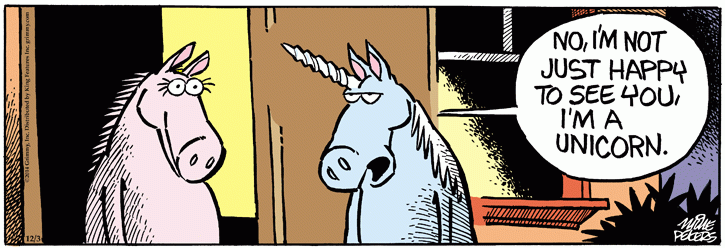
unicorn

Traversing such seemingly unrelated topics as aphrodisiacs, “Mr. Ed,” post-war culture, literacy, and the evolution of childhood,  Penn’s Comment of the Day is one of my all-time favorites. Here it is, a response to the post, “Daily Comics Ethics: When Did Erection Gags Become Appropriate For The Funny Pages?” I have a lot of reactions, but here are three:

  • If kids really don’t read the funny papers any more, what good are they? Who does read them? The Washington Post and other papers used to take “Doonesbury” out of the section and place it in the main body of the paper on the theory that it’s humor was “adult.” (Of course, “Doonesbury’s” humor has also been non-existent since around 1978—but I’ve never seen an erection joke there, either.)
  • Just because little kids are familiar with the term “horny” doesn’t mean they have any idea of what it refers to.
  • I like the “Mr. Ed” song!

In reply to your rhetorical (and tertiary) query, Jack, you missed (that small part of the) evolution just as we all did and do, because it was an evolution, a slow-moving American tsunami of post-war change beginning in the late 40s.

As a child, I recall controversy, strictly among adults, over things that wouldn’t be even thought of today such as the idea of having a girl (Lois Lane?) take up a weapon against a villain instead of waiting, albeit bravely, for Superman, to come rescue her. It was argued to be unladylike – and therefore, unsuitable for children’s comics — for females to fight for themselves if there was a man around, even as the WACS, nurses and ambulance drivers returned home, joining widowed moms & rosie-riveters in job-hunts. Or unless it was Wonder Woman. And oh the struggles to allow Wonder Woman — she of the skin-molding, crotch-height tights and the noticeable chest bumps, however well armored — into the son’s bedroom. Or the daughter’s wardrobe (next, she’ll want a bra!) Continue reading

Daily Comics Ethics: When Did Erection Gags Become Appropriate For The Funny Pages?

Grimm cartoon

When did I miss the evolution of the newspaper comics, always regarded as the young tyke’s entry into the newspaper perusal habit, into one more entertainment medium requiring ratings and advance parental review? The comic above appeared in today’s Washington Post and elsewhere. I think it’s funny—for a Playboy cartoon. Maybe it’s not too racy for the New Yorker. But the funny pages? Seriously? This is an erection joke! In a strip with Mother Goose in the title! (The strip is “Mother Goose and Grimm” by Mike  Peters, who is also an award-winning political cartoonist.) It refers to the classic naughty line that had censors screaming when Mae West said it (after writing it.) My Dad read the daily comics to me before I could read, then explained the jokes that I couldn’t understand. Is this the kind of joke toddlers will be having explained to them now? Continue reading

How Should We Judge Second Apologies?

Sure, who wouldn't think this was funny coming from a member of your school board?

Sure, who wouldn’t think this was funny coming from a member of your school board?

The most important feature of apologies is that they express sincere and honest regret for the real harm done. If the first apology for misconduct fails that test, how much credence should a second attempt have? Does it negate the first apology completely? Ought it to be read and understood in light of the initial, unsatisfactory apology? Or should it be ignored completely as a public relations document crafted to achieve a result, rather than to express genuine contrition?

The case of Chris Harris, a board member for the Hooks Independent School District in the town of Hooks, Texas, provides a fascinating test.

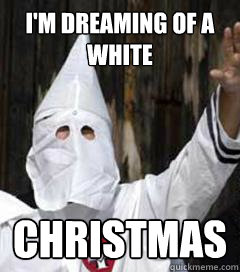
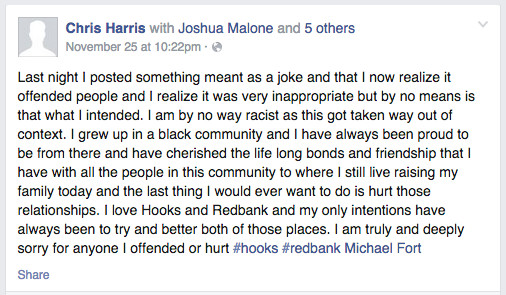
Lat week, Harris posted an image of a Klu Klux Klan member with the caption, “I’m dreaming of a white Christmas”  to his Facebook page. The reaction to this was what almost anyone with a fully functioning cerebrum would expect, a category that Harris does not belong to, or at least did not when he posted it. Perhaps after shouting, “Doh!” or perhaps not, Harris rushed to repair the damage, publishing this apology:

Harris apology 1

Terrible apology! Continue reading

Note To Advertisers: Babies Are Not Props. Do You Really Need To Have That Explained To You?

Let’s take a little break from the Ferguson Ethics Train Wreck, picking up passengers so fast that I can’t keep up with the manifest, and let Bill Cosby hide for a while, as suddenly all sorts of associates and colleagues are finally admitting that he wasn’t such a nice guy even when he wasn’t raping actresses, and focus on some child abuse—but funny child abuse!

Here’s a recent Halos recent commercial:

Wrong. This is an extreme example, but I frequently see infants being used—that’s the clue, “being used”—in TV shows, ads and movies featuring environments and  conditions that have to be stressful. Making babies cry to sell products or tell a story is unethical: they haven’t consented, they are helpless, and doing this to them is an abuse of power. It is also cruel.

How could a set full of techs and actors not feature any faint ringing of a single ethics alarm while a baby was duct taped to the back of a door? One disturbing sidebar to this “funny video”: some idiots have actually done this:

Go ahead, Halos, give those happy child abusers out there some new ideas.

This one was flagged by child actor advocate, and my friend, Paul Petersen, who has taken action to make sure Halo doesn’t engage in this kind of abuse again.

Babies aren’t props. They are human beings, This shouldn’t have to be taught to any adult, but it obviously does.