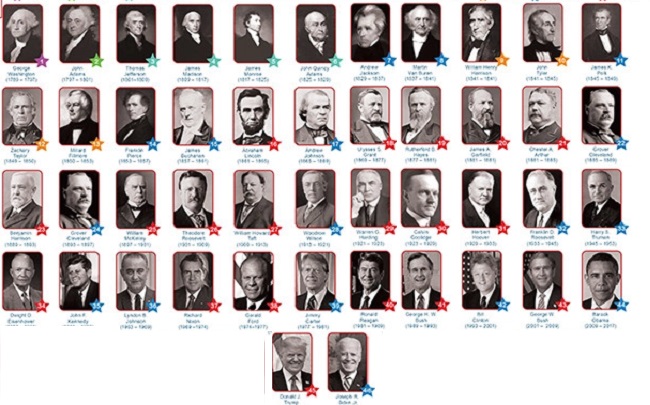
 Usually Ethics Alarms has a special Presidents Day feature, but not this year. I hope the mood passes, but right now I am thoroughly sick of the office. Three passions have driven the course of my life, beliefs, interest, pursuits, education, relationships and careers: baseball, Gilbert and Sullivan, and the Presidents of the United States. At this moment, I am disgusted with two of the three.
The accolades being heaped on Jimmy Carter as he has announced that he will wait to die with his family near rather than seek more medical care further sours my mood, because it cripples me with cognitive dissonance. All Presidents deserve the nation’s gratitude and respect, and Carter has led a life devoted to public service. Yet he was a terrible President, and did as much damage to the nation in his four years as any modern POTUS—at least until Joe Biden arrived.
1. “Red Joan” Not helping my mood was watching “Red Joan,” the 2019 British film celebrating the foolish Melita Stedman Norwood, a British civil servant who became a KGB spy in the post-war years. She was convinced that she was doing a good and ethical thing to send nuclear secrets to Stalin’s government so the USSR could develop its own atom bomb. The movie is fictionalized enough that Norwood, played by Judy Dench, is given a different name (Joan Stanley), but the beliefs she espouses are accurate representations of Norwood’s various explanations and rationalizations.
She thought Communism was the hope of the future; she thought the Russians “deserved” to have the nuclear advances developed by the U.S. and Great Britain shared with them; she thought the US using the atom bomb to end World War II was mass murder; and she believed that giving the Soviets the ability to wield nuclear power would prevent World War III—and continued to justify her treachery with the last excuse after she was exposed and caught in her 80s, taking credit for “saving millions of lives.”
My head exploded when the British nuclear scientist who was her lover erupted over learning that she had sent his work to the Soviets, telling her it was madness to give such secrets to a “ruthless dictator” like Stalin. “But we didn’t know that then!” Joan protests.
That’s what ethicists call “contrived ignorance.” Continue reading





 Ethics Alarms
I dabbled in journalism as an undergrad. Admittedly, that wasn’t exactly last week: the newsroom was stocked with manual typewriters, if that gives you a rough idea. There was no journalism department, and, I believe, only a single introductory course–which virtually no one on the staff of the newspaper took. A bunch of my colleagues turned out okay, though: three that I worked with ended up in senior management positions: one with the Wall Street Journal, one with the International Herald Tribune, one with Newsweek.
I did some day editing, mostly on the arts page; I had a weekly column, and I did a little news reporting. I never sought an upper-level editorial position. It’s possible, perhaps even probable, I could have been arts editor if I’d really wanted the job; I didn’t.
But I did have a lot of conversations about journalism with some people who were subsequently to be very successful in that business. The consensus was that objectivity was a goal, but one it was impossible to achieve. The reasons for this were two-fold. First, you can’t entirely suppress your own life experience, perspectives, and (yes) prejudices. Second, you inevitably interpret the significance of events. If X happened and Y also happened, there are manifold ways of framing the story, using variations on the theme of “despite” or “therefore,” for example. Even saying “X and Y” instead of “Y and X” often betrays a bias.
Continue reading →