
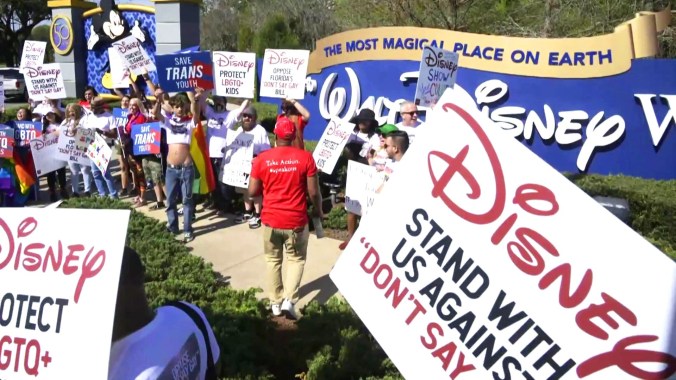
I have been intending to examine the Disney empire’s misbegotten entry into the battle over Florida’s recently passed “Parental Rights in Education” law for weeks, but postponed the project because it is too complicated to do correctly without involving other complex issues that are closely related to it. Unfortunately, these issues have proliferated during the delay.
For example, Florida is threatening to remove Disney’s special status that allowed it to operate Disney World as an autonomous municipal government because of the company’s political action. Is that kind of punishment for a political opposition ethical? Should Disney have such special status, regardless of why it is being threatened with its removal? If the special status should be removed anyway, does it matter if it is done in response to political speech?
Here’s another: Republicans in Congress are threatening to end Disney’s copyright on Mickey Mouse, also in response to its LBGTQ activism. But that copyright should have ended decades ago, and its artificial endurance has stifled creative works blocked by thousands of other drawn-out copyrights that aren’t Disney. Now I am dealing with copyright law policy, the importance of Disney to the culture, and what, if anything, the government should do to–what? Reward it? Strengthen it? Direct it? Control it?
The Disney LGTBQ advocacy issue also involves, as virtually every issue does now, media ethics, as almost all outlets other than Fox have a clear pro-LGTBQ bias. The New York Times reporter assigned to covering Disney and the Florida law controversy is Brooks Barnes, and he can’t be trusted. In an earlier story last month, the reporter wrote,
Earlier in the week, Mr. Chapek, the company’s chief executive, botched an internal email to Disney employees. He was seeking to explain Disney’s public silence on anti-L.G.B.T.Q. legislation in Florida that activists have labeled the “Don’t Say Gay” bill.
Continue reading →




 Ethics Alarms