You know, when I was being sued for defamation by He Who Must Not be Named, the plaintiff told the Massachusetts judge in our hearing that (I’m paraphrasing here, just in case he’s lurking and wants to sue me again) Ethics Alarms was an insane, far-right blog with robotic followers who would march into the sea if I so instructed. This was right before he went on a rant that I was sure would end with him taking out two small metal balls and start rolling them in his hand. This is not a far-right blog, and calling it such is like calling someone who opposes Black Lives Matter a racist. I can’t help it if almost all the ethical breaches are emanating from progressives lately, but it should not require a conservative orientation to condemn them for what they are.
A case in point: The Rutgers University English Department recently announced a list of “anti-racist” directives and initiatives, including an pledge to de-emphasize correct grammar. Rebecca Walkowitz, the English Department chair at Rutgers University, sent the email on “Juneteenth” —she’s so woke!“—titled “Department actions in solidarity with Black Lives Matter.”
[I shouldn’t have to point this out, but I will pause to do so anyway: no department of any institution should develop policies in “solidarity” with any organization or movement. That is not their job or function.]
In order to “contribute to the eradication of systemic inequities facing black, indigenous, and people of color,” among other steps, she wrote, the English Department will begin “incorporating ‘critical grammar’ into our pedagogy.”
“Critical grammar” pedagogy “challenges the familiar dogma that writing instruction should limit emphasis on grammar/sentence-level issues so as to not put students from multilingual, non-standard ‘academic’ English backgrounds at a disadvantage,” her email states. “Instead, it encourages students to develop a critical awareness of the variety of choices available to them w/ regard to micro-level issues in order to empower them and equip them to push against biases based on ‘written’ accents.”
They have no “choices.” They have to learn to communicate clearly, or they will not succeed. Continue reading →
Bulgaria has a holiday called “July Morning” that celebrates freedom, friendship, and love of life.
Maybe I’ll move to Bulgaria…
1. I cannot believe this doesn’t alienate more people than it pleases. I watched the Red Sox-Orioles game last night to open the Strangest Baseball Season Ever in Boston, and would have enjoyed it completely ( the Sox won 13-2) had I not had to constantly avert my eyes from the Red Sox management’s ostentatious virtue signaling, if you can call it that, since pandering to Black Lives Matter is far from virtuous.
Not only was the special BLM MLB logo at the back of the pitcher’s mound (BLM MLB is a palindrome!), but the full Black Lives Matter name was emblazoned on a banner, about 250 feet long, across the empty bleachers.
I’d love to know how many Red Sox executives, or if any of them, actually know what the “movement” the team is pimping for intends. My guess is that the decision to promote BLM was a cynical go along to get along decision that had nothing to do with substance, but rather was made in fear and expediency.
2. On the Fox News harassment accuser. The sexual harassment lawsuit filed against Tucker Carlson by Cathy Areu now appears to have fatal flaws. Continue reading →
I am most grateful—I think—to Ethics Bob Stone for bringing this story to my attention. It gives me hope, it really does, that we are quickly arriving at the point where the George Floyd Ethics Train Wreck will be revealed to all as being driven and enabled by people so silly and stupid, that there will be an ear-splitting slapping sound across the land, as Americans of sense and perspective bring their palms to their foreheads in the humbling realization that they have been taking seriously the blathering of fools and ignoramuses.
And with a ripple of embarrassed laughter, the suddenly enlightened will immediately begin going about life as they once did, devoid of self-flagellating guilt for believing in a land and a system where people are, or should be, judged by their talents, enterprise, accomplishments and the content of their character, and not, whether black, Black, white or other hues and shades, the color of their skin, their ancestors, or what their ancestors did or didn’t do. Thereafter this period of unrestrained hate and statue-toppling, the cancel culture, fear, groveling, virtue-signaling and grandstanding will come to be known as “The Great Stupid,” and we will collectively wonder, as with the Dutch Tulip Mania of the 17th Century and Disco, how the Hell something so mad could have happened, and for so long. Continue reading →
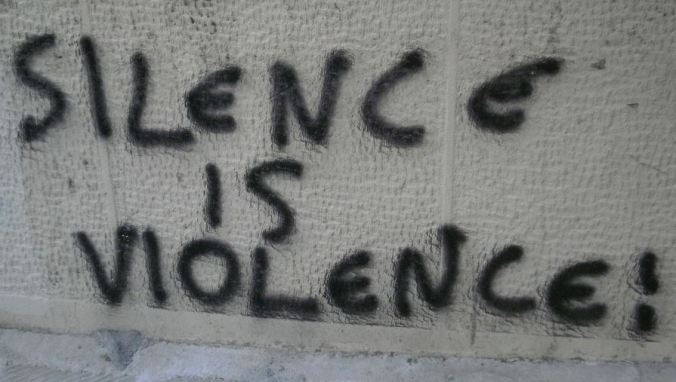
The epic, two-part Comment of the Day by Steve-O-In-NJ spawned a another Comment of the Day of perception and edge, this one by Humble Talent. His topic is the slogan “Silence is violence,” another example of a deft Comment of the Day saving me time, for I was going to have to post on it if someone else didn’t. That bumper-sticker line irritates me almost as much as “No justice, no peace,” “Black lives matter,” “Believe all women,” Give peace a chance,” “Better Red than dead,” and “Go Yankees!”
One of the tropes coming from the left in this latest bout of medical withdrawal guised as activism is that “Silence is Violence”. This in the latest variation on the theme of the left’s stretching to unrecognizability the definition of violence. No, silence is merely inconvenient for people looking to uproot the status quo.
Similar to that is speech. “Free speech” is one of the most commonly misused terms on the internet. The first amendment doesn’t protect you prom private individuals. A principled free speech position doesn’t require the right to an audience. There is no duty to listen. I actually think that “Free Speech” would be better understood if it were also approached from the inverse: Free speech includes the right to hear what someone wants to tell you.
Alizia made a comment recently, predicting that I would eventually speak in favor of the suppression of free speech because I wouldn’t speak out against Viacom firing a fellow after said fellow spouted anti-Semitic rhetoric on the air. I don’t think I’ll ever get there. But I do think we all need to take a step back and re-evaluate what things mean.
For instance, a “counter protest” is speech, but if the counter protest is designed not to respond to speech, but to drown it out and to prevent people from hearing the speaker they want to hear, not only does that violate free speech principles, but hiding behind free speech to conduct a counter-protest is hypocritical. A principled position is not a suicide pact. I don’t think we have a duty to humor the calls for free speech from the people actively violating yours. Sure, a protest is speech, but what’s going on here isn’t simply a protest, and it’s not just speech. Continue reading →
1. Our trustworthy news media, which we can trust to behave like this... From my AOL news feed: “Trump says he may not accept 2020 election results.” From the transcript of the Chris Wallace interview that the headline is referring to:
WALLACE: Are you suggesting that you might not accept the results of the election?
TRUMP: No.
What the President would not do is promise to accept the results if there were a valid reason not to accept the results. Once Al Gore challenged the Florida vote count after Bush had been declared the winner in 2000, the long standing precedent, followed by election losers like Andrew Jackson, Samuel Tilden and Richard Nixon, all of which had reasons to question the results in their contests, of accepting defeat without a challenge was erased. If any of it remained at all, Hilary Clinton’s pursuit of some way of reversing the Electoral College tally in 2016 completed the job. Trump’s refusal to promise a return to the old tradition is reasonable, especially with the chicanery enabled by mail-in ballots. What Joe Biden has suggested, despicably, is that Trump will not give up the Presidency even if he is defeated unequivocally and fairly. There is no justification for suggesting this. There is far more reason to believe that any Trump victory, even a resounding one, will send angry and frustrated Democrats into the streets
Trump, as usual, was trolling with his coy response here…
WALLACE: There is a tradition in this country — in fact, one of the prides of this country — is the peaceful transition of power and that no matter how hard-fought a campaign is, that at the end of the campaign that the loser concedes to the winner. Not saying that you’re necessarily going to be the loser or the winner, but that the loser concedes to the winner and that the country comes together in part for the good of the country. Are you saying you’re not prepared now to commit to that principle?
TRUMP: What I’m saying is that I will tell you at the time. I’ll keep you in suspense. OK?
TRUMP: And you know what? She’s the one that never accepted it.
WALLACE: I agree.
TRUMP: She never accepted her loss and she looks like a fool.
This isn’t a topic he should be playing with, because the Democrats and the news media will claim that something sinister is in the works. Trump gives a strong hint of his real meaning: if Hillary looked like a fool by refusing to accept the election results, he wouldn’t want to behave like Hillary. But the President should have simply said, “If I lose, fair and square, of course I will accept the results.”
He also should have answered Wallace’s question as I would have, by saying, “Chris, the tradition you speak of has been rejected twice by losing Democratic candidates since 2000.”
I thought that a TV version of “The Hard Way” (1991) I watched a bit of until I couldn’t stand any more had wrapped up the all-time prize for idiotic Bowdlerization of movie dialogue with such substitutions as “slug in a ditch” for “son of a bitch.” I mistakenly assumed that the days of red-penciling movie dialogue on the theory that a film’s audiences would be made up of six-year-old Mennonites and 88-year old nuns were long gone. But here was a a 2017 movie with a lot of rough language being made ridiculous by word censorship. “Fuck” was alternately represented by “flock,” “flip,” and “freak.” “Mother-fucker” became “flipper”—in a bar scene, I at first thought a fight started because one character called another a dolphin. “Bitch” for some reason was removed in favor of the word “cuck,” except it was pronounced like “cook.” A character complained about there being “too many cucks in here,” and for a second I thought I was watching “The Great British Baking Show.” All of these strange words ruined the movie, first because the silly replacements turned a smart and moving drama into a absurdist Monty Python skit, and second because the word substitution was so eccentric that I was constantly taken out of the story by wondering, “What word was supposed to be in there?”
In one scene, the protagonist played by Frances McDormand burst into the police station calling the officer played by Sam Rockwell a “fig-head.” Another officer indignantly shouts at her, “You can’t come in here and call a law enforcement officer a fig-head!” Wait–what the hell is a fig head?
This is incompetent and unfair to the film, the artists who made it, and the audience.
3. OK, I admit it, I have no idea what Kanye West is doing. And I don’t care. After announcing he was running for President, then implying that he wasn’t, the mentally ill rapper held a campaign event yesterday highlighted by his criticism of Harriet Tubman on the grounds that she “never actually freed the slaves, she just had them work for other white people.”
This is gallactically stupid, but it’s still smarter than Candidate Trump’s criticism of John McCain’s war heroism. At least Tubman, her family and friends aren’t alive to exact their revenge on West should he get elected.
1. Final plug, as the bat above (and in my hands) reminds me: If you are set up with Zoom (it’s free, you know), you still have time to register for the Smithsonian Associates program tomorrow evening (at 6:45 pm, EST) wherein I hold forth on how baseball has influenced American culture, values and history. Yes, it’s $35 bucks, but it goes to a good cause, and may help the Institute hire more competent employees who don’t peddle junk like the chart on “whiteness.” You’ll be able to ask questions, and I’m storing these experiences for the Ethics Alarms Zoom experience to come. Read all about it here…
The ideology of the racism-training industry …collapses all identity into racial categories. “It is crucial for white people to acknowledge and recognize our collective racial experience,” writes [ Robin DiAngelo, of temporary “White Fragility” fame,] whose teachings often encourage the formation of racial affinity groups. The program does not allow any end point for the process of racial consciousness. Racism is not a problem white people need to overcome in order to see people who look different as fully human — it is totalizing and inescapable. Of course, DiAngelo’s whites-only groups are not dreamed up in the same spirit as David Duke’s. The problem is that, at some point, the extremes begin to functionally resemble each other despite their mutual antipathy…. In some cases its ideas literally replicate anti-Black racism.”
1. This Morning’s Grovel: A white Seattle hairdresser apologized profusely for daring to wear dreadlocks. The key quote: “I have come to understand—far too belatedly—that my hairstyle is harmful.”
To lightly paraphrase Orwell: ‘She loved Big Brother.’
It’s hard to work up any sympathy for people like Irene—weak, ignorant, unwilling to stand up for basic human rights, like being able to wear your hair any damn way you want to. This is yet another of the one-way “rules” that are being delivered by edict as an alleged remedy for “systemic racism”: Blacks can do anything they want to, whites are severely limited. The hair rules: black women can straighten their hair, dye it blonde, adopt any style the choose as a method of self expression, but a white woman who chooses dreadlocks has “harmful hair.”
Those who won’t stand up for their own liberties deserve to lose them. Irene is a fool, and betraying the values of her country. Continue reading →
Upon careful consideration, I think this clip is the fairest representation of what black theater activists on Broadway are advocating:
In Part I of this series, we discussed the dead-end strategy recently pursued by the performing woke of imposing one-way limitations on which actors could portray what roles. Across the full range of group grievance activism, everyone is rushing to try to exploit and capitalize upon the George Floyd Freakout, perhaps recognizing that the present state of self-flagellation and submissiveness by white decision-makers, governments, businesses and other institutions won’t last forever. In their haste, many groups—in this I would include the “resistance,” Democrats and the news media among others—are metaphorically cutting their own throats. This is especially true of the theater community.
A coalition of theater artists called “We See You, White American Theater” has posted online a 29-page set of demands that if adopted, the New York Times opines, “would amount to a sweeping restructuring of the theater ecosystem in America.”
Wrong, Bias Breath! If adopted, the demands would kill commercial live theater, and it is more than half dead already, though most theater community members are in denial.
The list reminded me of the bad old days of the 1960s, when student anarchists, protesting the war in Vietnam, would take over university buildings and then, thinking that they had the upper hand, would submit a list of demands including the Moon and the kitchen sink, many of which had nothing to do with the war at all. This list of demands makes those look reasonable, one reason being that simply reading the 29 pages of arrogant woke-speak is a task few will have the patience to undertake.
I’ll just focus on some highlights. (By the way, you need to know that BIPOC means “Black, Indigenous and People of Color”):
“We demand the naming and acknowledgement of American Indian, Alaska Native and Native Hawaiian tribal land and its Native peoples who have lived, currently live, and will live on the land where any theatre activity happens.”
I hate to keep having to break it to these naifs, but theater is just not that important to most people, particularly those in power. “We have to rename Indianapolis to have theater here? OK—we won’t have any theater then! Problem solved!”
1. I’m cancelling Philip Gallanes. The advice columnist in the Times’ Sunday Styles section has provided some interesting topic for discussion here, but there have to be some consequences for irresponsibly spreading propaganda and falsehoods, even if they are sanctioned by his employers. In response to a “Social Q’s” query from someone who was annoyed that a neighbor had posted a “Defund the Police” sign and asked if it would be ethical to eschew calling the cops if she saw her neighbor’s house vandalized (Answer:Of course not.), Gallanes had to give readers the whole set of George Floyd Freakouts talking points:
“Many of the reports I’ve read about defunding the police focus on limiting the deployment of armed police officers to situations where they may be necessary and helpful — such as violent crimes. Many activists point to the large share of state and local budgets dedicated to police services when many calls to police (about persistent homelessness or family conflicts, for instance) would be better handled by social workers. Why not redirect some police funds to affordable housing and mental health services, they ask?”
Then why not say what you mean, I ask? Defund means defund. I resent this dodge.
“Still others would like to dismantle the current model of policing, as Minneapolis has pledged to do, and reimagine community safety given the frequency with which officers kill unarmed Black men and women.
And how’s that working out so far for Minneapolis, Phil? The frequency in which officers kill unarmed Black men and women is called “infrequently,” and the frequency is decreasing.Continue reading →
Extradimensional Cephalopod lassoed itself a Comment of the Day (I love the image of a cepalopod using a lasso!) with his musings on why races were designated “black” and “white,” since the white/black dichotomy is so frequently used to describe good/evil.
I’ll be back at the end with a rather lengthy discourse of my own on this subject, because it’s a favorite of mine.
I actually find it annoying that on the one hand, human races (groups of humans who share some similarities in appearance) have historically been identified by colors associated with their skin, while on the other hand, completely independently and before meeting humans from other continents on a regular basis, Europeans started to use colors to indicate whether things are good or bad.
This etymology likely came about because when things rot they often turn black, and because blackness implies darkness (the absence of light), which most humans use to evoke ignorance, fear, or bad luck because they can’t see in the dark. (I use the metaphor of darkness in a much more neutral/benevolent sense, but that’s quite rare.) Interestingly, the color white is associated with death and mourning in many Asian cultures.
With the exception of finance (black ink marking positive numbers and red ink marking negative numbers), most historical evocations of the color black indicate evil, corruption, morbidity, or otherwise something negative. “Black heart,” “blackguard,” “black magic,” “black hat,” “black market,” “blackball,” “blacklist,” “black mark,” “black day,” “black comedy/humor”… Continue reading →



 Ethics Alarms