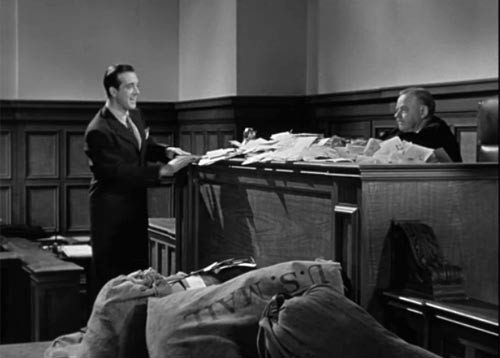
Merry Christmas, Everyone! And Here Is the Final Chapter of “Miracle On 34th Street,”An Ethics Companion, As Kris Kringle Gets His Day In Court [Updated]

It could be argued that the hearing (it’s not a trial) that serves as the dramatic climax to “Miracle on 34th Street” is the most memorable courtroom scene in movie history. That tells us something, though I’m not sure what. A more legally and ethically absurd spectacle would be difficult to imagine.

When we last saw Kris Kringle—if that indeed is his name—he was preparing to go to a hearing in which his sanity would be determined by a judge. (Insert Marx Brothers “Sanity Clause” joke here.) Lawyer Fred Gailey actually quits his law firm to take on the case, which he is handling pro bono. The hearing will he presided over by a judge played by Gene Lockhart, who has impeccable Christmas movie credentials, having played Bob Cratchit in one of the adaptations of “A Christmas Carol.”

The logical, legal and ethical aspects of the story go off the rails quickly, never to return. Mr. Macy orders Sawyer to have the case dropped, which makes no sense: if Sawyer were suing Kris for assault and battery, of if Macy’s had pressed criminal charges, Macy would have some say. But this is the state of New York saying that Kris is a threat to himself and others because he’s deluded. It’s a state matter now.

Sawyer goes to Fred and tries to get him to drop the case, saying “I represent Mr. Macy.” What, he’s a lawyer now? Not only does Macy have no role in this matter, Fred’s defending Kris, not prosecuting the case.

When Sawyer mentions that Macy’s wants to avoid publicity, Fred sees a little light bulb go on in his skull. “Very interesting,” he says out loud. “Publicity. Hmm. That’s not a bad idea! If I’m going to win this case… I’ll have to have plenty of public opinion!” Except that’s unethical. From New York’s Code of Professional Conduct, which wasn’t in force when the film was made but the principles were:

DR 7-107 [1200.38] Trial Publicity.
A. A lawyer participating in or associated with a criminal or civil matter, or associated in a law firm or government agency with a lawyer participating in or associated with a criminal or civil matter, shall not make an extrajudicial statement that a reasonable person would expect to be disseminated by means of public communication if the lawyer knows or reasonably should know that it will have a substantial likelihood of materially prejudicing an adjudicative proceeding in that matter….

Saying that one’s client will need publicity to influence public opinion is a clear statement of intent to violate the spirit if not the letter of the ethics rules. Fred breaches the rules again when he goes to see the judge to persuade him not to sign Kris’s commitment papers. In an adversary proceeding, a lawyer must not meet with a judge without opposing counsel present; that an ex parte communication, and strictly forbidden. Of course, it’s also unethical for the judge to let him do it.

That’s not all in the realm of judicial ethics. After suggesting that the fact that Kris says he’s Santa Claus makes his insanity a forgone conclusion, Judge Harper, who is apparently an elected judge (a situation I regard as a “pre-unethical condition”) is visited by his campaign manager, Charlie, an old pol played by none other than William Frawley, now immortal for co-starring in “I Love Lucy” as Fred Mertz. He suggest that Harper withdraw from the case:

“This Kringle case is dynamite. Let some judge handle it that isn’t coming up for reelection..I’m no legal brain trust. I don’t know a habeas from a corpus. But I do know politics. That’s my racket. I got you elected, didn’t I? And I’m gonna try to get you reelected….You’re a Pontius Pilate the minute you start!”

Then the judge’s grandchildren make a convenient entrance, and snub him because he’s being mean to Santa. Later, when the hearing somehow is turned into a referendum on whether Santa is real, Charlie returns with a dire warning:

Continue reading →

And The Latest Honoree In The Ethics Alarms “Presumed Racism Hall of Fame” is . . .

White judges

Among the bulwarks of the George Floyd Freakout and its accompanying “anti-racism” hustle is that all whites are racists, non-whites cannot succeed, prosper or find justice in the United States, and that anti-black racism should be presumed in any situation where that presumption might advance the cause of a black citizen.

Here is a blazing example, out of Fairfax County, Virginia, virtually in my back yard. Fairfax County Circuit Court Judge David Bernhard issued an opinion his week that the portraits of past judges from the Fairfax County Circuit Court might create the impression that the court itself biased. Bernhard won’t allow any portraits to be on display for any trial he presides over going forward.

“The Court is concerned the portraits may serve as unintended but implicit symbols that suggest the courtroom may be a place historically administered by whites for whites, and that thus others are of a lesser standing in the dispensing of justice,” Bernhard wrote. “The Defendant’s constitutional right to a fair jury trial stands paramount over the countervailing interest of paying homage to the tradition of adorning courtrooms with portraits that honor past jurists.” The judge’s opinion observes that the U.S. is experiencing “heightened attention to the past inequities visited upon persons of color,” so the fact that 45 of the 47 past judges whose portraits hang in the Fairfax County courthouse were white is now an implicit threat to black defendants.

His grovel came in response to a request to remove the portraits in a motion from the layer for Terrance Shipp Jr., who is scheduled to stand trial on charges of eluding police, assault on a law enforcement officer and other counts.

Continue reading →

Unethical . . . But Funny! Well, Stupid, Really . . .

Gross netting

This week, Superior Court Judge Kimberly Knill ordered the billionaire bond investor Bill Gross and his partner Amy Schwartz, to stop violating the noise ordinances of the Laguna Beach municipal code by playing the “Gilligan’s Island” theme song music on their outdoor speakers. Evidence showed that music was played so loudly it could be heard inside neighbor Mark Towfiq’s—he’s also a billionaire— home despite concrete construction and half-inch-thick, dual-pane windows.

Why was the couple inflicting the infamous earworm on their neighbor? It seems the music started when Towfiw objected to the Gross estate erecting the ugly plastic netting around a huge glass sculpture that they had installed in their back yard. When he complained, Gross, 76, and Schwartz, 51 retaliated by claiming their neighbor was a Peeping Tom. Then the the couple started inviting him to sit right down as they told a tale about a three hour tour, night after night.

The litigation, which involved teams of high-priced lawyers on both sides, commenced November 9. A city code enforcement official testified that Gross and Schwartz said they would lower the music if Towfiq dropped his complaint about the sculpture. Towfiq’s lawyers presented a text from Gross responding to their client’s request to turn down the music in which Gross wrote, “Peace on all fronts or we’ll just have nightly concerts big boy.”

Continue reading →

Morning Ethics Warm-Up, 12/23/2020: Stimulating! [Updated]

149326-The-Day-Before-Christmas-Eve

1. President Trump says will veto the so-called “stimulus bill.” He should. A nice, articulate Presidential veto statement about what’s wrong with a pork-loaded goody bag that will increase the National Debt even deeper into the red zone would be nice, but he hasn’t come up with more than a couple a nice, articulate statements in four years, so I rate the likelihood as slim.

But there is no downside at all of a Trump veto, even if Mitch McConnell gets the Senate to over-ride it. As Ethics Alarms commenter Humble Talent pointed out two days ago, the thing is a monstrosity and wildly irresponsible, never mind that virtually none of the elected representatives who voted for it knew what they were voting for.

Meanwhile, let’s give an Ethics Hero call-out to Rand Paul, who anyone could have predicted would have a head explosion over this bill, and he did not disappoint. Senator Paul excoriated his fellow Republican senators who voted for the multitrillion-dollar relief package and omnibus spending bills, saying that they abandoned their “soul” and their “fiscal integrity” for political expediency. Paul called the bill an example of the fantasy that “government can spend whatever it wants without the need to tax.” How can anyone seriously dispute his logic when he said,

“If free money was the answer … if money really did grow on trees, why not give more free money? Why not give it out all the time? Why stop at $600 a person? Why not $1,000? Why not $2,000? Maybe these new Free-Money Republicans should join the Everybody-Gets-A-Guaranteed-Income Caucus? Why not $20,000 a year for everybody, why not $30,000? If we can print out money with impunity, why not do it?”

In addition to Paul, only Republicans Rick Scott (FL), Marsha Blackburn (TN), Mike Lee (UT), Ron Johnson (WI) and Ted Cruz (TX) had the courage and integrity to vote “NO.”

Yahoo News, incidentally, really and truly has a story up titled, “Did Congress get it right with the new coronavirus stimulus?” It really does. Note that it doesn’t begin to cover all the junk that’s stuffed in the bill, because the reporter obviously hasn’t read the whole bill either.

Continue reading →

Tree Day Ethics Warm-Up, December 22, 2020

Tree needles

I’ll be writing this between bouts with the lights. The Marshall Tree was supposed to go up a week ago, then it rained, so the thing had to dry out. Then last week was consumed with an expert witness report, and now this weird tree with long needles and soft branches is standing in my living room, and none of my usual decoration techniques, and probably only 30% of our ornaments, will work with the damn thing. Yesterday I was supposed to hang the lights, and I was so stressed out I couldn’t do it. But today is the day…

1. Anyone surprised at this? A December survey by the international organization More in Common seemed to show that citizens on the far left are the most likely to report negative feelings about the United States.. Only 34% of the group More in Common calls “progressive activists” agreed with the statement “I feel proud to be American.” It was the only ideological group in the survey that agreed with that statement at a rate below 60%

All other respondent groups, including minorities and Americans identifying as politically conservative, strongly agreed with the statement, including 70% of black Americans and 76% of Hispanic Americans. Whites registered a 75% proportion asserting patriotic pride.

100% of the group categorized as “devoted conservatives” said that they take pride in being Americans. 80% of all respondents surveyed said they were thankful to be American, with more than two-thirds reporting a connection to their local communities and fellow Americans. The weakest sense of belonging to the culture and community came from progressive activists and younger respondents.

2. On priority for vaccines...I have read a lot of unethical nonsense being framed as ethics about the question of who should get the vaccine first. I expect to read a lot more. A Times article on the topic says, “Ultimately, the choice comes down to whether preventing death or curbing the spread of the virus and returning to some semblance of normalcy is the highest priority.” Is that really a difficult choice? Obviously the top priority for society in both the long and the short run is to get back to normal as quickly as possible, not to prioritize trying to delay the mortality of citizens who don’t have that long to live anyway. I haven’t heard the “if it saves just one life” rationalization yet, but I’m sure it is coming.

Then there is this: “To me the issue of ethics is very significant, very important for this country,” Dr. Peter Szilagyi, a committee member and a pediatrics professor at the University of California, Los Angeles, said at the time, “and clearly favors the essential worker group because of the high proportion of minority, low-income and low-education workers among essential workers.”

There it is: let’s prioritize by race, because not prioritizing by race is racist.

Continue reading →

And THIS Is Why Celebrities Should Shut Up And Act, Sing, Dance, Look Good, Or Whatever They Did To Get Famous . . .

Banks

Elizabeth Banks, a B+ movie actress whose career zenith was either playing Jeff Bridges’ wife in “Sea Biscuit” or a supporting role in “The Hunger Games” movies, decided to rant about “Stand your ground” laws last week. The impetus was the Ohio legislature passing a version of the law, thus joining about half the states. Banks responded by tweeting, to her

“Stand Your Ground is BS. We used to play hide and seek all over the neighborhood on summer nights. Intent was to play. We were kids but some of my cousins were big guys. There were a few easily-jumped fences in the neighborhood but also houses with no fences at all. A new neighbor moved onto our street. Apparently he mistook us hiding behind trees in his unfenced yard at 9pm for … burglars? Predators?” All of a sudden, an arrow was shot into the tree behind which we hid. From a professional bow and arrow. This guy didn’t yell out ‘who’s there’ or ‘get off my property or I’m calling the cops’ or any other question or warning. He just shot at children. He hit the tree so it was seemingly a warning shot. Message received, WE yelled out that we were just playing and could he let us please run away without shooting. Then we ran.”

“Also sometimes our dog got loose. We would go into yards looking for her. All I can think about when people pretend Stand Your Ground is about anything other than permission to kill people are those moments when I myself stepped onto a neighbor’s property. Where is the evidence that Stand Your Ground does anything but endanger your neighbors, their dogs, their kids? It helps nobody but people who want justified reasons to use a deadly weapon. If I’d been shot and killed playing hide and seek, would that new neighbor have been able to just shrug his shoulders while living across the street from my grieving parents? With laws like this, probably yes.I don’t want to live in a world where we fear our neighbors so much that we can’t freely lose a ball/dog/frisbee or cut through somebody’s yard to avoid harassment — all things I have done. What yards did you wander into and why?”

Observations:

Continue reading →

Comment Of The Day: Ethics Quiz: The French And Indian War Remains

This Comment of the Day by reliably thoughtful commenter JP is exactly what I hoped this particular Ethics Quiz would inspire. Unlike some ethics quizzes, and reminding everyone that an issue isn’t presented as an ethics quiz unless I have doubts about the ethically correct answer, this one has me torn right down the center. The usual ethical systems for approaching a problem are at odds here, making it a true ethics conflict.

Here is JP’s Comment of the Day on the post, “Ethics Quiz: The French And Indian War Remains”:

I think the simple answer is that depends.

There any a lot of laws in the context of digging up graves that often vary between state and context. The United States pretty much has a statue of limitation on 100 years for excavation (not to be confused with common graverobbing). I imagine this is because it is far outside any claim a family member might have. Jack alaudid to the Native American Graves Protection and Repatriation Act which protects remains on federal or tribal lands. These rules were essentially created to protect the living. The purpose of their creation is what I believe is at the heart of understanding if the act is ethical or not. The first question I would ask: who does it hurt?

Continue reading →

Saturday Morning Ethics: Christmas Countdown Edition

The story of that Christmas classic, Bing’s last holiday hit and also the last popular Christmas song that references its religious origins, is here.

I almost called this post the Clinton Impeachment Anniversary Edition, but decided to be more upbeat. It was on this date that William Jefferson Clinton became the second U.S. President to be impeached. Like the first, the unfortunate Andrew Johnson, Clinton was acquitted in the Senate. Also like Johnson, Clinton was impeached for genuine reasons consistent with the Constitution’s requirements. The next impeachment—did you notice how Democrats never mentioned it during the 2020 campaign?—-was very different: the Democratic House just decided it wanted to impeach President Trump and contrived an excuse to do it after three years of searching.

As veteran readers here know, it was the near complete absence of ethical analysis from the news media during Monica Madness and the mountain of rationalizations and obfuscations employed by Clinton’s defenders that prompted me to launch The Ethics Scoreboard, which in due course led to Ethics Alarms.

1. A bar exam ethics train wreck in California. The ABA Journal reports that more than 3,000 law school grads who sat for the State Bar of California’s remote October exam had their proctoring videos flagged for review, and dozens report receiving violation notices from the agency’s office of admissions. The issues flagged appear to be largely technology-based, and many claim they had no indication of a problem until they received violation notices. The flagging will create serious problems for those involved. A Chapter 6 Notice, as it is called, allows an applicant to respond in writing before any finding is made. If there is a determination that a test-taker violated procedures, bar actions could include warnings, a score of zero for the flagged sessions or the entire exam and negative marks on character and fitness evaluations, endangering the applicant’s prospects of receiving a license.

An individual can challenge the office’s determination and request an administrative hearing, and an unfavorable outcome can be appealed with the Committee of Bar Examiners and the California Supreme Court. However, those applicants’ October bar exam scores will be in limbo while hearings and appeals are resolved, and they will not be able to take the February 2021 exam when determinations of previous scores are pending.

The violations cited include examinees’ eyes being intermittently out of view of their webcams, audio not working; and test-takers not being present behind their computers during the exam. In other words, this is another disaster created by pandemic hysteria and technology unsuited to the challenge of providing an adequate alternative to in-person activity.

Continue reading →

Waning Thursday Ethics Wrap-up, 12/17/2020: Baseball, Football, And The Ripper

Traffic has been sluggish this week. I wonder if the blog is depressing people….I know it’s been depressing me.

1. A confirmation bias classic. I decided to watch the new Netflix documentary about the hunt for “the Yorkshire Ripper,” Peter Sutcliffe, only because Grace and I had been on a Jack the Ripper binge of late, including the well-done (but completely fictional) Johnny Depp film, “From Hell.” I did not expect “The Ripper” to tell one of most instructive tales of how bias makes you stupid as well illustrating as the perils of confirmation bias, but that’s what it does.

Sutcliffe, a Yorkshire truck driver, murdered 13 women and attacked nine others, but police missed him for five years because they convinced themselves that he only killed prostitutes. This, in turn, led the newspapers to name him after Jack the Ripper, the mysterious serial killer in Victorian London who killed and mutilated five prostitutes in 1888. The name, in turn, reinforced the bias that a Jack copycat was whom they were seeking. As a result, women who were not prostitutes and had been attacked by Sutcliffe were ignored when they went to the police.

With their investigation foundering, police officials decided that letters from someone claiming to be the Ripper were genuine—Jack the Ripper also wrote letters to the police, you see—and a tape recording referring to the letters must have had the real killer’s voice on it. So they had a speech expert identify the accent of the speaker, which placed him in a very small area in Yorkshire. Any suspect who didn’t have that accent was eliminated….including Sutcliffe, who was interviewed nine times. By the end of his rampage, Sutcliffe wasn’t killing prostitutes any more.

Sutcliffe was eventually captured by accident. Says one of those interviewed for the project: “No wonder the police couldn’t catch him. They were chasing a mythic Victorian maniac instead of a real man.”

Continue reading →

The Hunter Biden Laptop Story Suppression

Hunter and Joe

When people—like me—say that the 2020 election was stolen, they are not necessarily claiming that mass voter fraud changed the winner. They—and I—are saying that our democracy was not allowed to work because of a de facto conspiracy of the Big Tech firms and the mainstream news media to withhold important information from the voting public that they not only had a need to know, they had a right to know, in order to make an informed decision at the voting booth, or, sadly, the mail box. This was a disinformation campaign of more than four years in duration, but the latest example has proven to be the most infuriating: the suppression, in the closing weeks of the campaign, of the news that suspicious emails pointing to extensive influence peddling by Joe Biden’s black sheep son had been found on a discarded laptop belonging to the younger Biden.

Because there is disinformation about what happened still being peddled in the comments here, I’m going to revisit the issue. It raised its hoary head again after it was announced—by Hunter, a convenient distance from the election— that the Justice Department was investigating him over “tax’ matters. This, it should be said, was more obfuscation and misdirection. The documents published by the NY Post the in the weeks before the election—and subsequently buried and discredited by the rest of the news media— contained information about that, but we now know the investigation has been far broader. We know because now that the election is over, and Biden safely elected, reporters are finally asking questions.

Politico reported Monday night that “The federal investigation into President-elect Joe Biden’s son Hunter has been more extensive than a statement from Hunter Biden indicates,” Specifically, “the securities fraud unit in the Southern District of New York also scrutinized Hunter Biden’s finances”; “investigators in Delaware and Washington were also probing potential money laundering and Hunter Biden’s foreign ties”; and “federal authorities in the Western District of Pennsylvania are conducting a criminal investigation of a hospital business in which Joe Biden’s brother James was involved.” CNNs Shimon Prokupecz reported that “at least one of the matters investigators have examined is a 2017 gift of a 2.8-carat diamond that Hunter Biden received from CEFC [China Energy’]’s founder and former chairman Ye Jianming after a Miami business meeting.”

Incidentally, here is Politico’s stance before November 2:

Continue reading →