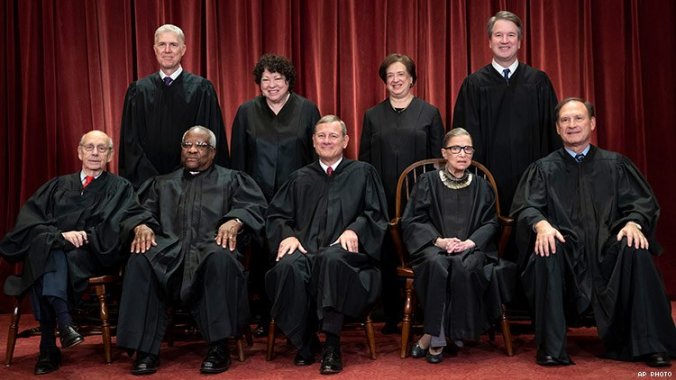
In an article yesterday in The Hill, Constitutional Law expert Professional Jonathan Turley proclaims that Justice Neil Gorsuch is owed an apology by the Washington political establishment (meaning D.C. Democrats and progressives) which had labeled him a “rubber stamp” and a right wing ideologue in the course of its non-stop wailing about the loss of Obama nominee Merrick Garland, the victim of a ruthless bit of partisan maneuvering by Mitch McConnell. One would have thought that Gorsuch had conspired with “Cocaine Mitch.”
Turley (who testified on Gorsuch’s behalf, so his essay has more than a bit of a smug “I told you so!” ring), focuses particularly on yesterday’s SCOTUS ruling in U.S. v. Davis, in which Gorsuch joined to so-called liberal wing to strike down an ambiguous law that allowed enhanced penalties for a “crime of violence.” Turley was impressed that Gorsuch squared off against Supreme Court rookie Bret Kavanaugh, whose dissent seemed to be based on a version of the “Everybody does it” rationalization, arguing that the statute was used in “tens of thousands of federal prosecutions” for over 30 years and calling it “surprising” that it should suddenly be ruled unconstitutional. Continue reading →
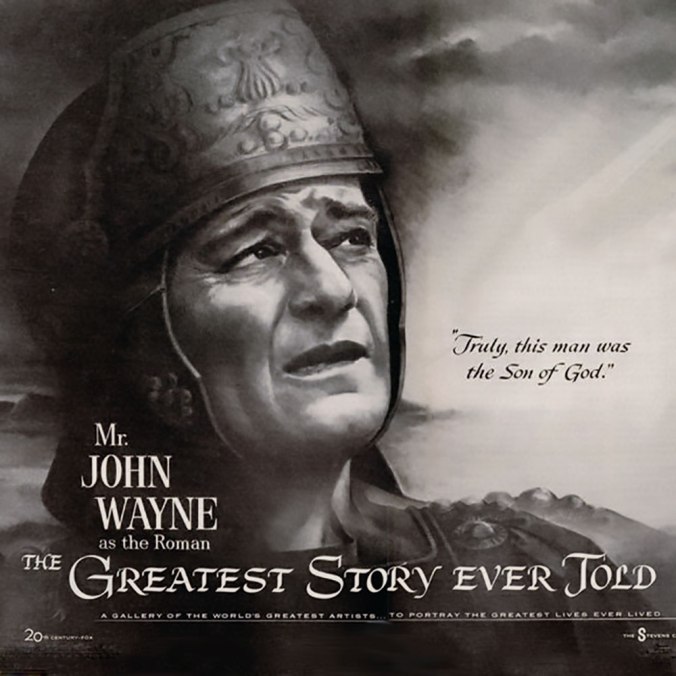
The movie “The Greatest Story Ever Told” was far from the “Greatest Movie Ever Made,” as the Duke’s casting as a Roman soldier demonstrated vividly.
OK, not really, but it better be good after yesterday’s potpourri never made it off the launch pad due to a series of unfortunate events. I’m using “The Greatest Legal Ethics Seminar Ever Taught!” as a title for an upcoming program I’m writing now, so the rhetoric is on my mind. My teaching partner complained that the title really puts the pressure on us to be outstanding. And that’s the point…
1. Harvard’s new President punts.Of course. The Harvard alumni magazine this month was notably light on criticism of the Ronald Sullivan fiasco, with only two critical letters on the topic, one of which made the suggestion that it might be a “conflict of interest” for someone who is defending a #MeToo villain to also serve as a residential faculty member (what was previously called a “House Master,” but that triggered some delicate students who felt it evoked slave-holders. No really. I’m serious. I don’t make this stuff up. Organizations capitulate to these complaints now, like Major League Baseball changing the name of the “Disabled List” because disabled rights activists complained). It is assuredly NOT a conflict of interest, though, by any definition but an erroneous one.
Deeper in the magazine, we learn that new President of Harvard, Lawrence Bacow, was asked during a faculty meeting about his views on the episode. His response was essentially a Harvard version of Ralph Kramden’s immortal “huminhuminahumina” when “The Honyemooners” hero had no explanation for some fiasco of his own engineering. Bacow said he would respect “the locus of authority,” meaning College Dean Rakesh Khuratna, who fired Sullivan after joining in student protests over the law professor and lawyer doing exactly what lawyers are supposed to do.
So now we know that, not for the first time, Harvard is being led by a weenie. What should he have said? How about “I am firing Dean Khuratna, and offering Prof. Sullivan his position back. Any Winthrop House students who feel “unsafe” are welcome to transfer to Yale”?
Most news media gave inadequate coverage to this story, and none, in my view, sufficiently condemned the university’s actions or the un-American values they represent. At least the New York Times is keeping the episode before its readers by publishing an op-ed by Sullivan titled “Why Harvard Was Wrong to Make Me Step Down.”
2. Insuring the life of a son in peril. Is this unethical somehow? It honestly never occurred to me. When I had to give a speech in Lagos, Nigeria, one of the most dangerous cites on Earth, my wife tried to take out a policy on my life with her as the beneficiary. I thought it was a good and prudent idea. But in Phillip Galane’s “Social Q’s” advice column, a son writes that he is still angry, decades later, that his late father did this , writing in part, Continue reading →
For more than a decade, Walmart used middlemen to make dubious payments to governments around the globe in order to open new locations, United States prosecutors and securities regulators said in a settlement agreement on Thursday. But even as employees frequently raised alarm, the company’s top leaders did little to prevent Walmart from being involved in bribery and corruption schemes.
That lack of internal control led to a seven-year inquiry that culminated on Thursday with Walmart’s Brazilian subsidiary pleading guilty to a federal crime. The guilty plea, and the $282 million in fines that Walmart has agreed to pay, capped one of the biggest investigations ever under the Foreign Corrupt Practices Act, which makes it illegal for American corporations to bribe overseas officials.
“Walmart profited from rapid international expansion, but in doing so chose not to take necessary steps to avoid corruption,” Brian A. Benczkowski, an assistant attorney general, said in a statement.The investigation, which was conducted by the Department of Justice and the Securities and Exchange Commission, came after The New York Times revealed in 2012 that Walmart had made suspicious payments to officials in Mexico and then tried to conceal them from top executives at the company’s headquarters in Bentonville, Ark. And even when the issues reached the main office, an internal investigation essentially went nowhere.
The remarkable story of how the road to Walmart’s international expansion was paved by bribes is fascinating, and perhaps especially so to me, as I have long identified and inveiged against the coercive and unethical technique among businesses, governments and law firms that I call the “Mission Impossible Directive.” You recall the way “Jim Phelps” (and before him, “Dan Briggs”) got his marching orders for his Impossible Missions Force, don’t you? Continue reading →
1 Every President should be hesitant to go to war. It is amusing watching Democrats and the news media (B.I.R.M.*) trying to thread the needle and criticize the President for pulling back on the decision to retaliate against Iran with a military response, when the Left virtually always protests military action of any kind. It is particularly amusing since the whole Iran confrontation exposes how irresponsible, dishonest, cynical, and cowardly the “solution” to the Iran problem was that President Obama secretly engineered: the “Let’s give Iran billions of dollars back to cause terrorism and chaos throughout the world in exchange for a promise not to nuke Israel until I’m rich, retired, and can’t be expected to do anything about it” plan.
2. About the Massie case. Nobody took the bait and wrote about the Massie Trial in last week’s open forum, so allow me to explain why it’s relevant.
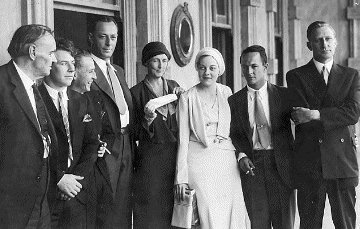
The legal and academic world is still reeling from Harvard’s punishing law school professor Ronald Sullivan for representing Harvey Weinstein, who, the supposedly educated student citizens of Harvard have apparently been taught to believe, doesn’t have a right to a fair trial and a zealous legal defense. In the Massie case, Clarence Darrow came out of retirement in 1932 to defend Grace Fortescue, a rich Southern heiress who had traveled to Hawaii in order to seek justice for her wild and unreliable daughter, who accused five Hawaiian men of raping her. The trial resulted in a mistrial due to a deadlocked jury, ramping up racial tensions between whites and native Hawaiians. Fortescue paid to have one of the native Hawaiians her daughter accused, Joe Kahahawa , kidnapped and brought to her home in Honolulu, where he was tortured and shot. Grace Fortescue, Thomas Massie, and Edward Lord. Deacon Jones were arrested at the scene and charged with murder. Darrow, 74 and long absent from the courtroom, agreed to defend Grace even though she was obviously guilty, a racist, and the kind of rich, privileged bully that he has spent his career opposing.
L to R: Clarence Darrow, Edward Lord, Deacon Jones, Sheriff Ross, Grace Fortescue, Thalia Massie, Thomas Massie, and George Leisure
Why would he do it? Two reasons, said Darrow: he had been wiped out by the Great Depression and needed the money (he was paid $30,000) and he had always wanted to visit Hawaii. Darrow, you see, knew that every defendant deserved the best possible defense, even rich racist murderers. Continue reading →
I am so, so far behind, both here on Ethics Alarms, and elsewhere, like prepping for some upcoming seminars, writing new programs, and trying to get the business and home budgets to work. Last week involved the car dying, getting a new one, enduring a six hour, 17 inning loss by the Red Sox, some lingering new computer glitches, and a major video shoot for which I had to write and refine the script, acquire the props and costumes, and rehearse the actors, then assist the team of seven who handled the shoot itself, all while being sick, and progressively exhausted. (This project would not have all happened without the brilliant and tireless work of my business partner and love of my life, Grace.)
Ethics Alarms was lower on the priority list this week than I would have liked it to have been. I’m sorry.
1. “The Rifleman” Ethics: As I have mentioned here before, “The Rifleman,” the 30 minute TV Western drama, starring Chuck Connors as Lucas McCain that ran from 1959-1962, was all about ethics, with almost every episode teaching an ethics lesson to the Rifleman’s son Mark, played by the charming juvenile actor Johnny Crawford. I just watched an episode from the show’s final season that I hadn’t seen before. Guest-starring Mark Goddard (best known as the hot-headed young co-pilot in the original “Lost in Space” on ABC), the story involved a charismatic young huckster whom Mark admires but his father distrusts. This causes rare friction between father and son. Eventually, Lucas is proven right: the young man is a liar and a crook who was taking advantage of Mark’s guilelessness.
Mark shamefully but manfully tells his father, “I apologize for being wrong.”
NO! One shouldn’t apologize for being wrong. One has an obligation to apologize for doing wrong, which includes making a bad decision because of laziness, carelessness, poor reasoning, inadequate analysis, or through some other failing. There is no shame or blame in being wrong in the kind of situation laid out in the episode, however.
Until the final moments, the audience couldn’t tell whether this would be one of the episodes where Chuck screws up, with the lesson to Mark being, “Jumping to conclusions and judging strangers harshly before you know anything about them is unfair, Mark. You were right. I’m proud of you.”
In fact, after Mark apologized, I expected his father to come back with exactly what I just wrote. This was moral luck: Mark had nothing to apologize for.
Boy, I’m never going to catch up if I let issues jump in line like that…Continue reading →
Have you ever had the experience of knowing immediately and without question that something was wrong, and have everyone around you argue, and smirk, and yell, and posture, and insult, and mock, and still know you are right, and then be ignored only to have the fact show you were right all along, as you knew you would be?
That’s been my experience with marijuana. At this point, I’m no longer angry about it, frustrated or even sad. I’m resigned. I’m not accepting, because that’s not how I’m wired. This isn’t even the only issue like this: I will not be surprised when in future years there will be other cultural suicidal decisions that I (and many others) warned about and tried to explain why they were utterly, stupidly, indefensibly wrong. We may just open the borders. We may gut the First Amendment, or try to ban guns. We may swallow the poison pill of socialism, or worse. I won’t be surprised. I have learned that the entropy of society drifts toward idiocy, ignorance and self-destruction. I know I am lucky that I was born quite a bit smarter than my typical fellow citizen, but they are not lucky that they so, so overwhelm me and people like me when it comes to guiding our cultural ship.
The New York Times article, authored by Kenneth L. Davis, the president and chief executive of the Mount Sinai Health System and Mary Jeanne Kreek, head of the Laboratory of the Biology of Addictive Diseases at Rockefeller University, is titled “Marijuana Damages Young Brains.”
It essentially outlines a public health crisis, and more: it explains that we are not merely legaizing but preparing to market and promote a “recreational drug” that will make the public even dumber and less intellectually capable now than they already are. They write, Continue reading →
You will note that the big hand is on the 6 and little one is on 5, as for some reason I am too tired to recall, my ethics day this day, June 20, 2019, begins with a 6:30 am bar association production meeting for a legal ethics video, and continues unbroken until 9 pm, when I will complete a three hour ethics seminar on the ethics of Clarence Darrow, with the estimable Darrow interpreter, Paul Morella. That’s about 15 straight hours. Who says ethics isn’t in demand?
So once again, I must ask the commentariat here to keep the fire burning and the discussion flowing. Anything goes, as long as it it is on topic and civil.
Maybe you will want to ponder this case, long regarded as Darrow’s ugliest, which I will be discussing today, among others:
Desperately trying to salvage the day with the next one looking worse, and a lot of important ethics matters being swept toward the falls, were they risk being swamped by rapidly moving events…
1. Great sequence, unethical to make it…Not only was D.W. Griffith a film pioneer and a racist, he was also quite mad. If you haven’t see this sequence from D.W. Griffiths’ “Way Down East,” you must. That’s Lillian Gish on the ice floe, and actor Richard Barthelmess trying to rescue her for real. It was shot on a frozen river as the ice broke up, and Gish was really headed over the falls, though they were only a few feet high. No stunt actors were used; Gish’s hair froze and she lost feeling in her hand from the cold. Her right hand was never quite right after that.
Things like this are what made actors’ unions necessary.
2. What a mess. The President’s Secretary of Defense nominee, Patrick Shanahan, resigned from the Acting-SOD role and removed his name from consideration in order to keep his family from being dragged through some awfully ugly mud, very little of which, it seems was of his making or germane to his qualifications for office.
Before their divorce, Shanahan’s ex-wife was arrested after punching him in the face; after the divorce, his son was arrested after attacking and nearly killing his mother with a baseball bat. The Waltons this wasn’t. Shanahan tried to defend his son after that episode, arguing in a message sent to his ex-wife’s brother that his son had acted in self-defense and writing…
“Use of a baseball bat in self- defense will likely be viewed as an imbalance of force,” However, Will’s mother harassed him for nearly three hours before the incident.”
It was expected that Democrats would weaponize the memo against him in hearings, #MeToo-style.
Shanahan told The Washington Post that he wrote the memo in the hours after his son’s attack on his ex, before he knew the full extent of her injuries, to prepare for his son’s initial court appearance. He said never intended for anyone other than his son’s attorneys and his brother-in-law to read it, but, of course, by showing the message to his brother-in-law it was no longer confidential.
Somehow, in a civilized culture, private tragedies like these should not become an impediment to public service. Yet it is hard to imagine how Shanahan thought it would not, since this is not a civilized political culture. Continue reading →
In the comments to yesterday’s post discussing the jaw-dropping ignorance and anti-gun bias displayed by a popular advice columnist, the question again arose as to why anti-gun advocates remain so uninformed about their own passion, and don’t bother to educate themselves sufficiently that they won’t sound like idiots—like, for example, “Ask Amy,” who confused hollow-point bullets with armor-piercing bullets, said the hollow-points were “exploding bullets,” referred to a common and popular handgun as the kind of weapon criminals use, and suggested that owning a gun was a dangerous sign of hidden criminal activity.
I think perhaps because they believe it unnecessary and irrelevant. Guns are bad regardless of the use or competence of the person owning them, and that badness is imputed, in large degree, to their owner. It’s a kind of guilt by association — if you own a gun, there is something fundamentally wrong with you based on that fact alone. Guns = Bad, and how they or their ammunition works is just a meaningless detail that couldn’t possibly interest an enlightened person.
You can tell by the way firearms opponents argue their points that they neither know nor care about the function of firearms. They don’t think all that stuff matters, and in their minds, no amount of facts can overcome the one simple judgment that firearm ownership is undesirable in advanced societies.
It is possible that the gun-haters actually fear knowledge about firearms — they fear they may be seduced by their apparently powerful evil, and thereby tempted to become what they not just despise, but actively want to despise. Continue reading →
“Ask Amy,” authored by Amy Dickinson, is one of the mid-level practitioners of the syndicated advice columnist’s craft—not consistently brilliant like Carolyn Hax, not as persistently wrong-headed as the now mercifully retired Emily Yoffe at Slate.
Dear Amy: This week, I discovered that my intelligent, hard-working, responsible 24-year-old daughter (who lives with me) is a gun owner! And it’s not a normal gun, either — it is a 40-caliber semi-automatic, and she has hollow-point bullets to go with it. Amy, this is the kind of weapon a criminal would possess! She says it is for emergencies. There have only been two home invasions in our neighborhood in the last 11 years. I’ve given her three choices: She can either give her weapon to me, sell it or move out in three weeks. I love my daughter and would be so sad for her to move into a place that she would hardly be able to afford, but now I have to lock my bedroom door at night because I don’t know what she’s going to do. Now she says that I don’t trust her, and is barely speaking to me. How can I convince her to stop endangering us?—Dumbfounded Father
Let’s make a couple of observations right away.
The father has every right to refuse to let the daughter keep a gun in his house; she is his guest. Nor was it respectful, fair or honest for her to bring a gun into the house without telling her host. I don’t know what the writer thinks is a “normal gun,” but a 40-caliber semi-automatic is certainly one in this day and age.
The writer is apparently frightened by the scary “semi-automatic” part, which just means he is unfamiliar with firearms that wouldn’t be used by Hopalong Cassidy.
“Amy, this is the kind of weapon a criminal would possess!” is free-floating anti-gun hysteria.
It’s also a gun a law-abiding citizen would possess, except that such a gun would be possessed legally. Continue reading →




 Ethics Alarms