Pinky was a happy, healthy pet dog until March 2016, when a friend visiting Pinky’s owner let her into the yard unsupervised. The neighbor’s cat, Rebel, had wondered into the yard, and Pinky had the feline in his maw until her owner ran out and commanded her to drop it. Rebel survived the trauma, but needed three dozen staples for her wounds.
Pinky was impounded after the city’s humane officer declared her a dangerous animal under the city ordinance. Of course, Pinky is a pit bull mix, so bias was already working against her. The Des Moines ordinance that bans the keeping of “dangerous animals” includes banning any animal “that has exhibited vicious propensities in present or past conduct, including such that the animal … has bitten another animal or human that causes a fracture, muscle tear, disfiguring lacerations or injury requiring corrective or cosmetic surgery.”
Such an ordinance could only be written by someone willfully ignorant of the behaviors of dogs as well as the vicissitudes of moral luck. Our wonderful and gentle English Mastiff, Patience, for example, once caused a bloody wound to my wife’s scalp when she gave the dog an unexpected buss on the muzzle. The dog jerked her head in surprise, nicking my wife’s head with a tooth. The wound bled profusely, and required stitches—and it was 100% my wife’s fault. Patience literally wouldn’t hurt a fly…indeed, she was afraid of flies.
As for Rebel, any cat that invades a dog’s home turf is asking for trouble. Continue reading →
What you just saw is a bald eagle landing on Seattle Mariners starter James Paxton’s shoulder during the National Anthem before yesterday’s Mariners-Twins game. Here’s a closer look…
The eagle got confused: it is supposed to go to his trainer, in one of the more spectacular Anthem displays that has ever been devised: I’ve seen this performance several times. After the game, Paxton was asked why he didn’t try to escape. His answer:
“I’m not gonna outrun an eagle, so just thought, we’ll see what happens.”
Heck, he had already endured the horror of Dessa’s incredibly off-key rendition of “The Star Spangled Banner,” what’s a mere bald eagle attack? Seriously, Paxton’s quote is an ethics guide: Don’t panic, don’t act on emotion, assess the situation, see what happens, and act accordingly. Of course, the fact that this strategy worked out well helps: if the eagle had ripped his eyes out, everyone would be saying Paxton was an idiot not to run.
How I would have loved to see this happen to Colin Kaepernick!
2. How the President gets himself into ethics trouble. I just watched a clip of Trump speaking yesterday about California’s sanctuary cities. “The thing is that these cities are protecting bad people,” he said, with emphasis. Naturally, this will be characterized as racism. It’s not racism, however. The statement is just overly simplistic, and exacerbated in its inflammatory elements by the President’s rudimentary vocabulary, in which the only operable adjectives appear to be great, bad, horrible, wonderful, terrible, sad, and a few more. It is impossible to communicate about complex issues competently and fairly with such meager tools. Illegal immigrants have broken our laws and willfully so. That is not good, but it does not make all of them bad people….though many are. Continue reading →
1 Fake history, baseball style. Broadcasts of Red Sox games from Fenway Park in Boston refer to “the Pesky Pole,” the official name of the tall, yellow foul pole in right field. It is named in honer of the late Johnny Pesky, who also is honored in a statue outside the park—it featured him and his team mates and longtime friends, Ted Williams, Dom DiMaggio, and Bobby Doerr. Pesky, with a couple of brief interruptions,was a Red Sox lifer, beginning with his 1942 rookie season, and ending with his death several years ago as an honorary coach. In between, he was Sox minor league manager, the big team’s manager, a hitting coach and a broadcaster.
The Pesky Pole got its name because the notoriously power-free shortstop reputedly hit several of the few he managed to slug in his career by knocking a pitch around the marker, which arose from what is now the shortest foul line in baseball. The low Fenway right field fence veers sharply out from there to over 400 feet, so such homers are considered, and indeed are, lucky flukes. During his brief and undistinguished tenure as a Red Sox radio color man, former Red Sox pitching ace Mel Parnell repeatedly told the story about how Johnny won a game for Mel in 1948 with a pole-shot. This tale led directly to the team officially naming the pole on September 27, 2006, on Pesky’s 87th birthday, with a commemorative plaque placed at its base and everything.
Afterwards, and not before, someone actually checked the game records. Pesky never hit the home run described by Parnell. He only hit six home runs in Fenway at all, and nobody knows how many hit the pole, looped around the pole, or even went to right field. (Pop-ups hit by Punch-and-Judy hitting shortstops sometimes landed in the screen over the left field wall for home runs, as the cursed Bucky Dent can attest.) Nevertheless, the fake history is in place: the Pesky Pole is named that because Johnny Pesky hit a famous home run off of it, or was famous for looping cheap homers around it, or something.
Baseball excels at creating fake history, the most notable being represented by the locale of its Hall of Fame, in Cooperstown, New York. When the museum was envisioned, the accepted story about the game’s origin was the Union general Abner Doubleday invented the sport in 1839 and organized the first game in Cooperstown. After the construction was underway, research suggested that everything about the Doubleday tale was rumor and myth, but baseball and the museum’s management, in one of the all-time classic examples of adopting the philosophy of the newspaper editor in “The Man Who Shot Liberty Valence,” went to great lengths to keep the original story before the public. Eventually some hard evidence surfaced suggesting that the game was invented by Alexander Cartwright, who was eventually inducted into the Hall as the game’s creator, while Doubleday is not. Nonetheless, the myth survives. Major League Baseball Commissioner Bud Selig, for example, said in 2010 that “I really believe that Abner Doubleday is the ‘Father of Baseball.'” This is the equivalent of saying that one believes in the Easter Bunny.
Selig was later inducted into the Hall of Fame.
2.Believe it or Not! I would support impeaching President Trump for his tweeting attacks against Amazon. This is such an abuse of Presidential power that it demands at least a Congressional reprimand or sanction. Amazon lost $53 billion in market value in the wake of the tweets, meaning that investors, retirees, and ordinary Americans lost wealth as well. It is unconscionable for a President of the United States to deliberately target a company, just as it is wrong for a President to punch down at a private citizen, but the consequences of doing what Trump has done to Amazon is far, far worse. The Wall Street Journal suggested in an editorial that if the attack on Amazon was politically motivated because Amazon mogul Jeff Bezos owns the Washington Post, impeachment would be justified. Yes, that would be even worse, but it is not an essential element of this “high crime.” The President of the United States must not abuse his power by intentionally harming lawful businesses.
The foolish resistance is so focused on trying to impeach Trump based on exotic laws and imaginary conspiracies that it doesn’t see the real thing when it’s right in front of its face, and the anti-Trump media has so destroyed its credibility by embracing ridiculous impeachment theories that a valid one will just look like more of the same. Continue reading →
An Ethics Alarms commenter with the evocative screen name of Fuck you, who is a bit behind on his surfing, or perhaps a really, really slow reader, was moved to author today’s Comment of the Day on a post from seven years ago regarding the tactics used by Mississippi law enforcement to foil a legal demonstration by Fred Phelps’ merry band of homophobes.
Why is this a Comment of the Day? It perfectly embodies the rudimentary, lizard-brain level of ethical analysis that predominates in the public, in much of the media, and among our elected officials. It is helpful, to me at least, to read such comments, for this is exactly the find of gut-level, emotion-based, legally and ethically ignorant reaction that my work exists to overcome. I’ll have more to say after the Fuck You has his say.
As an aside, it was nostalgic reading the names of the commenters on the original post. There, for example, fighting as usual, were liberal logic-cop tgt and uber-conservative Stephen Mark Pilling. Ah, those were the days…
Fuck you for this comparison. I know I’m coming in years later with this and I hope that others have already expressed a similar sentiment. I also understand the point you are trying to make. But still FUCK YOU. I sincerely hope that if you ever lose someone dear to you, these fucking hatemongers show up and protest that person’s funeral. FUCK YOU. Yes they have a right to protest but this type of shit should definitely qualify as a reasonable restriction, like yelling fire in a crowed theater.
FUCK YOU. This comparison is not only an insult to the Marine in question but also to the civil rights activists from decades ago that you just compared to the fucking WBC. FUCK YOU.
Once again Fuck you, you goddamn scum ass mother fucker. Oh, and FUCK YOU.
1. Another baseball ethics dispute! This is an exciting time of changes in the traditional wisdom of how to play Major League Baseball, all sparked by that new ethics bugaboo, Big Data. Now that so many aspects of the game can be measured and analyzed, tradition and assumptions rarely challenged are now under fire. One massive shift is, ironically, in the matter of shifts, radical defensive alignments in which players are not fielding their normal positions, but rather are places where computer spray charts for each batter suggest that the likelihood of fielding a ball is highest. This can mean anything from one lonely fielder on the left side of the infield, or four outfielders.
Shifts are not new, but they used to be used on a handful of super-sluggers with dead-pull propensities, notably Ted Williams, who famously refused to bunt for easy hits to the unoccupied side of the field, and instead usually tried to hit through or over the shift. It has been estimated that the Williams Shift, combined with the player’s infamous stubbornness, cost him many points off of his lifetime batting average, especially since Williams defeating the shift by bunting might have discouraged its use.
But he was Ted Williams, the second greatest hitter of all time. The question of whether lesser batters should bunt against shifts, for now many teams shift against everyone, has an easy answer: Of course they should.
In yesterday’s Twins-Orioles game, Twins starter Jose Berrios had a one-hit shutout in the ninth inning. leading with one out and no runners on base. O’s rookie catcher Chance Sisco came to the plate—he has my favorite baseball name this season–and the Twins put on a shift like the one Ted Williams despised:
So, knowing he wasn’t Ted Williams and also knowing that in baseball even seven run leads aren’t a sure thing, Chance dropped down a bunt to the left side for a single. Berrios then walked two batter Davis and Manny Machado to load the bases, but finished his shutout by getting the next two outs without further disruptions.
After the game, the Twins players questioned the ethics of Sisco’s hit. Berrios said, “I just know it’s not good for baseball [to bunt] in that situation. That’s it.” Twins outfielder Eddie Rosario said, “Nobody liked that. No, no, no. That’s not a good play.” Second baseman Brian Dozier added, “Obviously, we’re not a fan of it. He’s a young kid. I could’ve said something at second base but they have tremendous veteran leadership over there. I’m sure they’ll address that. It’s all about learning. You learn up here.”
When do you “learn” not to try to win the game and get on base? For Sisco, a rookie, sending the message that shifting against him is a bad risk also is a wise career move. There is a long-standing, and stupid, unwritten rule in baseball that it is “bush league” to try to break up a no-hitter with a bunt, but extending that dubious logic to a mere shutout breaks the Stupid Meter.
2. Coffee is good for you, but be worried when you drink it. Continuing its rapid devolution into Bizarro World, just as increasing scientific evidence suggest that coffee is good for you, California is demanding that it carry a tobacco-like warning label. Last week a judge ruled that Starbucks and other coffee companies in California must carry a cancer warning label because of a chemical produced while beans roast has been shown to cause cancer in high doses. California’s Safe Drinking Water and Toxic Enforcement Act requires companies with more than 10 employees to warn their customers about the presence of carcinogenic and toxic chemicals in their products, even in tiny amounts. Acrylamide, a chemical compound that is produced naturally during the roasting of coffee beans, is on the state’s list of chemicals known to cause cancer or reproductive toxicity. The judge ruled that the coffee company had the burden of proof to show that acrylamide posed no significant health risk to coffee drinkers, even though there is no evidence that coffee does pose a risk. Continue reading →
The abuser and his enabler, who is also a devoted champion of protecting women in the workplace for male predators unless the particular predator is useful to her.
Rep. Elizabeth Esty (D-Conn) was quick to demand the Rep. John Conyers resign when the facts surfaced of his habitual sexual harassment of staff and other women. She backed the shaming and eviction of Minnesota Senator Al Franken, another Democrat, based on allegations of sexual misconduct. She has been a vocal champion of the #MeToo movement on Capitol Hill.
But it has all been posturing, for Esty doesn’t embrace the actual principles of It’s Time or #MeToo. Like so many other employers, businesses and cultures, like NBC, CBS, Hollywood, the Weinstein Company, the Metropolitan Opera, the Trump White House, and, of course, the Catholic Church, Esty believes that sexual harassment and sexual abuse are unacceptable and a reason to point fingers and level accusations when someone else does it, enables it or ignores it, but when the abusive employee is your own and is a “high performer,” as in “a star,” it’s different somehow.
When she learned that her own valuable Congressional aide, chief of staff Tony Baker, had engaged in harassment and abuse of Esty’s own female staff members, Esty moved to protect Baker rather than the women. He was not dismissed from his position until three full months after his wrongful and illegal conduct was known to her, continuing to work with the same women he had threatened. Then she signed a non-disclosure agreement and paid him $5000, while also writing a glowing recommendation so he could be free to harass women someplace else. Baker got himself employed by Sandy Hook Promise, a gun control group, which dismissed him after the full story of the reasons behind his leaving Esty’s staff came out last week.
“You better fucking reply to me or I will fucking kill you,” Baker had said in a voice mail message to Estes aide Anna Kain. Kain was granted a restraining order against Baker after she signed a sworn affidavit that the Esty chief of staff punched and threatened to kill her. This and more was still not enough for Rep. Esty to see her way to firing him. Woke is apparently not the same as “awake.” Or sincere. Continue reading →
1. “The Rifleman” and “Fix the problem.” I recently was interviewed by a graduate student in organizational leadership and ethics. One thing we discussed was how popular culture in America once dedicated itself to teaching ethical values and ethics problem-solving, especially in shows aimed at young audiences. This is not so true any more; indeed, popular culture models unethical conduct at least as often today.
I told my interviewer about recently watching an episode of “The Rifleman,” the early ’60s TV Western about a single father raising his young son while being called upon to use his skill with a rifle to fight for civilization in the harsh frontier. In the episode, hero Lucas McCain (played by the under-rated Chuck Connors) had to deal with an old friend, now an infamous outlaw, who had come to town. (The ethical conflict between personal loyalty and an individual’s duty to society was a frequent theme in Westerns.) Lucas was a part-time deputy, and at the climax of the episode, his friend-gone-bad is prepared to ride out of town to escape arrest for his latest crime. Lucas tells him not to leave, and that if he tries to escape, Lucas will have to let his custom-made rifle settle the matter, as usual. (Peace-loving Lucas somehow managed to kill over a hundred men during the run of the series.) Smirking, his friend (Richard Anderson, later known as the genius behind “The Six Million Dollar Man”), says that he knows his old friend is bluffing. For Lucas owes him a lifetime debt: he once saved “The Rifleman’s” life. You’re a good man and a fair man, the villain says. “You won’t shoot me. I know you.” Then he mounts his horse , and with a smiling glance back at “The Rifleman,” who is seemingly paralyzed by the ethical conflict, starts to depart. Now his back is all Lucas has to shoot at, doubling the dilemma. You never shoot a man in the back, an ethical principle that the two officers who killed Stephon Clark somehow missed. We see McCain look at his deadly rifle, then again at the receding horseman. Then, suddenly, he hurls his rifle, knocking his friend off his horse. The stunned man is arrested by the sheriff, and says, lamely, as he’s led away. “I knew you wouldn’t shoot me.”
I love this episode. It teaches that we have to seek the best solution available when we face ethics conflicts, and that this often requires rejecting the binary option presented to us, and finding a way to fix the problem.
Of course, it helped that Chuck Connors used to play for the Dodgers, and could hurl that rifle with the accuracy of Sandy Koufax.
2. Here we go again! Now that anti-gun hysteria is again “in,” thanks to the cynical use of some Parkland students to carry the anti-Second Amendment message without having to accept the accountability adults do when they make ignorant, dishonest, and illogical arguments in public, teachers and school administrators are back to chilling free speech and expression by abusing their students with absurd “no-tolerance” enforcement. At North Carolina’s Roseboro-Salemburg Middle School, for example, a 13-year-old boy in the seventh grade was suspended for two days for drawing a stick figure holding a gun.
I drew pictures like this—well, I was little better at it—well into my teens. It’s a picture. It isn’t a threat. It isn’t anything sinister, except to hysterics and fanatics without a sense of perspective or proportion—you know, the kind of people who shouldn’t be trusted to mold young minds. “Due to everything happening in the nation, we’re just being extra vigilant about all issues of safety,” said Sampson County Schools’ Superintendent Eric Bracy, an idiot. How does punishing a boy for a drawing make anyone safer? It makes all of us less safe, by pushing us one step closer to government censorship of speech and thought.
Then we have Zach Cassidento, a high school senior at Amity High Regional School in Connecticut who was suspended and arrested —arrested!—for posting a picture of his birthday gift, an Airsoft gun, on Snapchat. He was not charged, but was suspended for a day from school….for posting, outside of school, on his personal account, the picture of an entirely legal toy gun (It shoots plastic pellets: my son has several of them).
The people who do this kind of thing to children in violation of their rights as Americans are the same people who cheer on David Hogg while signing factually and legally ridiculous petitions. They should not be permitted to teach, and this kind of conduct ought to be punished.
Where is the ACLU? For the organization not to attack these abuses is an abdication of the organization’s mission. Continue reading →
Only three states—New York, Delaware and California–have laws specifically shielding police misconduct records from the public. How can this possibly be justified?
From BuzzFeed, which was working from leaked documents:
…from 2011 to 2015 at least 319 New York Police Department employees who committed offenses serious enough to merit firing were allowed to keep their jobs. Many of the officers lied, cheated, stole, or assaulted New York City residents. At least fifty employees lied on official reports, under oath, or during an internal affairs investigation. Thirty-eight were found guilty by a police tribunal of excessive force, getting into a fight, or firing their gun unnecessarily. Fifty-seven were guilty of driving under the influence. Seventy-one were guilty of ticket-fixing. One officer, Jarrett Dill, threatened to kill someone. Another, Roberson Tunis, sexually harassed and inappropriately touched a fellow officer…At least two dozen of these employees worked in schools. Andrew Bailey was found guilty of touching a female student on the thigh and kissing her on the cheek while she was sitting in his car. In a school parking lot, while he was supposed to be on duty, Lester Robinson kissed a woman, removed his shirt, and began to remove his pants. And Juan Garcia, while off duty, illegally sold prescription medication to an undercover officer.
In every instance, the police commissioner, who has final authority in disciplinary decisions, assigned these officers to “dismissal probation,” a penalty with few practical consequences. The officer continues to do their job at their usual salary. They may get less overtime and won’t be promoted during that period, which usually lasts a year. When the year is over, so is the probation.
Wait—that’s not how they show it on “Blue Bloods!” More… Continue reading →
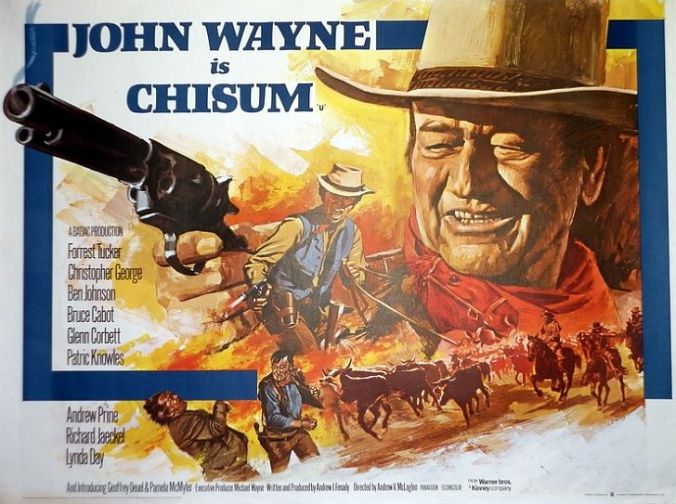
“Chisum” is a lesser effort by the Duke for sure; I saw the Western when it came out in 1970, and it made no impression on me at all, apparently. When I watched it again two days ago, almost nothing seemed familiar. There was one scene, however, that raised my eyebrows.
The story is very loosely based on John Chisum (of Chisum Trail fame) and his involvement in the Lincoln County War of 1878 in the New Mexico Territory. At one point in the story, British rancher and Chisum’s neighbor Henry Tunstall rides to Santa Fe to seek help from Territorial Governor Sam Axtell in the increasingly tense range war. Henry does not know that he has been framed for cattle rustling, and when he is intercepted by two deputies (they are in on the plot, but he doesn’t know that) who accuse him and tell him he is under arrest, he objects strenuously. Saying he is late, Tunstall starts to reach into a pocket. One of the deputies shoots him dead. The two then plant a gun on Tunstall to back the story that the deputy fired in self defense.
You get poor Ricardo Rodriguez, who was just freed from 2o years of wrongful imprisonment for a murder he did not commit. Unlike fellow Windy City justice victim Nevest Coleman, also let out of a cage this month after being wrongly convicted—what the heck is going on in Chicago, anyway?—Rodriguez wasn’t given his old job back. No, he was immediately taken into custody by ICE following his release.
Oh, I almost forgot…
KABOOM!
This is so bad it made my head explode.
Before he was sent to prison for a 1995 murder, Rodriguez was a lawful permanent resident of the US. His status was revoked when he was convicted of murder, and it is still revoked even though the murder charge was false. Now, finally out of prison after rotting away for a rime he didn’t commit, Rodriguez faces the deportation.
Rodriguez was brought to America as a child and his entire family is here. “It would be a very big injustice for them to do that to not only my mother, but my family, who have tried so hard to prove his innocence all these years,” his sister said.
I’ll go even further than that. The United States owes Rodriguez. It’s a different kind of debt than what it owes Miguel Perez-Montes, the Army combat veteran we just deported after removing his legal status for a drug conviction, but it is still a debt. Our justice system stole two decades from him. He should be given full citizenship along with a lot of money and an apology.