Morning Ethics Warm-Up: 7/29/2017

Good Morning!

1. There are several accurate and fair points in the New York Times overview of the Obamacare repeal and replace fiasco, as well as some details that all add up top one thing: the GOP, top to bottom, wasn’t prepared to follow up on the promises it was making during the campaign. To be responsible and honest, it should have had the substitute plan for the Affordable Care Act crafted, analyzed and ready before the 2016 campaign was even underway—you know, one that still dealt with pre-existing condition problem, capped mediacl negligence lawsuit awards. and took steps to lower health care cots while giving the public more choices rather than fewer and not adding to the national debt. Instead, they just used a false promise to stir up the base, like Harold Hill railing about the new pool table corrupting the youth in River City. It was a con job, in other words, all along. Incredibly, the Times reports—assuming that what it reports is true, and of that we can never be sure, remember—

“Vote yes, Republican leaders told the holdouts in their conference. We promise it will never become law. After seven years of railing against the evils of the Affordable Care Act, the party had winnowed its hopes of dismantling it down to a menu of options to appease recalcitrant lawmakers — with no more pretenses of lofty policy making, only a realpolitik plea to keep the legislation churning through the Capitol by voting to advance something, anything.”

That’s nauseating, and unethical governance and politics at its worst.

Other notes from the article

  • “A ruling party that never expected to win. A conservative base long primed to accept nothing less than a full repeal. An overpromising and often disengaged president with no command of the policy itself and little apparent interest in selling its merits to the public.”

It’s fine to face reality when you appear to be defeated. It is unethical to run for office without being as prepared to win as you would be if your were the frontrunner.

  • “Yet in private sessions…Republicans worried about being saddled with a politically toxic “Trumpcare,” with some acknowledging that their dual promises — repealing the law swiftly without pulling the rug out from Americans — could not be reconciled.”

This just occurred to them? Wasn’t this obviously a problem that could have been predicted since. oh, 2010?

  • “Senator Mitch McConnell of Kentucky, the majority leader, assembled a working group of 13 senators to draft the legislation — all of them male — excluding Ms. Murkowski and Ms. Collins.”

What a moron.

2. J.K Rowling, Harry Potter’s mommy who hates our President with a passion, sent out a re-tweet of an edited video appearing to show President Trump snubbing a child in a wheelchair. She wrote, “When someone shows you who they are, believe them.’ – Maya Angelou https://twitter.com/ansel/status/889596818383814656 …”

The tweet had gone viral, with more than 58 thousand retweets. It’s also carrying a lie. The actual, unedited video shows the President kneeling and talking to the boy. Now the tweet itself and the page of the tweeter has vanished.

Rowling has shown us that she is a foreign citizen using her influence to spread fake news in an effort to undermine our government. Someone should turn her into a newt. Continue reading

The D.C. Court Of Appeals Handgun Decision [UPDATED]

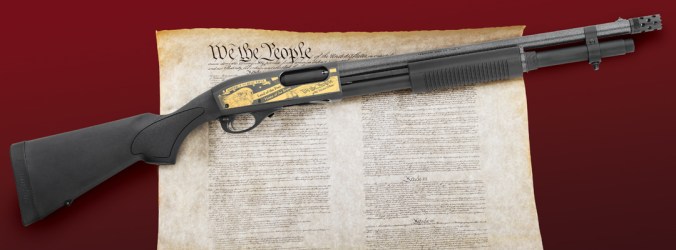
The U.S. Court of Appeals for the District of Columbia Circuit ruled this week that it is unconstitutional for the District government to restrict handgun licenses only to citizens who can prove a “special need for self-protection distinguishable from the general community as supported by evidence of specific threats or previous attacks that demonstrate a special danger to the applicant’s life.” D.C. now must follow a standard system approved by the Supreme Court as not unduly burdensome to Second Amendment rights: issuing permits to adults who pass a fingerprint-based background check and a safety training class.

You can read the whole opinion here.  Two cases were under scrutiny: Wrenn v. District of Columbia and Matthew Grace and Pink Pistols v. District of Columbia.  Circuit Judge Thomas B. Griffith wrote the opinion and was joined by Senior Judge Stephen F. Williams. Judge Karen LeCraft. Judge Karen Henderson, a Republican appointee, dissented.

This is a liberal court, but it properly upheld the Second Amendment while slapping down anti-gun talking points that I have always found obnoxious and totalitarian in spirit. “Why does anyone need a gun? Why do they need a semi-automatic weapon? Why do they need so much ammunition? I don’t need a gun. Guns are dangerous. If I don’t need one, you don’t need one.”

The government doesn’t have the right to tell me what I need. Strangers don’t get to tell me that my needs are unreasonable based on their beliefs and biases. In 2013, playwright and screenwriter David Mamet wrote an op-ed for Newsweek nicely articulating these principles. (If it is still available in its entirety, I lack the cleverness to find it. [UPDATE: Reader Frank Stephens was clever enough, and the link is here]. Newsweek banished the article to its ally The Daily Beast, where all links, including in my post about it, lead. That link is now dead: it just goes to the website. I searched the Daily Beast for the article: it isn’t there. But, oddly, a rebuttal to the article is. I suppose this is how the news media silences the apostates in its midst. Fortunately, this passage survives: Continue reading

Were AG Sessions’ Comments In Las Vegas Unethical?

Ethics Scout Fred points me to a little noted episode in the increasingly fraught existence of Attorney General Jeff Sessions, and asks whether the AG’s comments crossed ethical lines.

Let’s see…

During a speech about two weeks ago in Las Vegas in which he called for harsher prosecution of criminals and cooperation from local authorities as the federal government cracks down on illegal immigration, Sessions segued to the Cliven Bundy prosecution, and said, cryptically, of Nevada Acting U.S. Attorney Steven Myhre,

“I’ve got to tell you, it’s impressive when you have a tough case, a controversial case, and you’ve got the top guy leading the battle, going to court, standing up and defending the office and the principles of the law. I’m not taking sides or commenting on the case. Just want to say that leadership requires, a lot of times, our people to step up and be accountable.”

Supporters of the Bundy-led armed stand-off with federal authorities think that the Trump administration may sympathize with their anti-government stance, but Trump administration prosecutors are still seeking penalties for Bundy and his group.

Fred notes that “while Sessions is not responsible for how others take what he says, at least no more than any public speaker,  the effect of his remarks was to encourage lawbreakers,” based on the statement by Ashley Jones, a producer for radio show host Pete Santilli. Santili, a Bundy ally, is incarcerated pending trial in the case. Jones pronounced Sessions’ comments “a victory for us.”

Comments: Continue reading

The Strange World Of Magic Ethics

A recent controversy surrounding a hit magic show on Broadway has resurfaced an ethics tangent I was aware of but had forgotten about: magician ethics.

Magician Derek DelGaudio accused another magician of surreptitiously recording a video of an effect during a performance last month of his one-man show, “In & Of Itself.” The rival magician denied the allegation—it’s complicated, and you should read the whole tale here-–but the basic problem arises from the nature of magic tricks. They can’t be patented, because the patent would reveal how the magic trick was done in a publicly available source. This means, however, that a magician whose unique illusion he or she labored on and developed at great expenditure of time and expense can be stolen by another magician with the illusion’s creator having no legal recourse.

For a field that is all about fooling and deceiving people (who have consented to being deceived), magic has old and well-developed ethical traditions. Houdini, who took his name from a french magician named Robert Houdin, later exposed his role model as an unethical magician whose most famous illusions were stolen from other conjurers without payment or credit. Still, if a magician can figure out how another magician’s trick is performed by simply watching it, nothing legally or ethically dictates that that magician can’t perform the illusion as well. However, since magic is practiced by people who deceive for a living, it should come as no surprise that unethical practices are rampant. Continue reading

The Unethical, Un-American, State Travel Bans

Recently various states have decided to punish their fellow members of the United States of America for daring to adopt laws of which they do not approve. The method: bans on government employees traveling to those states on business and the state dime, with the hope that the state’s lead will discourage private travel as well. Why are they doing this? Oh, many reasons, I suppose, all of them insufficient to justify the conduct, which is unethical.

Some of the state legislators who pass these bans, and the governors who sign them, want to place economic sanctions on the other states, even if the effects are limited. After all, they can’t stop the citizens of the states from traveling, only government employees. But pressure is pressure, and the limited measures are an attempt to meddle in the democracy of those other bad states. Another reason is virtue-signalling, as a state seeks to show that it supports a group that is politically strong in that region against another state’s policies that displease it. A third reason is the related motive of grandstanding. Finally, a state might use a travel ban to strike back at another state that is banning state travel there. An eye for an eye, a voucher for a voucher.

Yes, this will end well.

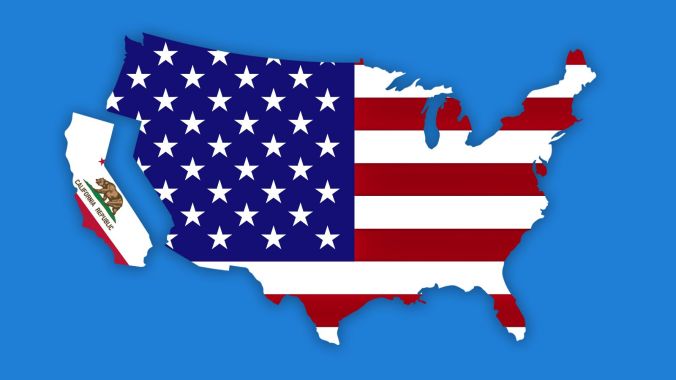
I wish I didn’t have to say this, because I know everyone thinks I pick on liberals, progressives and Democrats, but it’s the Democratic majority states that are using this weapon, especially…well, can you guess? Oh, come on, guess. Yes, the major offender is California. Others are New York, Minnesota, and Washington state.

“Our country has made great strides in dismantling prejudicial laws that have deprived too many of our fellow Americans of their precious rights,” says the public statement of California’s Attorney General Xavier Becerra of California, who has been instrumental in getting the Golden State to limit trips to Alabama, Kansas, Kentucky, Mississippi, North Carolina, South Dakota, Tennessee and Texas. You know, those conservative bad places, where people with sub-normal IQ’s cling to their guns and Bibles. His quote is a classic of arrogant, doctrinaire, narrow-minded, elitist self-righteousness. Continue reading

Multiple KABOOMS! From “The Good Illegal Immigrant” Files: The Good, Well, OK, Maybe Not So Good, Illegal Immigrant Driver

One head explosion after another splattered my office with gore as I read the New York Times sad, sad, <sniff> piece about poor, abused, illegal immigrants who drive without licenses. It began:

“Heading to church one evening in late March, a farmworker and her sister were stopped for speeding in the village of Geneseo, N.Y. They were driving with their five children in the back of the minivan. Two were not in car seats, as required. The police officer, trying to cite the driver for the infractions, discovered she had no driver’s license, so he called Border Patrol to review her Guatemalan passport. Both sisters were undocumented immigrants. They were detained and are facing deportation.”

Good.

The Times, however, currently engaged in a full-on “Let’s make illegal immigrants as sympathetic as possible” campaign—how can we  be so mean to people who were just trying to go to church?—makes it clear that such an event is just more cruelty and lack of compassion emanating from the Trump Presidency.

“Under a Trump administration that has taken an aggressive stance on illegal immigration, the moving car has become an easy target. A broken headlight, a seatbelt not worn, a child not in a car seat may be minor traffic violations, but for unauthorized immigrants, they can have life-altering consequences.”

KABOOM! #1. How shameless will the Times’s misrepresentations regarding this issue get? These people are not being deported for “minor traffic violations.” They are being deported because they ahve absolutely no business being in the country at all. The Yorkshire Ripper was caught because of a police stop for a minor traffic violation.  By the Times reasoning, this, and not  the 13 women he murdered, is why he was sentenced to life in prison.

These drivers are also not “undocumented.” Undocumented is what I was when I was stopped for speeding with an expired license. I was, however, still a citizen. “Undocumented” is a Times and illegal immigration lobby cover-word for what illegal immigrants really are: illegal immigrants.

The term deceitfully suggests that the “undocumented” individual was just missing some papers—t could happen to anybody! No, you are not just “missing papers” that you never had the right to have.

KABOOM! #2:

“As many as 12 states, along with the District of Columbia and Puerto Rico, offer driver’s licenses for unauthorized immigrants, up from three in 2010. New York, which has the third-largest immigrant population in the country, is not one of them.”

Three was unconscionable. Twelve is a scandal and a dangerous attack on sovereignty and the Rule of Law.

KABOOM! #3 and #4:

Supporters of efforts to allow those who are undocumented to get driver’s licenses say that public safety would improve because they would be required to pass road tests and obtain insurance. But critics said that licenses represented a privilege that unauthorized immigrants should not hold, because they should not be here in the first place.

The first sentence is a logical disconnect: Let’s make what these people do legal, because they’ll break the law if we don’t. Yes, and the fact that they’ll break the law if they can’t do something legally is why they are here illegally and why they cannot be trusted as citizens. To its credit, the Times at least quotes a Republican lawmaker who is not deceived, though the paper suggests that she has a comprehension problem:

Senator Kathleen A. Marchione, a Republican representing the Upper Hudson Valley…does not understand the argument for giving licenses to those who are undocumented.“Driving without a license should not give you a right to have a driver’s license when you are already breaking the law in two instances,” she said in an interview. “That’s like saying if a kid is drinking at 16 years old, we might as well let him.”

That is exactly what it is like. She “doesn’t understand” the argument because it doesn’t make sense and never has. The Times won’t accept this, as the second sentence in the quote above makes clear. This isn’t merely what “critics” say. It is a fact. There is no “other side” to facts, and the Times is misleading its readers to suggest that this is just a contrarian position.

KABBOOM #5 and #6 came after reading this quote:

Anne Doebler, a private immigration lawyer in Buffalo, said that undocumented immigrants want to follow traffic laws, and that civil law and immigration law should be kept distinct. “Why do we want to use our vehicle and traffic laws to enforce an immigration policy when it’s detrimental to public safety?” she asked. “I don’t want someone to hit me who doesn’t have insurance…I don’t care what their immigration status is.”

“Undocumented” as a cover-word for “illegal” no longer makes my head explode, it just makes me angry. But Doebler’s spin is outrageous. Oh, the illegal immigrants want to obey laws that make it easier for them to live here illegally, do they? Well, isn’t that wonderful! Why don’t they want to obey the immigration laws? Heck, why don’t we just stop enforcing all laws, since avoiding law enforcement often makes criminals and law breakers breach other rules, laws, and ethical obligations?

The Times cites statistics showing that hit and run accidents by illegal immigrants declines significantly when they are allowed to have licenses and insurance. Hey! I just thought of an even better way to reduce hit and run accidents by illegal residents!  Can you guess what that would be?

Would Doebler care what the immigration status of someone who, say, ran down her child was, if that individual had been allowed to stay in the country after a previous traffic infraction? Would she really think, “Illegal, legal, what’s the difference?” I think not. I think she would say, “the driver who killed my kid should not have been on the streets at all,” because that would be obvious and true.

Morning Ethics Warm-Up: 7/25/17

Good Morning!

1. The National Review began its story on this topic thusly:

“California and New York will become the first states to allow illegal immigrants to practice law and be sworn in as lawyers. In so doing, they will grant the privilege of upholding the law and defending the U.S. Constitution to people who have intentionally violated the rules, and who have no right whatsoever to be here.”

This is a fair and objective description. I detest conservative radio talk show host Micheal Savage, who wrote a right wing attack tome called “Liberalism is a Mental Disorder” just as I detest that title, and the approach to civil discourse and political disagreements that goes with it. (Ann Coulter preaches the same message, but is funnier when she does it.) However, when I read about things like this, I feel a magnetic pull to the position. In 2013, Governor Brown  signed into law a provision allowing illegal immigrants to be awarded licenses to practice law in the state California. At the same time as he vetoed nother bill passed by his reliably wacko legislature that would have allowed those who would not obey the nation’s immigration laws to be eligible to serve on juries, and thus pass judgment on the alleged crimes of U.S. citizens. Ponder that contrast for a minute, and see if your head explodes. Brown had a convoluted explanation for the seeming contradiction, but what he was doing was obvious: he was pandering to illegals and their supporters. Serving on juries is an obligation of citizenship that citizens find onerous: telling illegals that they didn’t have to meet this obligation while still harvesting citizenship benefits was a welcome decision.

At the time I wrote,

“I am not surprised by this turn of events, just made nauseous by it. I almost closed comments for this post. If I really have to explain to someone why those who have never taken affirmative steps to become citizens in this country should not be allowed to practice its laws after years of being in defiance of its laws, I’m not sure its worth the effort.”

Continue reading

From The Law vs Ethics Files: The July 24, 1983 Pine Tar Incident, When Baseball Chose Ethics Over Law, And Was 100% Wrong

I have written on this topic before, but this is the famous incident’s anniversary, and I have come to believe that the lesson learned from  the pine tar incident is increasingly the wrong one, and the consequences of this extend well beyond baseball.

On July 24, 1983, the Kansas City Royals were battling the New York Yankees at Yankee Stadium. With  two outs and a runner on first in the top of the ninth inning,  Royals third baseman George Brett hit a two-run home run off  Yankee closer  Goose Gossage to give his team a 5-4 lead.  Yankee manager Billy Martin, however, had been waiting like a spider for this moment.

Long ago, he had noticed that perennial batting champ Brett used a bat that had pine tar (used to allow a batter to grip the bat better) on the handle beyond what the rules allowed. MLB Rule 1.10(c) stated: “The bat handle, for not more than 18 inches from the end, may be covered or treated with any material or substance to improve the grip. Any such material or substance, which extends past the 18-inch limitation, shall cause the bat to be removed from the game.” At the time, such a hit was defined in the rules as an illegally batted ball, and the penalty for hitting “an illegally batted ball” was that the batter was to be declared out, under the explicit terms of the then-existing provisions of Rule 6.06.

That made Brett’s bat illegal, and any hit made using the bat an out. But Billy Martin didn’t want the bat to cause just any out. He had waited for a hit that would make the difference between victory or defeat for his team, and finally, at long last, this was it. Martin came out of the dugout carrying a rule book, and arguing that the home run shouldn’t count.  After examining the rules and the bat, home-plate umpire Tim McLelland ruled that Brett used indeed used excessive pine tar and called him out, overturning the home run and ending the game.

Brett’s resulting charge from the dugout (above) is video for the ages. Continue reading

Morning Ethics Warm-Up: 7/23/17

Good Morning!

1. Not a single comment on yesterday’s sole warm-up topic, the propriety of complimenting someone’s physical appearance or features? That’s fascinating.

2. I had to wrestle my fingers to the ground yesterday to avoid writing a full post on this editorial by the New York Times editors. I know everyone is sick of Ethics Alarms pointing out the relentless, unprofessional anti-Trump bias in the news media, because I’m sick of  writing about it. This may have been a new low, however. In the wake of Sean Spicer’s resignation as White House press secretary, the Times unleashed the equivalent of a mean playground taunt.  To read it, one would never guess that the Times had ever experienced any other press secretaries, especially President Obama’s trio of Robert Gibbs, Jay Carney and Josh Earnest , who were uniformly dishonest with disgraceful regularity. Spicer was a “four Pinocchio” spokesman? The standrad term her for Obama’s press lackies was “paid liars,” and the description was fair. Yet the Times didn’t greet the news of any of their withdrawals for the post with “Nyah nyah nyah you suck!” editorials, because the New York Times accepted that President’s lies and deceptions as designed for the greater good.

Of course, it was exactly this unethical journalistic bias that caused Spicer to adopt the attitude that most prompted the Times to attack him personally on his way out the door. He believed that journalists who don’t behave like journalists need not he respected as journalists, and he was absolutely correct in this. Indeed, no newspaper that isn’t able to discern that an editorial like the one yesterday regrading Spicer makes it look like a partisan hackery shop should be respected at all. Spicer was a really bad spokesman—inarticulate, inept, dishonest and not very bright. Nonetheless, he was trying to do a difficult job, did his best, and was no more nor less awful at it than all but a few Presidential press secretaries over the last half century or so. Only Spicer, however, was deemed deserving of such insults at the end, not even Ron Ziegler, Nixon’s complicit press secretary who looked and sounded like a half-successful laboratory clone of his boss. That is because the Times’ editorial was personal, based on emotion and anger, and an ethics alarms void.

3. This story from Canada reads like it was designed to illustrate the folly of giving government more power over our lives rather than less. Continue reading

Ethics Observations On The Florida Teens And The Drowning Man

The story from Florida about the five teenage boys who took a video of a man who drowned as they laughed and mocked him, never calling for help or alerting authorities, isn’t one of the apathetic bystander episodes that Ethics Alarms has discussed in the past. This is something worse, an episode that raises troubling questions about what kind of culture and society could produce young men so cruel and callous. One has to wonder how society can trust these young men, so obviously devoid of ethics alarms or conscience at such a young age….except that most of us will never know who they are, since their names have been withheld from publication because they are minors.

Meanwhile, the basic ethics question “What’s going on here?” is especially difficult. The episode naturally sparks such an emotional response that reason and analysis have a hard time clawing their way to the front. I’ve been pondering the story since it was publicized, and I still find it disorienting.

Here are some comments and observations, perhaps more random and disjointed than they ought to be: Continue reading