Comment Of The Day: “US Priorities: Make War On Cheese, Not On Drugs”

smoking_weedThe articulate squid commenter, Extradimensional Cephalopod, weighed into the contentious discussion over the wisdom of pot use and government approval there-of with this thought-provoking piece.

Here is his Comment of the Day on the post: US Priorities: Make War On Cheese, Not On Drugs.

I’ll have a few comments at the end.

Full disclosure: I have not used marijuana, but I have had its effects described to me in detail by people who have. My understanding of it is that it has at least two separate and notable effects, which can vary based on the particular strain. One of them is a relaxing effect, although some strains actually increase anxiety at some point after use. However, the relaxing effect makes it suitable for medical purposes such as treating seizures. The other effect I am aware of is an increase in the brain’s divergent thinking patterns; that is, it increases random association, enhancing creativity and making experiences more vivid. A user can increase this effect deliberately by increasing the quantity inhaled or ingested to the point where coherent thought is difficult, but this requires very high levels of intake. I am told that it is not chemically addictive, or toxic except inasmuch as inhaling smoke in general is toxic, but more on the level of incense rather than cigarettes.

In my opinion, people have a right to use the substance provided they do not take actions that put others at risk by doing so, such as driving. I see no reason to ban the substance, but one can certainly ban taking actions that become dangerous under its effects. As a transhumanist, I see nothing inherently wrong with using a form of technology to alter one’s mental state artificially. Marijuana does not seem like a harmful or dangerous way to do so, as long as one is responsible. I agree that people who use marijuana, or alcohol, for that matter, can become very boring and less able to have interesting conversations, although sometimes the opposite happens; it depends on who the person was to begin with and how they react.

On the other hand, the ethics system that I subscribe to and through which I come to the above conclusions is based on promoting consciousness. One of the root problems with this world is that humans get very easily addicted to mindsets, experiences, or control. Addictions are blind spots, limitations that a consciousness has picked up that allow it to be manipulated by the world instead of being its own master. An addiction occurs when a mindset, experience, or form of control automatically becomes a person’s first priority in certain situations even where the person would intellectually judge it to be subordinate to a more important goal. It is possible to get mentally addicted to pretty much anything: alcohol, marijuana, candy, sex, adrenaline, attention, solitude, et cetera. To a certain extent we all have addictions in that when our lives are changed we feel uncomfortable and stressed, but toning addictions down is part of empowering ourselves.

That being said, my ethics system leads me to disapprove of the use of marijuana (or other drugs, for that matter) as a means to induce apathy to escape the stress that would otherwise lead a person to self-improvement. My worldview draws a distinction between joy and well-being. Joy is a positive feeling towards one’s current circumstances. Well-being, however, I define as regularly developing new abilities or improving one’s point of view, or any sort of change that results in a person having a more harmonious relationship with the world and being able to promote harmony for other individuals. Here is where the “it’s the journey, not the destination” cliche comes in. Joy may be the destination that people try to reach because it is associated with a state of increased harmony, but consciousness, the process by which people try to reach asymptotically-increasing states of harmony, is what makes us people in the first place, with all the associated awareness and abilities, and it is consciousness that I prioritize.

Long story short: it’s okay to use drugs to augment one’s ability to improve oneself (especially if one has a disability that requires the use of drugs to bring mental functions within human normal), as a tool (yes, sometimes a crutch) to access mindsets you want to use but can’t invoke at will, or as a neutral form of recreation. Using drugs as a substitute for self-improvement so that one can stagnate without feeling bad about it is pathetic and not empowering at all.

I hope this post has been coherent, but I have an internal vocabulary that has developed in partial isolation, so if there is any confusion that you want resolved, please let me know.

It’s me again. Just a few notes:

  • One thing I always appreciate about EC is that he never makes a typo. I am awash in envy.
  • I have been shocked at how many commenters on the main post never have used pot. Either I am not as strange as I always thought I was, or this blog does not attract anything close to a representative cross-section of America.
  • I should have mentioned in the original post that the Federal government still regards pot as illegal. However, with its first confirmed former pot-head as President ( Clinton didn’t inhale, remember), and the “base” of the Democratic party as well as most reporters clearly in favor of Stoned America, I think the eventual legalization is a certainty.
  • Alcohol is not chemically addictive either, except for the minority of the population that doesn’t metabolize booze properly, those we call alcoholics. However, there are many alcohol addicts who are not alcoholics, and they are psychologically addicted, and seriously so. Psychological addiction to a drug can be and often is both indistinguishable from the physical kind, and just as destructive to them and those who depend on them.
  • I am dubious about the substantive beneficial effects of pot, John Lennon and Timothy Leary notwithstanding. The use of marijuana for genuine palliative purposes is obviously valid; it is also obviously being abused.
  • I endorse the Squid’s penultimate sentence, but I think that this kind of drug use should never be discussed without the adjective “irresponsible” prominently displayed. For this is why discouraging such use is a legitimate, indeed crucial, government function, and a function the government cannot perform while approving the conduct, and, as we all know is coming, profiting by it. The government has to promote responsible conduct from its citizens, because irresponsible conduct does material harm to society.
The Mind Of The Unethical Advocate: 41 School Shootings Just Isn’t Enough—Let’s Pretend There Are More

Shootings

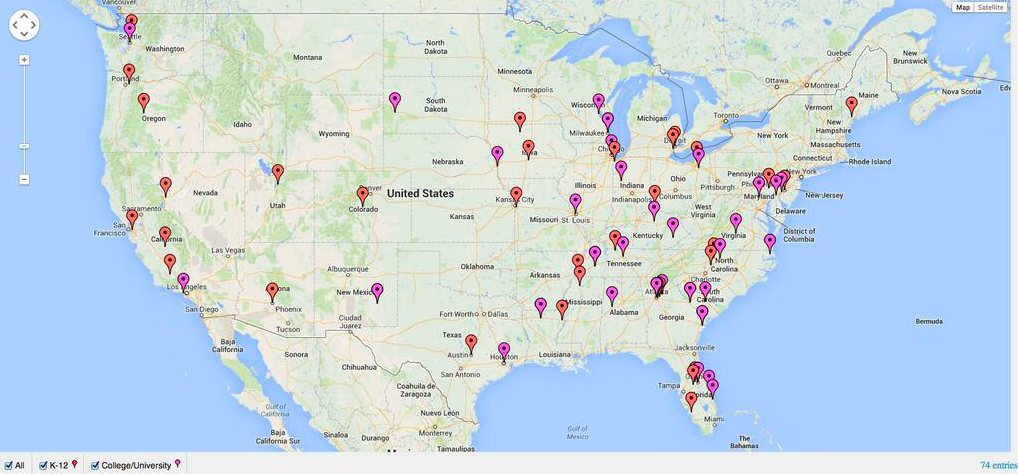
You have probably seen this map; it went viral on the internet almost immediately after it was first published on Twitter last week by  and editor at The Huffington Post. It purports to show the locales of the “1.37 deadly school shootings per week,” 74 in all,  that have occurred since the December, 2012 Sandy Hook massacre according to Everytown for Gun Safety. That is an anti-gun activist organization founded by Michael Bloomberg and Shannon Watts, and its release that “there have been at least 74 school shootings in America” since Newtown was just what the doctor ordered for the languishing gun control forces.

It’s an intentionally misleading number. Journalist Charles Johnson checked the facts, and these are not all “school shootings” in the sense that the public now understands the term and how honest journalists use it—episodes where someone brings a gun to a school and starts shooting teachers and kids. At least 33 of the “school shootings” just fit the conveniently broad definition used by Everytown for Gun Safety so as to make the strongest impression, fairness and truth be damned. They include not just Columbine and Newtown-type episodes, but also assaults, homicides, suicides, gang fights, and accidents involving guns that happened “inside a school building or on school or campus grounds.” Continue reading

Five Ethics Observations On House Majority Leader Eric Canter’s Upset Primary Loss

CantorYesterday, House Majority Leader Eric Cantor lost the GOP primary in Virginia’s 7th District to virtually unknown economics professor Dave Brat, conservative hard-liner who was backed by the Tea Party wing of the Virginia Republican Party, and the some influential voices on local conservative talk radio. You can get political analysis, though precious little of it objective, almost anywhere you look. Here are some ethics observations:

1. The turnout for the primary was less than 15%. Here is what that means: citizens who give a damn get their way. That is as it should be. An eligible voter who can watch the mess in our national government and sit out any opportunity to make his or her voice heard and vote count is a lazy and irresponsible citizen. This means that in the Virgina 7th District, more than 8 out of 10 voters are lazy and irresponsible. To them I say: I don’t care what you think. You have shirked the sacred responsibility of self-government. Go find a king somewhere. You don’t understand or appreciate democracy, and you don’t deserve one. Continue reading

The Unethical—But Useful!— White House “Oopsie!” Doctrine

rotting fish head

In a—oh, hell, I’m out of adjectives to describe “This is so ridiculous it makes me want to throw myself into a woodchipper”—move that will transform U.S. culture, the White House has pioneered a new and refreshingly simple way for wrongdoers and law-breakers to take responsibility for their misconduct.

Just say, “I forgot to obey the law. Sorry!” Let’s call it the “Oopsie!” Doctrine.

Yes, this is how the White House bravely owned up to intentionally violating the statute, the National Defense Authorization Act, that requires the Executive Branch to alert Congress of the pending release of prisoners from Guantanamo at least 30 days in advance. Deputy National Security Adviser Tony Blinken called Senate Intelligence Committee Chairwoman Dianne Feinstein (D-Calif.) to officially say that the White House was sorry it failed to alert her, and therefore Congress, in advance of a decision to release five Taliban prisoners from the prison in Guantanamo in exchange for American deserter, and quite possible traitor, Bowe Bergdahl. The Obama Administration is calling this “an oversight.”

That’s right. The White House breaking the law is an oversight. Never mind that the President was well aware of this particular law, having stated that he regarded it as unconstitutional when he signed it. It was an oversight! None of the foreign policy experts and advisors, neither the Secretary of State or Defense or all their little deputies, nor the hoards of lawyers that Defense, State and the White House employ, remembered that there was a little matter of a relatively recent law that had to be followed in cases like this one. They all missed it, had a brain fart, whiffed, were day-dreaming, took their eye off the ball, goofed, tripped up, pulled a boner. It can happen to anyone! Continue reading

ALL ABOARD! The Elliot Rodger Ethics Train Wreck Is Leaving Rationality Station!

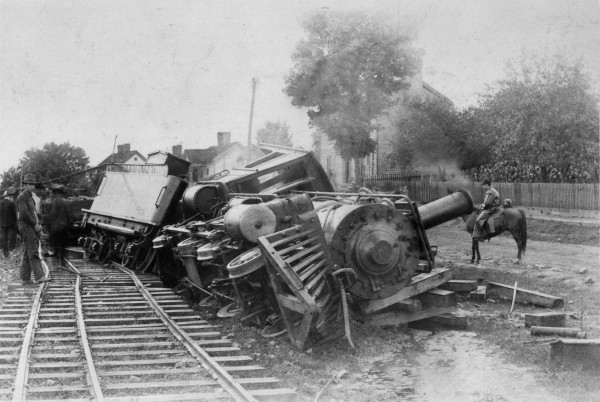
trainwreck6

Wait…I think I’ve seen this wreck before!

Richard Hernandez’s enraged rant at the National Rifle Association for getting three people stabbed to death by Elliot Rodger signaled that this mass killing would  be exploited to the max by a succession of unscrupulous and/or irrational activists, social critics, and pundits, and, as my son used to say before he stopped respecting the French, “Voilà!

The burgeoning ethics train wreck looks like it might be even more infuriating than most, though nothing, ever, will be able to top the Trayvon Martin-George Zimmerman Ethics Express for pure, widespread, unethical lunacy. Early indications are that the usual suspects will try to wring lessons from the crazed acts of a very unusual, spectacularly deranged, unsympathetic creep as if the fair and obvious answer isn’t there for all to see who are objective and smart enough to perceive it: this one mad act proves nothing. Not about the U.S., men, not about whites, not about guns, not about law, not about Hollywood. Nothing.

It’s a big country, and there’s lots of time before climate change destroys us all or something else does first. The attack of Elliot Roger is the opposite of signature significance, an utterly meaningless convergence of factors with fewer lessons to teach than other odd but deadly events, like the Great Boston Molasses Disaster of 1919, or the St. Pierre Snake Invasion of 1905. He means nothing, and should be shunted aside to obscurity as quietly and quickly as possible, so his undeserved notoriety doesn’t set off differently motivated but similarly unhinged sociopaths who are teetering on the brink. Unfortunately, that would require journalists, politicians and single-issue fanatics to be fair, logical and responsible. Continue reading

Ethics Quiz: The Sensitive Cop’s Facebook Confession

sensitive cop“If there was any time I despised wearing a police uniform, it was yesterday at the Capitol during the water rally. A girl I know who frequents the Capitol for environmental concerns looked at me and wanted me to participate with her in the event. I told her I have to remain unbiased while on duty at these events. She responded by saying, ‘You’re a person, aren’t you?’ That comment went straight through my heart!”

Thus did Douglas Day, a police officer at the West Virginia Capitol in Charleston, confess to Facebook friends his mixed emotions while doing his duty.

For this he was fired.

The day Day wrote his Facebook post, Capitol Police Lt. T.M. Johnson told him  that the post “shows no respect to the department, the uniform or the law enforcement community which he represents.”  About a week later, Sgt. A.E. Lanham Jr. wrote to Day that he “found the entire [Facebook] posting to be extremely offensive and shocking … This is just another episode of many incidents which show his bad attitude and lack of enthusiasm toward police work in general and toward our department in particular.”

Day was thunderstruck. “If they believed there was some sort of a violation I made, then why wasn’t it addressed? They never brought me in and never said anything to me,” Day said. “In 2½ years working there, I had no disciplinary action taken against me at any time. Nothing was ever written up and I received no reprimands.” So much for the “many incidents.” Continue reading

A Futile Ethics Request To Anti-Gun Activists: Don’t Exploit Richard Martinez

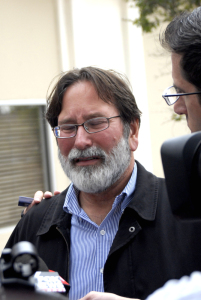
Richard Martinez

Richard Martinez

I am certain that plans are already in the works to trot out Richard Martinez, the grieving father of one of the victims of killer Elliot Rodger in his murderous rampage at the University of California in Santa Barbara, for service in hearings, at rallies, for fund-raisers, at protests and in anti-gun ads. The emotionally distraught father provided a ready-made media sound chomp in his CNN rant against anyone and anything that have, in his mind, prevented radical restrictions on guns, those who, in his view, contributed to the death of his son.

“What has changed? Have we learned nothing? These things are going to continue until somebody does something, so where the hell is the leadership? Where the hell are these people we elect to Congress that we spend so much money on? These people are getting rich sitting in Congress, what do they do? They don’t take care of our kids.My kid died because nobody responded to what happened at Sandy Hook. Those parents lost little kids. It’s bad enough that I lost my 20-year-old, but I had 20 years with my son, that’s all I’ll have. But those people lost their children at six and seven years old. How do you think they feel? And who’s talking to them now? Who is doing anything for them now? Who is standing up for those kids that died back then in an elementary school? Why wasn’t something done? It’s outrageous!”

I don’t blame Martinez for how he feels, but I will blame those who exploit him, and I know there is no chance that they won’t.

In 2013, we all saw how every Sandy Hook parent who was sufficiently enraged and camera-worthy fueled the shameless drive to use fear-mongering and exaggeration in the push to finally gut the Second Amendment, as anti-gun activists have so long wanted to do. Martinez is perfect, just as Cindy Sheehan, destroyed because her soldier son died in a war, was custom-fit for pacifists and anti-war advocates, just as a brain-damaged Gabby Giffords was ideal to have recite child-like generalities against firearms in Congress. Continue reading

Unethical Quote of the Month: Sen. Jay Rockefeller (D-WV)

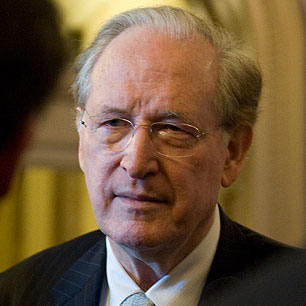
The Honorable Racebaiter And Jerk, Jay Rockefeller

The Honorable Racebaiter And Jerk, Jay Rockefeller

“It’s very important to take a long view at what’s going on here. And I’ll be able to dig up some emails that make part of the Affordable Care Act that doesn’t look good, especially from people who have made up their mind that they don’t want it to work. Because they don’t like the president, maybe he’s of the wrong color. Something of that sort.I’ve seen a lot of that and I know a lot of that to be true. It’s not something you’re meant to talk about in public, but it’s something I’m talking about in public because that is very true.”

—- Sen. Jay Rockefeller (D-WV), once again playing the race-card (he’s done it before) to impugn the motives of opponents of the Affordable Care Act and other Obama policy initiatives.

How low, lazy, irresponsible, despicable, and cowardly. Continue reading

Ethics Quote Of The Week: Michael Kinsley

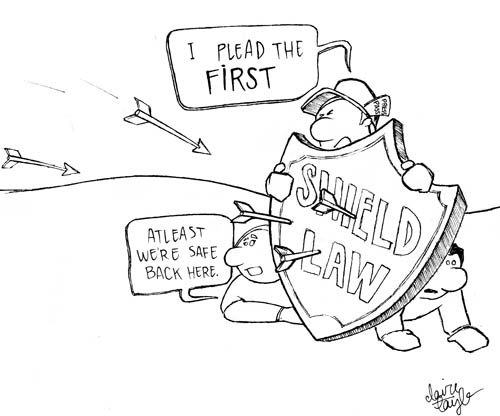
“As the news media struggles to expose government secrets and the government struggles to keep them secret, there is no invisible hand to assure that the right balance is struck. So what do we do about leaks of government information? Lock up the perpetrators or give them the Pulitzer Prize? (The Pulitzer people chose the second option.) This is not a straightforward or easy question. But I can’t see how we can have a policy that authorizes newspapers and reporters to chase down and publish any national security leaks they can find. This isn’t Easter and these are not eggs.”

—-Pundit and former editor of Slate Michael Kinsley, reviewing the book by Edward Snowden co-conspirator Glenn Greenwald’s book, “No Place to Hide.”

This is the heroic image the press has of itself, as it protects useful criminals and traitors. Unfortunately, it's a self-serving fantasy.

This is the heroic image the press has of itself, as it protects useful criminals and traitors. Unfortunately, it’s a self-serving fantasy.

I lost much of my respect for Kinsley (full disclosure: we’re college classmates; he’s a celebrity journalist, I’m not) when he was shouting liberal talking points at Robert Novak every week on “Crossfire.” I knew Mike was more nuanced than that, and later he admitted as much in various essays: it was all for show. He later admitted that he sometimes endorsed books without reading them completely, and began writing these odd op-eds that appeared to mock the very position he seemed to be taking. Kinsley is suffering from Parkinson’s Disease*, and perhaps that’s a factor in his self-conscious sense of remove from his own writings, but the impression he has given for decades now is of a detached intellectual who looks down his nose at the very profession that feeds him, and who finds it amusing that the rubes still hang on his words, when he doesn’t give them much thought himself.

This quote from his review of Greenwald’s book (hmmm…did Kinsley actually read this one?) fits the bill. It is sloppy, but sufficiently specific to be unethical. He is essentially suggesting censorship of the press, which is an irresponsible position. The publishing of leaks should not be infringed. Chasing them down, however, is another matter. Current laws, if Democrats would leave them alone, are currently sufficient to discourage criminal acquisition of national security documents: just throw journalists who won’t reveal their criminal—that’s what they are you know, like Snowden—sources in jail until they crack, rot, or both, for obstructing justice When journalists actively aid and abet the theft of documents and data, like Greenwald did, before they are acquired and published, prosecute them too, along with their souces. Publishing such documents or using them for investigations are legitimate and First Amendment-protected activities, but nothing in the Constitution protects the leakers, traitors and thieves, or journalists who conspire to help them break the law—which is the stealing, not the publishing.

I have called what the press does with stolen material “information laundering.” That function, unfortunately, is too important to the role of the press in our democracy to regulate or constrain it, no matter how often it is abused. Still,  this should not make those who aren’t journalists immune from prosecution, or journalists who cross the line that divides reporting the news from making it.

* This is a correction; the original post said MS. I apologize for the error; I shouldn’t have relied on memory.

__________________________

Sources: New York Times

Cartoon: Doyle, Baylor

A Puzzlement! Non-Lawyers Desperately Need A Legal Education, And Unemployed Lawyers Think Theirs Is Worthless


Quick, get a non-lawyer to pay you to teach him about the law, then you will have  rent money, and he'll be unemployable!

Quick, get a non-lawyer to pay you to teach him about the law, then you will have rent money, and he’ll be unemployable!

From the Fordham Law Review comes an article making an important point about American life: it is so intertwined with laws, regulations and procedures that citizens are overwhelmed, and at risk of serious adverse consequences. This provides a function for lawyers, indeed an essential one: allowing citizens of a democracy to be protected and served by laws rather than victimized by them. That is a function lawyers often serve, however, after legal ignorance has raised the specter of harm. From the abstract of Bridget Dunlap’s “Anyone Can Think Like a Lawyer,” which argues for “legal empowerment” for non-lawyers, and the duty of  lawyers to provide it: Continue reading